Equipartition gives mean energy for each independent quadratic term in a classical canonical Hamiltonian. For example, and each contribute this amount in a harmonic oscillator. It is a thermal average, not an instantaneous equality; constraints, nonquadratic terms or quantum level spacings large compared with require a different calculation.
The fluctuation-dissipation theorem connects equilibrium fluctuations with the dissipative part of linear response. If an applied force couples as , use response to and define the two-sided angular-frequency spectrum . The classical relation isFor a viscously damped particle, , the corresponding white-noise force satisfies . Noise replenishes energy lost by friction; their strengths cannot be varied independently at fixed equilibrium temperature.
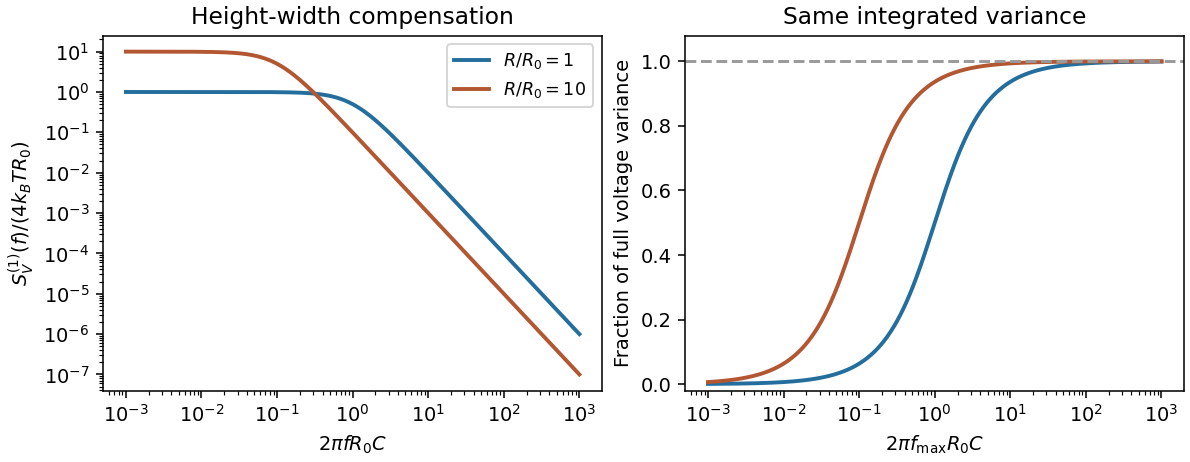
Electrically, the one-sided voltage-noise spectrum per hertz of an equilibrium resistor is . A capacitor in parallel filters it toThe same equilibrium voltage variance follows from equipartition. Increasing R makes the spectrum taller and narrower without changing its integrated area. This thermodynamic connection between dissipative conductance and thermal electrical fluctuations is the content of the classical noise calculation.[ref]
Thermal Agitation of Electric Charge in Conductors by Harry Nyquist. 1928, abstract: equilibrium thermodynamic and statistical calculation of thermal electromotive force

Articles by others on the same topic
There are currently no matching articles.