An equation of state relates equilibrium pressure, temperature and density. The ideal-gas form neglects intermolecular forces and excluded volume. A low-density real-gas expansion iswhere the virial coefficients encode interaction effects and generally depend on temperature.
A simple phenomenological example is the molar Van der Waals equationHere v is molar volume, b represents excluded volume and the attractive interaction lowers pressure through a. Its dilute expansion gives . It recovers the ideal-gas limit but is not a quantitatively universal equation for all real gases.
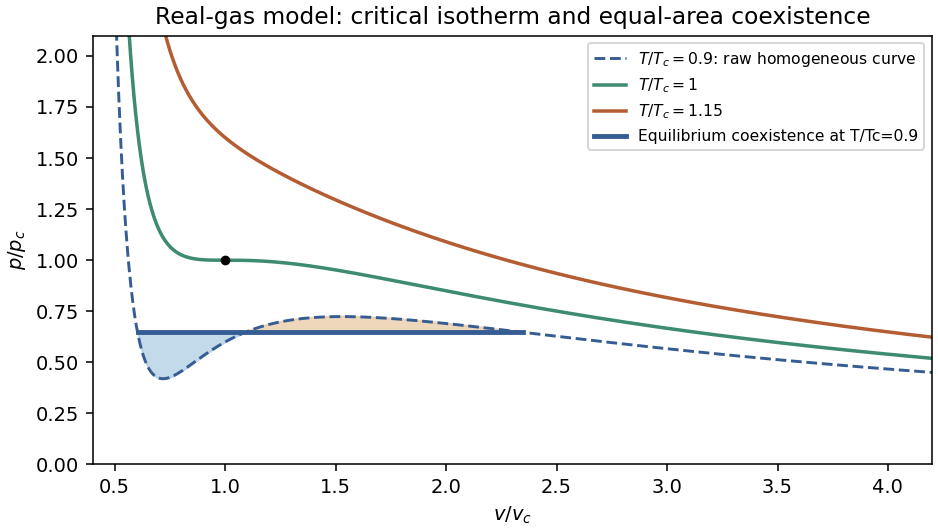
Below its critical temperature, the raw isotherm contains a region with , corresponding to negative isothermal compressibility and mechanical instability. Equilibrium phase separation replaces that segment by a coexistence pressure satisfying equal chemical potentials, equivalently the Maxwell equal-area construction. The critical point follows from :The distinction between an unstable homogeneous branch and a stable two-phase state is essential when interpreting a real-gas equation of state.

Articles by others on the same topic
There are currently no matching articles.