One particle. Use the classical phase-space normalization of one quantum state per volume , with no unspecified internal degeneracy. For and , the canonical partition function factorizes into momentum and position integrals:The Gaussian momentum integral is . In spherical coordinates, put :Therefore the classical ideal gas in a spherical linear trap hasHere is a force, in , so is a length and is dimensionless. A nonconfining would not give this finite spatial integral. As required by the classical phase-space approximation, the temperature must exceed the trap's discrete level scale.
Indistinguishable dilute particles. Independent labeled particles would give . In the classical dilute regime, division by removes the overcounting of permutations of identical particles:This is the Maxwell-Boltzmann limit, not an exact quantum canonical partition function at high occupation. Exchange effects cannot be captured merely by continuing this formula beyond its dilute regime.
Free energy, energy and entropy. The Helmholtz free energy isWith leading Stirling's approximation, , this becomesAt fixed trap strength, . Differentiating gives the requested entropy,The is : the first term comes from indistinguishability through Stirling's formula, and the second from the temperature dependence of . Without the large- approximation, . Independently,The kinetic contribution is and the linear-trap potential contribution is , also obtained from generalized equipartition.
Entropy curves and reversible cooling. For a fixed and a reference pair , the dependence can be written without logarithms of dimensional quantities:At each fixed , the entropy increases logarithmically and is concave downward in ; decreasing shifts the curve upward. Its formal classical divergence as marks failure of classical statistics, not a physical negative-infinite entropy.
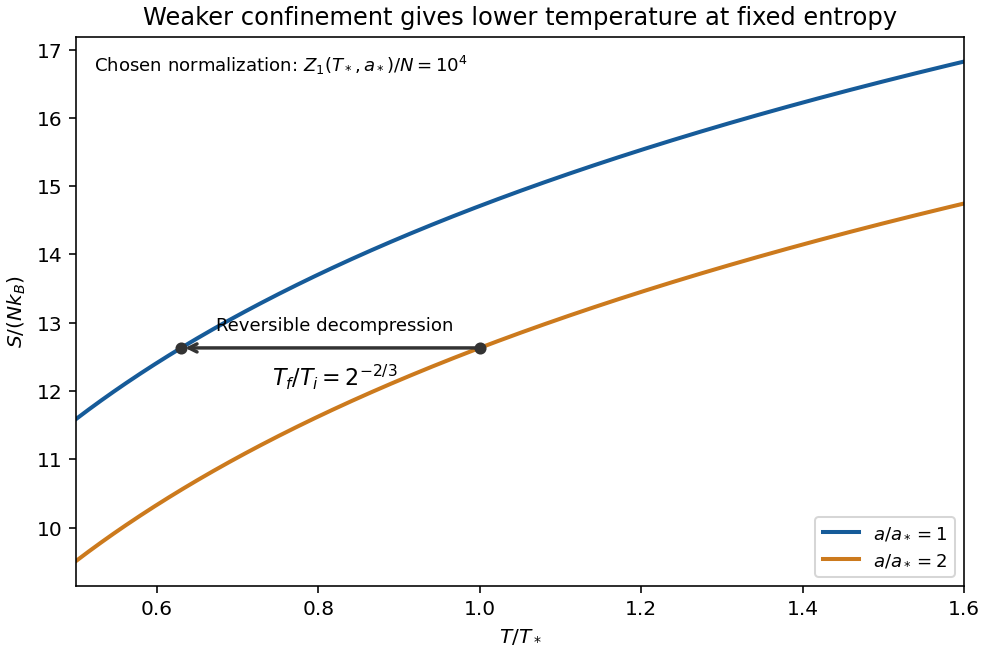
Original classical entropy curves for two linear-trap strengths; a horizontal constant-entropy arrow shows cooling on reversible decompression, within the dilute regime
. Details. 
For a reversible adiabatic change, is constant at fixed , soHence reducing lowers the temperature: this is isentropic decompression of a spherical linear trap. The gas does work on the control that weakens the trap. Equivalently , with ; inserting gives the same relation. Reversibility requires an equilibrium sequence without heat input or entropy production. Because stays constant on this adiabat, also stays constant: this mechanism cools the cloud but does not by itself increase quantum degeneracy.
Chemical potential and quantum threshold. From the extensive free energy,Thus the quantum gas fugacity is . Classical statistics requires ; quantum effects become important as the chemical potential comes within order of the lowest one-particle energy. With the semiclassical zero at the potential minimum, the quantum degeneracy threshold in a spherical linear trap is consequentlyThere are no numerical values of in the paper, so this parameter-dependent estimate is the requested atom number. It also follows from the peak density: , and degeneracy starts when is order one. The criterion is a crossover estimate, not an assertion that the classical formula remains valid at . For spinless bosons the continuum excited-state saturation is more specifically , while for fermions the onset is occupation constrained by exclusion. At temperatures comparable with the quantum trap spacing, the actual ground energy must be included consistently rather than identified exactly with the classical minimum.
Articles by others on the same topic
There are currently no matching articles.