Put and . The BCS quasiparticle spectrum has , so on either inverse branchConservation of states on one branch gives . Consequently the single-branch expression requested in the source isThere are no such states for in this ideal fully gapped model. Near the edge the density of states diverges as , an integrable singularity; at large it approaches its normal-state value.
Counting qualification. The energy map in the source is two-to-one. If literally counts all normal-state levels both above and below , the unweighted positive-energy quasiparticle density from a folded spectrum must sum both preimages, and is insteadAlready at , folding into doubles the positive-axis density. Thus the printed formula is not the unweighted count of all states under the literal mapping without an additional normalization convention.
There is also a standard physical quantity with exactly the printed normalization: the BCS electronic density of states, measured for example by single-electron superconducting tunneling. At positive , the electron spectral weights of the two roots are the BCS coherence factors . They sum to one, so the weighted sum is . This supplies a valid electronic-DOS interpretation, while keeping it distinct from counting every positive-energy excitation. Spin degeneracy must be included consistently in and the transformed density; it does not remove the branch-counting issue.
Repeated letters. There are six positions, with two copies of each of two letters. Counting labeled arrangements and dividing by the permutations of each repeated pair gives
Single-occupancy cells. For indistinguishable particles, specifying which of the distinct cells are occupied completely specifies a configuration. ThusFor distinguishable particles, each chosen occupied set admits assignments of particle labels:Equivalently, successively place labeled particles in available cells. The single-occupancy constraint is essential: this is not unrestricted stars and bars. Both counts give one empty configuration at ; at they give one unlabeled occupation pattern and labeled assignments.
In the grand canonical ensemble, the system exchanges both energy and particles with a reservoir at fixed temperature and chemical potential . The probability of a particular many-body microstate , with energy and particle number , is its Boltzmann weight divided by the grand canonical partition function , where . The denominator normalizes ; a degeneracy is accounted for by counting distinct microstates, rather than changing an individual state's probability.
For noninteracting particles, specify a microstate by the occupation numbers of one-particle levels of energy . Then , so the Gibbs probability factorizes between levels. Put .
For fermions, the Pauli exclusion principle permits in each complete one-particle state, giving . Its mean occupancy isthe Fermi-Dirac distribution.
For bosons, , so the geometric sum is when . Differentiating that sum givesthe Bose-Einstein distribution. Finite-system convergence requires ; condensation is the limiting approach to the lowest energy with macroscopic ground-state occupation. Both quantum distributions reduce to when occupation is small. The quantities derived here are mean occupancies of states, rather than normalized probabilities over the set of one-particle energies.
Structure through pair correlations. For a homogeneous isotropic monatomic liquid of number density , the radial distribution function is defined byIt compares the conditional density around a tagged particle with the bulk density. A repulsive core makes close neighbours unlikely; a first peak identifies a preferred coordination shell, and damped peaks at larger radii describe short-range order. Far away, in the bulk limit. Unlike a crystal, an ordinary liquid has no indefinitely repeated positional order. An ideal uncorrelated gas has away from the tagged particle. The shell factor must not be confused with itself.
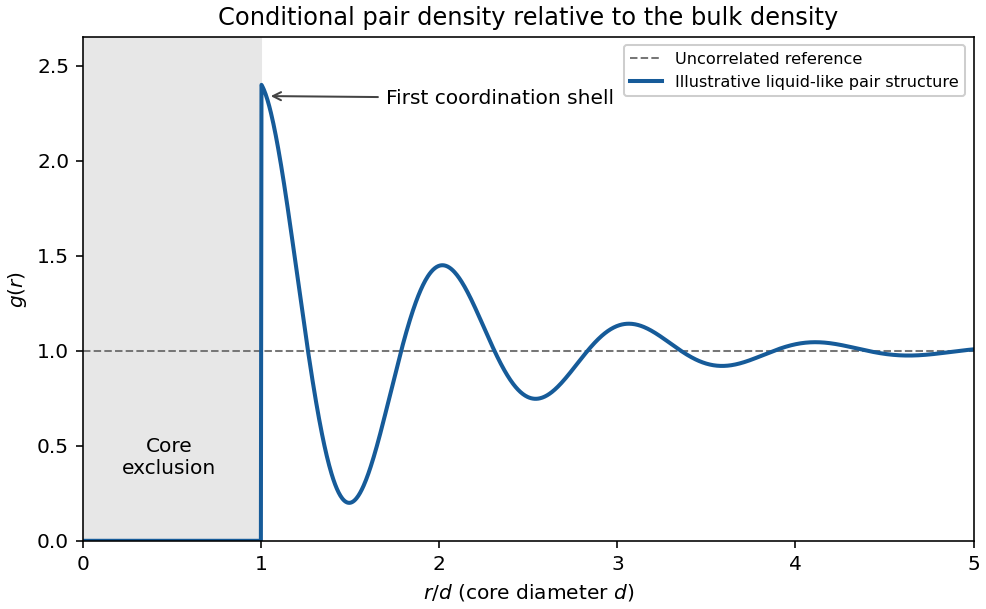
Original schematic radial distribution function showing a core exclusion region and damped liquid-like coordination shells; the curve is illustrative rather than measured data
. Details. 
The same pair structure enters the static structure factor measured through scattering. In the bulk isotropic convention,Thus real-space coordination and reciprocal-space scattering peaks describe the same correlations.
Energy from the structure. If interactions are sums of a central pair potential , the equipartition theorem gives the classical kinetic energy . Count the interaction of a tagged particle with its neighbours and divide by two to avoid counting each pair twice. The pair-correlation expression for internal energy isThis makes structure thermodynamically useful: short-distance repulsion and the attractive region contribute with different weights. Additional internal molecular modes or many-body interactions require extra terms. The formula is a classical bulk pair-potential result, not a universal energy formula for every liquid.
Pressure and the dilute expansion. The mechanical virial theorem relates the pair forces to pressure. The virial pressure from pair correlations isAt low density, , giving the virial expansionThe second virial coefficient has units of volume per particle; higher coefficients encode additional cluster correlations. A hard-sphere exclusion diameter gives . Attractions contribute negative terms and can make negative. Although the pair-correlation formulas can describe a dense liquid when its actual is known, truncating the virial series after a few terms is normally a dilute-fluid approximation. It should not be silently extrapolated through condensation or into a dense liquid.
Excited-state saturation. Consider first a uniform three-dimensional noninteracting gas of identical spinless bosons in a large box. Set the one-particle ground energy to zero. The Bose-Einstein distribution is , with quantum gas fugacity . For dispersion , the excited density of states isUsing the thermal de Broglie wavelength , integration givesThe polylogarithm is . Its finite value at implies a maximum excited population , with . Once this is less than , the excess particles occupy the ground state macroscopically. This is Bose-Einstein condensation, rather than occupation of a state by merely one or a few atoms.
Transition and condensate fraction. Setting the saturation number equal to gives the homogeneous ideal Bose gas condensation temperatureBelow this temperature, approaches zero from below in the thermodynamic limit, and particle conservation givesAbove there is no macroscopic condensate and adjusts to keep fixed. At finite , the chemical potential remains slightly below the ground energy and the transition is rounded.
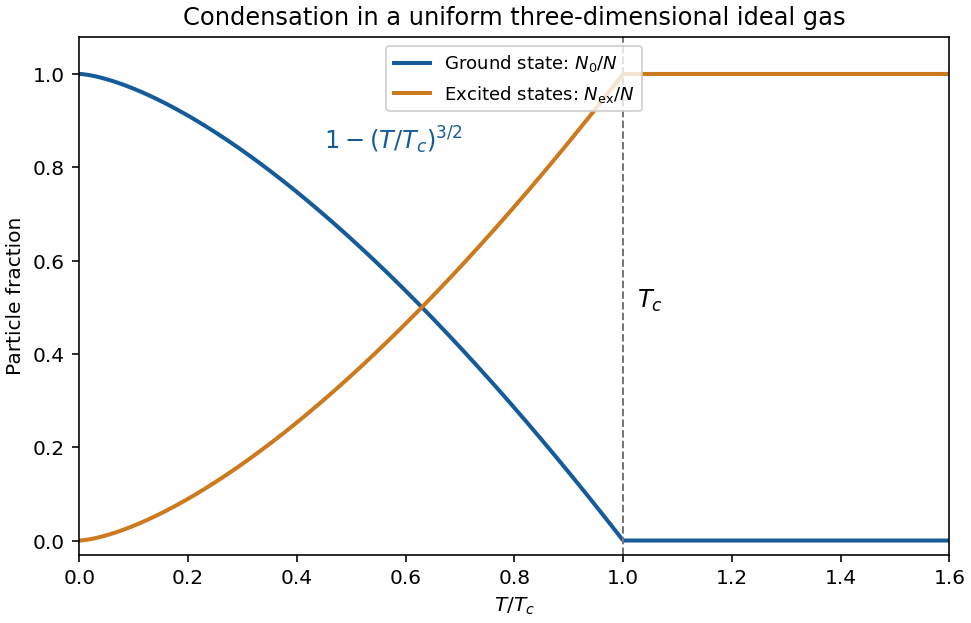
Original uniform ideal-gas condensate fraction and schematic accumulation in the lowest state below the critical temperature; the exponent is for a three-dimensional box
. Details. 
Energy and the role of geometry. The excited-state internal energy isThe zero-energy condensate contributes no term to this energy in the ideal model. Below ,Condensation depends on low-energy state counting: for a uniform quadratic-dispersion gas, a finite-temperature bulk condensate requires spatial dimension greater than two. A trap changes the density of states and therefore the temperature law; a three-dimensional harmonic trap gives a cubic, rather than , condensate-fraction exponent. Finally, an ideal-gas condensate should not automatically be called a superfluid: its free quadratic spectrum has zero critical speed by the Landau criterion. Interactions matter for the robust collective-flow properties of real dilute condensates.
Quanta of collective motion. An elementary excitation is a low-energy departure from the many-body ground state that can often be treated as a quasiparticle. Near an ordered equilibrium, small collective motions form normal modes. Quantization turns a harmonic mode of frequency into bosonic excitations with energy . Their number is not an independently conserved thermodynamic variable in equilibrium, so their chemical potential is zero andHere labels branches, and contains the ground-state contribution, including phonon zero-point energy where appropriate. The approximation is useful while interactions and damping of the excitations are weak enough that the modes remain identifiable.
Phonons. A phonon is a quantum of an elastic lattice-vibration mode. Long-wavelength acoustic phonon branches have , with one longitudinal and two transverse polarizations in a three-dimensional monatomic solid. A multi-atom primitive cell can also support optical phonon branches, generally with nonzero frequency at . Linear acoustic dispersion gives , so the energy integral has and the heat capacity obeys the Debye law. In the Debye model,At temperatures high compared with all phonon energies but below structural changes, the classical harmonic limit gives approximately . Optical modes are frozen out at temperatures well below their gaps.
Spin waves. A spin wave is a spatially varying collective precession of ordered spins; its quantum is a magnon. In a simple isotropic ferromagnet, a long-wavelength gapless branch has energy , where the spin stiffness has units . State counting gives . For one isotropic branch in three dimensions,This exponent is specific to a gapless quadratic ferromagnetic branch. Long-wavelength antiferromagnetic spin waves can be linear and instead give a heat-capacity law in three dimensions. Magnetic anisotropy or an applied field can open a gap, causing activated behaviour at still lower temperatures. Near a magnetic ordering transition, a dilute noninteracting spin-wave description is no longer adequate.
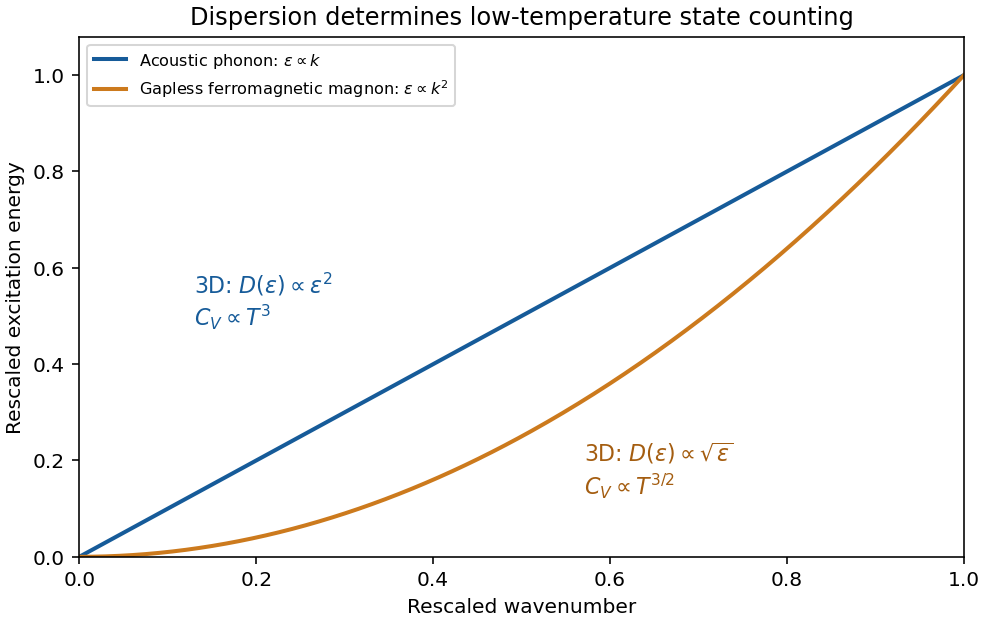
Original schematic linear acoustic-phonon and quadratic ferromagnetic-magnon dispersions with their three-dimensional low-temperature heat-capacity powers
. Details. 
These examples illustrate the low-temperature energy of gapless bosonic excitations: for in dimensions, , hence and . The exponent records both the spatial dimension and the dispersion, making calorimetry a probe of elementary excitations.
Component chemical potentials. Define the per-spin quantum concentration . For a classical component with one-particle potential energy , the local Helmholtz free energy density is . Its derivative with respect to number density gives the full local chemical potential, including the magnetic energy. With the up state defined as the lower level,The Bohr magneton is a magnetic moment; is an energy. The factor two for the two spin states is not already included in .
Total equilibrium chemical potential. If spin conversion is allowed, a particle can be added in either spin state at the same equilibrium free-energy cost. Thusnot their sum or zero. The total particle number, or a reservoir, fixes this common value; the supplied information does not specify a numerical chemical potential. A useful local expression is , with , whose density dependence is found below.
Why it is uniform and common. Moving a small number of one species from to changes the free energy by . If this difference were nonzero, a transfer could lower the free energy. Equilibrium under diffusion therefore requires each full chemical potential to be spatially constant. A spin flip transferring from down to up similarly changes free energy by , proving equality when spin relaxation is permitted. This is chemical equilibrium of a classical spin gas. Mere thermal contact at fixed separate spin populations would not enforce the latter equality; full spin equilibrium is the necessary assumption. A spatially varying magnetic field is balanced by a spatially varying density, not by a varying full chemical potential.
Magnetization. Invert the component equations at the common :The two levels have moments and along the field. The magnetization, magnetic moment per unit volume, is thereforeIts SI units are . This expression neglects interactions and magnetic feedback of the gas on the specified external field.
High-temperature response. For , and , yieldingAt fixed number density, this is the Curie law: the susceptibility with respect to is . The conventional dimensionless susceptibility with respect to is approximately when . At fixed , however, changes with temperature, so itself need not scale simply as . The moment per particle has the Curie behaviour; the density constraint must be stated.
Total density. Adding the two populations givesFor a finite container and fixed , normalization gives . In a weak field the leading density is uniform, with changes only of order . Particles preferentially occupy regions where the magnitude of the field lowers one of the spin energies, even though the common chemical potential remains uniform.
Gibbs free energy and its minimum. For fixed atom number , there are sites andconfigurations with indistinguishable vacancies. Their configurational entropy is . Relative to the vacancy-free Gibbs free energy , creating vacancies costs energy and pressure-volume work . Put . ThenAt leading thermodynamic order, Stirling's approximation givesThe minimum obtained from the stationary point below isIf the perfect crystal's internal energy and other entropy are chosen as zero, its pressure term is . More generally the information given fixes the vacancy contribution rather than the absolute bulk free energy. The pressure-volume term must be retained because the number of sites, and hence the volume, changes.
Equilibrium vacancy population. Differentiating the extensive free energy at fixed givesThe stationary point is consequently the unique interior minimum. Write ; its condition is , giving the requested thermodynamic result for equilibrium vacancies with variable lattice size,Substitution back into cancels the terms containing and yields the boxed minimum. In the dilute-defect limit , . The Bose-like denominator is a consequence of the changing number of lattice sites and combinatorial entropy; it does not assert that vacancies here are an ideal gas of bosonic particles.
There is a finite-size correction to a variable-site vacancy model if “average” is interpreted exactly. The microscopic count written above gives the relative isothermal-isobaric sumsoIts relative equilibrium free energy is . Thus the source's numerator is correct to leading extensive order, but is not the exact finite- mean for that stated configuration count. A free-energy minimum is likewise not generally identical to the mean of a finite distribution. These distinctions vanish relatively as .
Thermal volume. Each atom or vacancy occupies volume , so at the same thermodynamic accuracyFor the exact counting model, replace by in . The vacancy-free limit is as . This model isolates expansion from vacancies, taking and constant; it omits ordinary phonon thermal expansion. Its growth at high temperature should not be extrapolated to arbitrarily large vacancy fractions in a stable crystal, and is essential for a normalizable variable-site ensemble.
One particle. Use the classical phase-space normalization of one quantum state per volume , with no unspecified internal degeneracy. For and , the canonical partition function factorizes into momentum and position integrals:The Gaussian momentum integral is . In spherical coordinates, put :Therefore the classical ideal gas in a spherical linear trap hasHere is a force, in , so is a length and is dimensionless. A nonconfining would not give this finite spatial integral. As required by the classical phase-space approximation, the temperature must exceed the trap's discrete level scale.
Indistinguishable dilute particles. Independent labeled particles would give . In the classical dilute regime, division by removes the overcounting of permutations of identical particles:This is the Maxwell-Boltzmann limit, not an exact quantum canonical partition function at high occupation. Exchange effects cannot be captured merely by continuing this formula beyond its dilute regime.
Free energy, energy and entropy. The Helmholtz free energy isWith leading Stirling's approximation, , this becomesAt fixed trap strength, . Differentiating gives the requested entropy,The is : the first term comes from indistinguishability through Stirling's formula, and the second from the temperature dependence of . Without the large- approximation, . Independently,The kinetic contribution is and the linear-trap potential contribution is , also obtained from generalized equipartition.
Entropy curves and reversible cooling. For a fixed and a reference pair , the dependence can be written without logarithms of dimensional quantities:At each fixed , the entropy increases logarithmically and is concave downward in ; decreasing shifts the curve upward. Its formal classical divergence as marks failure of classical statistics, not a physical negative-infinite entropy.
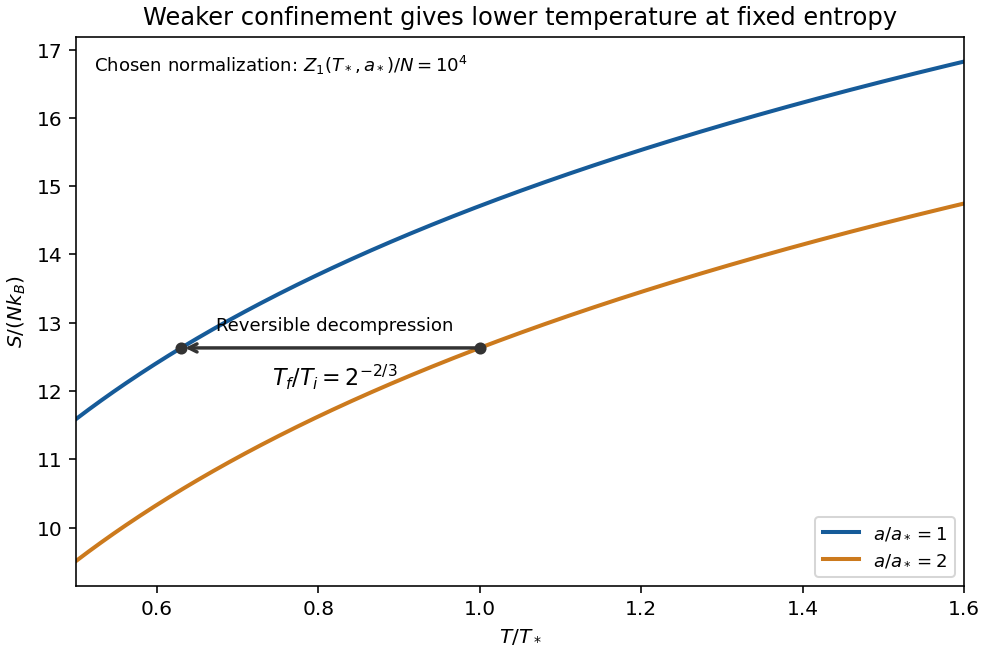
Original classical entropy curves for two linear-trap strengths; a horizontal constant-entropy arrow shows cooling on reversible decompression, within the dilute regime
. Details. 
For a reversible adiabatic change, is constant at fixed , soHence reducing lowers the temperature: this is isentropic decompression of a spherical linear trap. The gas does work on the control that weakens the trap. Equivalently , with ; inserting gives the same relation. Reversibility requires an equilibrium sequence without heat input or entropy production. Because stays constant on this adiabat, also stays constant: this mechanism cools the cloud but does not by itself increase quantum degeneracy.
Chemical potential and quantum threshold. From the extensive free energy,Thus the quantum gas fugacity is . Classical statistics requires ; quantum effects become important as the chemical potential comes within order of the lowest one-particle energy. With the semiclassical zero at the potential minimum, the quantum degeneracy threshold in a spherical linear trap is consequentlyThere are no numerical values of in the paper, so this parameter-dependent estimate is the requested atom number. It also follows from the peak density: , and degeneracy starts when is order one. The criterion is a crossover estimate, not an assertion that the classical formula remains valid at . For spinless bosons the continuum excited-state saturation is more specifically , while for fermions the onset is occupation constrained by exclusion. At temperatures comparable with the quantum trap spacing, the actual ground energy must be included consistently rather than identified exactly with the classical minimum.
Articles by others on the same topic
There are currently no matching articles.