Let , , and . The composite midpoint rule and composite trapezoidal rule areFor composite Simpson's rule with strips, the spacing is . Its odd-indexed nodes are the and its even interior nodes are the . ConsequentlyThis is an identity between the quadrature rules, not an approximation involving an omitted quadrature error.
Four differentiations giveFor , the fifth derivative is negative, so the fourth derivative is strictly decreasing. Since , strict decrease towards that endpoint implies for . On the closed interval, , with the maximum at and minimum at .
Take to be a positive even integer, as required by composite Simpson's rule. There are two-strip panels, each of width . Applying the supplied panel bound with the global fourth-derivative minimum and maximum , and summing, givesHere is the nonnegative absolute error. In this example Simpson's rule overestimates the integral, so . Each panel has that same sign because its fourth derivative is nonnegative; cancellation is not being assumed.[ref]
3.5 Quadrature, subsection (ii) Simpson’s Rule. §3.5(ii), equations 3.5.6–3.5.8: elementary and composite fourth-derivative remainders
On the panel , the maximum fourth derivative is at the left endpoint because it is decreasing. ThusThe geometric series and the sum of consecutive integers giveSubstitution provesFor , at least one panel's maximum is smaller than the global maximum , so this bound is strictly tighter than the global bound. For , the two bounds coincide.
The global bound requiresSince the strip count must be even, the smallest count certified by this bound is .
For the tighter bound, use the bisection method on the continuous extension for . The initial root bracket is valid: , while is below the global bound and hence below . To identify the smallest admissible even count, the monotonicity of can also be justified.
Put andFor , differentiation showsThe numerator is nonnegative because : its difference from starts at zero and has nonnegative derivative , by the arithmetic-geometric mean inequality. Thus , and . Therefore increases with , so is strictly decreasing with . Bisection locates its unique threshold crossing; then check the neighboring even integers, retaining the strict error inequality.
For example, and , so the tighter bound certifies strips. These are evaluations of the bound, not an assumption that it equals the actual quadrature error.
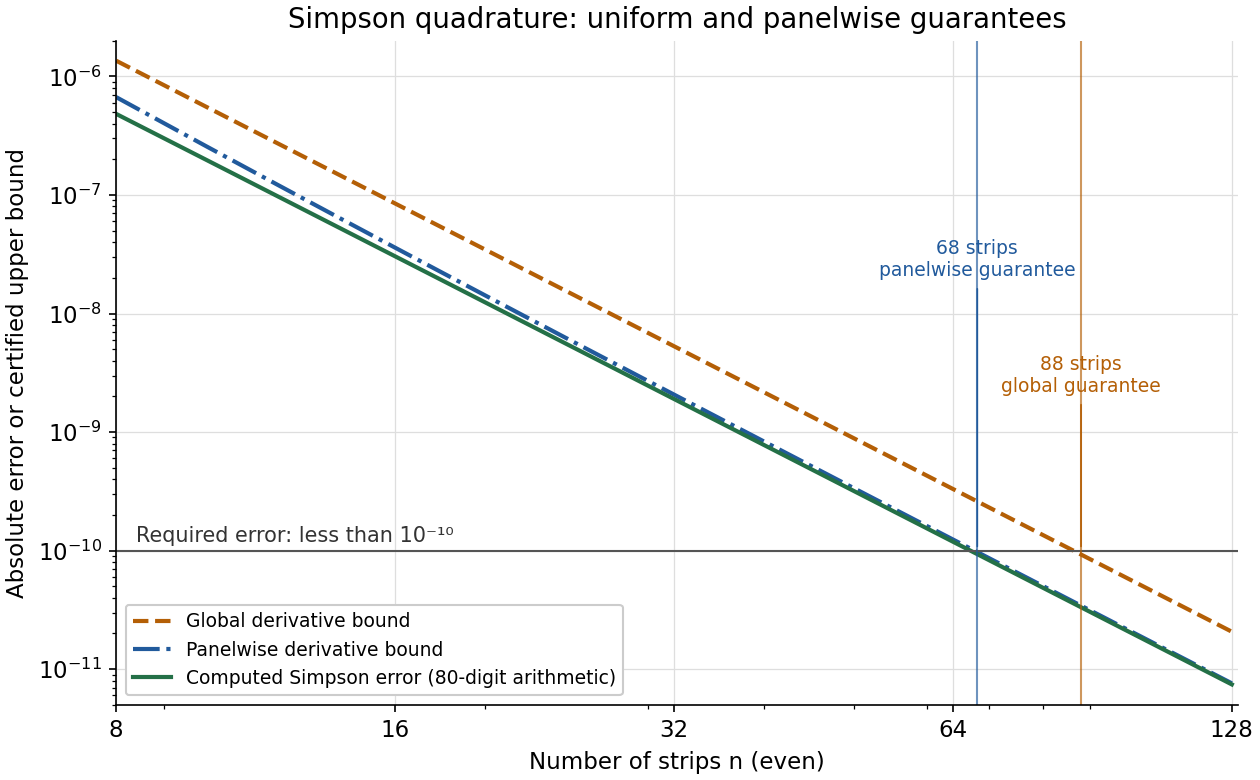
Computed Simpson errors and the two certified bounds, with the required error level
. Details. 
No: Monte Carlo integration is poorly suited to this smooth one-dimensional problem at such a tight tolerance. A sample-average Monte Carlo estimator has a standard error proportional to , whereas the deterministic composite Simpson's rule bound decreases as here and already certifies the target with tens of strips. Random sampling would require vastly more function evaluations and supplies a probabilistic error statement rather than the displayed deterministic guarantee.
Articles by others on the same topic
There are currently no matching articles.