Physical cosmology connects the universe's history to the measurable behaviour of its contents. The Friedmann equations describe cosmic expansion; atomic physics, radiation pressure and gravity determine what that expanding universe looks like. A particularly revealing example is the route from cosmological recombination through the photon-baryon fluid to the Cosmic microwave background acoustic peaks. The universe supplies the initial conditions and the laboratory; the prediction must still pass through a model of the telescope before it can be compared with observations.
The practical reward is that one sky contains several different tests. The Cosmic microwave background power spectrum carries information about the sound horizon, the cosmological baryon density and cosmic geometry. These are related quantities with different observational signatures. Angular sound-horizon degeneracy explains why measuring a characteristic angle alone cannot count the universe's baryons.
P. J. E. Peebles made the connection between microscopic processes and cosmological observables quantitative. His 1968 paper treated cosmological recombination as a kinetic problem. Capturing an Electron directly into the hydrogen ground state releases a photon that can ionize another atom. Net neutralization depends on escape of resonance radiation through cosmological redshift and on two-photon spontaneous emission from the state. An equilibrium Saha equation alone does not give that history.[ref]
Recombination of the Primeval Plasma by P. J. E. Peebles. Peebles, Recombination of the Primeval Plasma (1968), §§IIb–IId, pp.3–6
This matters for an acoustic prediction because the hydrogen ionization fraction fixes the supply of free Electrons for Thomson scattering. In physical units the scattering rate per photon is . The cosmological visibility function describes the distribution of last-scattering times. Thus atomic physics helps determine when the photon-baryon acoustic oscillator is read out, as well as how rapidly tight coupling fails.
In 1970 P. J. E. Peebles and J. T. Yu followed adiabatic cosmological perturbations by numerically integrating the photon collision equation through cosmological recombination. Their calculation connected acoustic evolution and dissipation to residual matter structure and microwave brightness fluctuations. It did not assume that a perfect photon-baryon fluid remained valid throughout last scattering. Their illustrative cosmological models and normalization were historical choices, rather than the present Lambda-CDM model; their predicted brightness variance versus angular resolution should not be relabelled as a modern measured spectrum.[ref]
Primeval Adiabatic Perturbation in an Expanding Universe by P. J. E. Peebles and J. T. Yu. Peebles and Yu, Primeval Adiabatic Perturbation in an Expanding Universe (1970), pp.815–816; §VI, pp.829–833, Figs.4–9
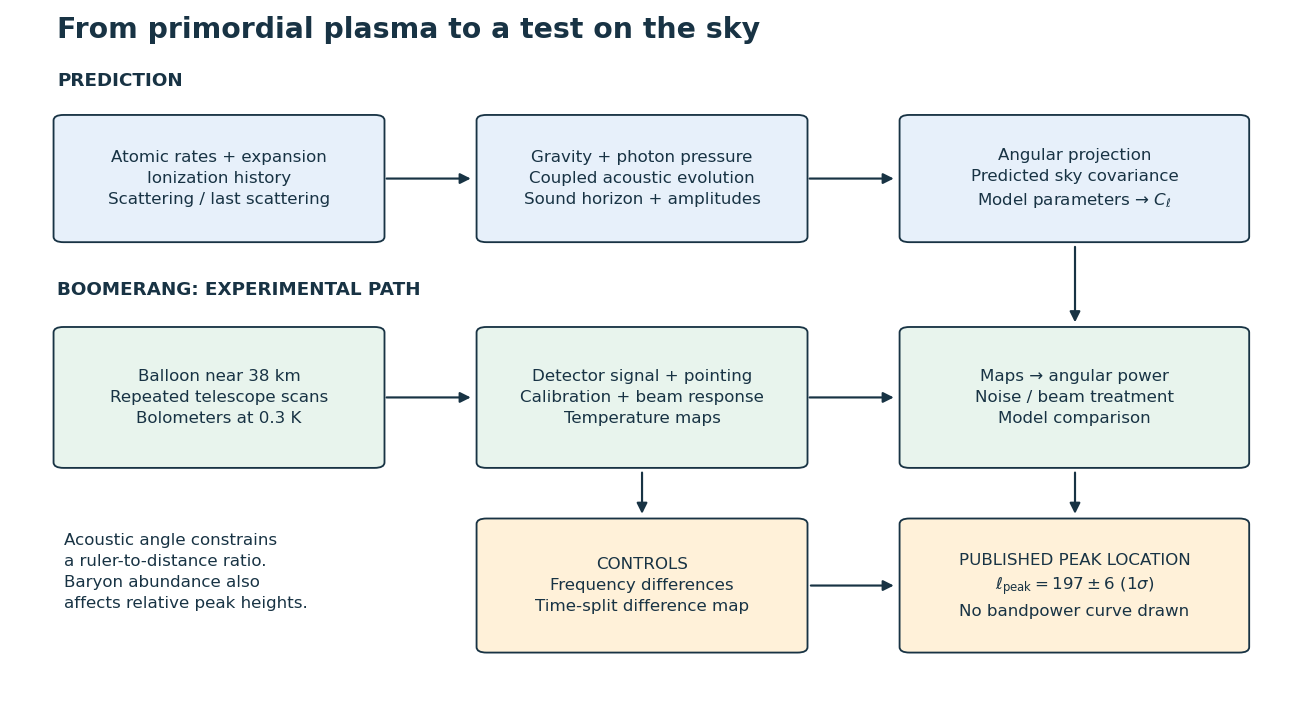
The continuing idea is a forward prediction: specify initial conditions, evolve the coupled matter and radiation, project onto the sky, and compare the result with an instrument's readout. Coherent initial phases are needed for acoustic variance peaks explains why a collection of oscillating modes does not automatically produce a peaked power spectrum. The BOOMERANG acoustic-peak measurement provides a later observational test of this physical programme.
A deliberately restricted forced harmonic oscillator shows two effects of the baryon loading parameter without duplicating the full photon Boltzmann hierarchy. Use conformal time in seconds, a comoving wavenumber in inverse metres, constant , and equal constant dimensionless Newtonian gauge gravitational potentials . The energy densities and use the same units. Neglect expansion drag, Silk damping and evolution of the potentials. The photon-baryon sound speed is . Writing for the photon monopole temperature perturbation, the photon-baryon acoustic oscillator reduces toFor this gives the displayed forced equation. Constant loading and the neglected expansion drag make this a local teaching model, not a self-consistent expanding cosmology with fixed forever.
Choose and , the static matter-era Sachs-Wolfe combination normalized by . With , direct substitution givesAt , successive extrema have equal magnitudes . At the stipulated , whereas . The shifted equilibrium makes alternating extrema unequal. This is an elementary illustration of how the baryon loading parameter changes acoustic amplitudes; these extrema are neither measured peak heights nor a complete Cosmic microwave background power spectrum. Comparing curves at fixed isolates the response; at fixed and , increasing also reduces the photon-baryon sound speed and hence the phase.
For example, holding gives sound horizons at and at . Their ratio is . Each term of the forced equation has units of inverse seconds squared because and are dimensionless and is an inverse time. In the actual photon-baryon fluid, grows with the scale factor and the sound horizon is the integral of the evolving photon-baryon sound speed.
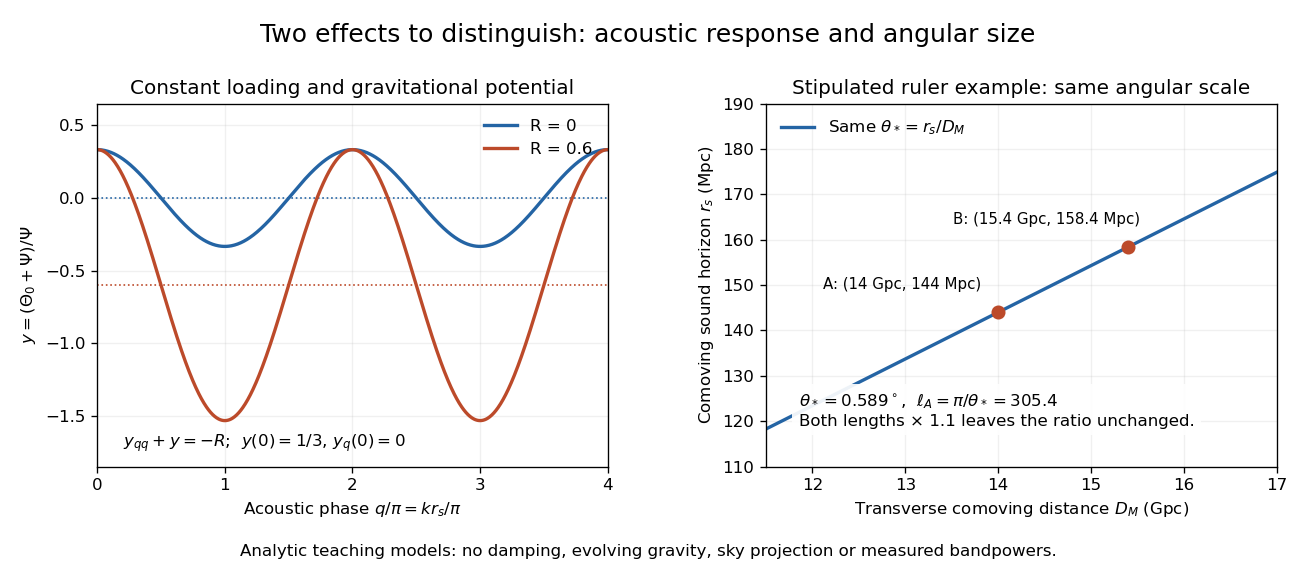
The angular sound horizon compares two lengths using the same distance convention. If is the angular diameter distance to last scattering at redshift , define the transverse comoving distance . A comoving sound horizon has proper length at emission, so its angular size is . Mixing a comoving ruler with would introduce an erroneous factor . In a curved FLRW metric, is generally different from the radial comoving distance.
For a stipulated example, and give radians, or , and an acoustic scale . Multiplying both lengths by gives and with exactly the same and . This example establishes a ratio degeneracy, without claiming that any arbitrary rescaling corresponds to an allowed cosmological model. Equivalently,Other observables are needed to separate changes that preserve the ratio.
The approximate adiabatic acoustic-peak spacing is . The first observed temperature peak is shifted by gravitational driving and angular projection of density and Doppler acoustic sources; it need not occur at . In particular, neither the illustrative nor the BOOMERANG acoustic-peak measurement of should be substituted for the other.
The cosmological baryon density enters through the baryon loading parameter and cosmological recombination, changing relative acoustic amplitudes as well as the sound horizon. The baryon-to-photon ratio counts net baryon number per photon, whereas is an angle. Constraining cosmological baryon density requires the pattern of relative peak heights within a model, with other parameters fitted jointly. Big Bang nucleosynthesis provides a separate abundance test. Baryon-density consistency between nucleosynthesis and the microwave background is consequently a test of one common cosmic history, rather than two direct measurements of the same angle. A first peak by itself cannot determine every component of the cosmological density parameter or uniquely fix spatial curvature of an FLRW universe.
BOOMERANG's 1998 Antarctic balloon flight scanned a low-dust region with a microwave telescope near and bolometers at . Ground beam measurements and microwave angular dipole calibration connected signals to sky temperature. Frequency-map and time-split differences tested contamination. The 2000 paper fitted the Cosmic microwave background power spectrum, finding at one standard deviation. Its near-flat-geometry inference used a chosen model family and parameter priors; secondary peaks were not yet established.[ref]
A Flat Universe from High-Resolution Maps of the Cosmic Microwave Background Radiation by P. de Bernardis and others. de Bernardis et al. (2000), PDF pp.3–9: apparatus, controls, peak fit
Articles by others on the same topic



Physical cosmology is a branch of cosmology that focuses on understanding the large-scale structure and dynamics of the universe through the application of physics. It involves the study of the origins, evolution, and eventual fate of the universe, with an emphasis on the physical laws and principles that govern these processes.