A planar rotation about the origin is the linear map represented by the rotation matrix . It preserves inner products, lengths, oriented angles and area, with positive angles measured anticlockwise. Its inverse is and its determinant is one.
For column coordinate vectors in the fixed Cartesian basis, an active planar rotation sends to . For radians,The endpoint travels counterclockwise through along a circle of radius . Its Euclidean norm stays . The second Cartesian basis direction becomes , whose dot product with is still zero.
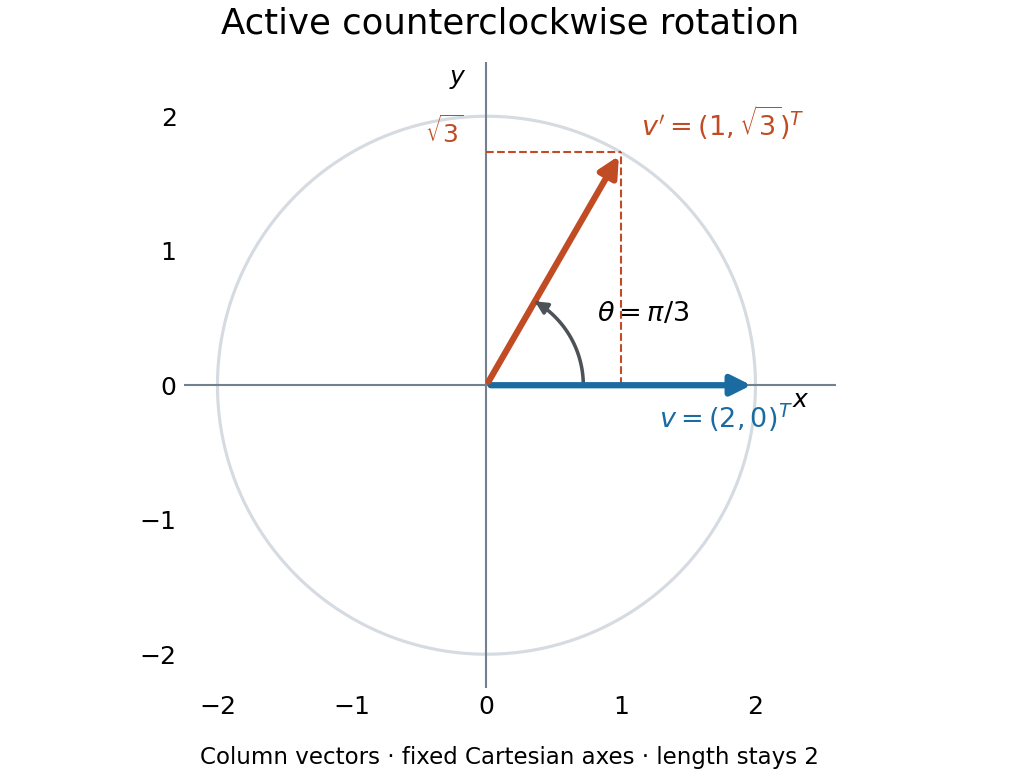
An active counterclockwise planar rotation by : the vector moves while the Cartesian basis stays fixed
. Details. 
A quick sign check is to look at the first column: must point above the horizontal axis for . The columns have unit Euclidean norm and zero dot product, so ; the determinant is . Finally, the transpose negates the off-diagonal entries, giving : turning back reverses the action. This is the same matrix used for passive rotation of coordinates, though that interpretation keeps the vector fixed.
A finite group of planar rotations about one point is a cyclic group. For a nontrivial group, choose its smallest positive rotation angle . Subtracting multiples of from any other group angle leaves a group angle in , hence zero. Applying the same argument to shows that for a positive integer . The identity-only group is cyclic as well.
Articles by others on the same topic
There are currently no matching articles.