An original deliberately local model makes the cooling quantitative. Fix a total amount of material, let be the mole fraction of solid, and stipulate molar entropiesThe constants and have units of molar entropy per temperature and molar entropy, respectively. Ignore their pressure dependence and the cell's own heat capacity. This is a local thermodynamics model, not an extrapolation to zero temperature. A constant positive cannot remain valid once the solid's spins order.
For a reversible thermodynamic process with no heat exchange, total entropy is constant. Differentiating giveswhen and . Define ; solving between two states givesIn particular, stipulate , and . ThenThe last expression is the local reversible heat requirement per mole frozen at the final state, divided by ; it is not the heat exchanged during the isolated compression. That compression exchanges no heat. This distinction separates the latent-heat sign from the actual boundary heat budget.
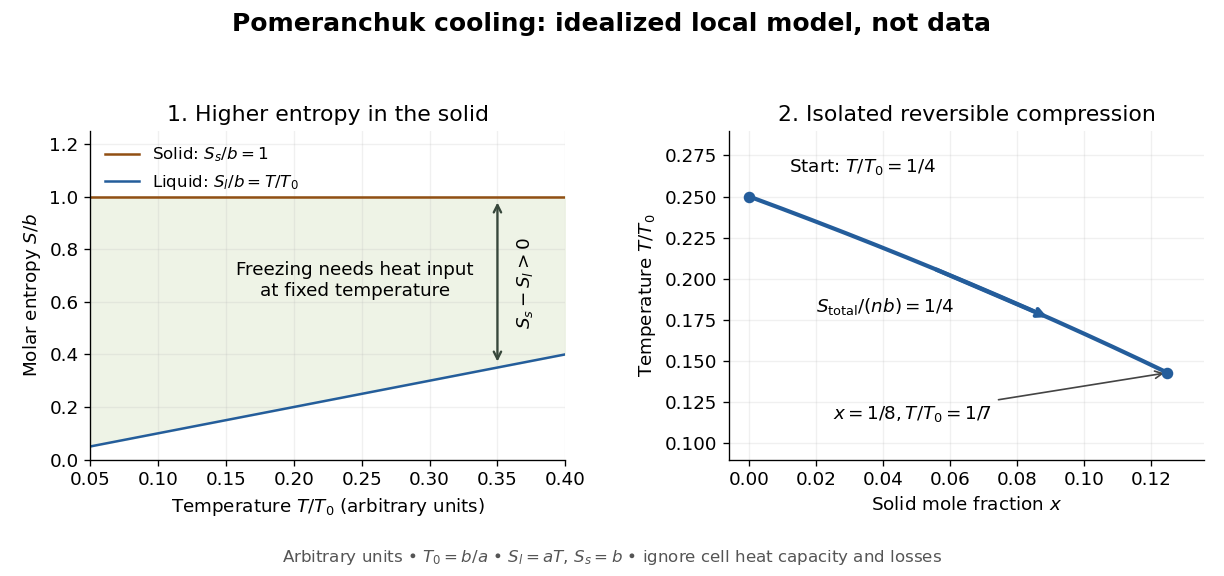

The utility of the model is its explicit condition: makes , while positive total heat capacity supplies a stable thermal response. More generally, for molar entropies depending only on temperature, let be the molar heat capacities. Then . Incoming heat or entropy production adds terms to the balance and can overwhelm the ideal cooling. Neither the numerical ratios above nor the straight entropy lines are measurements of helium-3.
Articles by others on the same topic
There are currently no matching articles.