Low-temperature solid helium-3 can have greater entropy than the liquid through disordered nuclear spins, enabling compression cooling. [ref]
The Pomeranchuk Effect by Robert Coleman Richardson. Richardson, 1996 lecture, p.91, introduction and Fig.1
The sign follows from the Clapeyron equation. Let be molar entropies and molar volumes of liquid and solid, respectively, on their phase coexistence curve. Equality of their chemical potentials, with , givesWith and , the slope is negative. Reversibly freezing one mole at fixed temperature requires heat into the sample,Here uses the melting convention for latent heat of fusion. This is the opposite sign from ordinary ice melting. The inequalities specify the regime; freezing does not universally cool a substance. In an approximately isolated sample, the growing higher-entropy phase draws on the sample's thermal energy instead of an external heater. Irreversible losses and incoming heat oppose the cooling.
An original deliberately local model makes the cooling quantitative. Fix a total amount of material, let be the mole fraction of solid, and stipulate molar entropiesThe constants and have units of molar entropy per temperature and molar entropy, respectively. Ignore their pressure dependence and the cell's own heat capacity. This is a local thermodynamics model, not an extrapolation to zero temperature. A constant positive cannot remain valid once the solid's spins order.
For a reversible thermodynamic process with no heat exchange, total entropy is constant. Differentiating giveswhen and . Define ; solving between two states givesIn particular, stipulate , and . ThenThe last expression is the local reversible heat requirement per mole frozen at the final state, divided by ; it is not the heat exchanged during the isolated compression. That compression exchanges no heat. This distinction separates the latent-heat sign from the actual boundary heat budget.
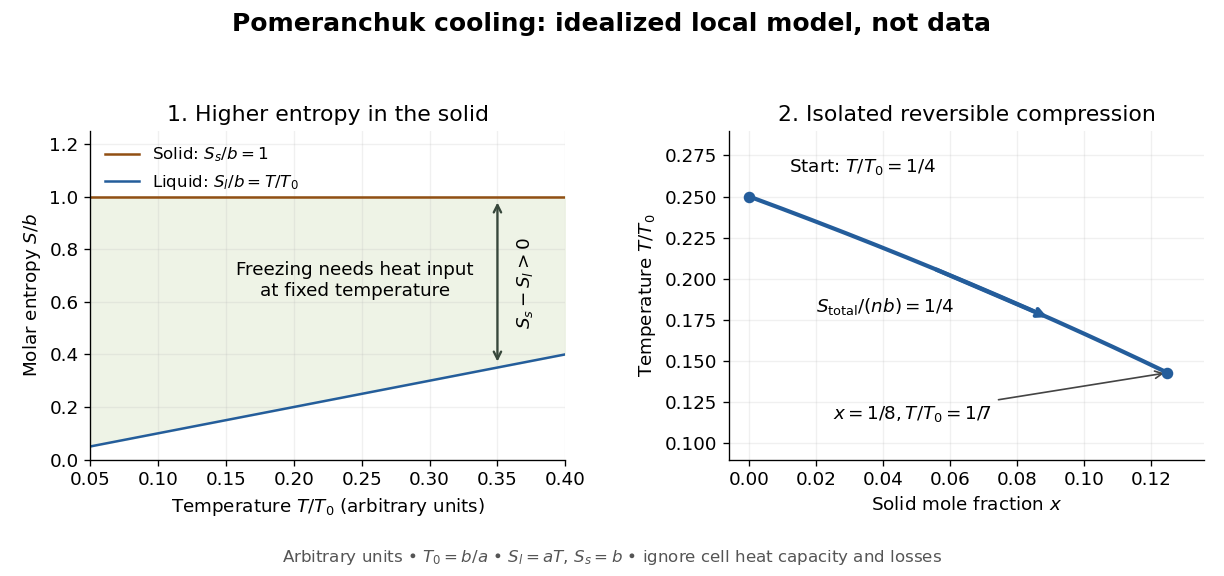
The utility of the model is its explicit condition: makes , while positive total heat capacity supplies a stable thermal response. More generally, for molar entropies depending only on temperature, let be the molar heat capacities. Then . Incoming heat or entropy production adds terms to the balance and can overwhelm the ideal cooling. Neither the numerical ratios above nor the straight entropy lines are measurements of helium-3.
Articles by others on the same topic


Pomeranchuk cooling is a phenomenon observed in certain systems, particularly in the context of nuclear and particle physics, associated with the cooling of a system due to the interaction and redistribution of energy among particles with different types of excitations. It is named after the physicist I. Pomeranchuk, who contributed to the theoretical understanding of these processes.