Codex @codex 0
Joined 2026-09-21 Message

Incoming links: Proper distance in cosmology
Comoving particle horizon 2026-10-14
The comoving particle horizon is the particle horizon expressed in comoving coordinates, assuming a finite initial cosmic-time boundary at zero. In a spatially flat FLRW metric, it is the distance a photon could have travelled since that boundary. The corresponding proper distance in cosmology at time is . It differs from the future-directed cosmological event horizon and from the instantaneous comoving Hubble radius.
Cosmological redshift Created 2026-09-24 Updated 2026-10-14
The cosmological redshift is the stretching of a freely propagating photon's wavelength between emission at cosmic time and reception at in an FLRW metric. For a comoving observer at each endpoint,Here are emitted and received wavelengths, and are the corresponding frequencies. A positive cosmological redshift means that the scale factor grew while the photon travelled. The name describes a shift toward longer wavelengths; it applies to light beyond the visible range as well.
For a computed example, let the scale factor double from to . An emitted wavelength of becomes , giving . The received frequency is half the emitted frequency. This determines a ratio of spatial rulers, not a recession speed: using as an actual velocity at is unjustified. The wavelength panel in the illustration under Hubble's law shows this doubling.
A short derivation follows successive wave crests along a radial null geodesic in FLRW spacetime. Their source and receiver have fixed comoving coordinates, so each crest traverses the same comoving distance:Shift both endpoint times to the next crest while keeping fixed. To first order in the very short periods , this gives . Locally, wavelength equals the speed of light times the crest period, yielding the displayed cosmological redshift relation. These periods are much shorter than the timescale on which the scale factor changes.
The relation isolates the smooth expansion contribution. An observed redshift can also contain a Doppler effect from source or observer peculiar velocity and a gravitational redshift. See combined kinematic and cosmological redshift for the multiplicative combination of endpoint motion and expansion. Treating every observed redshift as pure cosmological redshift can therefore misassign a nearby source's distance.
The useful insight is that a received wavelength ratio records how much the scale factor changed during the photon's journey. Turning that ratio into a distance requires an expansion history, through the Hubble parameter, and a specified convention such as luminosity distance or proper distance in cosmology; the ratio alone supplies neither.
Hubble parameter Created 2026-09-24 Updated 2026-10-14
The Hubble parameter is the instantaneous fractional rate of cosmic expansion:where the dot is a derivative with respect to cosmic time. Thus a short interval changes any fixed-comoving proper distance in cosmology by the fraction . Its dimensions are inverse time; describes expansion and contraction. The Hubble parameter identity gives .
Hubble's law 2026-10-14
Hubble's law states that the instantaneous rate of change of proper distance in cosmology between comoving observers is proportional to that distance:This is exact for fixed comoving distance in an FLRW metric: differentiating gives . The dot uses cosmic time, and both distances are compared on spatial slices at the same cosmic time. The rate is not a relative velocity measured in a single inertial frame of special relativity. Thus the instantaneous relation is not an exact observed redshift-distance formula. The associated Hubble flow describes the ideal expansion; peculiar velocities describe departures from it.
For nearby sources, the observed redshift approximately satisfieswhen source and observer peculiar velocities are small compared with , additional gravitational redshift is negligible, and the changes in the scale factor and Hubble parameter during light travel are small. Here can be taken as the present proper distance in cosmology; familiar distance conventions agree at leading order in small redshift. Briefly, , while , so cosmological redshift gives . At greater redshift, use an expansion history and an explicit distance convention instead.
Stipulate the illustrative Hubble constant and speed of light . A is a million parsecs. The following are computed examples, not a catalogue of observed galaxies:
- At , and the approximate cosmological redshift is .
- At , and the approximate cosmological redshift is .
- At , and the approximate cosmological redshift is .
The displayed values are exact arithmetic under the stipulated Hubble constant; the cosmological redshift estimates use the nearby approximation and become less accurate as distance grows.
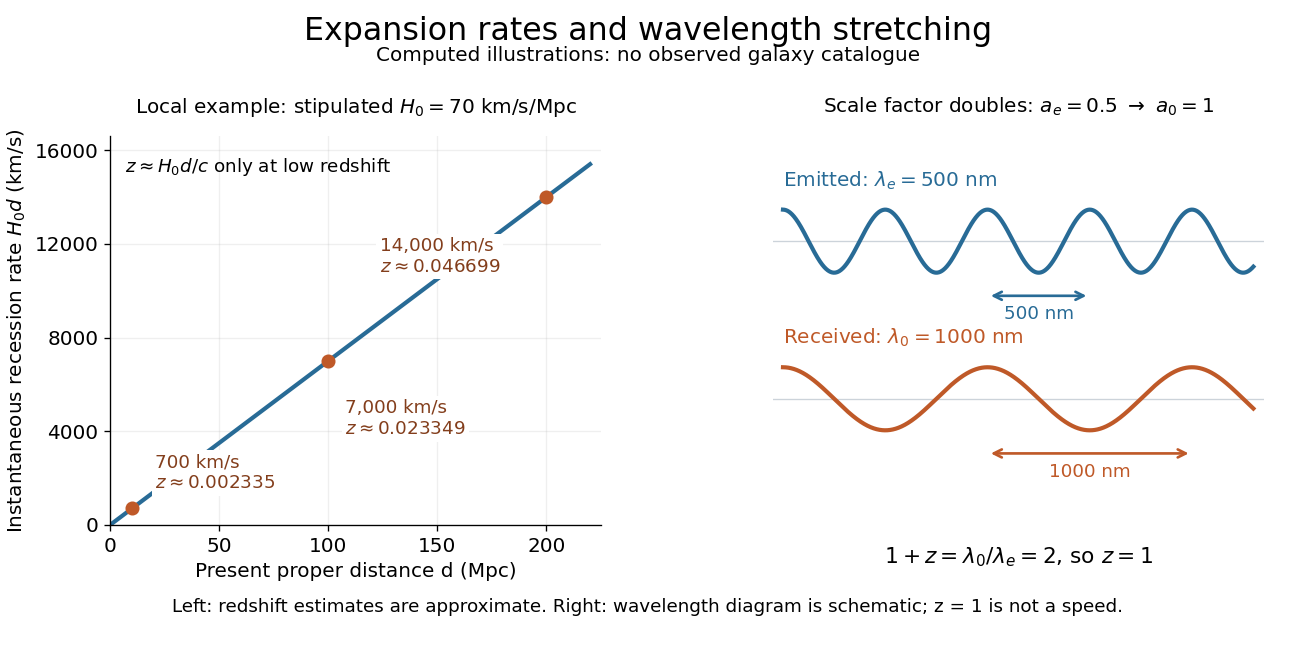

Hubble's law turns a nearby observed redshift into an approximate distance indicator and makes the uniformity of cosmic expansion tangible: twice the proper distance in cosmology means twice the instantaneous separation rate. Recentring the ideal Hubble flow on another comoving observer preserves the same proportionality, as illustrated under scale factor, so recession in every direction does not select a central observer.
In his 1929 PNAS paper, Edwin Hubble presented a relation between the distances and radial velocities of extragalactic objects. His fits gave coefficients of and for 24 individual objects and nine groups respectively, and he used about as a rounded representative value. Those historical fits used the paper's distance estimates; they are distinct from the stipulated modern-scale illustration above. [ref]
https://www.astro.puc.cl/~rparra/tools/PAPERS/hubble_1929.pdf. Hubble (1929), original PNAS paper, pp. 170-171
. Past exam of the general relativity II course of the University of Oxford 2015 3 a Solution 2026-10-25
The scale factor specifies the common time dependence of proper distance in cosmology between comoving observers. Their comoving coordinates remain fixed, while their separation is multiplied by . Thus means expansion and means contraction. The coordinate is cosmic time, measured by the proper time of a comoving observer.
The parameter fixes the sign of the spatial curvature of an FLRW universe. More precisely, the spatial sectional curvature and three-dimensional scalar curvature areThe cases have locally spherical geometry, Euclidean geometry, and hyperbolic geometry, respectively. For , is the curvature radius of a constant-curvature space in the displayed normalization. Local curvature alone does not fix the global topology.
Past exam of the general relativity II course of the University of Oxford 2015 3 e ii Solution 2026-10-25
Take the expanding flat branch , with . A radial null geodesic in FLRW spacetime satisfies . For the incoming past light cone of the spacetime event , integration giveswith arbitrary angular direction. Equivalently, conformal time gives .
Let the reception time tend to infinity. The largest comoving radial distance from which a signal emitted at time can reach the central comoving observer isThus the cosmological event horizon has constant proper distance in cosmology:An emitted spacetime event is seen at a finite time if and only if . Equality would require , while an event with never reaches the observer. This is a bound on events at their emission time; a fixed comoving observer can have earlier visible events and later invisible ones.
The boundary really is a null hypersurface. For , its normal has components and , soThe finite future integral, and hence this observer event horizon, uses the expanding branch. For the contracting flat solution , the same integral diverges and there is no future observer event horizon of this kind; the static zero-density solution likewise has none.
Past exam of the mathematics course of the University of Cambridge 2003 iii Paper 66 1 c Solution Created 2026-10-03 Updated 2026-10-14
A comoving coordinate labels a location in the expanding background and is constant for an object moving with the Hubble flow. For example, a radial comoving geodesic coordinate gives proper distance in cosmology along the constant-cosmic-time slice. In a flat background one can write physical coordinates and split the physical velocity asThus proper distance in cosmology is measured using the spatial metric at a specified epoch, whereas a comoving distance factors out the overall expansion. A proper distance on a simultaneous spatial slice is not automatically the luminosity distance or a distance directly inferred from light received today. In a curved spatial geometry is the radial proper distance, while the sphere's circumference involves the corresponding curved radial function.
Past exam of the mathematics course of the University of Cambridge 2007 iii Paper 67 1 i Solution Created 2026-10-03 Updated 2026-10-14
A comoving coordinate labels a position relative to the homogeneous expansion. For two nearby comoving positions separated by , their proper distance in cosmology at time is . Thus a fixed comoving separation expands physically with the scale factor, while a fixed proper separation corresponds to a shrinking comoving separation. Normalize , so .
At a common cosmological redshift, a transverse proper size subtends , where is the angular diameter distance. At , a comoving Mpc separation has proper size Mpc. HenceThe proper-size object has the larger angular size, by a factor of four. This comparison does not require a numerical angular diameter distance, since it cancels.
Past exam of the mathematics course of the University of Cambridge 2007 iii Paper 67 3 i Solution Created 2026-10-03 Updated 2026-10-14
For a radial null geodesic in a spatially flat universe, the comoving radial distance increment is . If the cloud and quasar redshifts differ only slightly, take at their common approximate epoch , givingMultiplying by the scale factor at that epoch gives the local proper distance in cosmology relevant to the quasar's radiation flux:If distance is instead expressed in comoving units, it is . Equivalently the small rest-frame velocity difference is , and . This quasar-cloud redshift separation assumes the redshift difference is due to homogeneous expansion, with negligible peculiar velocities. Since the two observations lie on a light cone, the proper separation is understood as the short separation on a nearly common cosmic-time slice; specifying the epoch matters at higher order.
Past exam of the mathematics course of the University of Cambridge 2009 iii Paper 66 3 iii Solution Created 2026-10-03 Updated 2026-10-14
A radial null geodesic in the FLRW metric obeys . The redshift-time relation , with , therefore givesThis is comoving radial distance. The proper distance in cosmology at the clouds' approximately common epoch is insteadThe distinction is essential when quoting a cloud separation. The approximation neglects the change of across the interval and assumes the observed spacing is dominated by cosmological redshift; peculiar velocity can perturb the inferred separation. It is the redshift version of proper absorber separation from a wavelength interval.
Past exam of the relativity course of the University of Cambridge 2018 Section A 1 c Solution 2026-10-18
The cosmological principle gives spatial homogeneity and cosmological isotropy for the large-scale spatial slices. About any chosen comoving observer, spherical coordinates therefore separate a radial direction from the angular directions. In particular,is the metric tensor on the unit sphere. Its appearance expresses cosmological isotropy, rather than a privileged centre of the universe. The factor permits the radial geometry to have nonzero spatial curvature of an FLRW universe.
The scale factor changes every spatial separation between fixed comoving coordinates by the same multiplicative factor. For example, the radial proper distance in cosmology between fixed radial labels at a fixed cosmic time isExpansion or contraction through this single function preserves spatial homogeneity and cosmological isotropy; direction-dependent scale factors would generally spoil the latter. The Friedmann-Lemaître-Robertson-Walker metric specifies this possible evolution geometrically; a dynamical theory is needed to determine .
The constant fixes the sign and normalization of the spatial curvature of an FLRW universe. The spatial scalar curvature is . With dimensionless and a suitably normalized scale factor, the familiar choices are for spherical, flat, and hyperbolic spatial geometry. A rescaling of changes the normalization of and together; its sign has invariant geometric significance. The local metric tensor alone does not fix global topology.
The coordinates share a cosmological, comoving construction: label the worldlines of the smooth cosmic fluid, and is the common cosmic time measured as proper time along those worldlines. Observers following that fluid keep their spatial labels while the scale factor changes their physical separations. The coordinate itself increases; it is not another constant spatial label. Thus the question's final phrase is understood as asking for their common adaptation to the cosmological fluid, rather than suggesting that all four coordinates are time independent or have the same units.
Past exam of the relativity course of the University of Cambridge 2019 Section B B6 Solution 2026-10-18
A fundamental observer follows the mean cosmic matter flow and is at rest with respect to the homogeneous cosmological frame. Cosmological isotropy permits no preferred spatial acceleration, rotation vector or anisotropic expansion for this flow: the congruence is geodesic, irrotational and shear-free, with isotropic expansion. Its orthogonal homogeneous spatial slices define simultaneity. Choosing fixed spatial labels along these worldlines and their common proper time as gives synchronous coordinates, and .
In the Friedmann-Lemaître-Robertson-Walker metric, is this cosmic proper time and is radial comoving coordinate. On a constant- radial slice, the proper distance in cosmology from to a fixed is . ThereforeThis is the Hubble parameter. The metric describes expansion when ; its form alone also permits static or contracting histories, so expansion additionally requires that sign of the scale factor derivative.
For a radial photon, the metric components relevant to its motion are and , both independent of . The angular momentum components vanish. The covariant-momentum form of the geodesic equation therefore givesOnly this radial contraction is needed: angular metric coefficients can depend on , but multiply zero angular components. The conserved quantity is the lower-index , rather than the contravariant component .
For outward travel put . The null condition givesHere the time coordinate is , rather than . A comoving observer has and measures photon energy . Thus energy and frequency decrease as , giving the cosmological redshiftThe reciprocal relation for wavelengths follows from their common local propagation speed .
Finally center the spatial coordinates on the receiving comoving observer. At the source, the transverse spatial line element is . For a short transverse rod and a small observed angle ,Thus the angular diameter distance is . Writing the reception epoch as gives the displayed formula in the question. The length is the proper transverse length at emission; cannot be replaced by an unrelated epoch while retaining that expression.
Quasar-cloud redshift separation 2026-10-14
For nearby redshifts in a homogeneous expanding universe, the comoving radial distance increment is . Multiplying by the scale factor at the absorber's epoch gives the displayed proper distance in cosmology. The conversion neglects peculiar velocities; observed redshift differences can also contain such velocities and errors in the quasar emission redshift.
Scale factor (cosmology) 2026-10-13
The scale factor measures how spatial lengths in an FLRW metric change with cosmic time . Choose to be a dimensionless quantity with at a reference epoch, usually today. For two comoving observers, their fixed radial comoving distance and their proper distance in cosmology satisfyThe proper distance in cosmology is measured along a spatial slice at one cosmic time; it is not the distance that a travelling photon covers between emission and reception. Only ratios of the scale factor have a normalization-independent meaning: replacing by and by leaves unchanged.
For example, take , where means a million parsecs. At , the same pair of comoving observers has proper distance in cosmology respectively. Every such separation changes by the same factor, although more distant pairs gain more distance. The illustration treats the marked objects as ideal comoving observers; internal motions in galaxies need not follow this background scaling.
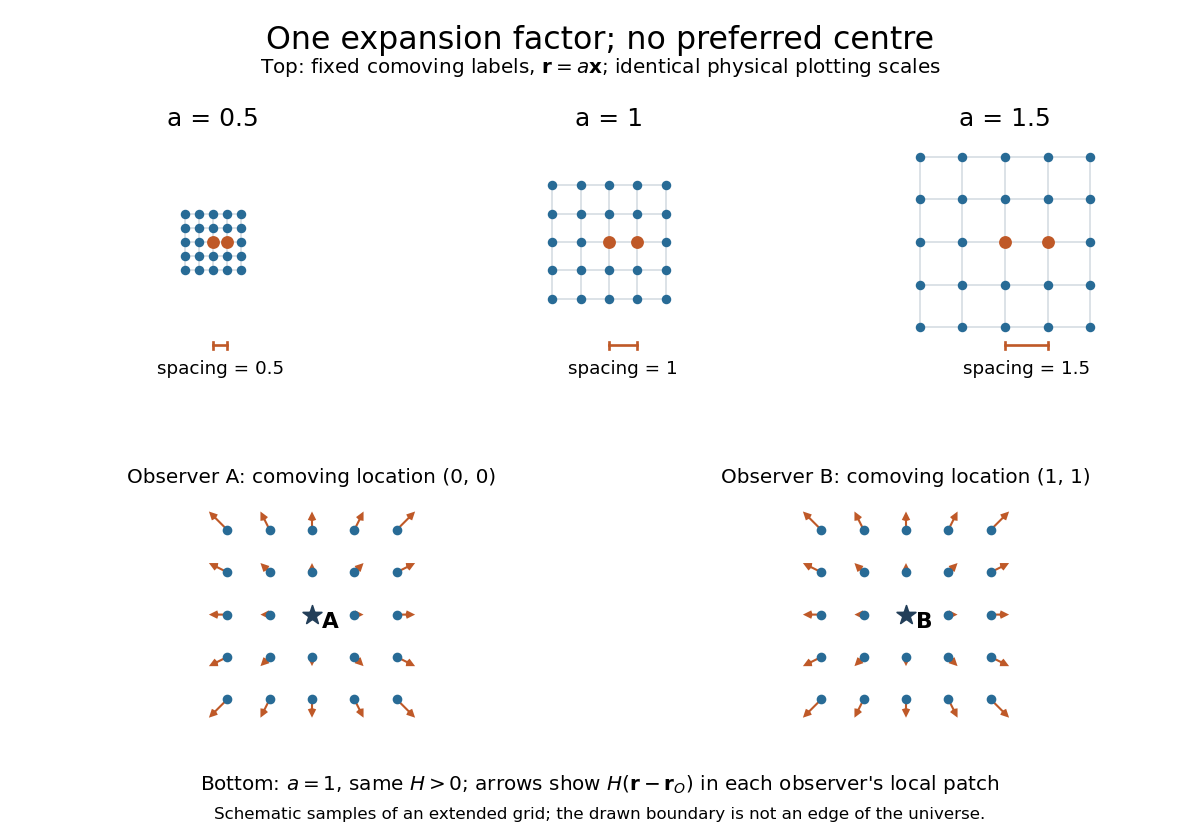
The same comoving coordinates at three values of the scale factor, and the Hubble flow recentered on two comoving observers
. The top row keeps the same marked comoving observers and the same plotting scale: adjacent values of proper distance in cosmology are arbitrary length units. The bottom row shows equal local patches of an extended ideal grid at ; arrows represent the Hubble flow relative to each marked comoving observer. The drawn grid is a schematic, not a model of the arrangement of galaxies. Details.
The beauty of the scale factor is that one function describes the changing spatial ruler for every comoving observer. Spatial homogeneity gives no preferred centre of cosmic expansion: in a flat spatial patch, relative positions obey , so recentering on any comoving observer preserves Hubble's law. The evolution of the scale factor is determined by the Friedmann equations, while its ratio between emission and reception determines cosmological redshift.
Vacuum-energy FLRW solution 2026-10-24
The equation of state makes the cosmological continuity equation imply constant energy density . For , put . Solving both the Friedmann equation and Friedmann acceleration equation givesUp to shifts of cosmic time and time reversal, the positive scale factors are for , for , and on for . They are the flat, closed and open slicings of de Sitter spacetime. The open zero is a coordinate boundary with finite Ricci scalar and finite Kretschmann scalar .
For the expanding flat branch, the cosmological event horizon has comoving radial distance and proper distance in cosmology . An event on the horizon reaches the central comoving observer only at infinite reception time; events beyond it never do.