For row reduction with a parameterized right-hand side at , the nonzero reduced equations areColumn 3 has no pivot element, so is a free variable in a linear system. Taking gives every solution:There is no further restriction on . Independent substitution into the original linear system givesConversely, the two reduced equations force exactly these coordinate formulas, so no solutions have been omitted. The same computation with zero right-hand side gives the kernel . Its dimension is one. The rank-nullity theorem appears here as : two pivot columns and one freely chosen coordinate account for the three unknowns.[ref]
The Rank Theorem. Interactive Linear Algebra by Dan Margalit and others; §2.9, Rank Theorem and preceding pivot-column/free-variable count
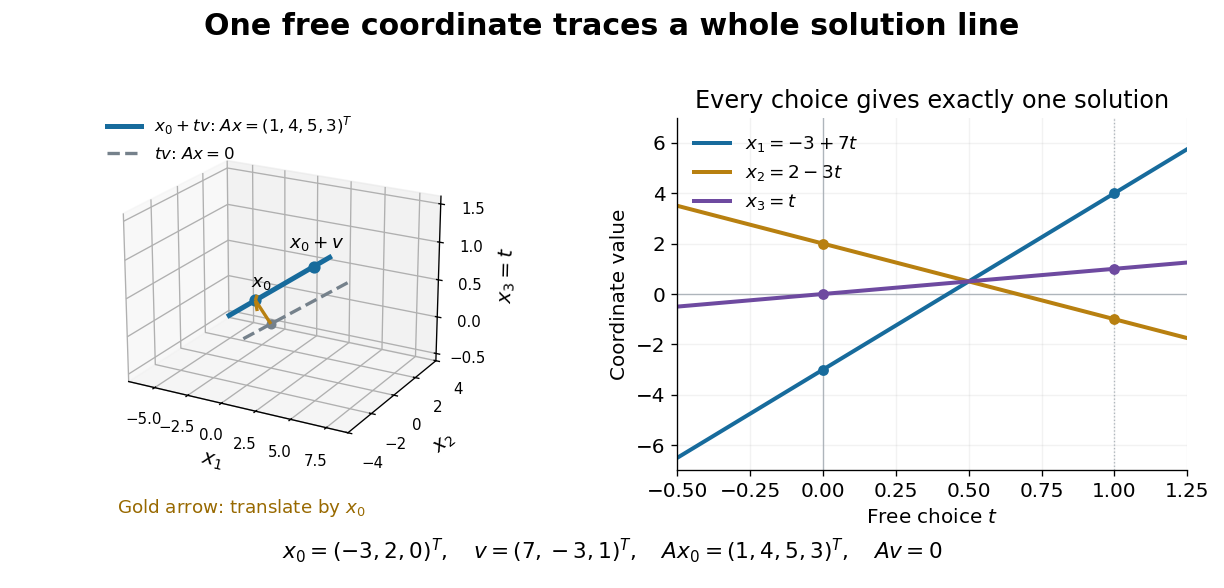
One free variable in a linear system traces an affine solution space of a linear equation parallel to its kernel
. Details. 
In general a consistent linear system has solution set . Subtracting from proves this description in both directions. The particular solution places the affine subspace, and the kernel supplies its directions.[ref]
Solution Sets. Interactive Linear Algebra by Dan Margalit and others; §2.4.2, Key Observation and its proof: translate homogeneous solutions by any particular solution
Over the real numbers this example is an entire line; over the rational numbers the same formula uses rational . A free variable in a linear system over a finite field instead has only finitely many choices.The pivot columns identify a different object: the original column space. Here they selectwhich form its basis, while . The corresponding reduced columns are and ; their linear span is a different plane. For example, every original output satisfies , but does not. Since is an invertible matrix, column linear relations survive even though the output vectors move. This is why choosing original columns at the reduced pivot positions works.
Articles by others on the same topic
There are currently no matching articles.