The Lamb-Mössbauer factor is the fraction in the coherent elastic line. In the harmonic-lattice approximation it is a Debye–Waller factor. Write the displacement of the emitting or absorbing atomic nucleus relative to its equilibrium site as , put , and define the angular wavenumber . Choose the equilibrium site so that . Its directional displacement variance is . A harmonic solid in thermal equilibrium has a Gaussian distribution for this displacement, whose characteristic function gives the elastic amplitudeTaking the squared magnitude gives the intensity fractionThe factor belongs to the amplitude exponent; it disappears when the amplitude is squared. For an isotropic solid, , so an equivalent expression is . Directional and three-dimensional mean squared displacements must not be substituted for one another without this factor.
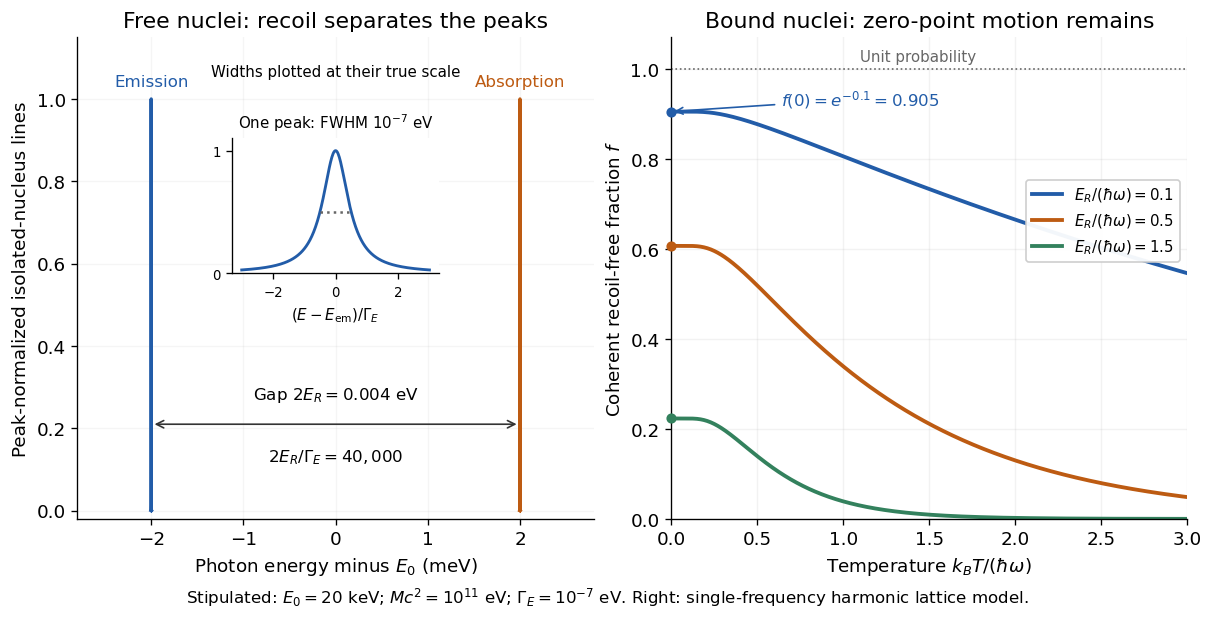
An Einstein solid approximation replaces the vibrational spectrum by one positive angular frequency . For the directional quantum harmonic oscillator, with the same effective mass as in ,Here is the Boltzmann constant and is temperature. This follows by taking the expected value of in each oscillator energy eigenstate, , and averaging with the Boltzmann distribution. Substitution givesThe zero-temperature limit retains zero-point energy and a nonzero displacement variance. Cooling therefore increases the recoil-free fraction towards a limit below one for finite . At high temperature, the exponent tends to . This is a single-frequency approximation to a harmonic lattice's coherent elastic weight, not a complete description of all zero-net-energy processes of an isolated oscillator. Real vibrational spectra, directional binding and anharmonic motion can change its predictions.
Extend the stipulated teaching system by choosing , so . Then , while at . If source and absorber are independent, the fraction of events eligible for recoil-free emission followed by recoil-free absorption contains the product ; this gives for two zero-temperature copies. It is not the total probability of absorption, which also depends on the number of resonant atomic nuclei, geometry and spectral line overlap.
Articles by others on the same topic


The Lamb–Mössbauer factor, often denoted as \( f \), is a key concept in the field of condensed matter physics and spectroscopy, particularly in relation to Mössbauer spectroscopy. It describes the fraction of the total intensity of a Mössbauer spectrum that is related to atoms that are well-ordered and not experiencing significant vibrational displacement or thermal motion.