Ruth E. Benesch was a biochemist whose work with Reinhold Benesch investigated hemoglobin and its interaction with small-molecule regulators. Their jointly authored 1969 account connected 2,3-Bisphosphoglycerate in red blood cells with lower oxygen affinity through preferential binding to deoxyhemoglobin. The published full byline uses Ruth E. Benesch; the middle initial is retained here.[ref]
Intracellular Organic Phosphates as Regulators of Oxygen Release by Haemoglobin by Reinhold Benesch and Ruth E. Benesch. Publisher byline and abstract, Nature221, pp.618–622, 1969
She was first author of a separate 1969 study of hemoglobin oxygenation in the presence of the same metabolite, with Reinhold Benesch and Chi Irg Yu. Its stated experimental variables were temperature, pH, ionic strength and hemoglobin concentration. Those variables matter because a ligand's effect is a property of the complete chemical equilibrium under specified conditions, not just the name of the ligand. The shared byline supports a collaborative contribution; it does not identify who performed every apparatus task.[ref]
Oxygenation of hemoglobin in the presence of 2,3-diphosphoglycerate. Effect of temperature, pH, ionic strength, and hemoglobin concentration by Ruth E. Benesch and others. Publisher title, byline and original June1969 issue information
An original binding calculation illustrates why protein concentration belongs in such a comparison. In a deliberately simplified one-site model, let be the total concentration of binding sites, the free concentration of 2,3-Bisphosphoglycerate, and its dissociation constant. The bound concentration isAt and , half the sites are occupied: . The total ligand concentration is , not . Substituting total concentration for free concentration would predict a different occupancy. These are stipulated numbers, not measured binding constants from her paper.
The biochemical insight extends beyond the small molecule: oxygenation and regulator binding are coupled properties of a protein. Their 1969 joint account describes one bound phosphate-metabolite molecule per hemoglobin tetramer, rather than one for every oxygen-binding subunit. This distinguishes regulatory stoichiometry from oxygen-carrying capacity.[ref]
Intracellular Organic Phosphates as Regulators of Oxygen Release by Haemoglobin by Reinhold Benesch and Ruth E. Benesch. Abstract: preferential deoxyhaemoglobin binding and one molecule per tetramer
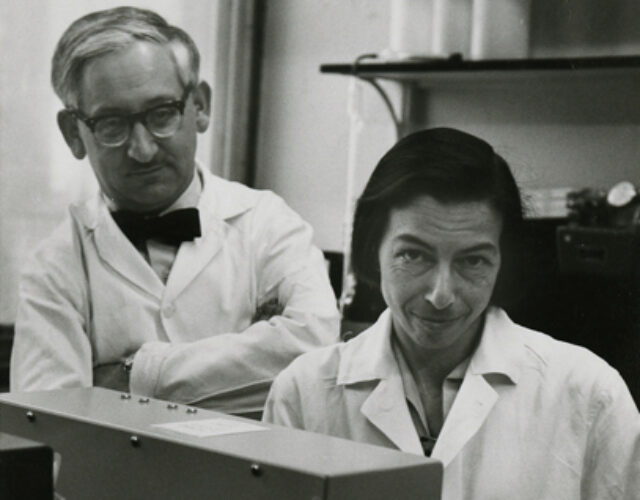
The historical photograph below is explicitly identified by the Science History Institute and credited to Columbia University's Department of Biochemistry.[ref]
Reinhold and Ruth Benesch photograph at the Science History Institute. Photograph caption and credit
Articles by others on the same topic
There are currently no matching articles.