A movable magnetic spectrometer selected scattered Electrons by momentum and scattering angle. Magnetic fields dispersed momenta at the focal plane. With relativistic Electrons, the inferred momentum determines outgoing energy . Commissioning included steering the beam through the spectrometer at zero angle to check its optics and accepted solid angle. Counters sorted events into momentum and angle bins. The acceptance entered the conversion from counts to differential scattering cross-sections.[ref]
Deep Inelastic Scattering: The Early Years by Richard Edward Taylor. 1990 Nobel lecture, Fig. 15, magnet optics; Fig. 33 and adjacent acceptance-calibration account
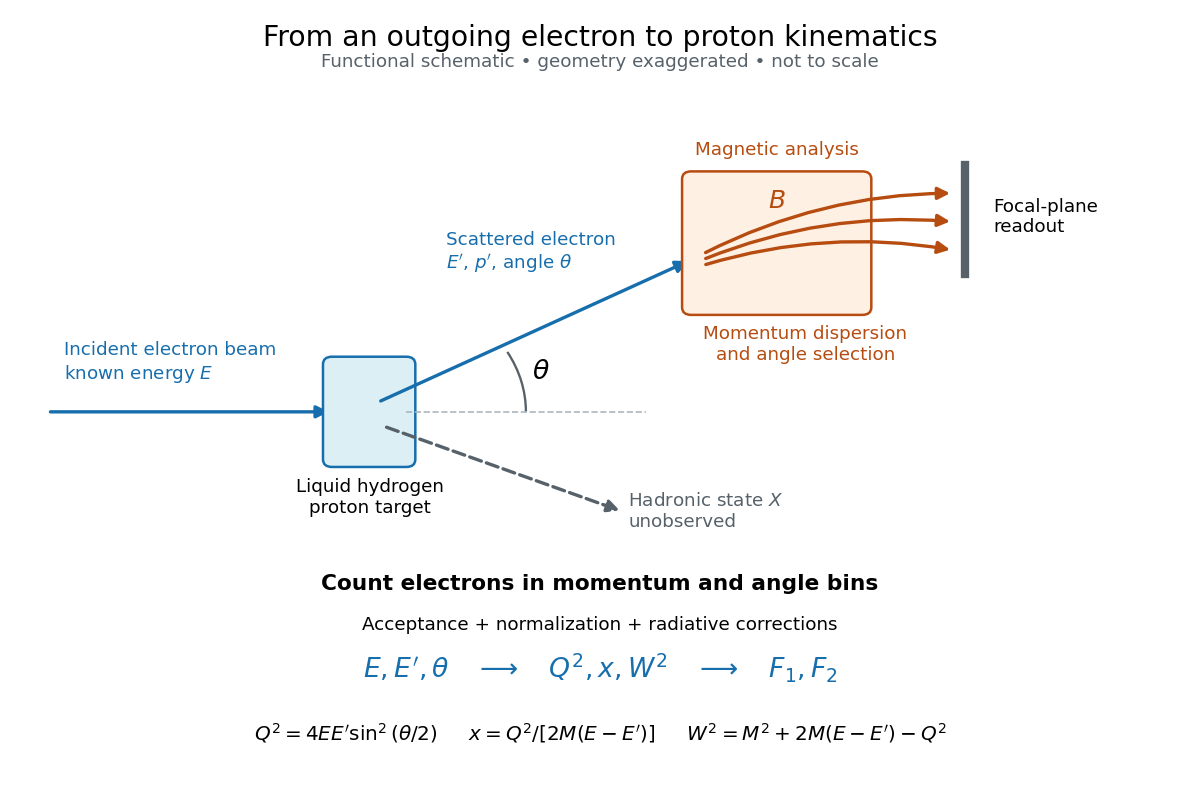

Radiative corrections matter because photon emission can move events from an elastic scattering peak into lower outgoing-energy bins. The analyses subtracted the elastic radiative tail before unfolding inelastic radiation. Independent MIT and SLAC procedures provided a check. An uncorrected low- tail alone therefore cannot establish deep inelastic scattering.[ref]
Deep Inelastic Scattering: Experiments on the Proton and the Observation of Scaling by Henry Way Kendall. Section IV.C, radiative-tail subtraction, unfolding and independent analyses; Figs. 6–8
Articles by others on the same topic
There are currently no matching articles.