Let be a Banach space over the complex numbers, and let be a bounded linear operator defined on all of . Its spectrum consists of those for which has no everywhere-defined bounded inverse. Its complement is the resolvent set of an operator . By the bounded inverse theorem, a bijective automatically has a bounded inverse. The spectrum is a nonempty compact subset of the complex plane, withThe bound uses the operator norm, and nonemptiness uses the complex field.[ref]
https://www.math.hkust.edu.hk/~makyli/4063/fanotes2_150615.pdf#page=38. HKUST Math 4063 notes, chapter 4, section 3: compactness and nonemptiness of the spectrum
For a real linear operator, complex spectral values are understood by extending it to a complex vector space; restricting to the real field can give an empty set.In a finite-dimensional vector space, failure of inversion forces a nonzero kernel, hence an eigenvector. An infinite-dimensional vector space allows an injective shifted linear operator that cannot solve every equation . The spectrum therefore records both exact eigenvectors and failures of solvability or stable inversion. Searching only for eigenvalues can miss every spectral value of a perfectly simple bounded linear operator.
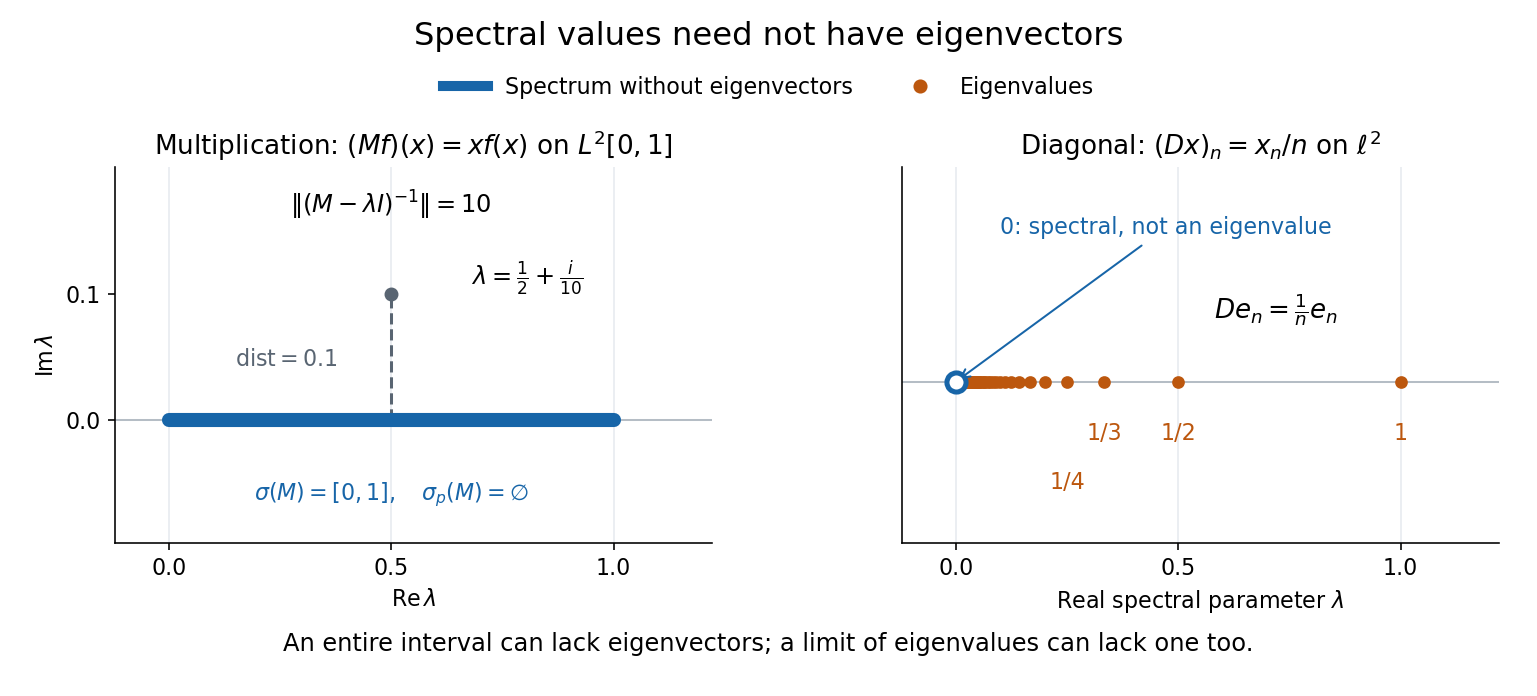
Consider the multiplication operator on the complex L2 space , with Lebesgue measure:Its operator norm is one. The inequality gives the upper bound; unit vectors concentrated near approach it. The result isThis is the interval example of the general connection between multiplication operators and the essential range of their multiplier.[ref]
https://hackmd.io/@knikct/BkX1s2PFr. Berkeley Math 224A, lecture 13: spectra of multiplication operators
Indeed, an eigenfunction would satisfy almost everywhere. It vanishes except possibly on the singleton , a null set; such a function is the zero vector in L2 space. Concentrating at one point cannot produce a nonzero L2 function.For , the inverse is completely explicit:The distance to a set is positive, so the inverse multiplier is bounded. Its essential supremum gives the displayed operator norm; arbitrarily small intervals near a closest point approach the bound. Our resolvent of an operator uses , the negative of this inverse, with the same operator norm. For , , and , the inverse norms are respectively , , and . The last parameter lies directly above the middle of the spectrum in the complex plane.
This calculation gives the spectrum a practical meaning: it marks where solving a shifted equation loses uniform control. At , the largest amplification of an input error is . Changing from to increases that factor from ten to one hundred. The equation remains uniquely solvable for each nonzero , but its sensitivity grows as the parameter approaches the spectrum.
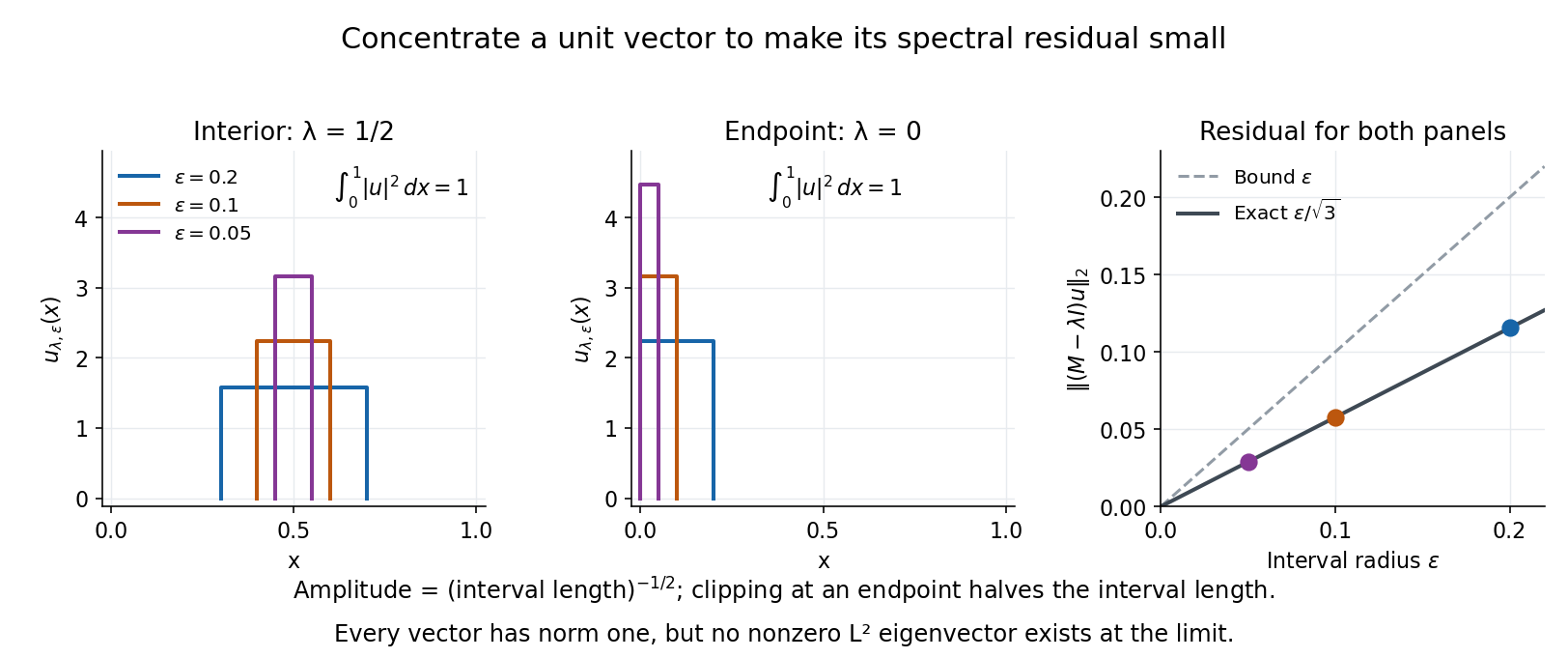
To see directly why every belongs to the spectrum, choose and define a clipped interval and a normalized indicator function:Its L2 norm is exactly one, including at both endpoints. On its support, , givingThus any choice produces approximate eigenvectors. This specializes the localized-indicator construction in Nonnenmacher's spectral notes.[ref]
https://www.imo.universite-paris-saclay.fr/~nonnenma/enseign/Spectral%20Theory%202021%20chap1-4.pdf#page=47. Nonnenmacher, Introduction to Spectral Theory (2021), proposition 4.2.15
A hypothetical bounded inverse would imply , impossible for arbitrarily small .For an interior point with , and the residual is exactly . At or , and the same residual formula holds, but the amplitude is rather than . At , taking gives amplitudes approximately and residuals . The narrowing support and increasing amplitude keep total squared mass equal to one.
For every , the continuous spectrum description is also concrete. Any L2 function can be approximated in L2 norm by its truncations to . Each truncation lies in the range of , since division there is bounded. The range is therefore dense. However, the constant function has no L2 function preimage: is not square-integrable, including at the endpoints.
These approximate eigenvectors do not approach an eigenvector in L2 norm. Any possible limit would have L2 norm one and satisfy by continuity, contradicting the empty point spectrum. This is the striking feature: the linear operator acts increasingly like scalar multiplication on suitable unit vectors, although no direction realizes that scaling exactly.


A complementary example is the diagonal operator on sequence space on complex l2 sequence space, with . The coordinate unit vectors satisfy , soZero is not an eigenvalue, since forces every coordinate to vanish. Nevertheless : these are approximate eigenvectors at zero. More concretely, belongs to l2 sequence space, but would require for all , which does not. Outside the displayed closed set, division by is uniformly bounded, proving that no further spectral values occur. Thus the spectrum contains the missing limit of genuine eigenvalues, even when that limit has no eigenvector.
Articles by others on the same topic
There are currently no matching articles.