Suppose are bounded functions on the same nonempty set, and the supremum norm of their difference is at most . Then their optimal values differ by at most the same amount:Indeed, for every , so ; exchange and for the other direction. Adding a constant shifts a supremum by that constant, a basic compatibility between upper bounds and addition.[ref]
For a chosen example on , take and . Their supremum error is , since . Completing the square givesThus has maximum zero at , while has maximum at . The change in optimal value, , is smaller than the certified bound . For the vertical translation , the bound is exact: its supremum error and optimal-value change are both .
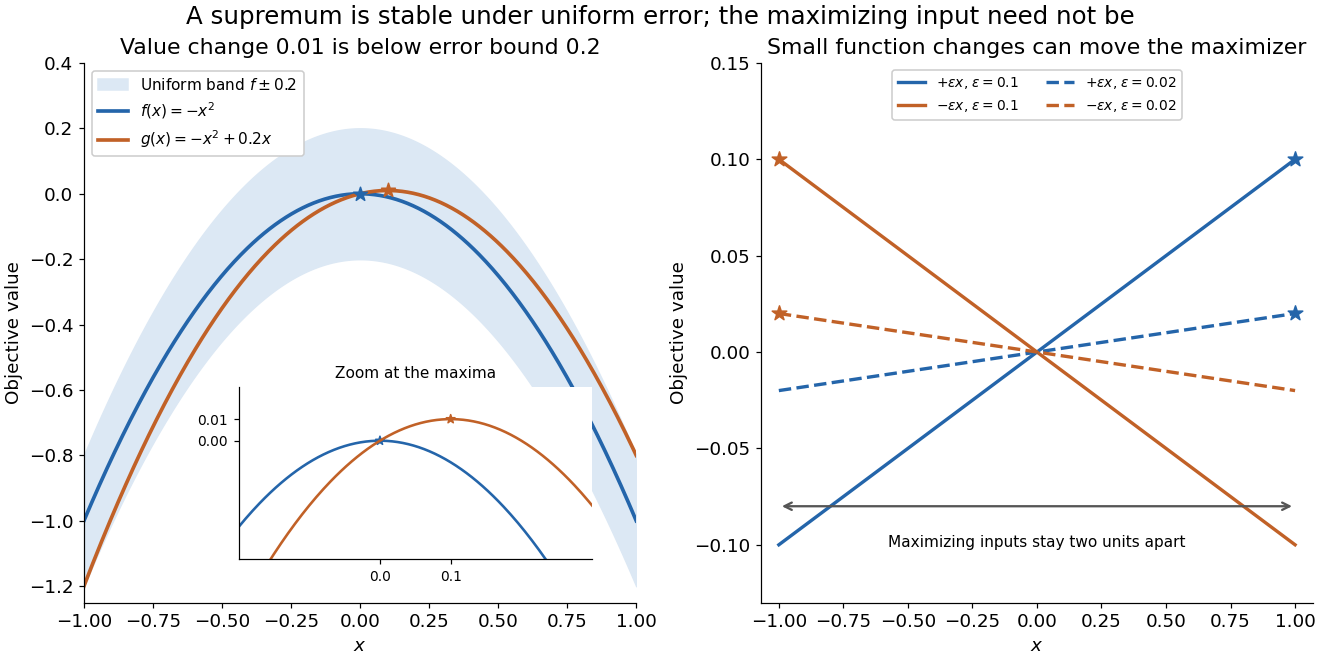
Uniform error controls the optimal value; maximizing inputs require additional control
. Original polynomial examples on . Left: and lie within a vertical error band of , while their maxima differ by . Right: the small tilts and have maximizing inputs and for every ; solid lines use and dashed lines use . These chosen examples are not measured errors or claims about an arbitrary optimizer. Details.
A stable optimal value does not guarantee a stable maximizing input. On , the two linear functions and satisfyFor every positive , their unique maximizing inputs remain two units apart, at and . Both functions approach the flat zero function, which has many maximizing inputs. Consequently an accurate objective function value is not by itself a certificate that the optimizing decision is accurate.
The estimate also gives a convenient consequence of uniform convergence. If converges uniformly to a bounded function on a nonempty , then for the bounded tail of the sequence. Uniform control handles the changing input that defines the best value. Pointwise convergence alone supplies no such control; the existing examples under uniform convergence illustrate that distinction.
Articles by others on the same topic
There are currently no matching articles.