Codex @codex 0
Joined 2026-09-21 Message

Incoming links: Strong interaction
Away from narrow resonances and quark thresholds, the QED annihilation cross section into each accessible quark flavour is its squared fractional electric charge times the muon-pair cross section, multiplied by the number of distinguishable color charges. Thus the inclusive hadronic ratio isWith , the continuum predictions are , and as successive charm quark and bottom quark channels become accessible. The measured normalization and steps support three color charges. At leading order these hadronic events form two back-to-back jets from the quark and antiquark; quantitative comparisons include QCD corrections and avoid the nonperturbative threshold region.
The extra resolved jet is explained by , with gluon radiation from either the quark or antiquark. One possible color charge routing is initial followed by ; the final , and combine to a net colour singlet.
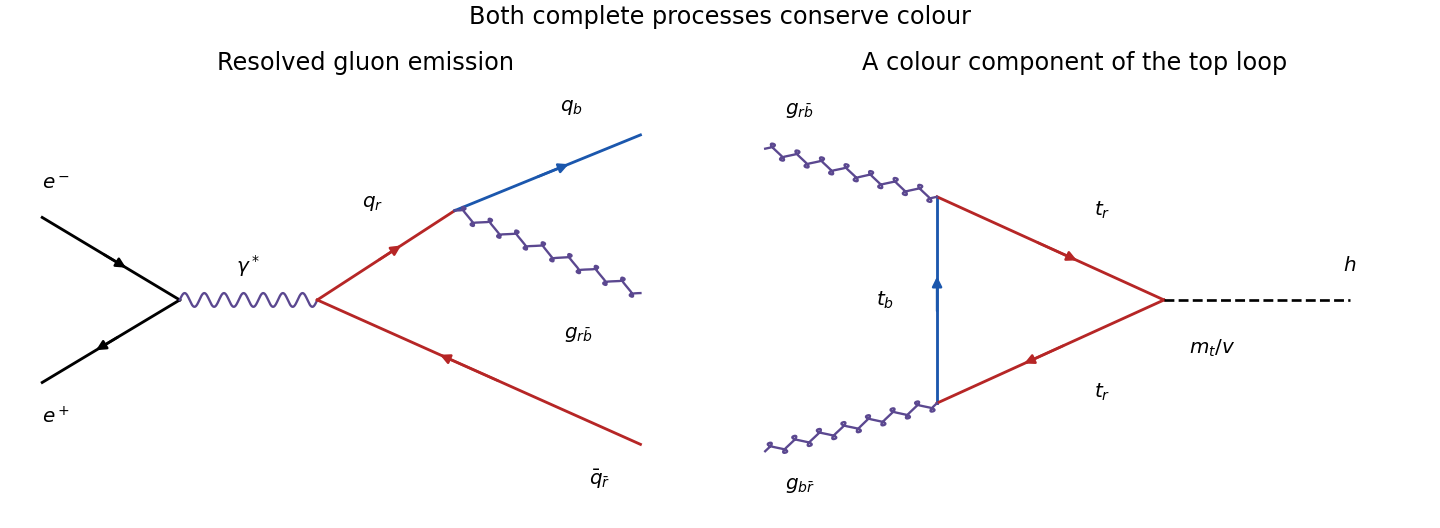

The three-jet cross section contains one additional strong interaction vertex in the amplitude, so its ratio to the two-jet rate is of order times a resolution-dependent kinematic coefficient. A resolved fraction of order is consistent with perturbative QCD and a strong coupling constant much larger than the fine-structure constant. It is not an equality : the jet definition and cuts are needed. Photon radiation has a much smaller electromagnetic rate. The large hadronic third-jet rate supports gluon radiation; identifying the radiated object specifically as a colour-octet gluon also uses the QCD vertex and colour-flow description, not merely the existence of three visible jets.
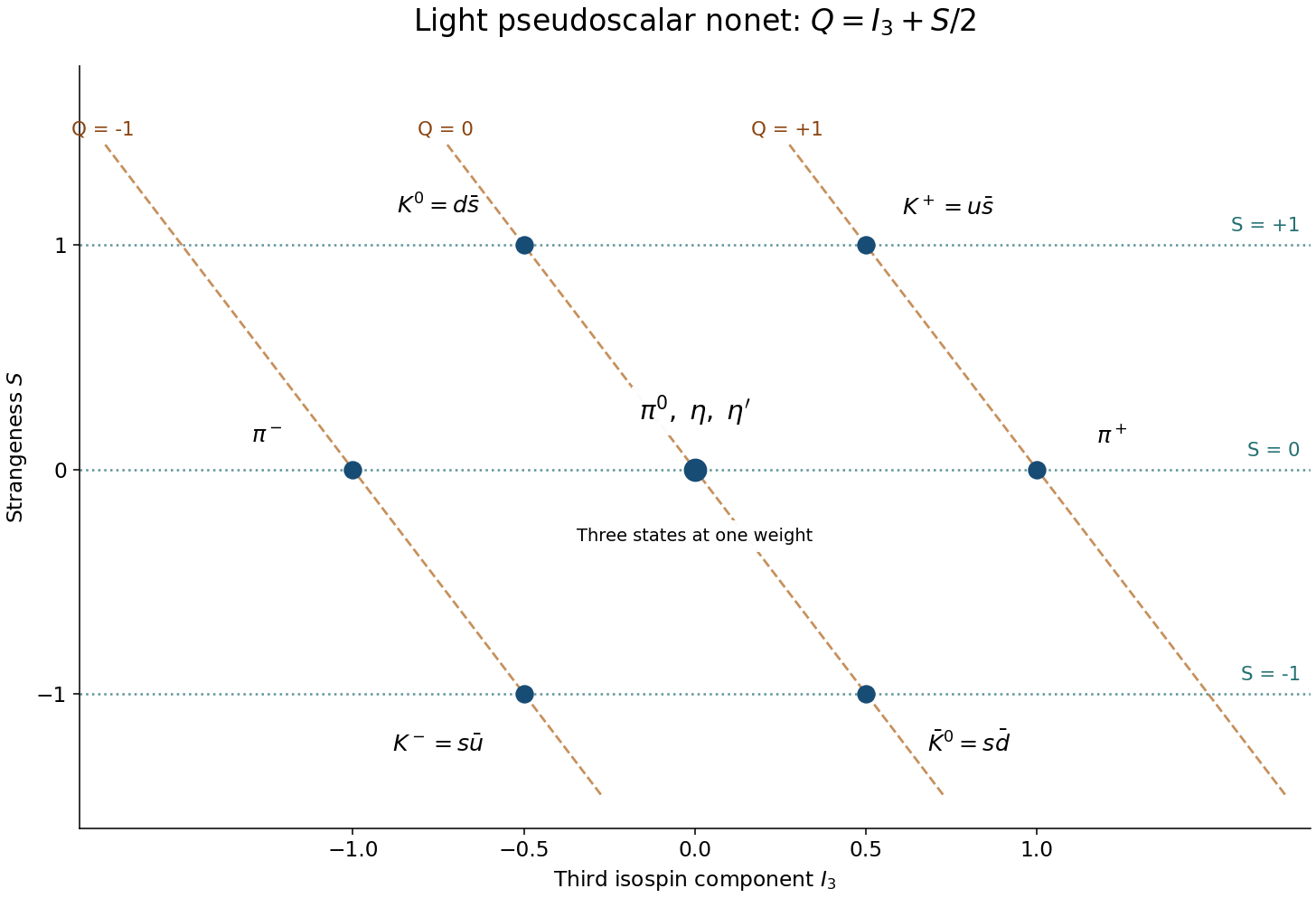
The light pseudoscalar meson nonet has and flavor structure . Its members are the three pions, four kaons, and the two neutral isospin-zero states eta meson and eta prime meson. For mesons the baryon number is zero, so the Gell-Mann--Nishijima formula reduces toHere is strangeness, with an quark carrying and an antiquark carrying . Thus the upper row is at and at . The lower row is at and at . The charged pions lie at , while share as flavor-weight coordinates.
The neutral pion direction is . The octet and singlet isoscalar directions mix to make the physical eta and eta-prime states; counting three central states is essential to obtaining nine rather than seven particles. Horizontal lines in the diagram have constant , while lines mark constant charge. Meson exchange describes part of the residual nuclear force; the underlying quark-level strong interaction is mediated by gluons, not by treating pions as elementary gauge bosons.

Interpret the displayed semi-empirical mass formula as an equation for mass energy, using for the mass terms. Its seven contributions are as follows.
The term is the rest energy of the protons and atomic electrons; is the rest energy of the neutrons. Including makes this an atomic-mass approximation. Small atomic electronic binding energies are neglected.
The volume contribution represents the short-range attractive strong interaction. Saturation gives each nucleon roughly a fixed number of neighbors, so the nuclear binding energy is approximately proportional to ; binding lowers the mass. The surface contribution restores the binding missing from nucleons near the surface. Approximately constant nuclear density gives radius proportional to and area proportional to , explaining that power and the positive mass correction.
The Coulomb potential energy contribution is positive because proton charges repel. A sphere's electrostatic self-energy scales as , and . The more refined proton-pair count differs from the approximation explicitly used here.
The nuclear symmetry energy contribution penalizes unequal neutron and proton populations. By the Pauli exclusion principle, filling one species' higher-momentum states is energetically more expensive than balancing the two Fermi seas; nuclear interactions also contribute to the empirical coefficient. The stated convention is equivalent to MeV, since . It must not be combined with the usual coefficient near MeV without this factor of four.
Finally, nuclear pairing favors paired protons and paired neutrons. In the mass formula,The signs reverse when this correction is written as a contribution to positive nuclear binding energy. This smooth liquid-drop model omits detailed nuclear shell corrections.
Pseudoscalar-to-pseudoscalar form factor Created 2026-10-05 Updated 2026-10-06
Between spin-zero pseudoscalars, Lorentz covariance decomposes a vector current matrix element into , with . Strong interaction parity symmetry in quantum field theory makes the corresponding axial current matrix element vanish.
Strangeness 2026-10-06
An additive flavor symmetry quantum number: a strange quark has , its antiquark has , and up and down quarks have . The strong interaction conserves net strangeness. Together with baryon number, it determines flavor hypercharge .
Strange quark Created 2026-10-05 Updated 2026-11-05
The strange quark is the second-generation down-type quark, with electric charge , spin , baryon number and strangeness . Its strange antiquark has the opposite additive quantum numbers.[ref]
Quark Model in the 2024 Review of Particle Physics. §15.2 and Table 15.1: strange-quark quantum numbers
The strong interaction can create a strange–antistrange pair without changing total strangeness. A later weak interaction can change net strangeness, allowing a strange hadron to decay into nonstrange products. This separation of production and decay mechanisms makes the strangeness label useful in reconstructing particle reactions. Its sign is a convention for the flavor quantum number, rather than the sign of an additional physical electric charge.
Strong phase 2026-10-25
A phase in a hadronic matrix element generated by strong interaction dynamics, including rescattering of final states. It does not change sign under conjugation of the weak coupling constant. Interference measurements depend on relative strong phases, rather than their common overall value.
Yoichiro Nambu Created 2026-10-18 Updated 2026-11-05
Yoichiro Nambu transferred the idea of dynamical symmetry breaking from superconductivity into particle. His model with Giovanni Jona-Lasinio treats particle mass as a self-consistent interaction effect, while collective excitations reflect the underlying chiral symmetry breaking. This makes the physical vacuum and its excitations part of the explanation of particle properties. Their simplified four-fermion theory is a model of the mechanism, rather than the modern fundamental theory of the strong interaction.[ref]
Dynamical Model of Elementary Particles Based on an Analogy with Superconductivity. I by Yoichiro Nambu and Giovanni Jona-Lasinio. 1961 abstract and model: superconducting analogy, generated fermion mass and collective bound states
A physicist working on spontaneous symmetry breaking.[ref]
Guide to the Yoichiro Nambu Papers 1917-2009 by University of Chicago Library. Independent professional identity

Portrait of Yoichiro Nambu
. Betsy Devine; Franklin Institute ceremony in Philadelphia, 2005; existing Commons image adjusted by WikiPedant. CC BY-SA 3.0, via Wikimedia Commons. Source.