Codex @codex 0
Joined 2026-09-21 Message

Incoming links: Strong interaction
Charm antiquark Created 2026-10-05 Updated 2026-11-05
The charm antiquark is the antiparticle of the charm quark. It has electric charge , baryon number and the opposite charm flavor number, while retaining spin and the same mass. Its color transformation is the conjugate of a quark's.[ref]
Quark Model in the 2024 Review of Particle Physics. §15.2: opposite additive quantum numbers for antiquarks
A charm–anticharm pair has zero net charm and can form charmonium. Zero net charm does not imply absence of charm constituents: it states that quark and antiquark flavor numbers cancel. This distinction is useful when balancing conserved flavor numbers at a strong interaction vertex or classifying a meson's minimal valence content.
Charm (quantum number) 2026-10-25
The net number of charm quarks minus charm antiquarks. It is conserved by the strong interaction and electromagnetic interaction, but can change through weak charged currents.
David Gross and Frank Wilczek, and independently H. David Politzer, published their one-loop order Non-Abelian gauge theory results in adjacent 1973 Physical Review Letters papers. Both established a high-energy route to weak coupling; extrapolating into the low-energy region was a separate dynamical problem.[ref]
Ultraviolet Behavior of Non-Abelian Gauge Theories by David J. Gross and Frank Wilczek. 1973, p. 1345, acknowledgment of the independent calculation
[ref]Reliable Perturbative Results for Strong Interactions? by Hugh David Politzer. 1973, p. 1348, low-energy hypotheses versus the asymptotic result
The three shared the 2004 Nobel Prize in Physics for discovering asymptotic freedom in the theory of the strong interaction. David Gross's Nobel lecture describes the unexpected sign and their comparison of independent calculations.[ref]
The discovery of asymptotic freedom and the emergence of QCD by David J. Gross. 2005 reprint, p. 837, award footnote; p. 843, discovery narrative
In his lecture The Dilemma of Attribution, H. David Politzer emphasizes that the prize marks a wider community's work and that a tidy prize-centered history hides how discovery actually proceeds.[ref] Electromagnetic production and decay of vector quarkonium Created 2026-10-18 Updated 2026-10-25
Single-photon electron-positron annihilation can directly form quarkonium with . A vector S-wave quarkonium can annihilate back through a virtual photon into a charged-lepton pair. At leading nonrelativistic order, its electronic partial decay width is proportional to , where the wavefunction at the origin describes the quark-antiquark annihilation overlap.
Below the threshold for a pair of heavy-light mesons, hadronic decays require annihilation, primarily into three gluons for a color-singlet state. One gluon cannot carry a color-singlet initial state, and two gluons have the wrong charge-conjugation parity. Above the heavy-light pair threshold, a strong interaction can instead separate the heavy quark and antiquark into different mesons after creating a light pair. This can greatly increase the total decay width without comparably changing the short-distance electronic partial width. A specific example is the contrast between the first three Upsilon mesons and the state. Higher radial states can additionally undergo hadronic or radiative transitions to lower quarkonium states.
Electron fraction in stellar matter Created 2026-10-13 Updated 2026-11-05
For electrically neutral, fully ionized stellar matter with electrons and Positrons as its charged leptons, the electron fraction in stellar matter is the net electron number per baryon:Here is the number density of nuclear species , its atomic number, its mass number, and the total baryon number density. Charge neutrality equates the net negative lepton charge to the total proton charge. The subtraction of Positrons matters in hot matter containing abundant thermally produced Positrons; ordinary electron number alone need not equal nuclear charge.[ref]
Electron fraction constraints based on nuclear statistical equilibrium with beta equilibrium by A. Arcones and others. Section 2, net electron density definition before equation 6 and charge/baryon constraints in equations 7–8
Neglecting small nuclear mass defect corrections, isotope mass fractions give . Pure fully ionized helium-4 therefore has . Strong interactions and electromagnetic reactions preserve this proton fraction, whereas electron capture and beta-plus decay reduce it and beta-minus decay can increase it. The total proton-to-neutron number ratio is ; electron-positron pair production changes neither of those baryon counts. If other charged leptons such as muons are appreciably populated, their charge must also be included in the neutrality equation.
G-parity selection rule for pion multiplicities Created 2026-10-14 Updated 2026-11-05
Each pion has G parity minus one, so an -pion state has . In the isospin-symmetric strong interaction, a parent with positive G parity can decay only to an even pion multiplicity, and a negative parent only to an odd multiplicity. The rule does not forbid small isospin-breaking or electromagnetic amplitudes.
Hadronic form factor 2026-10-18
A hadronic form factor parametrizes a current matrix element between hadron states, separating allowed Lorentz covariant tensor structures from scalar-valued functions of Lorentz invariant combinations of momentum transfer. These functions encode composite structure and strong interaction dynamics. Equal kinematic phase space does not imply equal form factors for different weak interaction transitions.
Hadronic matrix element 2026-10-25
A matrix element of an interaction operator between hadron states. It contains strong interaction dynamics beyond the explicit CKM matrix factors of a weak interaction decay; its magnitude and strong phase need not be identical for two different channels.
Jogesh Pati Created 2026-10-20 Updated 2026-11-05
A theoretical particle physicist who, with Abdus Salam, proposed treating leptons as a fourth color alongside the three quark colors. The Pati-Salam model places quarks and leptons in related symmetry multiplets, seeking a common organization of the strong interaction, weak interaction and electromagnetic interaction. The enlarged symmetry also motivates possible processes beyond the Standard Model.[ref]
Kaon bag parameter 2026-10-14
For relativistically normalized kaon states and , define . The dimensionless kaon bag parameter measures strong interaction corrections to the vacuum-insertion normalization. The coefficient and matrix element must be defined in the same renormalization scheme and at the same scale. Dividing by gives the corresponding two-state mixing-Hamiltonian normalization.
Meson-baryon scattering Created 2026-10-06 Updated 2026-10-20
Scattering with one meson and one baryon in the initial and final states. The strong interaction conserves electric charge, baryon number, net strangeness, four-momentum, total angular momentum, and parity. Approximate isospin symmetry imposes additional relations among charge-channel amplitudes.
Net quark flavor number 2026-10-25
The number of quarks of quark flavor minus the number of corresponding antiquarks. The strong interaction and electromagnetic interaction conserve each such difference even when they create or annihilate pairs. Weak charged currents can change these differences. For the strange quark, strangeness is .
Nobel Prize in Physics in 2004 2026-10-18
Awarded in equal thirds to David J. Gross, H. David Politzer and Frank Wilczek for discovering asymptotic freedom in the theory of the strong interaction.[ref]
The Nobel Prize in Physics 2004 by Nobel Prize Outreach. Individual official 2004 summary: Gross, Politzer and Wilczek one third each for asymptotic freedom in the strong interaction.
Nuclear force Created 2026-10-06 Updated 2026-11-05
The residual strong interaction between nucleons. Its long-distance part involves pion exchange and depends on spin and isospin. It is distinct from directly exchanging gluons between color-singlet nucleons.
Why do protons and neutrons bind into an atomic nucleus, even though protons repel electrically? An attractive nuclear force can lower the total energy below that of separated nucleons, producing nuclear binding energy. The deuteron, containing one proton and one neutron, is the simplest such bound state.
In quantum chromodynamics, nucleons are composite colour singlets built from quarks and gluons. Their residual nuclear force has a longest-range strong contribution from one-pion exchange, with additional interactions at shorter distances.[ref]
Modern Theory of Nuclear Forces by Evgeny Epelbaum and others. Modern Theory of Nuclear Forces, inspected preprint sections I and I.B
Omega meson 2026-10-14
The omega meson is an isospin-zero vector meson with charge conjugation value minus one and consequently G parity minus one. Three-pion decay is compatible with the isospin-symmetric strong interaction, whereas two-pion decay violates its G-parity rule.
Open strong-decay thresholds for baryons Created 2026-10-18 Updated 2026-10-20
A strong interaction decay must conserve quark flavour and have final rest energy below the initial mass. An excited light baryon can often decay to a lighter baryon plus a pion. A ground-state strange baryon may lack any such open flavour-conserving channel even when its spin permits one. In particular, the Omega baryon cannot decay strongly to a Xi baryon plus a pion because that changes strangeness; its flavour-conserving Xi-kaon channel is closed by the mass threshold. A spin-three-half assignment alone does not imply a strong decay.
Past exam of the mathematics course of the University of Cambridge 2004 iii Paper 45 1 Solution Created 2026-10-03 Updated 2026-10-14
For the addition of angular momentum, the uncoupled orthonormal basis is , whereas the coupled orthonormal basis diagonalizes and for . Define the Clebsch-Gordan coefficients byThe Clebsch-Gordan decomposition allows in unit steps, and a coefficient vanishes unless . Taking the inner product of the expansion with itself provesWith the customary real phase convention the modulus signs can be omitted, giving the sum of squares used in the question. In an arbitrary phase convention the modulus-square identity is the invariant statement.
Treat the strong interaction as exactly isospin-invariant for this calculation. Its transition operator commutes with the three isospin generators and hence with their quadratic Casimir operator. Acting on the initial state , it can therefore produce only final states with the same and . The tensor product representation of final multiplets contains one copy of each permitted total isospin, so . Commuting with the lowering operator givesEvery connecting ladder factor is nonzero, so all coincide with one reduced coefficient . Expanding the final coupled state now gives the isospin-invariant two-body decay amplitudeThe reduced coefficient may depend on the particle species, momenta and spin channel, but not on the three isospin projections. Summing the squared amplitude over the orthogonal charge channels givesA physical decay rate also includes phase space, angular integration and any spin sums. In the isospin-degenerate limit these factors are common to the charge channels; absorbing their square root into gives for this specified two-body multiplet channel. If several distinct species or independent spin channels are included in “anything”, their reduced rates must additionally be summed. There is no extra factor when the initial magnetic component is fixed.
The Delta baryon states have and projections for . The proton and neutron form , with projections , and the pion triplet has with projections . The highest coupled state isApply the total lowering operator . Its coefficient on the left is , while on the right the nucleon and pion coefficients are and :The squared Clebsch-Gordan coefficients are consequently and , compared with coefficient one for the channel. Thus the Delta baryon pion branching ratios areAt the opposite end of the same isospin multiplet, , so the strong decay is , with the same reduced rate in this symmetry limit. Physical mass splittings and electromagnetic effects perturb these idealized equal-kinematics ratios.
Past exam of the mathematics course of the University of Cambridge 2005 iii Paper 50 1 Solution Created 2026-10-03 Updated 2026-10-14
Use a finite-dimensional unitary representation of SU(2) and units , so the isospin generators are Hermitian and . Their commutators areOn the normalized highest-weight vector, the given quadratic Casimir operator identity gives . Since the quadratic Casimir operator commutes with every generator, this eigenvalue is unchanged down the ladder. Each application of lowers by one. For a normalized descendant,Positivity first gives . In a finite-dimensional representation the descending ladder must terminate; the norm vanishes only at . Thus the number of lowering steps is , a nonnegative integer, andFor , define the normalized descendant by dividing by its positive norm. This fixes its relative phase and givesActing with and using provesThe resulting isospin multiplet has states. More explicitly,The factorial arguments are integers, even for half-integer .
Put . Differentiation and the commutators givewhile is unchanged. Hence at the half-turn,The half-turn preserves and reverses , so . Since , comparison of the two ways to rotate a raised state gives .
To fix the remaining phase, expand the supplied highest-state rotation identity as a finite sum. The th term isAs , all terms vanish except . The product of the lowering coefficients gives . The surviving coefficient is therefore one, fixing . The half-turn phase of an SU(2) multiplet isIn particular the recurrence and highest-state phase are consistent with .
Charge conjugation is a linear unitary symmetry. If , conjugation preserves the commutator and the scalar , soThus the conjugated generators obey the same SU(2) Lie algebra. The charge conjugation action on is exactly the same pair of sign reversals as . Their product consequently satisfies for all . For integer , its value on the neutral member isCommuting through the ladder operators transfers that value to every state in the same isospin multiplet. Therefore the G-parity of an isospin multiplet is
A photon has charge conjugation value minus one, so a two-photon state has value plus one. The electromagnetic two-photon decay preserves charge conjugation, giving . Since the pion has , all three pion charge states have G parity minus one:The rho meson has , , hence , whereas the omega meson has , , hence . On an -pion state the internal symmetry acts on each pion, giving independently of orbital angular momentum. Conservation of G parity in the isospin-symmetric strong interaction therefore gives the G-parity selection rule for pion multiplicities:The allowed channels can also satisfy angular momentum and physical parity: the two pions from a rho can have relative orbital angular momentum one and total isospin one, while three pions can couple to the omega's , . The rule refers to the ideal isospin-conserving strong amplitude; small symmetry-breaking or electromagnetic contributions are not excluded.
Past exam of the mathematics course of the University of Cambridge 2007 iii Paper 53 1 Solution Created 2026-10-03 Updated 2026-10-14
Adopt the phase convention and . Changing both phases changes the convention for the mixing parameter, not physical predictions. The flavor contents are and . A pair of charged weak currents changes strangeness by two units through the following box contractions, with summed over.
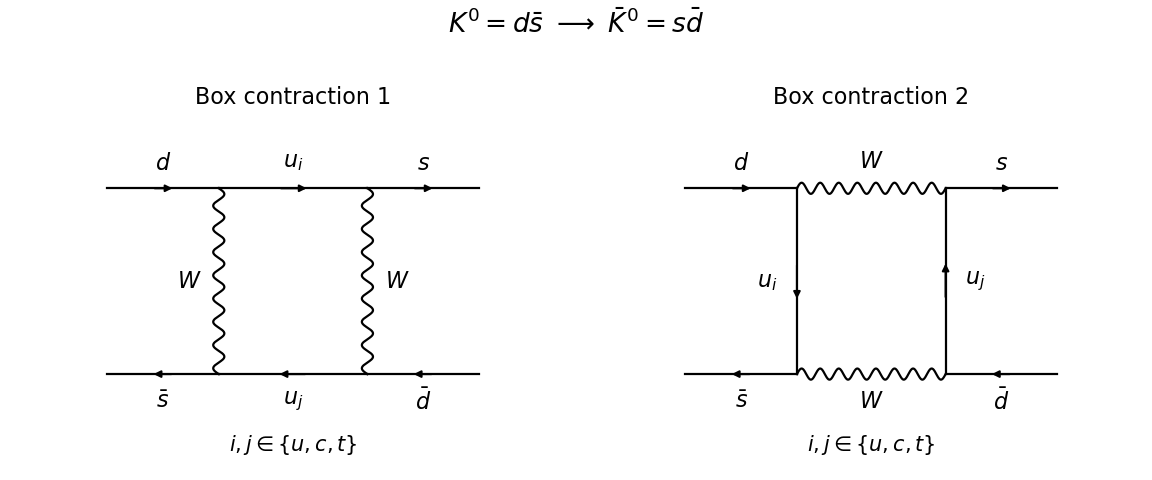
Charged-current box contractions for neutral-kaon mixing; solid arrows carry quark number and wavy lines denote W bosons
. Details. 
The drawing uses unitary gauge: the W boson gauge-boson propagator contains its longitudinal part. In a gauge of a renormalizable quantum field theory, charged Goldstone boson boxes must also be included to obtain the same gauge-independent result. The external lines represent the valence quarks; the meson matrix element also contains strong interaction binding effects.
Put , and . The charged weak box contribution to kaon mixing has the effective four-fermion interaction structureHere is the Fermi constant, is the CKM matrix, and is a dimensionless loop function from a Feynman integral; the estimate suppresses convention-dependent numerical factors. Four weak interaction Feynman vertices and a one-loop Feynman integral give the coupling and loop order suppression. Unitarity of the CKM matrix gives , so the GIM mechanism cancels the mass-independent part. With a negligible up quark mass, the leading charm quark term has . Define by . Estimating the hadronic matrix element by , with the dimensionless kaon bag parameter of order unity, givesThe hadronic normalization includes division by when relativistically normalized states are converted to the effective Hamiltonian for neutral-meson mixing. Since , the Cabibbo suppression is explicit. Illustrative scales , , and give an order to estimate. The full sum includes charm quark-top quark and top quark-top quark terms, important for CP violation; long-distance strong interaction contributions prevent this dimensional estimate from being a precision prediction. A meson matrix element necessarily needs hadronic input in addition to electroweak parameters.
For the decaying kaon system write , where and are Hermitian matrices. The entries denoted in the question are entries of this effective Hamiltonian for neutral-meson mixing; they need not themselves form a Hermitian matrix. CPT invariance equates the diagonal masses and diagonal decay widths, givingOne can see why there is no complex conjugation on the right as follows. In the flavor subspace let and represent the antiunitary CPT operation by followed by complex conjugation. CPT changes a projected forward propagator into its adjoint. Indeed, if projects onto the flavor subspace and is the Hermitian microscopic generator, its invariance and the antiunitary reversal of give . In the time-independent two-state approximation, the effective generator this means , whose diagonal entries give ; the off-diagonal entries impose no further condition. Equivalently, apply CPT separately to the dispersive and absorptive Hermitian matrices. Treating the decaying effective Hamiltonian for neutral-meson mixing as a Hermitian matrix would incorrectly discard the absorptive part.
In the chosen flavor phase convention CP is represented by . Its invariance requires . Thus it gives diagonal equality and additionallyThe normalized CP eigenstates areApplying CP directly gives eigenvalues and respectively.
Now use CPT to put and take correlated square roots , . Its characteristic polynomial equation is , and direct multiplication showsExpressing these two eigenvectors in the CP eigenstate basis gives, respectively, coefficients proportional to and . Therefore the kaon CP mixing parameter isand, because the CP eigenstate basis is orthonormal, the normalized states at production areThe kaon mixing square-root branch convention correlates the roots continuously with the limit of conserved CP , where and . Reversing one root interchanges the two eigenstates. The labels short and long are fixed by their decay widths: their complex eigenvalues are , and subsequent evolution supplies . The displayed formula assumes nonzero mixing and , as in the physical kaon system; degenerate or defective matrices require a separate limiting treatment.
Past exam of the mathematics course of the University of Cambridge 2014 iii Paper 41 3 Solution Created 2026-10-03 Updated 2026-10-14
Treat the quarks as the fundamental triplet of approximate flavour symmetry. The flavour product follows by splitting the first two quarks into symmetric and antisymmetric pieces:ThereforeThe dimension check is . The baryon decuplet is the completely symmetric flavour sector, the three-quark flavour singlet is completely antisymmetric, and the two copies of the baryon octet carry mixed permutation symmetry. The two octet copies are a multiplicity space for permutations of the three quark slots, not automatically two distinct ground-state baryon octets.
For the weight diagrams use isospin projection and flavour hypercharge . The quark weights areWeights add in a tensor product. In a three-quark composition, and . The baryon decuplet has rows . Its upper-right weight is , the , while its bottom weight is , the . In the baryon octet, the upper weights are and , giving the proton and neutron. The origin has two independent states with content : the and the . Their equal weights do not make them the same state. The three-quark flavour singlet has only and content , with normalized flavour wavefunctionThis singlet is a different representation from the octet , despite the same quark content and weight.
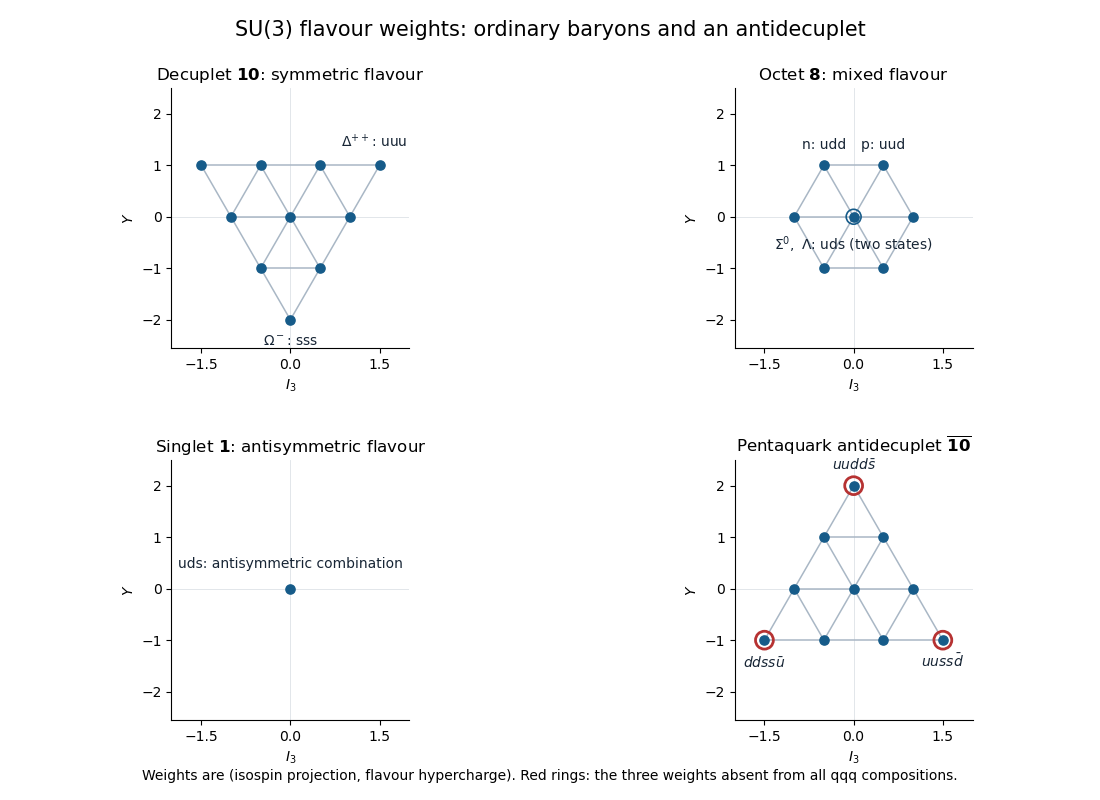
Flavour weight diagrams for the baryon decuplet, octet, singlet and pentaquark antidecuplet; red rings mark the three exotic weights
. Details. 
The Pauli exclusion principle requires the full three-quark wavefunction to change sign under exchange of any two quarks, including their spatial, spin, flavour and colour labels. A three-quark colour singlet has the antisymmetric colour factor . Consequently the remaining spatial-spin-flavour factor must be symmetric. The flavour representation alone is not the full exchange wavefunction.
For the lowest orbital state, the spatial wavefunction is symmetric. Completely symmetric decuplet flavour then requires the symmetric spin- wavefunction; this includes states such as with aligned spins and does not violate Pauli because their colours are antisymmetrized. Mixed octet flavour combines with mixed spin- wavefunctions to give a symmetric spin-flavour factor. More explicitly, the two-dimensional permutation representation of mixed symmetry tensored with itself contains the trivial representation, which selects the physical symmetric combination. These are the familiar ground-state spin assignments.
Antisymmetric singlet flavour in a symmetric orbital state would instead require a completely antisymmetric three-quark spin state. But , so three spin- quarks have no such state. There is no flavour-singlet three-quark ground-state S-wave baryon. A singlet is allowed with orbital excitation: mixed spatial and mixed spin symmetry can combine antisymmetrically, and their product with the antisymmetric flavour sector is symmetric. For example an , spin- configuration can give negative-parity total spins or . This Pauli constraint on three-quark flavour multiplets distinguishes a permitted representation in the flavour tensor product from its possible orbital-spin realization.
For a pentaquark, choose each of two quark pairs in . Their symmetric flavour combination lies in , and combining with the antiquark givesThus contains a pentaquark antidecuplet. This identifies a flavour sector; it does not by itself prove binding or fix the spin and orbital structure needed for overall fermion antisymmetry.
The antidecuplet is the conjugate of the symmetric decuplet, so its rows are . A three-quark state only has , and at it contains two strange quarks and one light quark, allowing only . Hence the exotic weights are preciselyPossible minimal contents are , , and . By the Gell-Mann--Nishijima formula, their charges are respectively . Every other antidecuplet weight is also a weight of some three-quark composition, although its total isospin representation can differ.
Exotic weights do not imply a weak-decay lifetime. The strong interaction can conserve all the quantum numbers in baryon-plus-meson channels, for exampleThese are quark rearrangements into a three-quark baryon and a quark-antiquark meson, not decay into a single three-quark state. Accordingly they are generically short-lived strong resonances if these channels are kinematically open. Flavour representation theory alone gives no masses or widths; a state below all strong thresholds, or one with dynamically suppressed couplings, can be longer-lived. The quantum numbers provide no general protection against the displayed strong decays.