Consider one chosen model at a fixed total energy, with two open scattering channels, no absorption and no omitted outgoing modes. Channel 1 leaves the target unchanged; channel 2 excites it. Let and . For the same projectile mass, conservation of energy then requires a target excitation . These are hypothetical parameters, not a fit to a particular atom. Each incoming or outgoing mode is normalized to unit probability current; the outgoing modes will have the angular profiles specified below.
Choose the S-matrixThis phenomenological unitary matrix specifies the channel conversion; it is not derived here from an interaction potential energy. For incidence in channel 1, its first column gives the outgoing flux amplitudesTo recover ordinary wave coefficients relative to an incident coefficient one, undo the velocity normalization:Thus is allowed: channel 2 travels more slowly. Its outgoing probability current fraction is , not . Renormalizing the unweighted squares would give and , the wrong probabilities. More generally the ordinary coefficient map is , with ; it obeys . The conserved quantity is the squared coefficient norm weighted by velocity, which represents probability current.
Now specify an original angular realization of these two outgoing modes, with scattering angle and no azimuth dependence:The first normalization follows from , where . These angular profiles define the modes of this model; they are not asserted to follow from Born's approximation or an atomic potential energy. The joint directional probability densities are
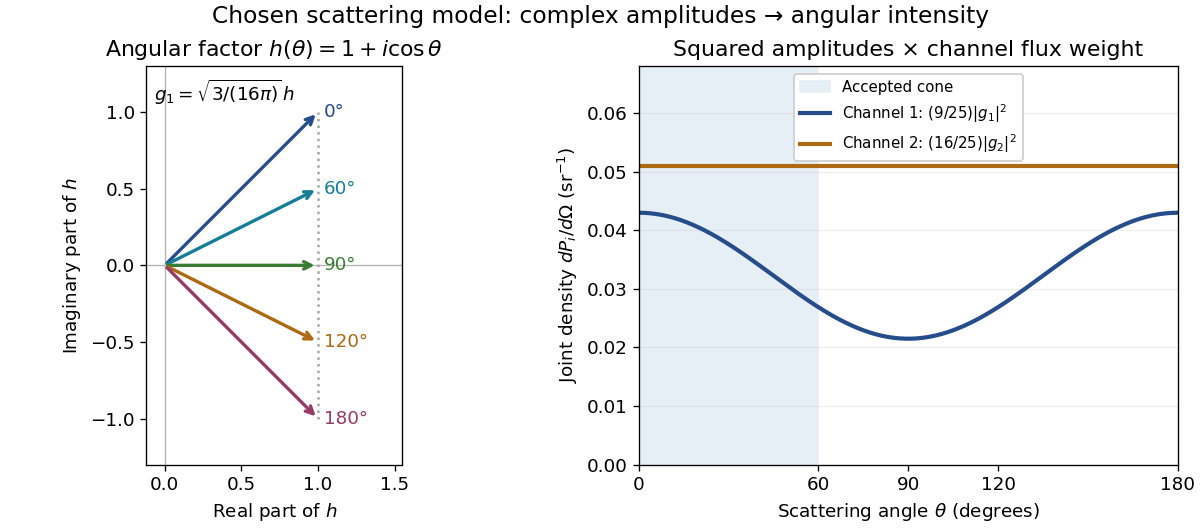
Complex angular amplitudes become channel-resolved scattering intensity
. Original two-channel model. Left: arrows in the complex plane show , the angular factor of . Right: the joint directional probability densities , per solid angle, retain the channel flux weights and . The shaded interval is the cone ; its probability requires the measure , not the area under a curve against degrees. These are chosen amplitudes, not historical measurements. Source. Details.
Suppose a detector accepts the cone , with full azimuth and unit efficiency. Its angular fractions within the channels areMultiplying the angular fractions by the outgoing flux weights givesFor independent incident events, the expected values are therefore and accepted detections, compared with and over all directions. The remaining expected events fall outside the cone. The chosen incident number makes the expectations integers; actual counts fluctuate. Conditional on a detection inside the cone, the channel probabilities are and , rather than and . Angular acceptance changes the observed channel proportions even with equal detector efficiencies.
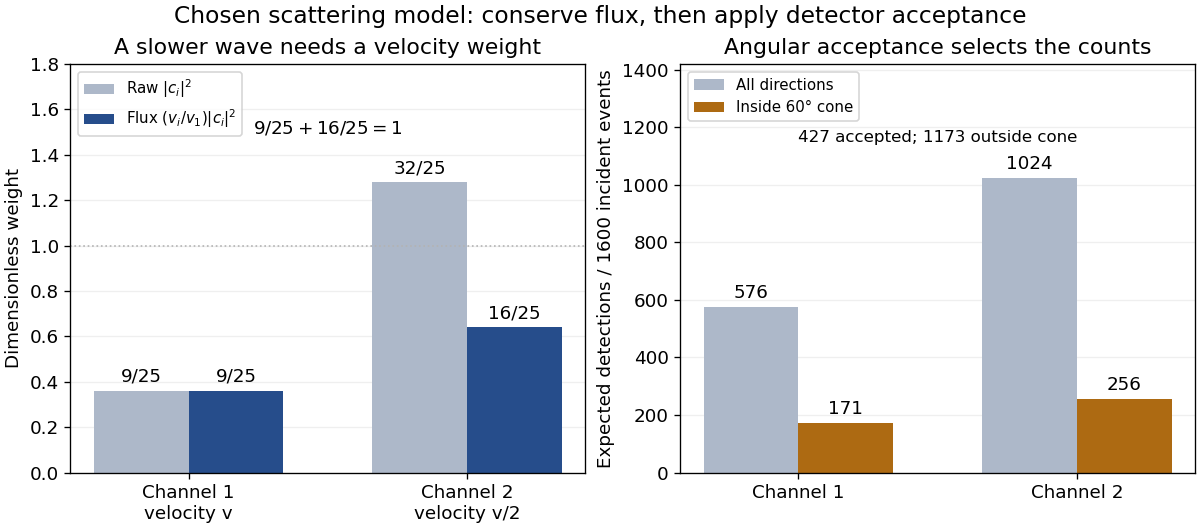

The final atomic states are orthogonal, so ignoring the atomic readout adds the two channel intensities; it does not produce . Coherent paths that reach the same final state can instead interfere, as the existing probability amplitude and quantum superposition examples demonstrate. The distinction is physical distinguishability of final states, not whether the detector operator chooses to display their labels. Flux normalization and angular integration make the scattering interpretation useful: they turn complex outgoing waves into conserved event weights and then into the statistics of a specified detector.
Articles by others on the same topic
There are currently no matching articles.