
As of my last knowledge update in October 2023, there is no widely recognized individual or entity named Anton Sushkevich. It is possible that Anton Sushkevich could refer to a private individual or a lesser-known figure in a specific field, such as business, academia, or arts, but without additional context, it is difficult to provide specific information.
As of my last knowledge update in October 2021, Archibald Read Richardson did not refer to a widely recognized person or concept. It might be a specific individual's name or could refer to a lesser-known entity or subject that hasn't gained significant public attention. If it's something that emerged more recently, I may not have information on it.
As of my last knowledge update in October 2021, there is no widely recognized public figure, event, or entity by the name "Bethany Rose Marsh." It's possible that she could be a private individual or that new developments have occurred since then. If Bethany Rose Marsh has emerged as a notable figure or topic after my last update, I would not have that information. You may want to check the latest news or sources for the most current information.
A vacuum is a space that is essentially devoid of matter, meaning it has very low pressure and density, and contains very few particles, such as atoms or molecules. In an ideal vacuum, there would be no air or any other substances; however, achieving a perfect vacuum is practically impossible. In physics, vacuums are often described in terms of pressure, with standard atmospheric pressure at sea level being about 101,325 pascals (or 1 atmosphere).
lspci00:00.0 Host bridge: Intel Corporation Xeon E3-1200 v6/7th Gen Core Processor Host Bridge/DRAM Registers (rev 05)
00:01.0 PCI bridge: Intel Corporation 6th-10th Gen Core Processor PCIe Controller (x16) (rev 05)
00:08.0 System peripheral: Intel Corporation Xeon E3-1200 v5/v6 / E3-1500 v5 / 6th/7th/8th Gen Core Processor Gaussian Mixture Model
00:14.0 USB controller: Intel Corporation 100 Series/C230 Series Chipset Family USB 3.0 xHCI Controller (rev 31)
00:14.2 Signal processing controller: Intel Corporation 100 Series/C230 Series Chipset Family Thermal Subsystem (rev 31)
00:15.0 Signal processing controller: Intel Corporation 100 Series/C230 Series Chipset Family Serial IO I2C Controller #0 (rev 31)
00:16.0 Communication controller: Intel Corporation 100 Series/C230 Series Chipset Family MEI Controller #1 (rev 31)
00:17.0 SATA controller: Intel Corporation Q170/Q150/B150/H170/H110/Z170/CM236 Chipset SATA Controller [AHCI Mode] (rev 31)
00:1c.0 PCI bridge: Intel Corporation 100 Series/C230 Series Chipset Family PCI Express Root Port #1 (rev f1)
00:1c.2 PCI bridge: Intel Corporation 100 Series/C230 Series Chipset Family PCI Express Root Port #3 (rev f1)
00:1c.4 PCI bridge: Intel Corporation 100 Series/C230 Series Chipset Family PCI Express Root Port #5 (rev f1)
00:1d.0 PCI bridge: Intel Corporation 100 Series/C230 Series Chipset Family PCI Express Root Port #9 (rev f1)
00:1d.4 PCI bridge: Intel Corporation 100 Series/C230 Series Chipset Family PCI Express Root Port #13 (rev f1)
00:1f.0 ISA bridge: Intel Corporation CM238 Chipset LPC/eSPI Controller (rev 31)
00:1f.2 Memory controller: Intel Corporation 100 Series/C230 Series Chipset Family Power Management Controller (rev 31)
00:1f.3 Audio device: Intel Corporation CM238 HD Audio Controller (rev 31)
00:1f.4 SMBus: Intel Corporation 100 Series/C230 Series Chipset Family SMBus (rev 31)
00:1f.6 Ethernet controller: Intel Corporation Ethernet Connection (5) I219-LM (rev 31)
01:00.0 VGA compatible controller: NVIDIA Corporation GM107GLM [Quadro M1200 Mobile] (rev a2)
01:00.1 Audio device: NVIDIA Corporation GM107 High Definition Audio Controller [GeForce 940MX] (rev a1)
04:00.0 Network controller: Intel Corporation Wireless 8265 / 8275 (rev 78)
3e:00.0 Non-Volatile memory controller: Samsung Electronics Co Ltd NVMe SSD Controller SM981/PM981/PM983
3f:00.0 Unassigned class [ff00]: Realtek Semiconductor Co., Ltd. RTS525A PCI Express Card Reader (rev 01)lspci -t-[0000:00]-+-00.0
+-00.2
+-01.0
+-02.0
+-02.1-[01]----00.0
+-02.2-[02]----00.0
+-02.4-[03]----00.0
+-03.0
+-04.0
+-04.1-[04-63]--
+-08.0
+-08.1-[64]--+-00.0
| +-00.1
| +-00.2
| +-00.3
| +-00.4
| +-00.5
| \-00.6
+-08.2-[65]--+-00.0
| \-00.1
+-08.3-[66]--+-00.0
| +-00.3
| +-00.4
| \-00.6
+-14.0
+-14.3
+-18.0
+-18.1
+-18.2
+-18.3
+-18.4
+-18.5
+-18.6
\-18.7Linux on SSH and bare metal blinker both work on this board, so the rest of the board seems alive.
Serial from
cat /proc/cpuinfo: 00000000c77ddb77Datasheets: Raspberry Pi 3.
This is a major feature: we have now started to inject the following buttons next to every single pre-rendered header:
This crucial feature makes it clear to every new user that every single header has its own separate metadata, which is a crucial idea of the website.
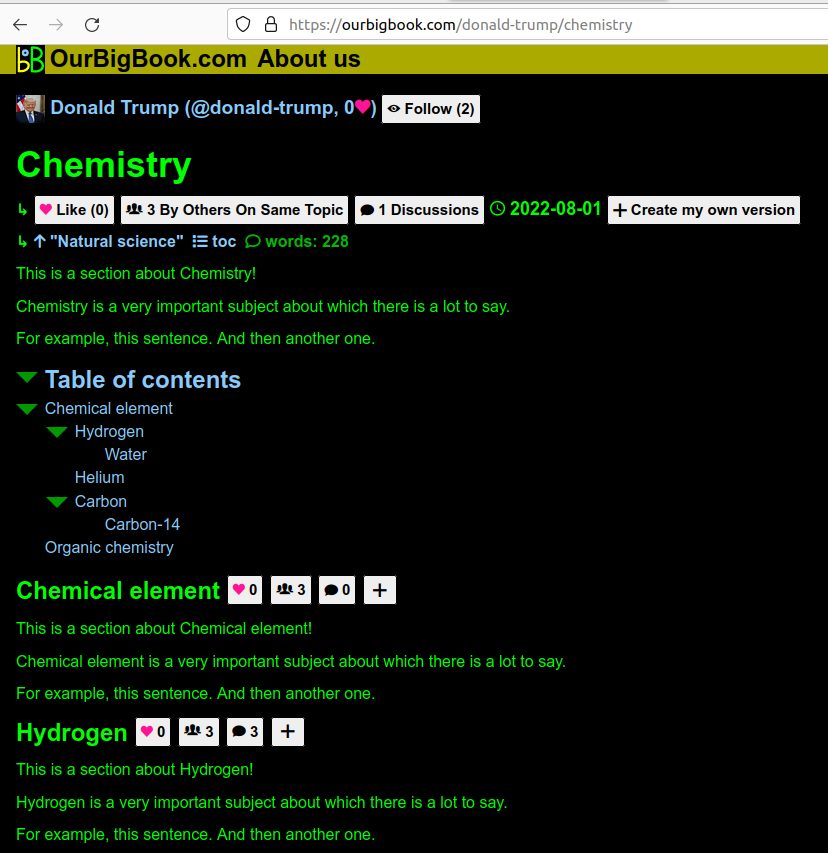
Screenshot showing metadata next to each header
. The page is: ourbigbook.com/donald-trump/chemistry. Note how even the subheaders "Chemical element" and "Hydrogen" show the metadata. Ciro's Edict #4 Enable reference features into ourbigbook.com by  Ciro Santilli 40 Updated 2025-07-16
Ciro Santilli 40 Updated 2025-07-16The opposite of from first principles.
Unit of mass.
Defined in the 2019 redefinition of the SI base units via the Planck constant. This was possible due to the development of the Kibble balance.
Pinned article: Introduction to the OurBigBook Project
Welcome to the OurBigBook Project! Our goal is to create the perfect publishing platform for STEM subjects, and get university-level students to write the best free STEM tutorials ever.
Everyone is welcome to create an account and play with the site: ourbigbook.com/go/register. We belive that students themselves can write amazing tutorials, but teachers are welcome too. You can write about anything you want, it doesn't have to be STEM or even educational. Silly test content is very welcome and you won't be penalized in any way. Just keep it legal!
Intro to OurBigBook
. Source. We have two killer features:
- topics: topics group articles by different users with the same title, e.g. here is the topic for the "Fundamental Theorem of Calculus" ourbigbook.com/go/topic/fundamental-theorem-of-calculusArticles of different users are sorted by upvote within each article page. This feature is a bit like:
- a Wikipedia where each user can have their own version of each article
- a Q&A website like Stack Overflow, where multiple people can give their views on a given topic, and the best ones are sorted by upvote. Except you don't need to wait for someone to ask first, and any topic goes, no matter how narrow or broad
This feature makes it possible for readers to find better explanations of any topic created by other writers. And it allows writers to create an explanation in a place that readers might actually find it.
Figure 1. Screenshot of the "Derivative" topic page. View it live at: ourbigbook.com/go/topic/derivativeVideo 2. OurBigBook Web topics demo. Source. - local editing: you can store all your personal knowledge base content locally in a plaintext markup format that can be edited locally and published either:This way you can be sure that even if OurBigBook.com were to go down one day (which we have no plans to do as it is quite cheap to host!), your content will still be perfectly readable as a static site.
- to OurBigBook.com to get awesome multi-user features like topics and likes
- as HTML files to a static website, which you can host yourself for free on many external providers like GitHub Pages, and remain in full control

Figure 3. Visual Studio Code extension installation.
Figure 4. Visual Studio Code extension tree navigation.
Figure 5. Web editor. You can also edit articles on the Web editor without installing anything locally.Video 3. Edit locally and publish demo. Source. This shows editing OurBigBook Markup and publishing it using the Visual Studio Code extension.Video 4. OurBigBook Visual Studio Code extension editing and navigation demo. Source. 
- Infinitely deep tables of contents:


All our software is open source and hosted at: github.com/ourbigbook/ourbigbook
Further documentation can be found at: docs.ourbigbook.com
Feel free to reach our to us for any help or suggestions: docs.ourbigbook.com/#contact