"Ion" can refer to several different concepts depending on the context: 1. **Chemistry**: In scientific terms, an ion is an atom or molecule that has a net electrical charge due to the loss or gain of one or more electrons. Ions can be either positive (cations) if they have lost electrons, or negative (anions) if they have gained electrons. Ions play a crucial role in various chemical reactions and processes, including those in biological systems.
Articles by others on the same topic

An ion is a chemical atom or a group of chemical atoms with a nonzero net electric charge. A positive ion is a cation; a negative ion is an anion. The whole entity carries the electric charge: a hydronium ion is a group of four chemical atoms with net charge . This definition agrees with [ref].
For an ordinary ion containing only atomic nuclei and electrons, let count all its protons and all its electrons. Each proton contributes the elementary charge , each electron contributes , and neutrons contribute zero. ThereforeThe signed integer is the net electric charge number. Removing an electron increases by one; adding an electron decreases by one. Changing the electron count leaves the atomic number, and therefore the identity of the chemical element, unchanged.
For example, a neutral sodium chemical atom has protons and electrons. Its cation still has protons, but only electrons, so . A neutral chlorine chemical atom has protons and electrons; its anion has protons and electrons, so . These are particle inventories, not pictures of atomic orbitals. See 2.6 Ionic and Molecular Compounds (§2.6: ions and ionic compounds).
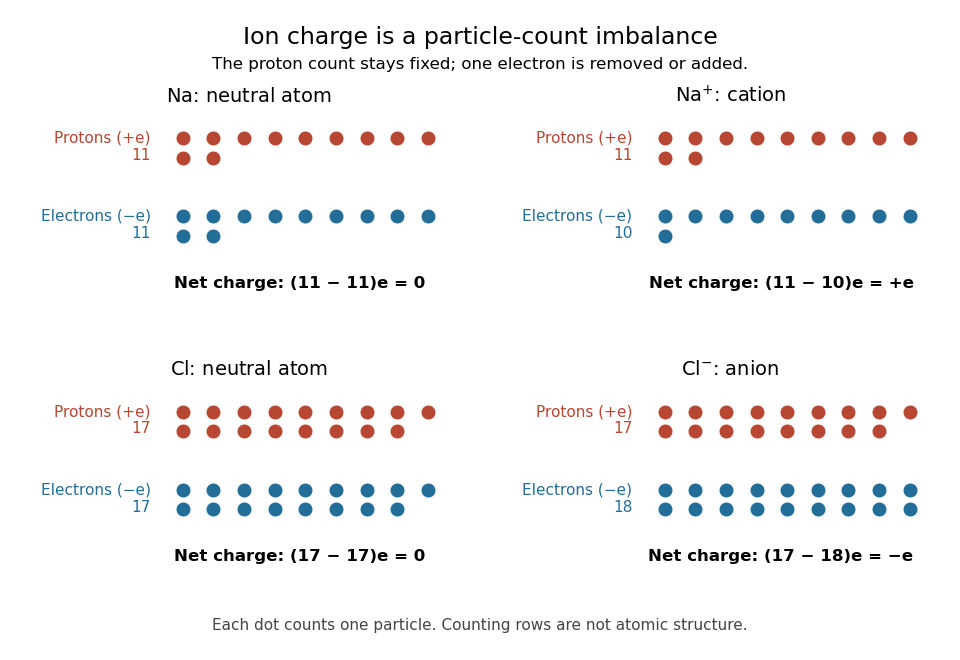
Ion electric charge bookkeeping: neutral sodium and chlorine chemical atoms compared with their cation and anion
. Every colored dot counts one proton or one electron. Rows are counting arrays, not spatial models of atomic nuclei or electron shells. The net electric charges are . Details.One sodium chloride formula unit accounts for one cation and one anion, whose net electric charges sum to zero. Ordinary solid sodium chloride is an extended arrangement of ions, rather than discrete molecules. This is a useful distinction: a neutral material can contain charged constituents, and its chemical formula tells us their ratio without claiming that each pair is a separate molecule.
Ion bookkeeping connects chemistry to electric current: moving ions can transport electric charge, while stationary ions cannot supply a transport current density. In electrochemistry, both signs of ions can contribute to the same conventional current. An ion opposing a fixed electric charge is called a counterion.

