The Lorentz force is the force exerted on a charged particle moving through an electromagnetic field. It is named after the Dutch physicist Hendrik Lorentz.
Articles by others on the same topic

The Lorentz force is the force exerted by an electric field and a magnetic field on a body with electric charge and velocity . In SI units its form in nonrelativistic classical mechanics, using mass and Newton's second law, isBoth fields are evaluated at the body's position at the current time. The electric field contributes even at rest, whereas the magnetic force depends on velocity through a cross product. [ref]
https://openstax.org/books/university-physics-volume-2/pages/5-4-electric-field. OpenStax, electric force and field
; [ref]https://openstax.org/books/university-physics-volume-2/pages/11-2-magnetic-fields-and-lines. OpenStax, magnetic force on moving charge
.For a concrete charged particle in a uniform magnetic field, use nondimensionalization to stipulate , magnetic field , zero electric field, initial position , and initial velocity . These are rescaled quantities, not an assertion that the mass, electric charge, and magnetic field have the same physical units. At the start, , so the magnetic acceleration points toward . The resulting circular motion isAt the position is and the velocity is ; at the position is and the velocity is . Thus the circle has center and radius one. Viewed from toward the plane, the motion is clockwise. Changing only the electric charge to gives position and reverses the bending to counterclockwise.
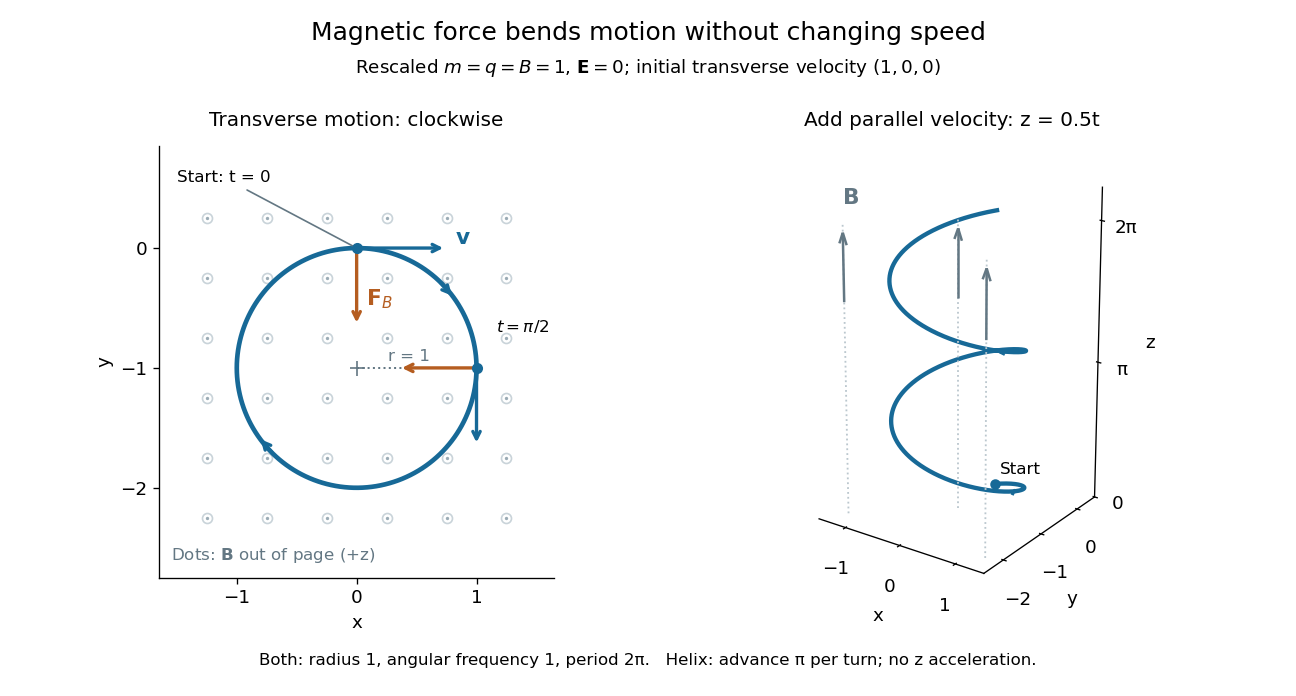
Adding initial velocity leaves the transverse circular motion unchanged and givesThis is a helix of transverse radius one, cyclotron frequency , and transverse period ; the advance along in one turn is . The parallel component of velocity stays constant because the magnetic force has no parallel component: there is no magnetic acceleration along the magnetic field. If the initial velocity were entirely parallel to the magnetic field, the magnetic force would vanish and the path would be straight. [ref].
More generally, with zero electric field, no other forces, and a uniform constant magnetic field of magnitude , decompose velocity into perpendicular and parallel components. For nonzero electric charge , the perpendicular speed determines the gyroradius, while the cyclotron frequency is an angular frequency:These are nonrelativistic formulas; see the relativistic cyclotron orbit for the correction. The beauty is that increasing perpendicular speed increases the radius in exactly the proportion needed to leave the period unchanged. Conversely, known magnetic field, perpendicular speed, and measured radius determine the magnitude of the electric charge divided by mass. This makes the same geometry useful for comparing bodies with different electric charge and mass.
Two short checks explain the result. First, the cross product gives for both stipulated positive-electric charge paths, exactly their acceleration. Second, the transverse magnetic force supplies the centripetal acceleration, so ; for this gives the gyroradius, and gives the cyclotron frequency.
Magnetic forces do no work: the instantaneous power of the magnetic part of the Lorentz force vanishes because a cross product is perpendicular to its first argument. The work-energy theorem therefore givesThe dot product is zero at every instant, rather than only after a full turn. With zero electric field and no other forces, the kinetic energy and speed remain constant; the electric field can increase or decrease kinetic energy according to the sign of . In the two stipulated examples the constant kinetic energy is respectively and in rescaled units. The extra parallel velocity raises kinetic energy without changing the gyroradius or the cyclotron frequency.
For an electric example in rescaled units, stipulate , zero magnetic field, constant electric field , no other forces, and rest at . The Lorentz force gives acceleration and velocity , hence kinetic energy and power . At , the kinetic energy has risen from zero to two: the electric field has done positive work.
The existing electromagnetic field tensor formulation expresses the same interaction covariantly. For four-momentum and four-velocity , using proper time , the Lorentz force law isIts spatial and temporal components are


Equation 1.
Lorentz force
. A little suspicious that it bears the name of Lorentz, who is famous for special relativity, isn't it? See: Maxwell's equations require special relativity.