Topics (203k) Articles (205k) Users (305) Discussions (237) Comments (383) Files (715) New article

Mnemonic: the gradient shows the direction in which the function increases fastest.
Therefore, it has to:
- take a scalar field as input. Otherwise, how do you decide which vector is larger than the other?
- output a vector field that contains the direction in which the scalar increases fastest locally at each point. This has to give out vectors, since we are talking about directions
Can be denoted either by:Our default symbol is going to be:
- the upper case Greek letter delta
- nabla symbol squared
Ciro Santilli thinks that maybe the government does not need to provide those, but it needs to regulate the fuck out of them, notably control over censorship in those platforms: the deplatforming of Donald Trump.
Related:
Things that are not nice such as:
- Taboola, Outbrain, and other chumbox
- BLOBs
- Europe cookie law
- adhesive inside mobile phones and more generally, planned obsolescence
- Jupyter Notebook
- typographical characters that look like ASCII ones, but are not the ASCII ones, e.g. typographical quotes, em-dash. The non-breaking hyphen is not even whitespace, and by def Why not stick to ASCII when ASCII is good enough?
- excessive encapsulation
- replacement of master and slave terminology from technology
- mailing lists. And to add insult to injury, HTML on mailing list messages instead of plaintext.
- blank lines in code added by people trying to increase clarity, especially when there is already indentation for that. Every blank line must be preceded by a line comment explaining what the following block is about, or removed.
- messaging software that force you to have a mobile phone
- advertisements by telephone/SMS
- "state" such as global variables and object members, long live functional programming?
- mosquitoes, the only intrinsically bad thing about tropical countries
- projects with slow compilation times
- Microsoft Windows
- the 2019 Chinese government
- e-learning websites that only allows verified teachers to write content. Cowards who can't handle ranking algorithms.
- domain-specific language
- a build system without an out-of-tree option
- non-linear Git history: stackoverflow.com/questions/20348629/what-are-advantages-of-keeping-linear-history-in-git
- visual programming languages like Scratch. Waste of time. Text programming languages are already equally as visual due to indentation:Just make good serious gamedev libraries and integrated development environments for those real languages instead.
if x == 0: x = 1 - software that prevents you from running as root. Let me fucking shoot myself in the foot if I want to. It is better than having to deal with your hand holding bullshit, which is done in a different way for every project. E.g.: stackoverflow.com/questions/17466017/how-to-solve-you-must-not-be-root-to-run-crosstool-ng-when-using-ct-ng/53099177#53099177
- Medium
- luxury goods
- euphemism
- closed access academic journals are evil
- websites without OAuth
- shower room without a window to the exterior (mould!!!)
- single programs with their interface split across multiple windows, e.g. GIMP, ZynAddSubFX
- graphical user interfaces
- logograms
- infinitesimals. Just use limit instead, please
- country
- knowledge olympiads
- programming languages without a decent dominating package system
- closed source offline software used by millions
- exams
- security through obscurities
- dots in Gmail address
- things in websites that look like links, and behave like links, but don't let you middle click to open them on a separate tab
- K-pop
- numerical computing language
- fiscal paradises
- when the front-end of an website changes an important permanent state, but the URL does not change
- splash screens: you should show boot messages so that people will know what to Google for when things fail. Do you think computer newbies will be afraid and have nightmares?
- milk chocolate: why would you eat that instead of dark chocolate if you are older than 10?
- to talk about something without giving the real name to not scare off the audience
- mathematical symbol that looks like a Greek letter but isn't. Or perhaps mathematical notation in general
- when more than two people gather to play a board game or video game, and two or more people start chatting on and on about random subjects rather than concentrating on the game
- watching television while eating. Same for reading, or doing basically anything else but eat. The only acceptable activity is talking relaxedly, not about work.
- noises coming out of your bicycle. It is so hard to find where they come to fix them!!!
- code drop
- private cars as opposed to public transport. As a cyclist, you can just see the effect that large roads have on nearby areas, it just destroys nature.
- closed standards
- double consonants that make no difference to sound. Dilema? Dilemma? Dillema? Dillemma? Please!
- social media websites that show stuff from people you don't follow when you don't explicitly want that, including things which are not ads, just random suggestions. Twitter starting being like that cirac a 2022. Facebook got worse around that time. It is a constant fight against those stupid websites.
- socks with short legs that don't protect your ankle/lower calf from cold/scratches/dirt, e.g. liner socks
- Presta valves. Why would such a flimsy tech have become so popular compared to the infinitely superior Schrader!
- kimchi
- reverse debugging
- E Ink
- web archiving
- Buildroot
- integrated development environments
- degreaser
- UML: while it might seem like a over-thought thing and likely is, the basic idea that understanding "one to one vs one to many vs many to many" relationships between objects and which object can see which object, is a fantastic approach towards understanding complex object oriented code
- open source software, including open source scientific computing consultancies
- computer
- FOSDEM. Ciro Santilli attended in 2016, and felt extremely good together with all those amazingly smart open source hackers: www.quora.com/What-are-the-best-open-source-conferences/answer/Ciro-Santilli
- Sass
- vimium
- bisection
- vector graphics, notably scalable Vector Graphics
- ASCII art
- OAuth
- command-line interface
- virtualization
- Anusol
- autodidacticism and self-directed learning
- end-to-end encryption
- The Criterion Collection
- version control
- SQLite
- Guerrilla Mail
- POSIX
- static website
- Freeman Dyson
- open access academic publishers
- unconditional basic income
- transhumanism
- 2FA, and notably 2FA apps
- human-readable formats
- wealth tax
- Reproducible builds
- F-Droid
- Can't get you out of my head by Adam Curtis (2021)
- drug liberalization
- Wiki-binge
- molecular Sciences Course of the University of São Paulo
- meal deal
- clade, as opposed to taxonomic ranks
- lingua franca, see also: having more than one natural language is bad for the world
- rsync
- zip hoodies
This section is about functions that operates on arbitrary sets.
Output: another sequence of complex numbers such that:Intuitively, this means that we are braking up the complex signal into sinusoidal frequencies:and is the amplitude of each sine.
- : is kind of magic and ends up being a constant added to the signal because
- : sinusoidal that completes one cycle over the signal. The larger the , the larger the resolution of that sinusoidal. But it completes one cycle regardless.
- : sinusoidal that completes two cycles over the signal
- ...
- : sinusoidal that completes cycles over the signal
Motivation: similar to the Fourier transform:In particular, the discrete Fourier transform is used in signal processing after a analog-to-digital converter. Digital signal processing historically likely grew more and more over analog processing as digital processors got faster and faster as it gives more flexibility in algorithm design.
- compression: a sine would use N points in the time domain, but in the frequency domain just one, so we can throw the rest away. A sum of two sines, only two. So if your signal has periodicity, in general you can compress it with the transform
- noise removal: many systems add noise only at certain frequencies, which are hopefully different from the main frequencies of the actual signal. By doing the transform, we can remove those frequencies to attain a better signal-to-noise
Sample software implementations:
- numpy.fft, notably see the example: numpy/fft.py
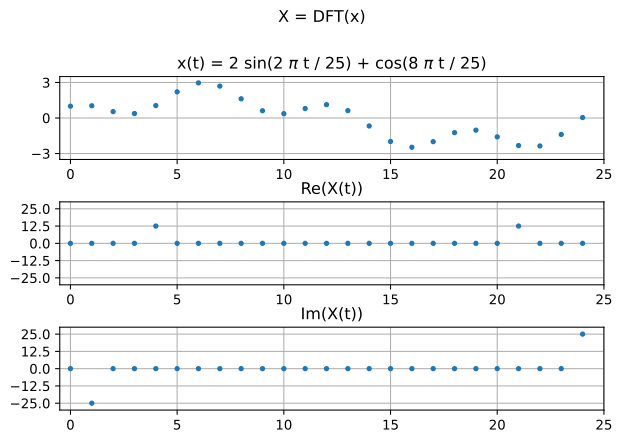
DFT of with 25 points
. This is a simple example of a discrete Fourier transform for a real input signal. It illustrates how the DFT takes N complex numbers as input, and produces N complex numbers as output. It also illustrates how the discrete Fourier transform of a real signal is symmetric around the center point.Continuous version of the Fourier series.
Can be used to represent functions that are not periodic: math.stackexchange.com/questions/221137/what-is-the-difference-between-fourier-series-and-fourier-transformation while the Fourier series is only for periodic functions.
Therefore, the Fourier transform can be seen as a generalization of the Fourier series that can also decompose functions defined on the entire real line.
As a more concrete example, just like the Fourier series is how you solve the heat equation on a line segment with Dirichlet boundary conditions as shown at: Section "Solving partial differential equations with the Fourier series", the Fourier transform is what you need to solve the problem when the domain is the entire real line.
First published by Fourier in 1807 to solve the heat equation.
A conjecture is an open problem in mathematics for which some famous dude gave heuristic arguments which indicate if the theorem is true or false.
Previously known as "Food From Electricity", "NeoCarbonFood" sounds like a more commercializable version of it.
Uses electricity to electrolyse water into hydrogen and oxygen molecules, and then use bacteria that do hydrogen chemosynthesis to convert it into food.
Pinned article: Introduction to the OurBigBook Project
Welcome to the OurBigBook Project! Our goal is to create the perfect publishing platform for STEM subjects, and get university-level students to write the best free STEM tutorials ever.
Everyone is welcome to create an account and play with the site: ourbigbook.com/go/register. We belive that students themselves can write amazing tutorials, but teachers are welcome too. You can write about anything you want, it doesn't have to be STEM or even educational. Silly test content is very welcome and you won't be penalized in any way. Just keep it legal!
Intro to OurBigBook
. Source. We have two killer features:
- topics: topics group articles by different users with the same title, e.g. here is the topic for the "Fundamental Theorem of Calculus" ourbigbook.com/go/topic/fundamental-theorem-of-calculusArticles of different users are sorted by upvote within each article page. This feature is a bit like:
- a Wikipedia where each user can have their own version of each article
- a Q&A website like Stack Overflow, where multiple people can give their views on a given topic, and the best ones are sorted by upvote. Except you don't need to wait for someone to ask first, and any topic goes, no matter how narrow or broad
This feature makes it possible for readers to find better explanations of any topic created by other writers. And it allows writers to create an explanation in a place that readers might actually find it.
Figure 1. Screenshot of the "Derivative" topic page. View it live at: ourbigbook.com/go/topic/derivativeVideo 2. OurBigBook Web topics demo. Source. - local editing: you can store all your personal knowledge base content locally in a plaintext markup format that can be edited locally and published either:This way you can be sure that even if OurBigBook.com were to go down one day (which we have no plans to do as it is quite cheap to host!), your content will still be perfectly readable as a static site.
- to OurBigBook.com to get awesome multi-user features like topics and likes
- as HTML files to a static website, which you can host yourself for free on many external providers like GitHub Pages, and remain in full control

Figure 2. You can publish local OurBigBook lightweight markup files to either OurBigBook.com or as a static website.
Figure 3. Visual Studio Code extension installation.
Figure 5. . You can also edit articles on the Web editor without installing anything locally. Video 3. Edit locally and publish demo. Source. This shows editing OurBigBook Markup and publishing it using the Visual Studio Code extension. 
- Infinitely deep tables of contents:


All our software is open source and hosted at: github.com/ourbigbook/ourbigbook
Further documentation can be found at: docs.ourbigbook.com
Feel free to reach our to us for any help or suggestions: docs.ourbigbook.com/#contact