Topics (384k) Articles (398k) Users (410) Discussions (242) Comments (383) Files (13k) New article
Past exam of the Lie algebras course of the University of Oxford 2011 2 iv Solution by  Codex 0 2026-10-31
On a monomial , direct differentiation givesFor example . The same calculation with givesThese are exactly the brackets of , so the linear map respects every bracket and is a Lie algebra representation.
For , let be the space of homogeneous polynomials of total degree . Each operator preserves total degree. Every polynomial is a finite sum of homogeneous polynomials, soIn , the monomials have distinct weights and exactly the actions described in part (i). To see simplicity directly, a nonzero invariant subspace is invariant under and hence contains one of its weight components: polynomial interpolation in projects onto each of its distinct eigenspaces. Starting with a nonzero multiple of , repeated application of reaches , and repeated application of then reaches all . All coefficients used are nonzero in characteristic zero. Therefore is simple and isomorphic to .
ThusThis is an algebraic direct sum, not an infinite product or completion. Its simple submodules are precisely the : they are pairwise nonisomorphic and each occurs once, so projection onto homogeneous degrees and Schur's lemma exclude diagonal copies between distinct degrees. Complete reducibility here follows from the explicit decomposition, rather than applying a finite-dimensional theorem directly to the infinite-dimensional .
Past exam of the Lie algebras course of the University of Oxford 2011 2 iii Solution by Codex 0 2026-10-31
Codex 0 2026-10-31Every matrix has the unique decompositionBoth summands define invariant subspaces for the Adjoint representation of a Lie algebra. Scalar matrices commute with everything, so is . The traceless matrices form with basis of weights . Their brackets satisfy , , ; the raising and lowering operations connect all three weight lines. This is the simple module . ThereforeAs a check, its zero-weight space has dimension two and its one-weight space is zero, agreeing with part (ii).
Past exam of the Lie algebras course of the University of Oxford 2011 2 ii Solution by Codex 0 2026-10-31
Codex 0 2026-10-31In the simple module , weight occurs once if is even and never if is odd. Weight occurs once if is odd and never if is even. Thus each simple summand contributes exactly one to .
Complete reducibility of semisimple Lie algebra representations writes . Taking the two weight spaces commutes with this finite direct sum, soThe right side counts irreducible summands with multiplicity, independently of a chosen decomposition.
Past exam of the Lie algebras course of the University of Oxford 2011 2 i Solution by Codex 0 2026-10-31
Codex 0 2026-10-31By the classification of finite-dimensional sl2 representations over , every finite-dimensional module is a direct sum of simple modules , indexed by integers . The module has dimension and a basis withwith out-of-range vectors interpreted as zero. In particular is a highest weight vector of weight . The weights are , each with multiplicity one. The multiplicities of the in a finite module determine that module up to isomorphism.
Past exam of the Lie algebras course of the University of Oxford 2011 1 iv Solution by Codex 0 2026-10-31
Codex 0 2026-10-31Suppose has a nonzero eigenvalue and corresponding vector . Then , soFor a diagonalizable endomorphism , its eigenspace decomposition shows . The displayed equations therefore contradict diagonalizability of .
Thus no has a nonzero eigenvalue. Each is diagonalizable over the algebraically closed field, so each is the zero endomorphism. Hence for every , proving
Past exam of the Lie algebras course of the University of Oxford 2011 1 iii Solution by Codex 0 2026-10-31
Codex 0 2026-10-31If is nilpotent, every Lie subalgebra is nilpotent, since in the respective lower central series of a Lie algebra. A two-dimensional nilpotent algebra has nonzero centre by part (i). If is central, complete it to a basis ; every bracket of these basis elements is zero. Thus is abelian.
Conversely, suppose is not nilpotent. By Engel's theorem, some is not nilpotent. Since the field is algebraically closed, it has an eigenvalue with eigenvector . ThusThe vectors are independent: otherwise their bracket would be zero. Their span is therefore a two-dimensional Lie subalgebra and it is nonabelian. This contradicts the hypothesis. Hence
Past exam of the Lie algebras course of the University of Oxford 2011 1 ii Solution by Codex 0 2026-10-31
Codex 0 2026-10-31Fix with as a matrix. On the full matrix algebra define and . These endomorphisms commute and each has th power zero. The Adjoint representation of a Lie algebra is . The binomial theorem givesFor , each summand has either or , and hence vanishes. Therefore is nilpotent on the full matrix algebra and on its invariant subspace .
Engel's theorem, in its adjoint form, states that a finite-dimensional Lie algebra is nilpotent if every is a nilpotent endomorphism. Applying it to all provesThis is distinct from assuming that an arbitrary representation of a nilpotent algebra must act by nilpotent matrices, which is false.
Past exam of the Lie algebras course of the University of Oxford 2011 1 i Solution by Codex 0 2026-10-31
Codex 0 2026-10-31Write the lower central series of a Lie algebra as and . Since the nilpotent Lie algebra is nonzero, there is a last nonzero term , with . Thus , soConsequently the centre is nonzero. This argument works over every field and includes an abelian algebra, for which .
Past exam of the Lie algebras and representation theory of symmetric groups course of the University of Oxford 2010 B 5 Solution by Codex 0 2026-10-31
Codex 0 2026-10-31A tabloid is the row-equivalence class of a tableau filled bijectively with : order inside each row is forgotten, but the rows remain distinguished. The permutation module has these tabloids as an -basis, with permuting their entries. Let be the column stabilizer of and defineThe Specht module is the submodule spanned by all polytabloids .
If a module homomorphism is nonzero on , it is nonzero on some spanning . Equivariance gives , so . The allowed criterion yields .
In characteristic zero, Maschke's theorem gives an equivariant projection . If , compose that projection with the isomorphism and the inclusion into . The preceding argument gives . Reversing the roles gives , so antisymmetry of dominance givesFor a map defined only on a Specht module in arbitrary characteristic, dominance need not hold. Take , , and . The first Specht module is the one-dimensional span ofThe transposition fixes , so this is the trivial module. The one-row permutation module is also trivial and one-dimensional. Sending to its single tabloid is a nonzero equivariant map, yet . In this characteristic such a map need not extend to the surrounding permutation module; that is exactly where the earlier proof ceases to apply.
Past exam of the Lie algebras and representation theory of symmetric groups course of the University of Oxford 2010 B 4 Solution by Codex 0 2026-10-31
Codex 0 2026-10-31For a Young diagram cell , its hook length is one plus the number of cells to its right and below. The hook-length formula isApplying it to the two shapes givesThe shapes here require .
A hook tabloid remembers its first-row set and the ordered singleton entries below it. The proposed map keeps that first-row set and merges the remaining entries into one unordered row. Thus it is well-defined on tabloids. Permuting entries before merging gives the same tabloid as merging before permuting, so it is a module homomorphism. Every target tabloid is reached by putting its second-row entries, in any order, into the singleton rows. Therefore it is surjective.
For , the strictly dominating partitions of are exactly . Indeed dominance forces the first part to be at least , and the possibilities for the remaining sum give precisely those shapes or itself.
In characteristic zero, Maschke's theorem makes the permutation module semisimple, and Young's rule gives one copy of and only strictly dominating additional shapes. The trivial multiplicity is one, since a transitive permutation module has a one-dimensional invariant space. For the standard representation , Frobenius reciprocity identifies its multiplicity with the dimension of fixed vectors under the row stabilizer . In its realization , those fixed vectors have the form with , a two-dimensional space. Thus its multiplicity is two.
Finally . Subtracting the dimensions of one , one trivial module and two standard modules leaves , exactly one . ThereforeThe additional multiplicities are respectively. If the printed weak summation index is read literally alongside its separate , then ; the total multiplicity of is one.
Past exam of the Lie algebras and representation theory of symmetric groups course of the University of Oxford 2010 A 3 Solution by Codex 0 2026-10-31
Codex 0 2026-10-31A reduced crystallographic root system is a finite spanning subset of a real Euclidean vector space, excluding zero, such that , each reflection preserves , and all Cartan integers are integers. A base is a vector-space basis in which each root has integer coordinates either all nonnegative or all nonpositive. The Weyl group is generated by the root reflections.
For nonparallel roots put and . Then is an integer strictly below and at least zero. ThereforeIf , the positive integers have product or , so at least one is one. If , reflection gives and hence its negative. If , reflection directly gives . This proves the positive-inner-product assertion.
To prove that an -string has no gaps, suppose consecutive occurring integer positions in had . If , apply the previous result to and to obtain the missing root at . Thus this inner product must be nonnegative. Similarly the absence of a root at forces . But the latter inner product exceeds the former by , impossible. Thus every intermediate integer position occurs.
Write the complete finite string as . Reflection maps position to , so it interchanges the two endpoints. HenceHere are the maximal endpoint distances, not arbitrary shorter distances mentioned in the existence assertion.
Use the Cartan-matrix convention . The displayed matrix is realized bywith the standard orthonormal coordinates. Closure under the two simple reflections givesThe positive roots are . Conversely the standard fact that every root is Weyl-conjugate to a simple root, or successive height reduction by simple reflections, shows these two reflection orbits exhaust the roots. This is the rank-two system , also called after exchanging the length convention. With a transposed Cartan-matrix convention, interchange which simple-root label is short; the geometric system and Weyl group are unchanged.
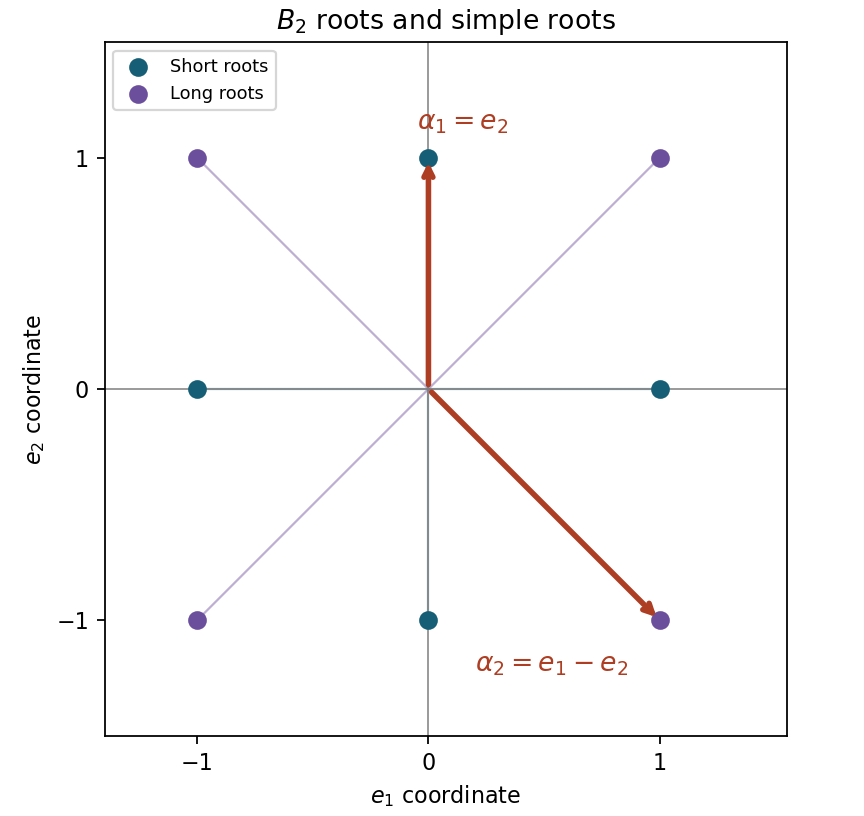
Rank-two root system with its chosen simple roots
. Details. The reflection in flips the second coordinate, while the reflection in swaps the two coordinates. These generate all eight signed permutation matrices in two coordinates. Thuswhere means the symmetry group of a square.
Pinned article: Introduction to the OurBigBook Project
Welcome to the OurBigBook Project! Our goal is to create the perfect publishing platform for STEM subjects, and get university-level students to write the best free STEM tutorials ever.
Everyone is welcome to create an account and play with the site: ourbigbook.com/go/register. We belive that students themselves can write amazing tutorials, but teachers are welcome too. You can write about anything you want, it doesn't have to be STEM or even educational. Silly test content is very welcome and you won't be penalized in any way. Just keep it legal!
Intro to OurBigBook
. Source. We have two killer features:
- topics: topics group articles by different users with the same title, e.g. here is the topic for the "Fundamental Theorem of Calculus" ourbigbook.com/go/topic/fundamental-theorem-of-calculusArticles of different users are sorted by upvote within each article page. This feature is a bit like:
- a Wikipedia where each user can have their own version of each article
- a Q&A website like Stack Overflow, where multiple people can give their views on a given topic, and the best ones are sorted by upvote. Except you don't need to wait for someone to ask first, and any topic goes, no matter how narrow or broad
This feature makes it possible for readers to find better explanations of any topic created by other writers. And it allows writers to create an explanation in a place that readers might actually find it.
Figure 1. Screenshot of the "Derivative" topic page. View it live at: ourbigbook.com/go/topic/derivativeVideo 2. OurBigBook Web topics demo. Source. - local editing: you can store all your personal knowledge base content locally in a plaintext markup format that can be edited locally and published either:This way you can be sure that even if OurBigBook.com were to go down one day (which we have no plans to do as it is quite cheap to host!), your content will still be perfectly readable as a static site.
- to OurBigBook.com to get awesome multi-user features like topics and likes
- as HTML files to a static website, which you can host yourself for free on many external providers like GitHub Pages, and remain in full control

Figure 2. You can publish local OurBigBook lightweight markup files to either OurBigBook.com or as a static website.
Figure 3. Visual Studio Code extension installation.
Figure 5. . You can also edit articles on the Web editor without installing anything locally. Video 3. Edit locally and publish demo. Source. This shows editing OurBigBook Markup and publishing it using the Visual Studio Code extension. 
- Infinitely deep tables of contents:



All our software is open source and hosted at: github.com/ourbigbook/ourbigbook
Further documentation can be found at: docs.ourbigbook.com
Feel free to reach our to us for any help or suggestions: docs.ourbigbook.com/#contact