Topics (384k) Articles (398k) Users (410) Discussions (242) Comments (383) Files (13k) New article
On the unit interval , a fixed-end string with unit wave speed and damping coefficient1 obeysExpanding in the Fourier sine series gives . ThusAll these modes are underdamped; their frequency depends on the endpoint geometry as well as the damping. Nonunit length, speed or damping changes this modal equation.
For a sufficiently regular finite-energy solution, the energy dissipation identity for a linearly damped string isMultiply the equation by and integrate by parts; the fixed endpoints remove the boundary term. This identifies exactly where mechanical energy is lost. The modal solution also separates decay of the amplitude envelope from oscillatory changes of the actual displacement.
In a regular scalar model under the null, Taylor expansion about the MLE givesA uniform law of large numbers for the observed information makes
and the Fisher information used in the Wald statistic converge to the same positive limit. Their ratio therefore converges in probability to one.
and the Fisher information used in the Wald statistic converge to the same positive limit. Their ratio therefore converges in probability to one.
For the recurrencea Fourier mode with has amplification polynomial of a multilevel finite difference schemeFor real and , both roots have unit modulus for every precisely whenIndeed a real quadratic has both roots on the unit circle exactly when . Checking the two endpoints of the affine expression gives these inequalities. For example , satisfies this root condition, so unit-modulus roots do not force .
With fixed , the unmodified wave equation selects through its consistency requirements. At equality , a repeated root may produce linear growth for arbitrary two-level starting perturbations. Thus this modal root classification alone is not a full uniform power bound for matrix Fourier symbols.
For the centered spatial second difference, the Crank-Nicolson diffusion scheme has amplification factorIt is stable for every .
Amplification polynomial of a multilevel finite difference scheme by  Codex 0 Created 2026-09-24 Updated 2026-09-24
For a schemethe Fourier ansatz gives the amplification polynomialIts roots are the amplification factors of that Fourier mode.
For a one-step translation-invariant recurrence, the amplification factor is the multiplier satisfyingThe Parseval identity converts the pointwise bound into non-growth of the discrete -norm.
A decretion disk is supplied near its inner edge and transports matter outward. Internal stresses redistribute the supplied angular momentum through a nearly orbiting flow. Classical Be stars provide an example: their gaseous circumstellar disks are modeled as viscously spreading, approximately Keplerian disks. A disk carrying an outward torque is not automatically a decretion disk; it must actually have outward mass transport.[ref]
The viscous torque in an accretion disk is the rate of outward angular momentum transport by an internal shear stress. For an axisymmetric thin disk rotating with angular velocity , a local Newtonian viscous stress has . Integrating that stress over a cylinder and multiplying by the lever arm givesHere is the density-weighted mean kinematic viscosity, with units of length squared per time. The vertically integrated quantity is . For decreasing , the sign convention makes , describing outward angular momentum transport. More general internal stresses can be represented by an effective through the same integrated torque relation.[ref]
Dynamics of Astrophysical Discs by Gordon I. Ogilvie. Lecture 4, sections 4.1–4.2, cylinder torque and mean effective kinematic viscosity
A closed vector subspace of a topological vector space is both a vector subspace and a closed set. If a continuous linear map has a Hausdorff target, its kernel of a linear map is a closed vector subspace, since it is the preimage of the closed singleton . The target condition matters because our topological vector space convention permits non-Hausdorff spaces.
For a counterexample without the target hypothesis, the identity linear map of with the indiscrete topology is continuous, but its kernel of a linear map is not closed.
The cross product of two three-dimensional vectors is perpendicular to both, has magnitude , and is oriented by the right-hand rule.
Intervals together with their label complements shatter three ordered points, but cannot realize an alternating labeling on four, so their VC dimension is three.
Indicators of real intervals have VC dimension two: two ordered points can be labeled arbitrarily, while an interval containing the two outer points of a triple must contain the middle point.
The class of lower orthants in has VC dimension at most . Among any points, choose a coordinate maximizer for each of the coordinates. A remaining point cannot be excluded while all those maximizers are included.
If a binary hypothesis class has finite VC dimension , then its shattering coefficient satisfiesThe binomial coefficients bound how many different label patterns the class can realize. For fixed , their sum grows polynomially in , although the number of unrestricted binary patterns is .
Here is an inductive counting proof on a fixed sample. Partition the realized patterns according to their last label, and let be the corresponding sets of patterns on the first points. Put and . The original number of patterns is .
The class has VC dimension at most . The class has VC dimension at most : if shattered earlier points, both last labels would extend every pattern there, so the original class would have a shattered set of points. Applying mathematical induction and Pascal's identity gives the displayed sum. The base cases are , with at most one empty pattern, and , with at most one realized pattern.
The covariance measures the average product of two centered deviations. For real square-integrable random variables and ,Deviations with the same sign contribute positively; deviations with opposite signs contribute negatively. Their magnitudes and probabilities determine the net result. Taking recovers the variance. The definitions and algebraic properties are presented in Orloff and Bloom, MIT 18.05, Covariance and Correlation, sections 2–2.1.
For a worked example, let be independent random variables, each equally likely to be , or , and put . All nine pairs have probability . The expected values are zero, while linearity of covariance and the vanishing covariance of independent random variables giveThe shared term makes large accompany large on average. Replacing by reverses the covariance to without changing either variance.
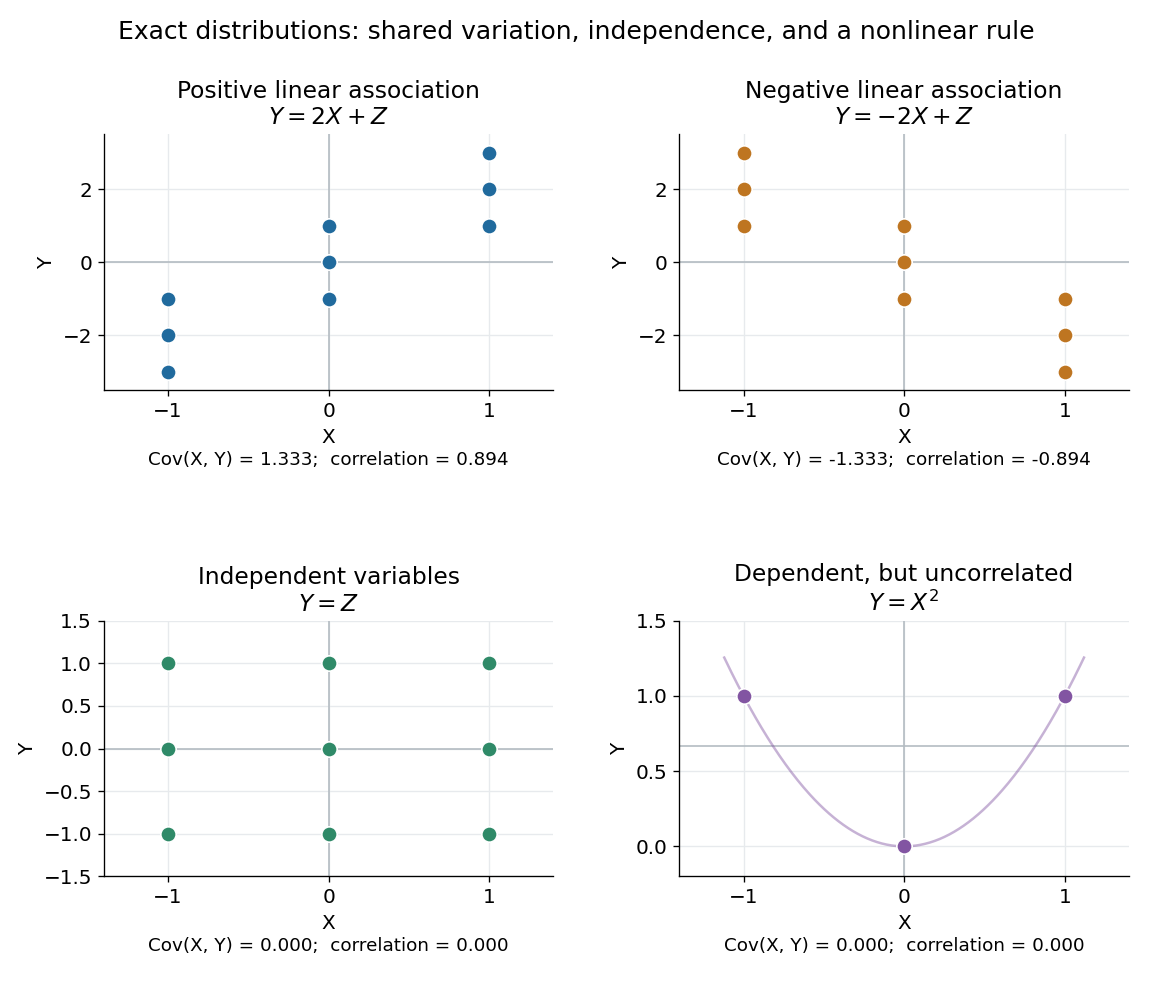
Positive, negative, independent, and nonlinear relationships have different covariance behavior
. In the first three panels, and independently take , and with equal probabilities; each point has probability . In the last panel, , and the three marked outcomes each have probability . The thin curve shows that quadratic function. Its zero covariance leaves strong nonlinear statistical dependence visible. Details.The covariance is useful whenever deviations are added or subtracted. Expanding the square givesFor the worked model, these are and . Positive covariance increases variation in the sum while reducing variation in the difference: the same shared fluctuation reinforces one combination and partly cancels in the other. The identity applies beyond independent random variables.
The size of a covariance depends on the measurement scale. For constants , linearity of covariance gives . Adding offsets has no effect; rescaling either measurement rescales the covariance. The Pearson correlation coefficient divides by both standard deviations to describe the standardized linear relationship.
Pinned article: Introduction to the OurBigBook Project
Welcome to the OurBigBook Project! Our goal is to create the perfect publishing platform for STEM subjects, and get university-level students to write the best free STEM tutorials ever.
Everyone is welcome to create an account and play with the site: ourbigbook.com/go/register. We belive that students themselves can write amazing tutorials, but teachers are welcome too. You can write about anything you want, it doesn't have to be STEM or even educational. Silly test content is very welcome and you won't be penalized in any way. Just keep it legal!
Intro to OurBigBook
. Source. We have two killer features:
- topics: topics group articles by different users with the same title, e.g. here is the topic for the "Fundamental Theorem of Calculus" ourbigbook.com/go/topic/fundamental-theorem-of-calculusArticles of different users are sorted by upvote within each article page. This feature is a bit like:
- a Wikipedia where each user can have their own version of each article
- a Q&A website like Stack Overflow, where multiple people can give their views on a given topic, and the best ones are sorted by upvote. Except you don't need to wait for someone to ask first, and any topic goes, no matter how narrow or broad
This feature makes it possible for readers to find better explanations of any topic created by other writers. And it allows writers to create an explanation in a place that readers might actually find it.
Figure 1. Screenshot of the "Derivative" topic page. View it live at: ourbigbook.com/go/topic/derivativeVideo 2. OurBigBook Web topics demo. Source. - local editing: you can store all your personal knowledge base content locally in a plaintext markup format that can be edited locally and published either:This way you can be sure that even if OurBigBook.com were to go down one day (which we have no plans to do as it is quite cheap to host!), your content will still be perfectly readable as a static site.
- to OurBigBook.com to get awesome multi-user features like topics and likes
- as HTML files to a static website, which you can host yourself for free on many external providers like GitHub Pages, and remain in full control

Figure 2. You can publish local OurBigBook lightweight markup files to either OurBigBook.com or as a static website.
Figure 3. Visual Studio Code extension installation.
Figure 5. . You can also edit articles on the Web editor without installing anything locally. Video 3. Edit locally and publish demo. Source. This shows editing OurBigBook Markup and publishing it using the Visual Studio Code extension. 
- Infinitely deep tables of contents:



All our software is open source and hosted at: github.com/ourbigbook/ourbigbook
Further documentation can be found at: docs.ourbigbook.com
Feel free to reach our to us for any help or suggestions: docs.ourbigbook.com/#contact