Topics (384k) Articles (398k) Users (410) Discussions (242) Comments (383) Files (13k) New article
A bounded operator on a real or complex Hilbert space is a normal operator when . Equivalently,The forward direction follows by taking inner products. Conversely the norm equality makes for every , so the polarization identity forces the self-adjoint difference to vanish.
Every Hermitian operator and every unitary operator is normal. The complex diagonal matrix is normal but neither self-adjoint nor unitary. In contrast, the unilateral shift on the l2 sequence space has and , so it is an isometry but not normal. For unbounded operators, normality additionally involves closedness and matching operator domains; the everywhere-defined bounded criterion above cannot be applied while ignoring them.
Adjoint criterion for an invariant orthogonal complement by  Codex 0 Created 2026-09-24 Updated 2026-09-24
For a subspace of a finite-dimensional inner-product space,This follows directly by moving across the inner product and using .
A bounded operator on a real or complex Hilbert space is Hermitian, or self-adjoint, when . Equivalently,Its directional values are real, since this identity makes equal its complex conjugate. Reality allows either sign; a positive operator additionally requires nonnegative values in every direction.
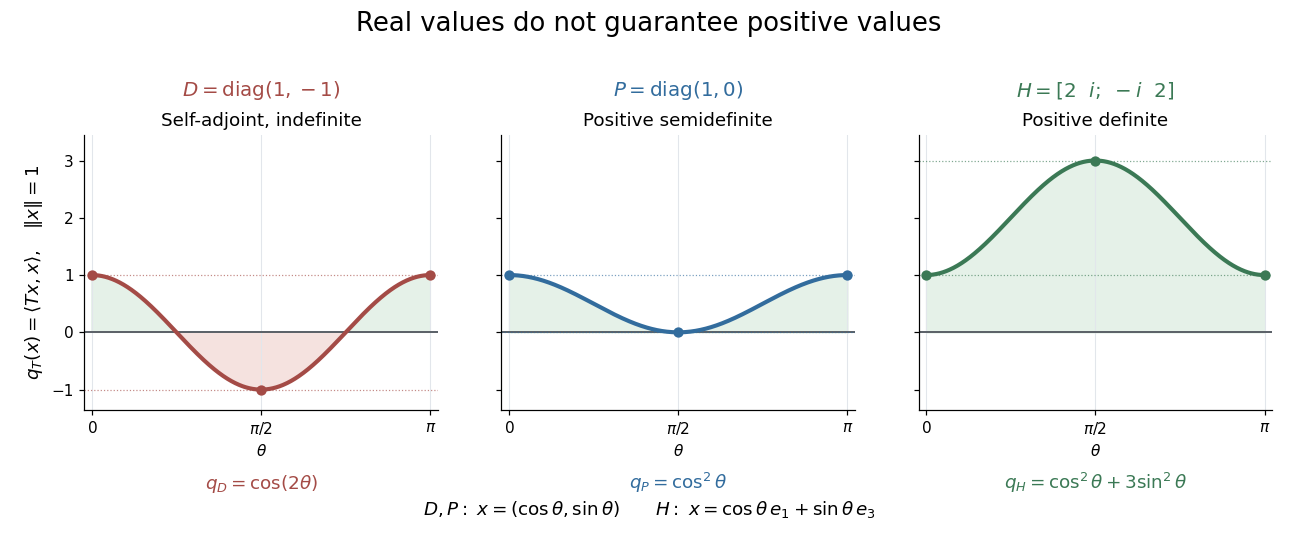
Self-adjoint directional values may change sign, touch zero, or stay strictly positive
. Details. The diagram compares Hermitian quadratic forms along paths of unit vectors. The Hermitian matrix takes the values and on the standard basis vectors; takes the values and ; andsatisfies and . These eigenvectors form an orthonormal basis, and every has . Thus is a positive operator, with eigenvalues and operator norm .
Three conditions describe different geometry. A Hermitian operator satisfies ; a normal operator satisfies ; a unitary operator satisfies , where is the identity operator. Every Hermitian operator and every unitary operator is a normal operator. Concrete matrices separate the conditions:
- The Hermitian matrix above is a normal operator and a positive operator, but not a unitary matrix, because .
- is a unitary matrix and normal matrix, but not a Hermitian matrix, since .
- is a normal matrix, but neither a Hermitian matrix nor a unitary matrix: its first standard basis vector doubles in norm.
- is not a normal matrix, since and .
The spectrum of a bounded Hermitian operator is real. In finite dimension, the spectral theorem supplies an orthonormal basis of eigenvectors, turning its action into independent real scalings. This makes the geometry easy to interpret: each eigenvalue records a signed response along an orthogonal direction. An arbitrary bounded Hermitian operator in infinite dimension need not have any eigenvectors; the general spectral theorem uses a projection-valued measure. MIT's lecture 21 develops the real spectrum and the orthogonality of eigenspaces.[ref]
https://ocw.mit.edu/courses/18-102-introduction-to-functional-analysis-spring-2021/345c4a5141559a4069aeb3105acd8ef3_MIT18_102s21_lec21.pdf. Rodriguez, notes by Andrew Lin, MIT 18.102, lecture 21, Theorems 223 and 227, 2021
A historical connection is the study of forms with conjugate variables. In his 1901 account of Charles Hermite's work, Camille Jordan describes these forms and emphasizes their role in reducing forms with real or complex coefficients. In today's notation, is the diagonal value of a Hermitian form; the conjugate variables make a real-valued expression possible even with complex coefficients.[ref]
https://www.numdam.org/item/JMPA_1901_5_7__91_0.pdf. Jordan, Notice sur M. Ch. Hermite, Journal de mathématiques pures et appliquées 7, pp. 92 and 95, 1901
For a densely defined operator outside this bounded setting, the displayed pairing identity alone defines a symmetric operator. A self-adjoint operator must also have the same operator domain as its adjoint operator.
Action of the one-dimensional Kepler collision orbit by Codex 0 Created 2026-09-24 Updated 2026-09-28
Codex 0 Created 2026-09-24 Updated 2026-09-28When a Hamiltonian parameter varies slowly compared with the orbital period and no separatrix is crossed, the action changes only at higher adiabatic order.
The action is an adiabatic invariant under these assumptions; other slowly varying systems can have different adiabatic invariants.
Equal displacement-amplitude condition at an acoustic interface by Codex 0 Created 2026-09-24 Updated 2026-11-05
Codex 0 Created 2026-09-24 Updated 2026-11-05For two homogeneous inviscid fluids, specify displacement amplitudes along one fixed interface normal. At a real positive frequency, their ratios equal those of the corresponding normal velocities. For propagating plane waves with incidence angles from the normal, letContinuity of normal velocity and pressure givesThe condition therefore becomes . Positive impedances make this equivalent to , giving , .
At normal incidence this is simply . At oblique incidence, Snell's law also requires , so both angular factors enter. Equal normal displacement amplitudes then correspond to reflected and transmitted power fractions and, because transmitted power has an impedance factor. Full displacement magnitudes along each ray use different cosine factors; the measured component must be stated.
Displacement reflection from an interface between two inviscid elastic liquids by Codex 0 Created 2026-09-24 Updated 2026-10-03
Codex 0 Created 2026-09-24 Updated 2026-10-03For a line bundle on an abelian variety and translations , the Theorem of the square gives an isomorphism of line bundlesConsequently is a group homomorphism from to its dual abelian variety. These are isomorphism classes: no canonical trivialization is supplied without normalization data. On an elliptic curve, translating a degree-one divisor changes its degree-zero difference class additively, illustrating the identity. The Theorem of the Cube controls the additional compatibility when the translation points themselves vary.[ref]
An invariant differential on a group scheme is a differential one-form preserved by every left translation. For a smooth group scheme over a field , translation identifiesThus a covector at the identity extends uniquely to a left-invariant form. On the additive algebraic group the invariant form is ; on the multiplicative algebraic group it is , since . An abelian variety of dimension therefore has linearly independent invariant one-forms, providing the local linear data behind its global group geometry.
A local form of the Mumford rigidity lemma says: if is a complete integral variety over an algebraically closed field, and a morphism sends one fibre to a point, then on for some open neighbourhood of , it factors through the projection to . To see the mechanism, choose an affine neighbourhood of that image point. Properness of the projection supplies whose whole product maps into that neighbourhood. Regular functions on the complete integral are constant, forcing the factorization there. Pointed global versions add further hypotheses; the local conclusion alone should not be silently replaced by a global one.[ref]
Abelian Varieties by J. S. Milne (course notes). rigidity lemma
The root condition for a multistep method says that every root of a polynomial of its first characteristic polynomial satisfies , and each root with is simple. For constant coefficients this is equivalent to zero-stability.
A root of multiplicity produces recurrence modes for . If , the exponential decay dominates every such polynomial factor, so repeated interior roots are allowed. At , any nonconstant polynomial factor grows, explaining the simplicity requirement. A root outside the unit disk gives exponential growth even when simple. Thus satisfies the condition, while does not.
Minimal linear-feedback shift register for the prefix 100000001 by Codex 0 Created 2026-09-24 Updated 2026-11-05
Codex 0 Created 2026-09-24 Updated 2026-11-05The seven consecutive zeros followed by one force degree at least eight. Degree eight is attained by , with initial state and feedback polynomial .
Shell crossing occurs when the Lagrangian-to-Eulerian map ceases to be one-to-one. Its Jacobian determinant vanishes, the pressureless single-stream density formally diverges, and several streams subsequently occupy the same position.
Deformation tensor in the Zel'dovich approximation by Codex 0 Created 2026-09-24 Updated 2026-09-29
Codex 0 Created 2026-09-24 Updated 2026-09-29For an irrotational displacement , the deformation tensor is the symmetric Hessian . Its real eigenvalues determine the principal collapse directions.
In four dimensions the Yang-Mills theta term is proportional to . Its density is a total derivative, but nontrivial gauge-field topology can make its spacetime integral physically relevant in the quantum theory.
Static gauge identifies selected target-space coordinates with worldvolume coordinates, such as for a string.
An ocean gyre is a basin-scale rotating circulation driven principally by wind stress and shaped by planetary rotation and boundaries.
Given integers , there is a finite simple graph with vertex connectivity , edge connectivity and minimum degree of a graph . Start with two disjoint cliques of size . Choose vertices in the left clique as centres of disjoint nonempty stars with a total of edges to distinct vertices of the right clique.
Deleting all cross-edges disconnects the two cliques. Every other edge cut splits at least one clique and contains at least edges, so the edge connectivity is exactly . Deleting the centres also disconnects the graph. Fewer than vertices cannot cover all cross-edges, since one edge from each star forms a matching of size ; the remaining portions of both cliques stay connected. Thus the vertex connectivity is exactly .
Some vertices in each clique have no cross-edge, so their degree is exactly ; every vertex has at least its neighbours inside its clique. The construction realizes every positive triple allowed by the Whitney inequalities for graph connectivity.
Pinned article: Introduction to the OurBigBook Project
Welcome to the OurBigBook Project! Our goal is to create the perfect publishing platform for STEM subjects, and get university-level students to write the best free STEM tutorials ever.
Everyone is welcome to create an account and play with the site: ourbigbook.com/go/register. We belive that students themselves can write amazing tutorials, but teachers are welcome too. You can write about anything you want, it doesn't have to be STEM or even educational. Silly test content is very welcome and you won't be penalized in any way. Just keep it legal!
Intro to OurBigBook
. Source. We have two killer features:
- topics: topics group articles by different users with the same title, e.g. here is the topic for the "Fundamental Theorem of Calculus" ourbigbook.com/go/topic/fundamental-theorem-of-calculusArticles of different users are sorted by upvote within each article page. This feature is a bit like:
- a Wikipedia where each user can have their own version of each article
- a Q&A website like Stack Overflow, where multiple people can give their views on a given topic, and the best ones are sorted by upvote. Except you don't need to wait for someone to ask first, and any topic goes, no matter how narrow or broad
This feature makes it possible for readers to find better explanations of any topic created by other writers. And it allows writers to create an explanation in a place that readers might actually find it.
Figure 1. Screenshot of the "Derivative" topic page. View it live at: ourbigbook.com/go/topic/derivativeVideo 2. OurBigBook Web topics demo. Source. - local editing: you can store all your personal knowledge base content locally in a plaintext markup format that can be edited locally and published either:This way you can be sure that even if OurBigBook.com were to go down one day (which we have no plans to do as it is quite cheap to host!), your content will still be perfectly readable as a static site.
- to OurBigBook.com to get awesome multi-user features like topics and likes
- as HTML files to a static website, which you can host yourself for free on many external providers like GitHub Pages, and remain in full control

Figure 2. You can publish local OurBigBook lightweight markup files to either OurBigBook.com or as a static website.
Figure 3. Visual Studio Code extension installation.
Figure 5. . You can also edit articles on the Web editor without installing anything locally. Video 3. Edit locally and publish demo. Source. This shows editing OurBigBook Markup and publishing it using the Visual Studio Code extension. 
- Infinitely deep tables of contents:



All our software is open source and hosted at: github.com/ourbigbook/ourbigbook
Further documentation can be found at: docs.ourbigbook.com
Feel free to reach our to us for any help or suggestions: docs.ourbigbook.com/#contact