Topics (384k) Articles (398k) Users (410) Discussions (242) Comments (383) Files (13k) New article
A semi-infinite horizontal plate at unit height and a floor at zero give a velocity potential strip of height and an upper unit semicircle in the complex velocity . Their matching half-plane maps give . Along the fluid free boundary put , . Then and . Its downstream limit is , which must equal the downstream depth . Thus the contraction is exactly one half.
A unit-speed free layer turning downward around a reentrant wall corner has complex velocity in the first-quadrant exterior of the unit disc. Upstream , downstream , and the corner has infinite speed because its fluid angle is . Squaring , applying , and squaring again maps this domain to the upper half-plane with upstream, corner and downstream at . The potential strip map has the same normalization, proving the formula. The sign of the turn and the fluid corner angle determine whether the relevant hodograph is an exterior or interior quarter disc.
Holding probabilities cancel from hitting-probability equations by  Codex 0 Created 2026-10-31 Updated 2026-11-05
Outside a target set, first-step analysis for a Markov chain gives . Moving the holding term and dividing gives the displayed average over the next distinct state. Thus inserting or removing self-loops preserves eventual hitting probabilities, provided the state is not made absorbing and the relative probabilities of its exits are unchanged. Boundary values are one on the target and zero in closed classes unable to reach it. The waiting time changes, but the sequence of distinct visited states does not.
Let be a twice continuously differentiable local diffeomorphism, and suppose . The chain rule gives the displayed transformation of the Hessian matrix: terms containing second partial derivatives of are multiplied by first partial derivatives of and vanish at the critical point. By Sylvester's law of inertia, the numbers of positive, negative and zero eigenvalues are unchanged. Independently of nondegeneracy, the local diffeomorphism preserves the critical point's status as a local minimum, local maximum or saddle point of a scalar function, because it maps neighbourhoods to neighbourhoods.
Each basis of a finite-dimensional complex vector space determines a unique complex inner product making that basis orthonormal. In coordinates it is , with the first argument linear. The formula is sesquilinear, has conjugate symmetry, and satisfies , which is positive unless . Expanding any inner product in the given basis proves uniqueness. Its codomain is the complex numbers; only its diagonal values are necessarily real. The resulting identification with the dual space is conjugate-linear, not complex-linear.
A witness constant is a fresh constant symbol added to a first-order language so that an existential assertion has a named witness. In a Henkin construction one adds , with absent from the previous language. Freshness preserves consistency. Repeating the construction for the successively enlarged languages supplies the witness property used in a term model.
A Henkin theory has named witnesses for its provable existential sentences. In a Henkin construction, fresh constants and the corresponding Henkin witness axioms give this witness property. Completeness or maximal consistency can be imposed in an additional extension step.
The displayed fundamental solution solves on the real line with a Dirac delta at the initial time. It is the ordinary heat kernel multiplied by , because that factor removes the constant reaction term. Its integral is and it converges to the Dirac delta as . Convolution with initial data gives the corresponding solution. For the total mass decays by absorption; for it grows instead.
A logic hazard in which an output intended to remain one briefly falls to zero. In a sum of products, cover every adjacent pair of one-cells in a Karnaugh map with a common product implicant. That term omits the changing input and remains one throughout the transition, holding the OR output high regardless of the other path delays. This argument assumes one input changes at a time and the circuit starts settled.
For a concrete circuit, let , , , and . Give every gate, including each inverter, propagation delay 10 ns. Starting from , lower at time zero. Signal falls at 10 ns, while rises only at 20 ns. Their gap passes through the two OR gates, making fall during 30–40 ns even though its steady-state value remains one.
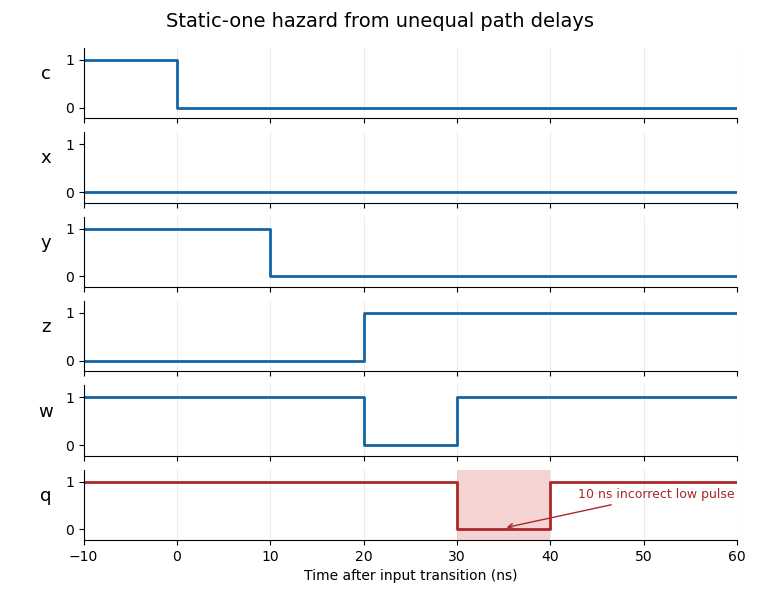
A static-one logic hazard from unequal inversion and product paths
. Details. Adding the two consensus theorem products and preserves the Boolean function and holds the output high across every potentially hazardous single-input transition. The resulting five-term expression factors as . When a change of could leave the output steadily one, and keep the second product steadily one. In the zero-to-zero case with changing , and keep both output products zero. Changes of use only one polarity each and therefore have no opposite-polarity race. This factored implementation uses three OR gates, two AND gates and two NOT gates, with a 40 ns maximum input-to-output path at the stated delays.
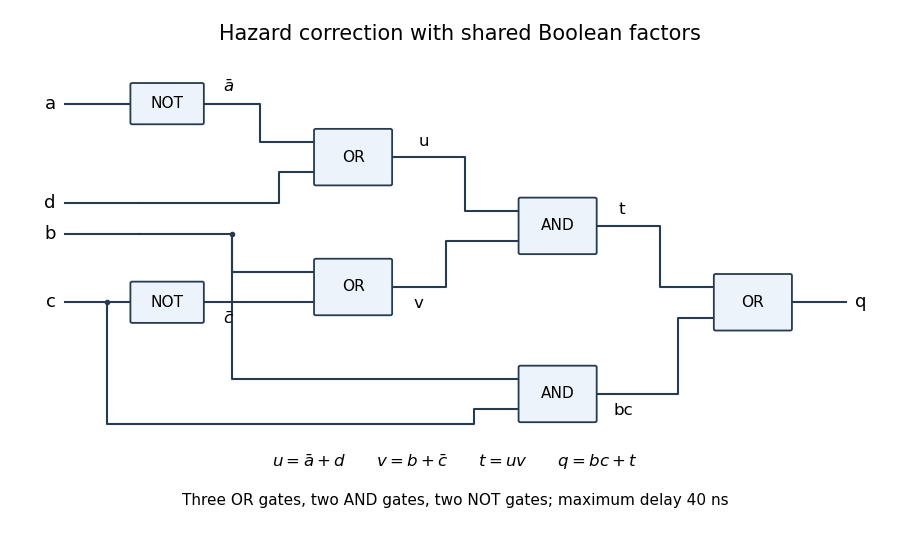
A shared-factor implementation of the consensus theorem correction
. Details. For linear antiplane elasticity with body forces and Dirichlet data proportional to time, uniqueness gives at any fixed crack length . The minimized elastic-plus-load potential and its energy release rate scale quadratically. The local Griffith fracture criterion laws are , and , with positive toughness .
If is finite and continuous near the initial length, it is bounded there by . Continuity of the crack path keeps it in that neighborhood for a positive interval. Choose the interval short enough that ; complementarity then forces zero growth throughout it. This proves a positive initial waiting time without assuming the crack is stationary in advance.
An element of a partially ordered set is a least element if for every . A least element is unique: two such elements are below each other, so antisymmetry makes them equal.
A grammar derivation that always expands the leftmost remaining nonterminal symbol. In a context-free grammar, each parse tree specifies exactly one leftmost derivation. Two distinct leftmost derivations of the same word therefore prove that the context-free grammar is an ambiguous grammar.
Map propositional letters to arithmetic sentences, map falsity to a refutable sentence, commute with implication and interpret by an arithmetical provability predicate. Propositional axioms remain theorems. The K axiom uses the second of the derivability conditions, and the Löb axiom uses the Internal form of Löb's theorem. Modus ponens rule is preserved directly, and the necessitation rule uses the first derivability condition. Induction on a GL proof therefore proves the displayed soundness implication for Peano arithmetic with the stipulated provability predicate.
The Löb axiom gives . The tautology , necessitated and distributed, gives . Thus , and replacing the antecedent in gives exactly . Setting produces a negative-provability fixed point, provably equivalent to .
In Gödel-Löb logic, the one-variable identity solves a boxed equation with a formula omitting its unknown letter. A finite simultaneous system can be solved by elimination. First solve its last equation with the other unknowns treated as parameters, substitute that formula into the preceding equations, and apply induction. Substituting the resulting solutions back into the last formula completes the system. This construction introduces no new parameter letters.
If every occurrence of in lies under a box, Gödel-Löb logic has a formula without , using only the other letters of , satisfying the displayed equivalence. Write using the outermost boxes that contain , so has no . Solve by simultaneous boxed fixed-point elimination in GL. If the solutions are , then works by replacement of provably equivalent formulas.
A formula provably equivalent to a boxed formula satisfies in GL. The displayed fixed point then gives both and under , hence . Boxed explosion proves the reverse implication. Under arithmetic realization this is a formal inconsistency statement; Sigma-1 soundness excludes its provability, while second incompleteness excludes provability of its negation.
Pinned article: Introduction to the OurBigBook Project
Welcome to the OurBigBook Project! Our goal is to create the perfect publishing platform for STEM subjects, and get university-level students to write the best free STEM tutorials ever.
Everyone is welcome to create an account and play with the site: ourbigbook.com/go/register. We belive that students themselves can write amazing tutorials, but teachers are welcome too. You can write about anything you want, it doesn't have to be STEM or even educational. Silly test content is very welcome and you won't be penalized in any way. Just keep it legal!
Intro to OurBigBook
. Source. We have two killer features:
- topics: topics group articles by different users with the same title, e.g. here is the topic for the "Fundamental Theorem of Calculus" ourbigbook.com/go/topic/fundamental-theorem-of-calculusArticles of different users are sorted by upvote within each article page. This feature is a bit like:
- a Wikipedia where each user can have their own version of each article
- a Q&A website like Stack Overflow, where multiple people can give their views on a given topic, and the best ones are sorted by upvote. Except you don't need to wait for someone to ask first, and any topic goes, no matter how narrow or broad
This feature makes it possible for readers to find better explanations of any topic created by other writers. And it allows writers to create an explanation in a place that readers might actually find it.
Figure 1. Screenshot of the "Derivative" topic page. View it live at: ourbigbook.com/go/topic/derivativeVideo 2. OurBigBook Web topics demo. Source. - local editing: you can store all your personal knowledge base content locally in a plaintext markup format that can be edited locally and published either:This way you can be sure that even if OurBigBook.com were to go down one day (which we have no plans to do as it is quite cheap to host!), your content will still be perfectly readable as a static site.
- to OurBigBook.com to get awesome multi-user features like topics and likes
- as HTML files to a static website, which you can host yourself for free on many external providers like GitHub Pages, and remain in full control

Figure 2. You can publish local OurBigBook lightweight markup files to either OurBigBook.com or as a static website.
Figure 3. Visual Studio Code extension installation.
Figure 5. . You can also edit articles on the Web editor without installing anything locally. Video 3. Edit locally and publish demo. Source. This shows editing OurBigBook Markup and publishing it using the Visual Studio Code extension. 
- Infinitely deep tables of contents:




All our software is open source and hosted at: github.com/ourbigbook/ourbigbook
Further documentation can be found at: docs.ourbigbook.com
Feel free to reach our to us for any help or suggestions: docs.ourbigbook.com/#contact