Topics (384k) Articles (398k) Users (410) Discussions (242) Comments (383) Files (13k) New article

Rewriting suitable general axioms into definitions or primitive inclusions that can be processed when an atomic label is encountered. For example, can be absorbed as .
The quadratic Taylor polynomial of at is . Multiplying by gives , proving the exact displayed identity. Thus for every real , with equality only at one. In particular, a claim that to the right of one has the wrong sign. The Lagrange remainder also proves this direction there, since for . The exact identity is stronger: it controls the sign globally and shows the fourth-order contact at the expansion point.
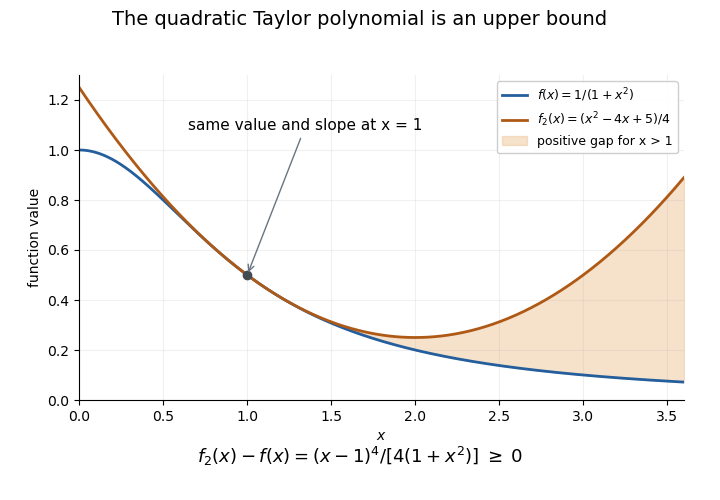
The quadratic Taylor polynomial globally majorizes the reciprocal quadratic
. Details. If the zero set of a differentiable function is a submanifold, the chain rule always places its tangent space inside . Equality follows from the full-rank hypotheses of the regular level set theorem, but may fail for a singular defining function even when the zero set itself is smooth. For , , the zero set is the single point . Its tangent space is zero, while has kernel . One should therefore check the constraint qualification before using the kernel formula.
Two smooth differential systems related by a nonlinear change of dependent variables need not define the same weak solutions. If , a smooth function satisfies for smooth ; even when this can be written as another divergence, its Rankine-Hugoniot conditions need not be equivalent to those in . The smooth chain rule does not justify multiplying jump distributions by discontinuous coefficients.
For example the shallow water equations can be written smoothly as and . Mechanical mass and momentum conservation instead select and . These systems agree for smooth positive , but their jump laws differ. The states and satisfy the mass/momentum jump laws with speed , while the velocity-form jump equation would demand . A model for discontinuities must specify the conservative variables or an equivalent admissible regularization, rather than using smooth equivalence alone.
A sampled Boolean circuit that suppresses short input changes using recent samples. A three-sample majority function removes isolated one-sample changes; a stateful variant updates its stored output only after three equal input samples. These are different specifications.
Let be a nonempty compact space and let be continuous and nowhere zero. On , define . Multiplication by is an isometry onto with its ordinary uniform norm, because division by the continuous nonvanishing provides the inverse. Thus the weighted space is a Banach space. Equivalently, the extreme value theorem gives , and . A weighted Cauchy sequence is uniformly Cauchy, has a continuous uniform limit, and the upper bound gives convergence also in the weighted norm.
An inclusion-minimal superkey: removing any of its database attributes destroys the superkey property. Minimal means inclusion-minimal, not necessarily smallest in size.
A subset of a topological space is locally closed if for an open set and a closed set . Equivalently, is open in its closure , or is closed in . For the equivalence, implies , so . Relative complementation proves the second condition implies the third. Conversely, if is closed, then is such an intersection.
Every subring of the rational numbers containing is a principal ideal domain. If is reduced, Bézout's identity gives integers with , hence . Thus every reduced denominator occurring in is a unit.
Let have real eigenfunctions obeying and homogeneous Dirichlet boundary conditions, with . Suppose , with possibly nonzero endpoint values. The Lagrange identity for a Sturm-Liouville operator givesDivision by gives the displayed coefficient whenever the denominator is nonzero. At resonance in a differential equation, equality of the forcing projection and the boundary term is the Fredholm solvability condition. The Sturm-Liouville eigenfunction expansion represents the interior solution in the weighted inner product sense; its zero endpoint terms do not reproduce nonzero boundary traces by pointwise substitution. A smooth lift of the endpoint data reduces the calculation to homogeneous Dirichlet boundary conditions.
A finite directed graph admits an infinite edge-following walk from exactly when a directed cycle is reachable from . An infinite walk repeats a vertex and therefore contains a reachable cycle; conversely, reach a cycle and repeat it. In a strongly connected component, a cycle exists precisely when the component has at least two vertices or is a singleton with a self-loop. Reachability followed by the two-pass strongly connected component algorithm decides the criterion in time.
The nonempty set of vertices visited infinitely often by a single infinite walk lies within one strongly connected component. For two such vertices, arbitrarily late visits supply directed walks in both directions. This set need not be the whole component: the walk can keep choosing one cycle and omit other vertices.
A directed graph with black and white edges has a closed walk containing both colours exactly when some strongly connected component has internal edges of both colours. Join the two chosen edges with graph paths inside the strongly connected component. A corresponding claim for a simple cycle is false: differently coloured graph cycles can meet at a single vertex.
For normal Hausdorff , if has a clopen base, extend a Urysohn's lemma separator of two closed subsets of . Their closures in are separated; compactness gives a clopen separator, whose trace works in . Conversely separate the traces of the low and high level sets of a continuous by clopen . The characteristic function of extends into on . Density ensures its one level contains the zero level of and misses the one level. Applying this with separating a point from a closed set gives a clopen base for .
Let be a nonempty bounded Lipschitz domain, and define byThis operator is strictly monotone: the difference pairing is the sum of and the nonnegative integral , which is strictly positive wherever . The bounded-domain hypothesis also makes nonzero constant functions admissible in .
For constant ,Thus is not a nonlinear coercive operator in the large-norm sense. On , the Poincaré inequality instead giveswhich proves coercivity on that zero-boundary space. The example separates being a strictly monotone operator from coercivity and identifies the uncontrolled constant direction.
Under the usual integrand regularity, an admissible curve satisfying the weak Euler-Lagrange equation, a coercively positive second variation, and the strengthened Weierstrass condition is a strong local minimizer of a variational integral. Strict excess away from the reference slope gives strict minimality. Coercive positivity means for every zero-trace variation and some .
Suppose the incident axisymmetric flow is an incompressible flow and an irrotational flow, with Stokes streamfunction regular inside . The displayed transformation adds an impermeable sphere at without new finite exterior singularities. Writing and , direct differentiation showsHence the Stokes streamfunction equation for irrotational flow is preserved. At , , making the radial velocity zero. Exterior points sample only the regular interior under inversion. If vanishes at the origin and is there with smooth regular derivatives, the induced velocity decays at infinity. This is an inversion construction for an axisymmetric streamfunction, distinct from a scalar Kelvin transform.
For conforming piecewise affine elements on uniform squares split along their positive diagonals, a lower-triangle element matrix is in consecutive vertex order. Finite element assembly gives diagonal entry 4 and four axis-neighbor entries . The diagonal mesh edges contribute zero coupling because the corresponding local shape-function gradients are perpendicular. Strong Dirichlet elimination removes known-neighbor columns and adjusts the load.
Consider players choosing a safe action worth or a joint action whose total reward is shared equally among its participants if , and is zero otherwise. Assume and . The safe-action profile is a Nash equilibrium. For , a profile is a Nash equilibrium exactly under the displayed conditions: a joint participant must prefer to , and a safe participant must prefer to . An unsuccessful participant would strictly prefer the safe action. The all-joint endpoint is an equilibrium exactly when .
Pilula Scillae Composita is a compound squill pill. Its multiple ingredients and solid unit form distinguish it from squill alone.[ref]
The Essentials of Materia Medica and Therapeutics by Alfred Baring Garrod (1865). Pilula Scillae Composita, named preparation in the corresponding monograph
Pinned article: Introduction to the OurBigBook Project
Welcome to the OurBigBook Project! Our goal is to create the perfect publishing platform for STEM subjects, and get university-level students to write the best free STEM tutorials ever.
Everyone is welcome to create an account and play with the site: ourbigbook.com/go/register. We belive that students themselves can write amazing tutorials, but teachers are welcome too. You can write about anything you want, it doesn't have to be STEM or even educational. Silly test content is very welcome and you won't be penalized in any way. Just keep it legal!
Intro to OurBigBook
. Source. We have two killer features:
- topics: topics group articles by different users with the same title, e.g. here is the topic for the "Fundamental Theorem of Calculus" ourbigbook.com/go/topic/fundamental-theorem-of-calculusArticles of different users are sorted by upvote within each article page. This feature is a bit like:
- a Wikipedia where each user can have their own version of each article
- a Q&A website like Stack Overflow, where multiple people can give their views on a given topic, and the best ones are sorted by upvote. Except you don't need to wait for someone to ask first, and any topic goes, no matter how narrow or broad
This feature makes it possible for readers to find better explanations of any topic created by other writers. And it allows writers to create an explanation in a place that readers might actually find it.
Figure 1. Screenshot of the "Derivative" topic page. View it live at: ourbigbook.com/go/topic/derivativeVideo 2. OurBigBook Web topics demo. Source. - local editing: you can store all your personal knowledge base content locally in a plaintext markup format that can be edited locally and published either:This way you can be sure that even if OurBigBook.com were to go down one day (which we have no plans to do as it is quite cheap to host!), your content will still be perfectly readable as a static site.
- to OurBigBook.com to get awesome multi-user features like topics and likes
- as HTML files to a static website, which you can host yourself for free on many external providers like GitHub Pages, and remain in full control

Figure 2. You can publish local OurBigBook lightweight markup files to either OurBigBook.com or as a static website.
Figure 3. Visual Studio Code extension installation.
Figure 5. . You can also edit articles on the Web editor without installing anything locally. Video 3. Edit locally and publish demo. Source. This shows editing OurBigBook Markup and publishing it using the Visual Studio Code extension. 
- Infinitely deep tables of contents:



All our software is open source and hosted at: github.com/ourbigbook/ourbigbook
Further documentation can be found at: docs.ourbigbook.com
Feel free to reach our to us for any help or suggestions: docs.ourbigbook.com/#contact