Topics (384k) Articles (398k) Users (410) Discussions (242) Comments (383) Files (13k) New article

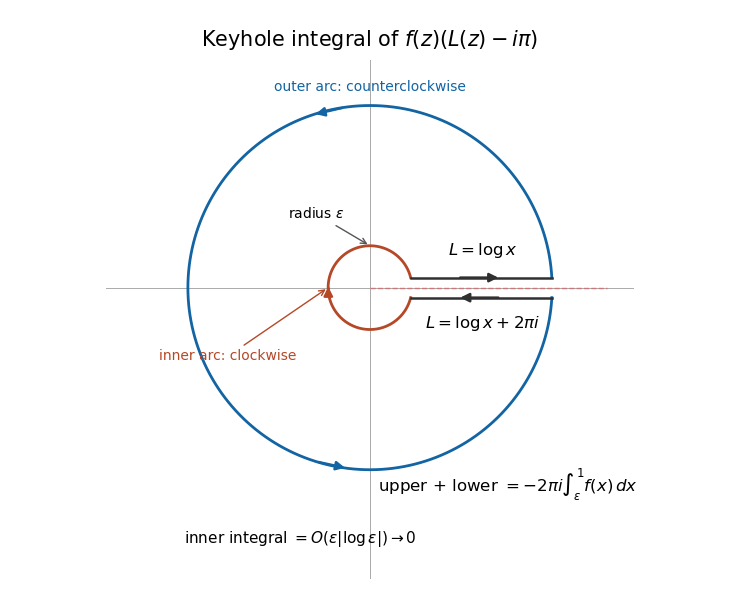
For an entire function , use the complex logarithm with argument in . The unit-circle integral in the title uses the branch's one-sided boundary values at its crossing with the cut. On a keyhole contour, the outward upper bank has , and the inward lower bank has . Their combined integral of is . The inner circle contributes , which vanishes. The Cauchy integral theorem on the slit plane therefore gives the identity.
On , . The estimation lemma consequently givesSubtracting the middle branch value centres the weight and produces this bound. The contour crosses the cut only in the limiting boundary-value interpretation, so it is not a closed contour inside the logarithm's domain.
If an entire function satisfied , then . Differentiating would give , a contradiction. More generally, the order of every zero of a square of a holomorphic function is even, so a simple zero prevents a holomorphic square root on any neighborhood containing it. A square root can still exist on a slit domain avoiding the zero. The identity theorem can force this obstruction from values specified only on a sequence accumulating elsewhere in a connected domain.
A particulate carbon-rich product of incomplete combustion, with structure and impurities depending on formation conditions.
Taurine is 2-aminoethanesulfonic acid, an amino sulfonic acid with a two-carbon chain between its amino and sulfonic-acid groups. Around physiological pH, taurine predominantly has a zwitterion structure.
Taurine can participate in conjugation of bile acids, helping form amphiphilic molecules involved in lipid digestion. Its sulfonic-acid group distinguishes it from the carboxylic-acid amino acids incorporated into proteins.[ref]
Taurine in ChEBI. Definition, structure, and biological roles
Cystine is the disulfide formed when two cysteine units are linked through their sulfur atoms. Oxidation forms the disulfide bond; reduction can regenerate two thiol groups.
Within a protein, the analogous linkage joins two cysteine residues and can stabilize a folded structure or connect separate chains. This makes sulfur oxidation state a direct link between chemical reactivity and protein structure.
A holder may choose a shout time and receive , or choose no shout and receive . The lock-in term is signed, so shouting below strike can create a negative payoff. Backward induction must compare this actual contract with waiting. For , multipliers , bank growth , strike 101 and two periods, the optimal policy waits at zero, shouts after the first up move, and never shouts after the first down move. The risk-neutral price is . Claim payoffs at a recombined stock node can differ according to earlier shout history.
The finite alphabet of symbols permitted on the stack of a pushdown automaton. It may contain nonterminal symbols, terminal symbols, and a fresh stack bottom marker, independently of the input alphabet.
A delayed acknowledgement postpones a response briefly so that one acknowledgement may cover more data or accompany returning data. Its timer can interact with Nagle's algorithm to delay a short exchange.
A historical designation used for the vinegar-forming surface growth. It should not be assumed to identify every modern vinegar organism as one species.
Highly concentrated acetic acid, distinguished from the dilute acid used in other pharmaceutical formulas.
A collection of pus in tissues around a tonsil. The localized cavity differs from uncomplicated diffuse tonsillitis, despite overlapping pain and inflammation.
Pinned article: Introduction to the OurBigBook Project
Welcome to the OurBigBook Project! Our goal is to create the perfect publishing platform for STEM subjects, and get university-level students to write the best free STEM tutorials ever.
Everyone is welcome to create an account and play with the site: ourbigbook.com/go/register. We belive that students themselves can write amazing tutorials, but teachers are welcome too. You can write about anything you want, it doesn't have to be STEM or even educational. Silly test content is very welcome and you won't be penalized in any way. Just keep it legal!
Intro to OurBigBook
. Source. We have two killer features:
- topics: topics group articles by different users with the same title, e.g. here is the topic for the "Fundamental Theorem of Calculus" ourbigbook.com/go/topic/fundamental-theorem-of-calculusArticles of different users are sorted by upvote within each article page. This feature is a bit like:
- a Wikipedia where each user can have their own version of each article
- a Q&A website like Stack Overflow, where multiple people can give their views on a given topic, and the best ones are sorted by upvote. Except you don't need to wait for someone to ask first, and any topic goes, no matter how narrow or broad
This feature makes it possible for readers to find better explanations of any topic created by other writers. And it allows writers to create an explanation in a place that readers might actually find it.
Figure 1. Screenshot of the "Derivative" topic page. View it live at: ourbigbook.com/go/topic/derivativeVideo 2. OurBigBook Web topics demo. Source. - local editing: you can store all your personal knowledge base content locally in a plaintext markup format that can be edited locally and published either:This way you can be sure that even if OurBigBook.com were to go down one day (which we have no plans to do as it is quite cheap to host!), your content will still be perfectly readable as a static site.
- to OurBigBook.com to get awesome multi-user features like topics and likes
- as HTML files to a static website, which you can host yourself for free on many external providers like GitHub Pages, and remain in full control

Figure 2. You can publish local OurBigBook lightweight markup files to either OurBigBook.com or as a static website.
Figure 3. Visual Studio Code extension installation.
Figure 5. . You can also edit articles on the Web editor without installing anything locally. Video 3. Edit locally and publish demo. Source. This shows editing OurBigBook Markup and publishing it using the Visual Studio Code extension. 
- Infinitely deep tables of contents:



All our software is open source and hosted at: github.com/ourbigbook/ourbigbook
Further documentation can be found at: docs.ourbigbook.com
Feel free to reach our to us for any help or suggestions: docs.ourbigbook.com/#contact