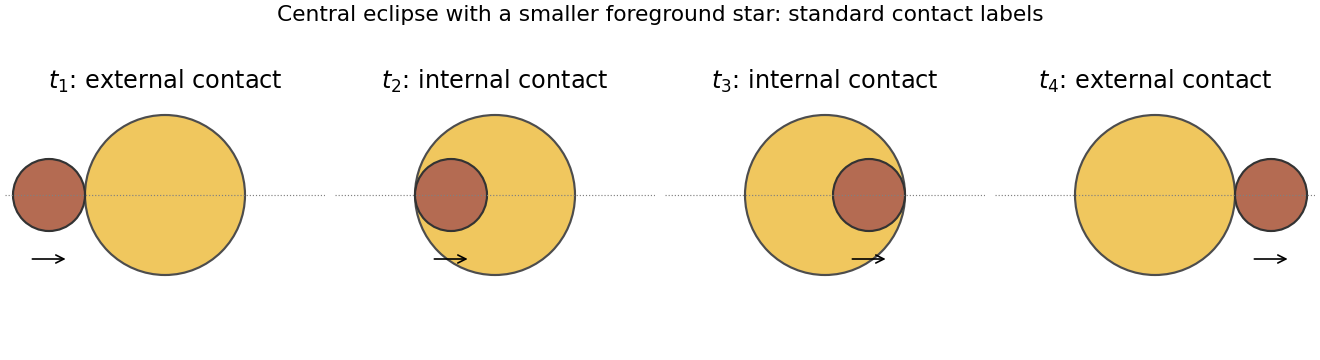
TODO: the source light curve, its numerical contact phases and the meanings of the four plotted time labels are absent, so unique numerical stellar radii cannot be recovered. The central eclipse contact-radius relations explain what the missing measurements would determine.
If denote the usual first through fourth contacts of a central eclipse, define and , and let be the two radii. For a circular edge-on orbit,
Taking half their sum and difference gives the radii. For short eclipses the familiar approximation is and , with . At first and fourth contact the discs touch externally; at second and third the smaller disc is just internally tangent to the larger. Noncentral eclipses require the projected impact parameter as well.
Figure 1.
Conditional central-eclipse contact geometry; this schematic supplies no readings from the missing source light curve
. Details.
Equal radial velocity amplitudes imply equal stellar masses. Under the circular, edge-on eclipsing binary interpretation, each star moves at , and the relative speed is . Thus
Using days gives
More generally, spectroscopic binary amplitudes determine and . Thus these numerical masses and separation use , ; eclipses alone imply high inclination rather than its exact value.
For two bodies of masses , the relative Kepler orbit has semimajor axis and orbital period satisfying Kepler's third law
Here is the semimajor axis of the separation vector, not either star's individual barycentric orbit. In conventional stellar units the same relation is approximately , with year, astronomical unit and solar mass as the units.
Substituting the electron Lorentz factor in the supplied energy-loss formula gives
Without replenishment, the electron's momentum decreases. The reference dipoles then bend it more tightly, producing a displaced orbit. In linear beam optics, and , where per uncompensated turn. In an ideal planar ring the horizontal dispersion is nonzero and the orbit shifts horizontally, inward where . There is no corresponding vertical closed-orbit shift when . Real coupling or vertical dispersion can change that idealization.
With current A, the number of circulating particles is , so the radiated power is
The revolution time cancels when using beam current. Radio-frequency cavities restore the lost energy longitudinally, with synchronous gain in the sine-phase convention. Their RF power system must supply at least this beam power, in addition to its own losses. Radiation damping and quantum excitation determine beam emittances; they should not be confused with the dispersive closed-orbit shift from a momentum change.
For a GeV electron, . With m, the stated synchrotron critical frequency formula gives
At the same total beam energy and bend radius, a proton has , and the same supplied formula gives
The ratio is , explaining the strong suppression for protons. The critical-energy formula is an ultrarelativistic approximation, excellent for the electron and only approximate for this moderately relativistic proton. If “5 GeV proton beam” instead denotes kinetic energy, then and the estimate is about eV; the two beam-energy conventions should not be mixed.
Relativistic radiation is concentrated into an angle of order around the instantaneous velocity. The emission direction sweeps past a tangent observer over an orbital interval of order . Since the charge moves toward the observer, arrival times are compressed by an additional factor of order , giving the spectral scale .
The conventional numerical factor follows from the radiation Fourier phase. Near the tangent direction, circular motion gives
With , this becomes . The resulting Airy-type integrals are expressible through modified Bessel functions with tangent-plane argument . The standard angle-integrated synchrotron radiation spectrum has shape
It therefore identifies
The beaming argument supplies the physical scaling; the spectral integral fixes the conventional factor . Critical energy is a broad spectral scale, not a hard photon-energy cutoff.[ref]
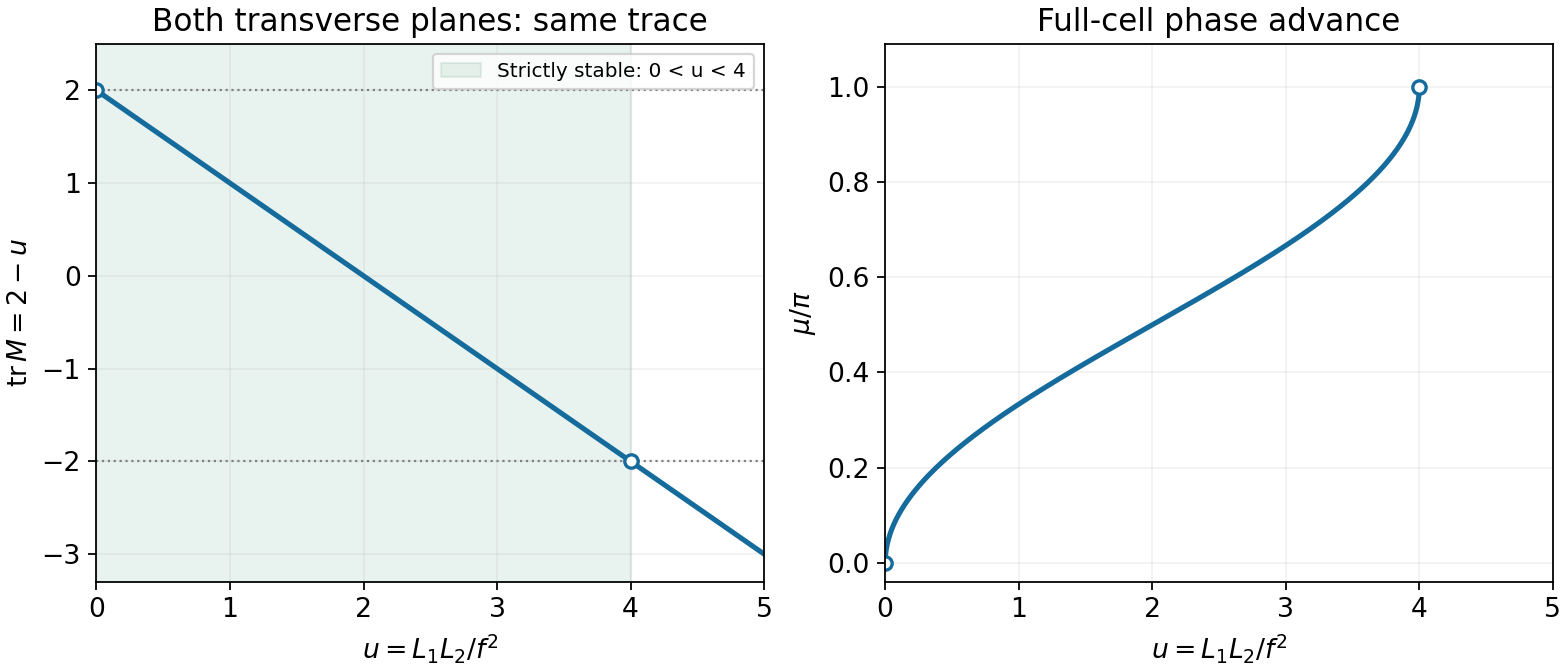
For a real determinant-one map, bounded generic repeated transport requires eigenvalues , equivalently . Here both planes have , so
For positive drift lengths and , this means . The equalities are marginal and generally produce a Jordan-block growth rather than stable motion. Moving the reference point changes the map by a similarity transformation, , so the eigenvalues and full-cell phase advance are unchanged.
Write the stable map using the Courant-Snyder parameters, also called Twiss parameters:
At the chosen reference point , , and . Repeated traversal gives
If the full ring contains identical cells, its one-turn phase is modulo ; ring turns use . The displayed is for repetitions of the specified cell.
Figure 1.
Stability and phase advance of the equal-strength quadrupole cell
. Both transverse planes have trace 2 minus L_1 L_2/f squared. The strict stable interval excludes the two marginal boundaries. Details.
Maps act on column vectors, so the first element appears at the right of the product. Starting immediately before the focusing kick, one full cell has
Multiplying gives
It has , as required for this lossless linear beam optics. The other transverse plane experiences the opposite quadrupole signs, so
The two planes have different envelopes but the same trace and therefore the same stable phase-advance magnitude for this equal-strength doublet.
Use transverse coordinates and a signed focusing strength in Hill's equation, . A drift of length has beam transfer matrix
For a uniform focusing quadrupole magnet with , and a defocusing one with ,
The focusing plane has oscillatory trajectories, while the defocusing plane has hyperbolic growth and decay. A magnetic quadrupole focuses one transverse plane and defocuses the other; reversing its gradient interchanges their roles.
If and the element's internal drift can be neglected or assigned separately, its kick may be concentrated at one position. With ,
Both kicks preserve position and change the slope linearly with displacement. All these ideal uncoupled maps have determinant one.
Evaluate the envelopes at their displayed arguments and set . The common phase cancels from every bilinear. Direct use of the Pauli matrices gives
The physical longitudinal current is : the two density profiles move in opposite directions. Their separate transport identities give .
For a coherent superposition, the transverse currents and generally do not vanish. They are independent of , so they contribute no divergence in this one-dimensional construction. Omitting them would give an incorrect local four-current. Pointwise, , so the pure two-component Weyl current is future null wherever the density is nonzero. If only one envelope is present, the current points entirely along its propagation direction; an incoherent average can remove the transverse interference terms.
For dependence on alone and constant , remove the common phase by . Then . The normalized eigenvectors
obey . The corresponding first-order transport equations have characteristics and , respectively, giving
Here propagates toward and toward , both at unit speed.
For a fixed unit vector , replace by and choose orthonormal spinors satisfying . If , one choice is
Independent constant phases on the spinors can be absorbed into the two arbitrary envelope functions.
Assume the scalar potential is real, so the Weyl equation has a Hermitian Hamiltonian . Multiplying the equation and its adjoint by and respectively gives
Thus with and , the lower-index four-current obeys .
For ,
Consequently is conserved for spatially constant ; a spatially uniform time-dependent scalar offset would also commute with it. For general nonuniform it is not conserved. At nonzero momentum, , so the helicity eigenvalues are . In the chosen constant-potential Weyl Hamiltonian, the positive branch has helicity ; the negative branch has . An expectation value in a superposition need not itself be an eigenvalue.

Pinned article: Introduction to the OurBigBook Project

Welcome to the OurBigBook Project! Our goal is to create the perfect publishing platform for STEM subjects, and get university-level students to write the best free STEM tutorials ever.
Everyone is welcome to create an account and play with the site: ourbigbook.com/go/register. We belive that students themselves can write amazing tutorials, but teachers are welcome too. You can write about anything you want, it doesn't have to be STEM or even educational. Silly test content is very welcome and you won't be penalized in any way. Just keep it legal!
We have two killer features:
  1. topics: topics group articles by different users with the same title, e.g. here is the topic for the "Fundamental Theorem of Calculus" ourbigbook.com/go/topic/fundamental-theorem-of-calculus
    Articles of different users are sorted by upvote within each article page. This feature is a bit like:
    • a Wikipedia where each user can have their own version of each article
    • a Q&A website like Stack Overflow, where multiple people can give their views on a given topic, and the best ones are sorted by upvote. Except you don't need to wait for someone to ask first, and any topic goes, no matter how narrow or broad
    This feature makes it possible for readers to find better explanations of any topic created by other writers. And it allows writers to create an explanation in a place that readers might actually find it.

    Figure 1.
    Screenshot of the "Derivative" topic page
    . View it live at: ourbigbook.com/go/topic/derivative
  2. local editing: you can store all your personal knowledge base content locally in a plaintext markup format that can be edited locally and published either:
    This way you can be sure that even if OurBigBook.com were to go down one day (which we have no plans to do as it is quite cheap to host!), your content will still be perfectly readable as a static site.
    Figure 5. . You can also edit articles on the Web editor without installing anything locally.
    Video 3.
    Edit locally and publish demo
    . Source. This shows editing OurBigBook Markup and publishing it using the Visual Studio Code extension.

  3. https://raw.githubusercontent.com/ourbigbook/ourbigbook-media/master/feature/x/hilbert-space-arrow.png
  4. Infinitely deep tables of contents:
    Figure 6.
    Dynamic article tree with infinitely deep table of contents
    .
    Descendant pages can also show up as toplevel e.g.: ourbigbook.com/cirosantilli/chordate-subclade
All our software is open source and hosted at: github.com/ourbigbook/ourbigbook
Further documentation can be found at: docs.ourbigbook.com
Feel free to reach our to us for any help or suggestions: docs.ourbigbook.com/#contact