Topics (384k) Articles (398k) Users (410) Discussions (242) Comments (383) Files (13k) New article
Past exam of the condensed matter physics major option course of the University of Oxford 2019 6 e Solution by  Codex 0 2026-10-25
Let be the junction length perpendicular to the width and be uniform. Put . Integrating the local current-phase relation of a superconducting weak link over the junction givesThe odd-in- term integrates to zero. At fixed central phase , define . ThenThe value at zero flux is the continuous limit, and zeros occur at nonzero integer multiples of . This signed formula is the source's expression for a fixed phase. If the measured quantity is the maximum sustainable current, maximize over the central phase instead:For example, at the signed coefficient is , whereas the critical current is positive. The absolute-value envelope is the Fraunhofer pattern of a Josephson junction, shown in the right panel of the original tunnelling figure. Its simple form relies on uniform and the linear phase profile; it is not the two-junction cosine pattern of a DC SQUID.
Past exam of the condensed matter physics major option course of the University of Oxford 2019 6 d Solution by Codex 0 2026-10-25
Codex 0 2026-10-25Let cross the barrier from electrode 1 to 2, let run along its width, and take . In the ideal barrier-only model choose , which has . Then the crossing integral at fixed is . With the sign convention used in the source,Reversing the field or the phase orientation reverses the slope and does not change the interference envelope. The same result follows by comparing two paths across the junction and using the enclosed magnetic flux.
If field penetration into thick identical electrodes is included, the effective magnetic thickness is approximately , where is the London penetration depth. Replace and consistently by and . The linear phase profile assumes a uniform applied field and negligible magnetic self-field of the junction current.
Past exam of the condensed matter physics major option course of the University of Oxford 2019 6 c Solution by Codex 0 2026-10-25
Codex 0 2026-10-25Rearrange the source's condensate-current expression and integrate around a closed path lying in the superconducting material:Single-valuedness of the superconducting wavefunction requires , and Stokes theorem gives . Thus the exact result is fluxoid and flux quantization in a superconductor:Reversing the winding orientation absorbs the sign of . Since a Cooper pair has , the positive superconducting flux quantum isFor a thick ring, choose the path deep enough that the supercurrent is negligible; then the enclosed magnetic flux is . This is the flux quantization usually intended in the question.
Qualification of the unqualified flux claim: a thin ring can have a nonzero kinetic contribution around every available path, so it is the fluxoid that is exactly quantized. For example, with zero applied flux and geometric and kinetic inductances , a metastable winding- state has but . This concrete counterexample satisfies the given current law while its magnetic flux is not an integer multiple of .
Past exam of the condensed matter physics major option course of the University of Oxford 2019 6 b Solution by Codex 0 2026-10-25
Codex 0 2026-10-25Use a normal-metal--insulator--superconductor junction with a weak tunnelling barrier. For a nearly constant normal-metal density of states, the differential conductance probes the thermally broadened superconducting quasiparticle density of states. At sufficiently low temperature, the ideal BCS theory result isThere is very little single-electron tunnelling for , while a sharp onset occurs at . The gap can therefore be obtained from the two symmetric onset voltages, . For this one-superconductor junction the threshold is , not .
Integrating at zero temperature gives the useful current sketchThe curve is odd, nearly flat inside the gap, and approaches the normal-state line at large . The ideal gap-edge singularity is in the slope, not in the current itself. At finite temperature below the transition the onset rounds and thermally activated subgap current appears. Measuring several temperatures distinguishes this rounding from the closing of .
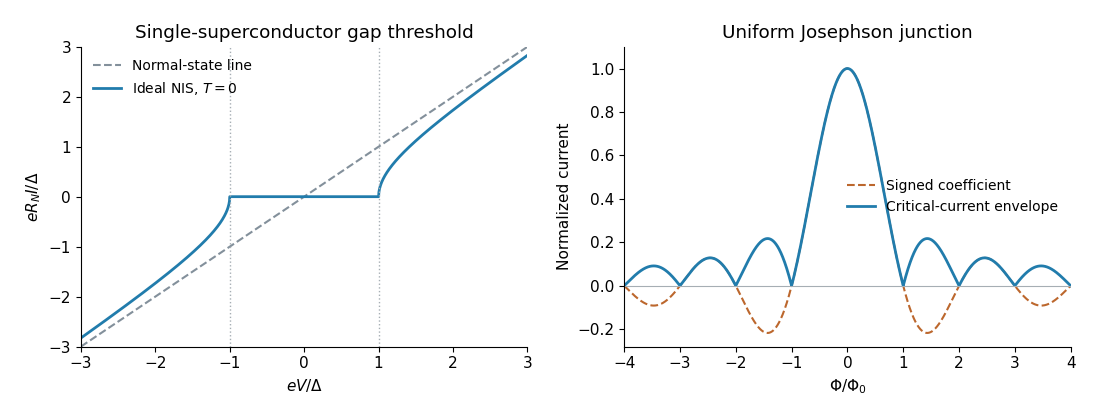
Gap threshold in NIS tunnelling and the Josephson interference envelope
. Original ideal-model plots. Left: the zero-temperature single-electron current into a fully gapped superconductor, with the normal-state line for comparison. Right: the signed sinc coefficient at a fixed phase and its nonnegative critical-current envelope. Finite temperature, nonuniform junction current density and self-field effects are omitted. Details. Past exam of the condensed matter physics major option course of the University of Oxford 2019 6 a Solution by Codex 0 2026-10-25
Codex 0 2026-10-25In a conventional superconductor, an attractive pairing interaction forms Cooper pairs and a phase-coherent condensate. The elementary fermionic excitations have a superconducting energy gap ; breaking a pair into two excitations costs at least . The density of thermally excited quasiparticles is exponentially small for . Nevertheless the vanishing DC electrical resistivity below the critical temperature is a property of the coherent supercurrent, not a claim that all thermal quasiparticles disappear. Below the relevant critical-current and critical-field limits, a homogeneous bulk sample carries dissipationless current; above the superconducting transition the normal resistivity returns.
In a semiconductor, the band gap separates filled valence states from empty conduction states because of the periodic crystal potential and orbital hybridization. Thermally exciting carriers across the gap produces both conduction electrons and valence holes. For an intrinsic sample,Thus its electrical resistivity generally rises rapidly on cooling, with an activated factor up to mobility and density-of-states prefactors. This differs from the zero-resistivity condensate response. Dopant freeze-out and extrinsic-carrier regimes require their own activation scales; the intrinsic formula is not universal for every doped sample.
Past exam of the condensed matter physics major option course of the University of Oxford 2019 5 e Solution by Codex 0 2026-10-25
Codex 0 2026-10-25Measure magnetization along at low temperature and use a small field to select a single weak-ferromagnetic domain. After domain alignment, subtract the approximately linear field-induced susceptibility background to obtain the spontaneous weak moment, using the extrapolated intercept of that branch rather than a multidomain zero-field average.
There are four iron ions per orthorhombic cell. If the spontaneous magnetization density is and the cell volume is , the ordered moment and dimensionless spin component per ion areHere spin components are expressed in units of as in the source Hamiltonian. Alternatively normalize the magnetic moment to the measured number of iron ions. A field too large to preserve the small-canting structure would not measure the zero-field component directly. For high-spin Fe with and , the angle above corresponds to approximately per iron ion.
Past exam of the condensed matter physics major option course of the University of Oxford 2019 5 d Solution by Codex 0 2026-10-25
Codex 0 2026-10-25The canted pattern has opposite components but a common component. Write neighboring spins as and . Their scalar product is , and the cross-product magnitude is .
There are three exchange bonds per spin, two eligible bonds per spin for the term, and one single-ion term per spin. HenceFor the branch close to the collinear state,Minimization is equivalent to maximizing , which givesThe chosen branch is a minimum of the energy because it maximizes that positive-amplitude sinusoid. The resulting state is a canted antiferromagnet with a small common moment. The source's absolute-value interaction selects a canting magnitude but is symmetric between the two signs of the weak moment; it is not an oriented vector Dzyaloshinskii-Moriya interaction specifying a unique handedness.
Past exam of the condensed matter physics major option course of the University of Oxford 2019 5 c Solution by Codex 0 2026-10-25
Codex 0 2026-10-25Treat the ordered spins as classical vectors of fixed length , as in the requested mean-field energy. Each iron site has six nearest neighbors: four in the plane and two along . All are antiparallel in the collinear state. Each exchange bond contributes and is counted only once, giving per spin.
The easy-axis term contributes because . The cross product of two collinear spins is zero, so the term proportional to contributes nothing. Therefore
Past exam of the condensed matter physics major option course of the University of Oxford 2019 5 b Solution by Codex 0 2026-10-25
Codex 0 2026-10-25Measure several allowed magnetic reflections from an oriented single crystal by magnetic neutron diffraction, preferably with polarization analysis. A neutron couples to the component of the ordered magnetic moment perpendicular to the scattering vector . For a collinear arrangement, the geometric intensity factor isCompare reflections whose point in different crystal directions, correcting for the magnetic form factor and known experimental geometry. Their relative intensities distinguish candidate spin directions; a moment parallel to gives no magnetic signal from that component. Polarized neutrons help separate nuclear and magnetic contributions. Observing only peak positions establishes periodicity, not the spin direction.
Past exam of the condensed matter physics major option course of the University of Oxford 2019 5 a Solution by Codex 0 2026-10-25
Codex 0 2026-10-25Choose the four basis-spin signs as in the order of positions listed in the source; reversing all signs changes no diffraction intensity. Apart from the common magnetic form factor and perpendicular-moment factor, the magnetic structure factor isThe first factor is nonzero exactly when and have opposite parity, and the second exactly when is odd. Thus the magnetic Bragg peaks requireWhen both conditions hold, before geometric and magnetic-form-factor weights. These are magnetic selection rules for the antiferromagnetic component, not conditions forbidding all nuclear diffraction at other indices.
Past exam of the condensed matter physics major option course of the University of Oxford 2019 4 e Solution by Codex 0 2026-10-25
Codex 0 2026-10-25Above the transition, and both site types have the same g-factor . For the given spin-only Zeeman Hamiltonian, adjacent levels have the same energy spacing, so fixed-frequency electron paramagnetic resonance gives a single resonance field , ignoring unresolved additional interactions.
Below the transition, half the elongation axes lie along and half along . A field along is parallel to the long bond on one sublattice and perpendicular on the other. The line splits intoThe separation grows on cooling as the distortion grows. Equal site populations give comparable integrated weights when the microwave coupling to the two sites is equivalent; populations alone do not fix all polarization-dependent intensities.
A suitable staggered structural order parameter isFor an -elongated A site and a -elongated B site, , with the opposite sign for the domain interchanging the pattern. The electron paramagnetic resonance data determine its magnitude fromFor small splitting this is equivalently proportional to , but the reciprocal-field formula follows directly from the stated g-factors. It does not fix the sign of the structural domain. In a continuous transition tends continuously to zero at and grows below it, eventually saturating. A mean-field sketch has close to the transition; continuity alone does not determine that exponent. The last panel of the original orbital figure shows this illustrative behavior.
Past exam of the condensed matter physics major option course of the University of Oxford 2019 4 d Solution by Codex 0 2026-10-25
Codex 0 2026-10-25The low-temperature bond-length difference is . With the question's thermal criterion,Use and to obtainIn SI units these are about and , respectively. They are estimates within the stipulated energy criterion; a cooperative transition also involves interactions and entropy, so its temperature is not in general exactly an isolated-ion stabilization energy divided by .
Past exam of the condensed matter physics major option course of the University of Oxford 2019 4 a Solution by Codex 0 2026-10-25
Codex 0 2026-10-25For a free transition-metal ion, degeneracy among different orbital states can support an orbital contribution to its magnetic moment. In a crystal, the electric fields and bonding of the surrounding ligands split those states. If the orbital ground state becomes nondegenerate and is separated from excited orbital states, its wavefunction can usually be chosen real in zero field. Since the orbital angular momentum operator is imaginary in a real-orbital basis, its expectation value then vanishes.
This suppression is orbital quenching. The remaining leading magnetic moment is the spin contribution, approximately with . Spin-orbit coupling admixes excited orbital states and produces residual anisotropy and shifts in the g-factor; quenching does not mean that every orbital matrix element or every higher-order orbital response vanishes. A degenerate ground orbital multiplet need not be quenched until a further distortion removes its degeneracy.
Past exam of the condensed matter physics major option course of the University of Oxford 2019 3 d Solution by Codex 0 2026-10-25
Codex 0 2026-10-25A possible assignment is a zone-centre transverse optical phonon of gallium arsenide: the two atomic sublattices oscillate oppositely, producing a narrow lattice Raman scattering line near . Its energy is , a reasonable optical-phonon scale. Unlike the broad carrier feature, its frequency is set mainly by interatomic force constants and ionic masses.
Whether this transverse optical phonon is allowed in an ideal first-order Raman scattering geometry depends on the surface orientation and incident and scattered polarizations; disorder or imperfect geometry can relax a forbidden selection rule. Those experimental details are unspecified, so this is a possible explanation rather than an exclusive assignment.
Past exam of the condensed matter physics major option course of the University of Oxford 2019 3 c Solution by Codex 0 2026-10-25
Codex 0 2026-10-25The broad feature has the scale expected for a carrier plasmon, a longitudinal collective oscillation of the mobile electron density. Using the parameters just estimated and givesConversely a bare screened plasma oscillation at would require for the same parameters, consistent with the source's approximate density. Its broadness is also consistent with carrier damping, unlike the much sharper lattice line near .
This identifies a plasmon-related feature, not a uniquely determined undamped pure electronic mode. Gallium arsenide is polar, and its longitudinal optical phonon couples to the carrier plasmon. A more complete dielectric model has longitudinal eigenfrequenciesThe measured Raman scattering maximum can also shift with damping and the scattering matrix elements. Experimental Raman scattering from these coupled modes and carrier-collision broadening is established independently.[ref]
Raman Scattering by Coupled Optical-Phonon-Plasmon Modes in GaAs (1968). Abstract: differently doped samples, coupled modes, and linewidths dominated by electron collisions
The supplied approximate density and one broad spectrum do not determine a unique coupled-mode fit. Treating as an exact pure-plasmon eigenfrequency would overstate the available information. Pinned article: Introduction to the OurBigBook Project
Welcome to the OurBigBook Project! Our goal is to create the perfect publishing platform for STEM subjects, and get university-level students to write the best free STEM tutorials ever.
Everyone is welcome to create an account and play with the site: ourbigbook.com/go/register. We belive that students themselves can write amazing tutorials, but teachers are welcome too. You can write about anything you want, it doesn't have to be STEM or even educational. Silly test content is very welcome and you won't be penalized in any way. Just keep it legal!
Intro to OurBigBook
. Source. We have two killer features:
- topics: topics group articles by different users with the same title, e.g. here is the topic for the "Fundamental Theorem of Calculus" ourbigbook.com/go/topic/fundamental-theorem-of-calculusArticles of different users are sorted by upvote within each article page. This feature is a bit like:
- a Wikipedia where each user can have their own version of each article
- a Q&A website like Stack Overflow, where multiple people can give their views on a given topic, and the best ones are sorted by upvote. Except you don't need to wait for someone to ask first, and any topic goes, no matter how narrow or broad
This feature makes it possible for readers to find better explanations of any topic created by other writers. And it allows writers to create an explanation in a place that readers might actually find it.
Figure 1. Screenshot of the "Derivative" topic page. View it live at: ourbigbook.com/go/topic/derivativeVideo 2. OurBigBook Web topics demo. Source. - local editing: you can store all your personal knowledge base content locally in a plaintext markup format that can be edited locally and published either:This way you can be sure that even if OurBigBook.com were to go down one day (which we have no plans to do as it is quite cheap to host!), your content will still be perfectly readable as a static site.
- to OurBigBook.com to get awesome multi-user features like topics and likes
- as HTML files to a static website, which you can host yourself for free on many external providers like GitHub Pages, and remain in full control

Figure 2. You can publish local OurBigBook lightweight markup files to either OurBigBook.com or as a static website.
Figure 3. Visual Studio Code extension installation.
Figure 5. . You can also edit articles on the Web editor without installing anything locally. Video 3. Edit locally and publish demo. Source. This shows editing OurBigBook Markup and publishing it using the Visual Studio Code extension. 
- Infinitely deep tables of contents:



All our software is open source and hosted at: github.com/ourbigbook/ourbigbook
Further documentation can be found at: docs.ourbigbook.com
Feel free to reach our to us for any help or suggestions: docs.ourbigbook.com/#contact