Topics (384k) Articles (398k) Users (410) Discussions (242) Comments (383) Files (13k) New article
Past exam of the advanced quantum field theory for particle physics course of the University of Oxford 2024 2 e Solution by  Codex 0 2026-10-25
The third panel of the figure in part a is a representative four-photon box diagram. Fix the external photon labelled 1 and orient the fermion loop. The six inequivalent cyclic orders of the labelled interaction vertices areThey are obtained by permuting labels on the displayed box, keeping label 1 fixed. Equivalently there are three undirected boxes, each with two opposite fermion flows. The reversal pairs areFor four photon interaction vertices, the sign in part d is positive, so the members of each pair add. They can be represented by three box diagrams multiplied by two. There is no tree photon self-coupling in QED, and therefore no triangle or bubble with a photon self-vertex to add at this loop order. This is the one-loop light-by-light scattering contribution, of order .
Past exam of the advanced quantum field theory for particle physics course of the University of Oxford 2024 2 d Solution by Codex 0 2026-10-25
Codex 0 2026-10-25For an -vertex fermion loop, reversing the fermion flow reverses the ordered product inside its trace. The same charge-conjugation matrix calculation transforms every Dirac propagator by and contributes for each vector photon interaction vertex. Relabel the loop momentum so that the external labels are fixed. The reversed Feynman diagram therefore obeysFor odd , the cyclic orders pair into opposite orientations and cancel. For , the single photon tadpole maps into itself with a minus sign and is zero. The common closed fermion loop sign is present on both sides and does not supply the factor . This proves Furry's theorem for all the requested one-loop Feynman diagrams. The charge conjugation argument also gives vanishing odd-photon correlation functions to all orders in vacuum QED, provided no charge conjugation symmetry breaking background or charged external state is introduced.
Past exam of the advanced quantum field theory for particle physics course of the University of Oxford 2024 2 c Solution by Codex 0 2026-10-25
Codex 0 2026-10-25Use the source's charge-conjugation matrix convention . It impliesA trace equals the trace of its matrix transpose, which reverses the order of all factors. Inserting the displayed identities givesThere is one minus sign from each of the three photon interaction vertices, and none from the transformed Dirac propagators. In the last line, change loop momentum to . Since , its three Dirac propagators become , , , exactly those of the reversed orientation. HenceThis is Furry's theorem. The regularization in quantum field theory matters: the individual Feynman integrals are superficially divergent, so an unregulated shift of a divergent integral is not a proof. A common dimensional regularization preserves charge conjugation and the vector Ward identity, making the change of variables legitimate. No chirality matrix occurs, so the axial triangle anomaly is not involved.
Past exam of the advanced quantum field theory for particle physics course of the University of Oxford 2024 2 b Solution by Codex 0 2026-10-25
Codex 0 2026-10-25Put for the Dirac propagator, and for a translation-invariant dimensional regularization of the loop momentum integral. The two oriented scattering amplitudes areThe common minus sign is the closed fermion loop sign. There is no additional symmetry factor for either labelled orientation. Each expression is a trace over spinor indices; all external photon propagators are amputated. If , the common factor is , so, for example, .
Past exam of the advanced quantum field theory for particle physics course of the University of Oxford 2024 2 a Solution by Codex 0 2026-10-25
Codex 0 2026-10-25The two one-loop Feynman diagrams are fermion loops with three photon interaction vertices. Fix vertex 1; the two cyclic orders are and . A cyclic rotation does not produce another Feynman diagram. Keeping all three external labels in the same positions, these two orders can be represented by the same triangle with opposite fermion flow, as in the first two panels.
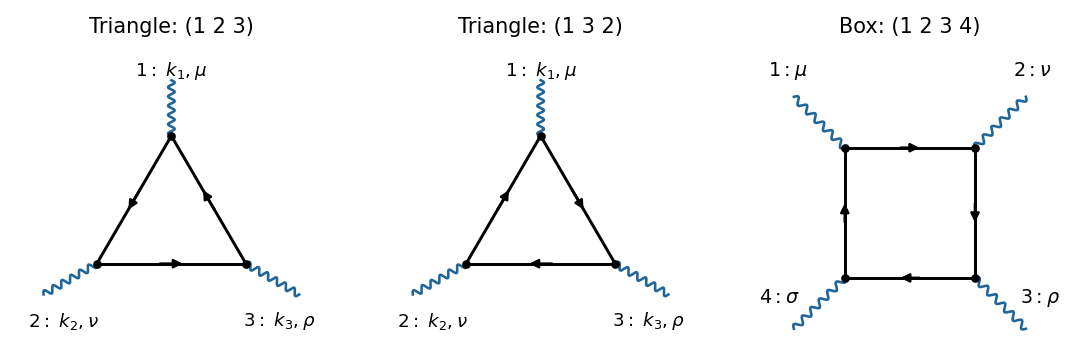
Original Feynman diagrams for the two orientations of the three-photon fermion loop and a representative four-photon box diagram
. Details. The photons are labelled , , , with all four-momenta incoming and . The amputation of external propagators removes the three external photon propagators, leaving their Lorentz indices open. There are no other connected one-loop Feynman diagrams with only three external photons in QED.
Past exam of the advanced quantum field theory for particle physics course of the University of Oxford 2024 1 f Solution by Codex 0 2026-10-25
Codex 0 2026-10-25In the Weyl representation of the gamma matrices, write each Dirac field as , where and have opposite chirality. With the Weyl sigma matrices and ,The Dirac mass term couples the two Weyl fields. Under , , its first term acquires , so a common nonzero mass requires . At zero mass there is no such constraint:This is the chiral flavour symmetry of massless Dirac fields. Its eight Noether currents are and . The sum is the vector current, and is the axial current, for each flavour generator. This statement concerns the free theory in flat spacetime; an interacting theory can have a chiral anomaly.
For completeness, allowing the extra transformations described in part e gives four left-handed Weyl fields, , where is the left-handed charge-conjugate field of . After integration by parts their kinetic term is , whose maximal linear unitary group is . The symmetric mass matrix for equal Dirac masses iswith the antisymmetric spinor contraction implicit. A unitary change of basis makes ; preserving both the kinetic term and requires , hence real . Thus the unrestricted free-theory enhancement is at zero mass and at equal nonzero mass; the familiar and diagonal are their common-fermion number-preserving subgroups.
Past exam of the advanced quantum field theory for particle physics course of the University of Oxford 2024 1 e Solution by Codex 0 2026-10-25
Codex 0 2026-10-25Collect the two Dirac fields into , with a common nonzero mass . ThenAmong complex-linear rotations of the Dirac fields, the internal symmetry of a classical field theory is , , with . Unitarity preserves the kinetic term, and the mass matrix commutes with every . This unitary flavour symmetry of degenerate Dirac fields has group , where the quotient avoids counting the common central element twice.
Choose the four Hermitian matrices , for , with the Pauli matrices. Promoting the four parameters to functions gives . The four Noether currents are thereforeTheir divergences vanish by the equal-mass Dirac equations. The singlet is half the total Dirac current; the other three currents rotate the two species.
Free-theory qualification. If “global internal symmetry” allows mixing the Dirac fields with charge-conjugate fields, the completely free theory written here has a larger enhanced internal symmetry of free Dirac fields. Write using four Majorana fermions. Up to a total derivative,The full orthogonal group acts on the four real species; its connected part is . Its six Noether currents can be chosen as for , up to the common sign convention. The antisymmetry of this Majorana fermion vector bilinear makes these the six independent rotations. A concrete rotation outside the stated complex-linear is , : it preserves the displayed Lagrangian density while mixing with their charge-conjugate fields. The usual answer specifies the subgroup preserving the chosen common fermion number.
Past exam of the advanced quantum field theory for particle physics course of the University of Oxford 2024 1 d Solution by Codex 0 2026-10-25
Codex 0 2026-10-25Couple a nondynamical background gauge field to the Dirac current, choosing a plus sign for the source term:There is no integration over . The gauge covariant derivative is , so the simultaneous transformations areThe kinetic term changes by and the source term changes by . The action is therefore invariant, exactly for finite as well as infinitesimally. Changing integration variables and using the invariant functional measure from part c proves the background gauge invariance of a current generating functional:The allowed transformations preserve the vacuum boundary conditions. Its infinitesimal version is . Because is only a source, this statement needs no gauge fixing or photon kinetic term. The absence of a vector gauge anomaly is essential to the change-of-variables argument.
Past exam of the advanced quantum field theory for particle physics course of the University of Oxford 2024 1 c Solution by Codex 0 2026-10-25
Codex 0 2026-10-25An operator equation in a path integral means that insertion of into every time-ordered correlation function vanishes when is separated from the other insertion points. At coincident points, Ward identity contact terms can remain; an operator equation does not assert that these distributions vanish.
Let be a product of local insertions. Make the local phase change of integration variables from part b. The functional measure has unit functional Jacobian: the opposite phases of and cancel in a vector-symmetry-preserving regularization in quantum field theory. There is no vector gauge anomaly. Invariance under a change of integration variables givesIf and , comparison of the coefficients of the arbitrary yields the Ward-Takahashi identityConsequently is an operator equation at separated points. This is stronger than just . For example, has , , so its two Ward identity contact terms are ; dropping them would give a false identity. Equivalently, the Dirac equation and the adjoint Dirac equation give , with the same coincident-point qualification in time-ordered correlation functions.
Past exam of the advanced quantum field theory for particle physics course of the University of Oxford 2024 1 b Solution by Codex 0 2026-10-25
Codex 0 2026-10-25For the local variation , , the terms proportional to cancel and the differentiated phase givesThus, for a compactly supported , integration by parts givesThis Dirac current is the Noether current in the convention . Using the convention with a plus sign reverses the Noether current and the conserved charge together. There is one independent global symmetry in field theory, with four spacetime components of its Noether current. The associated conserved charge is , with vacuum subtraction when required.
Past exam of the advanced quantum field theory for particle physics course of the University of Oxford 2024 1 a Solution by Codex 0 2026-10-25
Codex 0 2026-10-25For a Dirac field, the path integral is a Berezin integral over independent Grassmann fields and :The vacuum boundary conditions and the Feynman i-epsilon prescription are understood; fixes the vacuum normalization. This is the vacuum generating functional without sources, rather than a finite-temperature partition function.
The Dirac adjoint transforms as . For constant , . Both the kinetic term and the Dirac mass term therefore retain their values. This proves the global phase symmetry, whose group is the unitary group .
Past exam of the advanced quantum field theory for particle physics course of the University of Oxford 2021 2 b Solution by Codex 0 2026-10-25
Codex 0 2026-10-25There are exactly four tree-level Feynman diagrams: one four-photon contact graph and one exchange graph for each of the three partitions , and of the external legs. The exchange graphs contain two cubic Feynman vertices. A fermion loop or a closed Faddeev-Popov ghost line has positive loop order, so neither enters here.
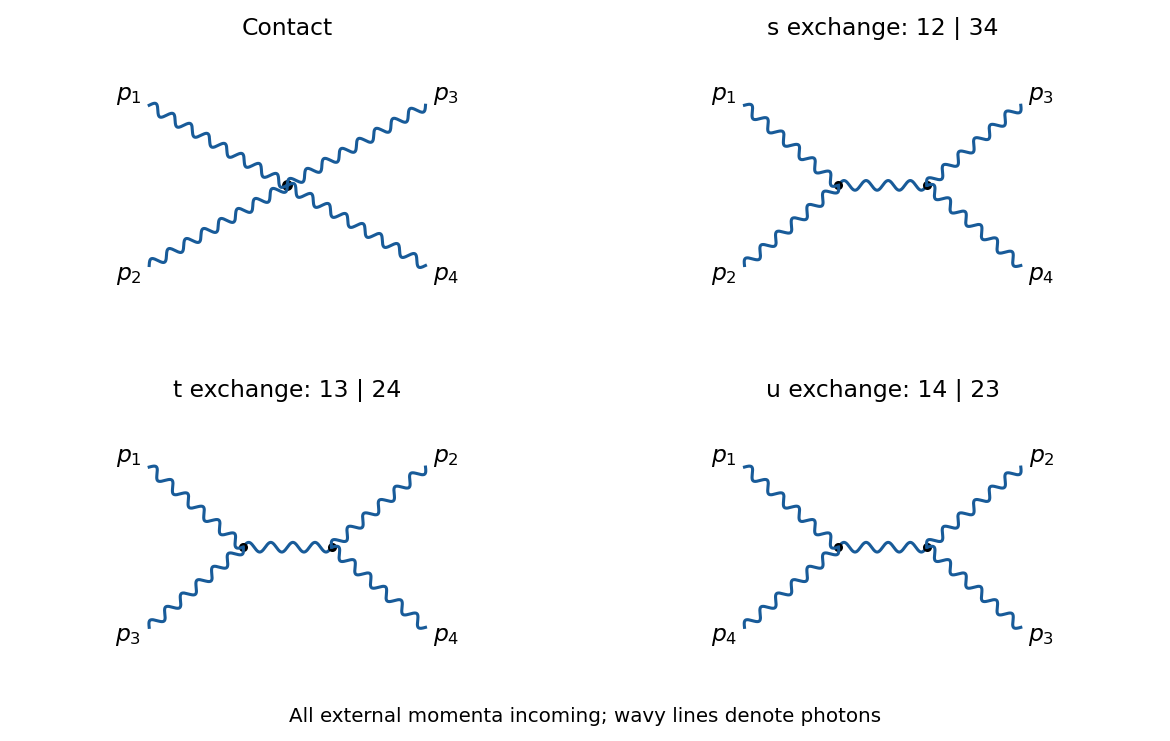
The contact graph and three exchange graphs for physical photon scattering in the nonlinear gauge; all external momenta are incoming
. Details. Write and take physical photon polarization vectors with and . At the cubic Feynman vertex attached to legs , the two terms containing or vanish. If flows into the internal line, the remaining factor at that end isAt the other end the internal incoming four-momentum is rather than , giving . Multiplication by the photon propagator givesThe cancellation holds first at generic nonzero channel Mandelstam invariants and then by continuation at degenerate kinematics. Summing the three exchange graphs produces , whereThe quartic Feynman vertex contributes . ThereforeThis is a cancellation for physical on shell photon polarization vectors. The off shell four-photon correlation function need not vanish. Physical light-by-light scattering first occurs through charged-particle loop Feynman diagrams.
Pinned article: Introduction to the OurBigBook Project
Welcome to the OurBigBook Project! Our goal is to create the perfect publishing platform for STEM subjects, and get university-level students to write the best free STEM tutorials ever.
Everyone is welcome to create an account and play with the site: ourbigbook.com/go/register. We belive that students themselves can write amazing tutorials, but teachers are welcome too. You can write about anything you want, it doesn't have to be STEM or even educational. Silly test content is very welcome and you won't be penalized in any way. Just keep it legal!
Intro to OurBigBook
. Source. We have two killer features:
- topics: topics group articles by different users with the same title, e.g. here is the topic for the "Fundamental Theorem of Calculus" ourbigbook.com/go/topic/fundamental-theorem-of-calculusArticles of different users are sorted by upvote within each article page. This feature is a bit like:
- a Wikipedia where each user can have their own version of each article
- a Q&A website like Stack Overflow, where multiple people can give their views on a given topic, and the best ones are sorted by upvote. Except you don't need to wait for someone to ask first, and any topic goes, no matter how narrow or broad
This feature makes it possible for readers to find better explanations of any topic created by other writers. And it allows writers to create an explanation in a place that readers might actually find it.
Figure 1. Screenshot of the "Derivative" topic page. View it live at: ourbigbook.com/go/topic/derivativeVideo 2. OurBigBook Web topics demo. Source. - local editing: you can store all your personal knowledge base content locally in a plaintext markup format that can be edited locally and published either:This way you can be sure that even if OurBigBook.com were to go down one day (which we have no plans to do as it is quite cheap to host!), your content will still be perfectly readable as a static site.
- to OurBigBook.com to get awesome multi-user features like topics and likes
- as HTML files to a static website, which you can host yourself for free on many external providers like GitHub Pages, and remain in full control

Figure 2. You can publish local OurBigBook lightweight markup files to either OurBigBook.com or as a static website.
Figure 3. Visual Studio Code extension installation.
Figure 5. . You can also edit articles on the Web editor without installing anything locally. Video 3. Edit locally and publish demo. Source. This shows editing OurBigBook Markup and publishing it using the Visual Studio Code extension. 
- Infinitely deep tables of contents:




All our software is open source and hosted at: github.com/ourbigbook/ourbigbook
Further documentation can be found at: docs.ourbigbook.com
Feel free to reach our to us for any help or suggestions: docs.ourbigbook.com/#contact