Topics (384k) Articles (398k) Users (410) Discussions (242) Comments (383) Files (13k) New article
Past exam of the advanced quantum theory: path integrals and many-particle physics course of the University of Oxford 2025 2 d Solution by  Codex 0 2026-10-25
The canonical anticommutation relations make , so the proposed exponential function terminates exactly:Use the inverse Bogoliubov transformation , , and the actions and . The two vacuum state conditions becomeBoth therefore require . Normalizing this quantum state gives . Choosing positive , which fixes an irrelevant overall global phase, yields because . Thus the two-mode fermionic paired vacuum isThe other sign for describes the same physical quantum state. The positive relative coefficient is fixed by the paper's pairing order and the convention .
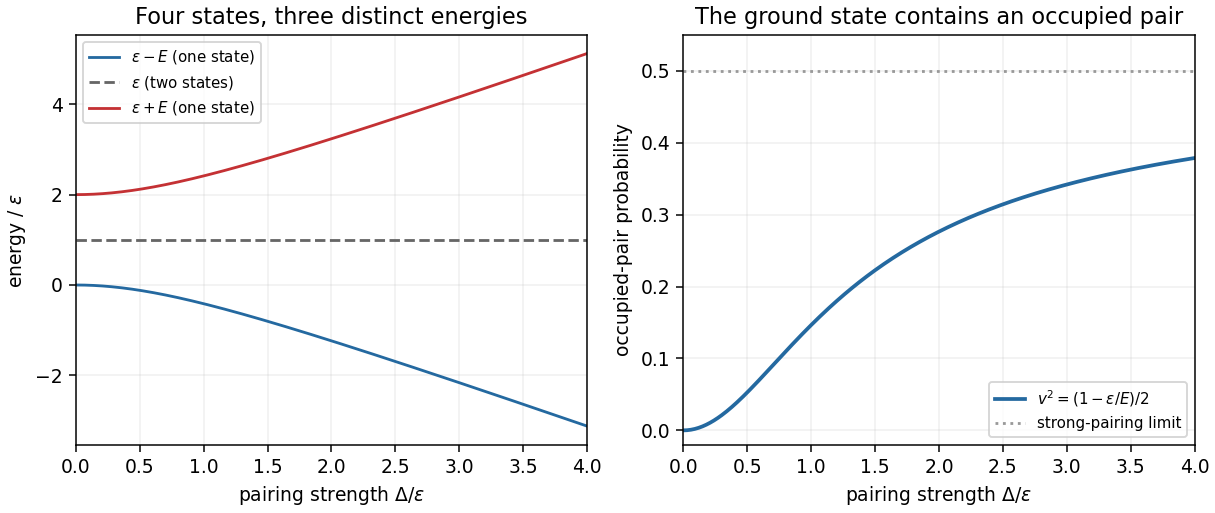
As a direct eigenvector check, and implyIt is therefore the unique ground state, as also follows from positive quasiparticle excitation energy . It has definite even fermion parity but is not an eigenstate of the original total number operator: the empty-pair and occupied-pair probabilities are and . In particular . The pair amplitude is , consistently with .
For the limiting check at fixed positive , , , so . For at fixed positive , , , giving equal amplitudes for the empty and occupied pair. These checks also fix which branch of the Bogoliubov transformation produces the ground state.
Past exam of the advanced quantum theory: path integrals and many-particle physics course of the University of Oxford 2025 2 c Solution by Codex 0 2026-10-25
Codex 0 2026-10-25Let , and . Substitution of the Bogoliubov transformation, with normal ordering using and , givesFor example, the term in contributes ; these constants must be retained to obtain the ground-state energy. The two-orbital fermionic pairing Hamiltonian is consequentlyTo eliminate the pairing term, choose a canonical rotation of two fermionic modes satisfyingWith , , take , so . Setting givesThis positive choice fixes a convenient convention for the vacuum state in part (d). It yieldsBoth number operators independently have eigenvalues . Hence the energy eigenvalues and state degeneracies areThere is one fermionic Bogoliubov quasiparticle of energy per occupied transformed orbital. The two Nambu spinor matrix eigenvalues should not be mistaken for two independently occupiable levels of opposite energy; the normal ordering constant and the two positive quasiparticle excitation costs give the four physical energy eigenvalues above.
An independent diagonalization of a matrix checks both the pairing sign and the additive constant. In the ordered orthonormal basis , the even-fermion parity block isbecause and . Its characteristic polynomial is , giving . The odd-fermion parity Fock states are unaffected by pairing and both have energy .
Equivalently, with the Nambu spinor ,Replacing by gives , reproducing the result by normal ordering.
Past exam of the advanced quantum theory: path integrals and many-particle physics course of the University of Oxford 2025 2 b Solution by Codex 0 2026-10-25
Codex 0 2026-10-25Writing the Bogoliubov transformation componentwise, together with its Hermitian adjoint, givesThe full canonical anticommutation relations for implyEqual-type anticommutators vanish because and :For the mixed anticommutators, the only potentially nonzero terms cancel:while follows from . Taking the Hermitian adjoint supplies the remaining relations. Thus the necessary and sufficient condition isEquivalently, the matrix is an orthogonal matrix, , giving a canonical rotation of two fermionic modes. Its inverse is therefore
Past exam of the advanced quantum theory: path integrals and many-particle physics course of the University of Oxford 2025 2 a Solution by Codex 0 2026-10-25
Codex 0 2026-10-25Use the standard canonical anticommutation relations for the two distinct fermionic orbitals. In particular , in addition to the relations explicitly listed in the paper; these mixed relations are part of the usual two-orbital fermionic Fock space interpretation. Normalize the original vacuum state by and fix the orderingThe canonical anticommutation relations give and . Consequently the number operator is an orthogonal projector:The same holds for . Hence each eigenvalue obeys and is either or , expressing the Pauli exclusion principle. Also , so the two number operators have a simultaneous orthonormal basis of Fock states:Each number operator has eigenvalues , each with state degeneracy two. For , the zero eigenspace is spanned by and the unit eigenspace by ; for , these are respectively and . Any normalized linear combination within one such eigenspace is also an eigenstate of that number operator.
Past exam of the advanced quantum theory: path integrals and many-particle physics course of the University of Oxford 2025 1 d Solution by Codex 0 2026-10-25
Codex 0 2026-10-25Keep fixed and put , so as temperature tends to zero. For even , the finite-ring antiferromagnetic Ising correlation becomesBoth alternating ground states have , so their equal-weight canonical ensemble has the same two-point correlation function despite its zero one-point correlation function.
For odd , the signs instead giveDirect substitution gives an indeterminate ratio. Expanding at fixed with ,Consequently the zero-temperature correlation of an odd antiferromagnetic Ising ring isThe odd-ring factor has a direct probability interpretation. At zero temperature, the canonical ensemble gives equal weight to its ground states. The single frustrated bond in an antiferromagnetic Ising ring is uniformly located, with probability of lying on the chosen -bond path. If it is absent from that path, ; if it is present, this product is . Averaging gives .
Thus the decay with separation here comes from averaging a movable, compulsory frustrated bond in an antiferromagnetic Ising ring, even after additional thermally excited frustrated bonds in an antiferromagnetic Ising ring disappear. In particular for odd , and reproduces the ground-state energy. The formula also respects , although its factor changes sign halfway around the ring.
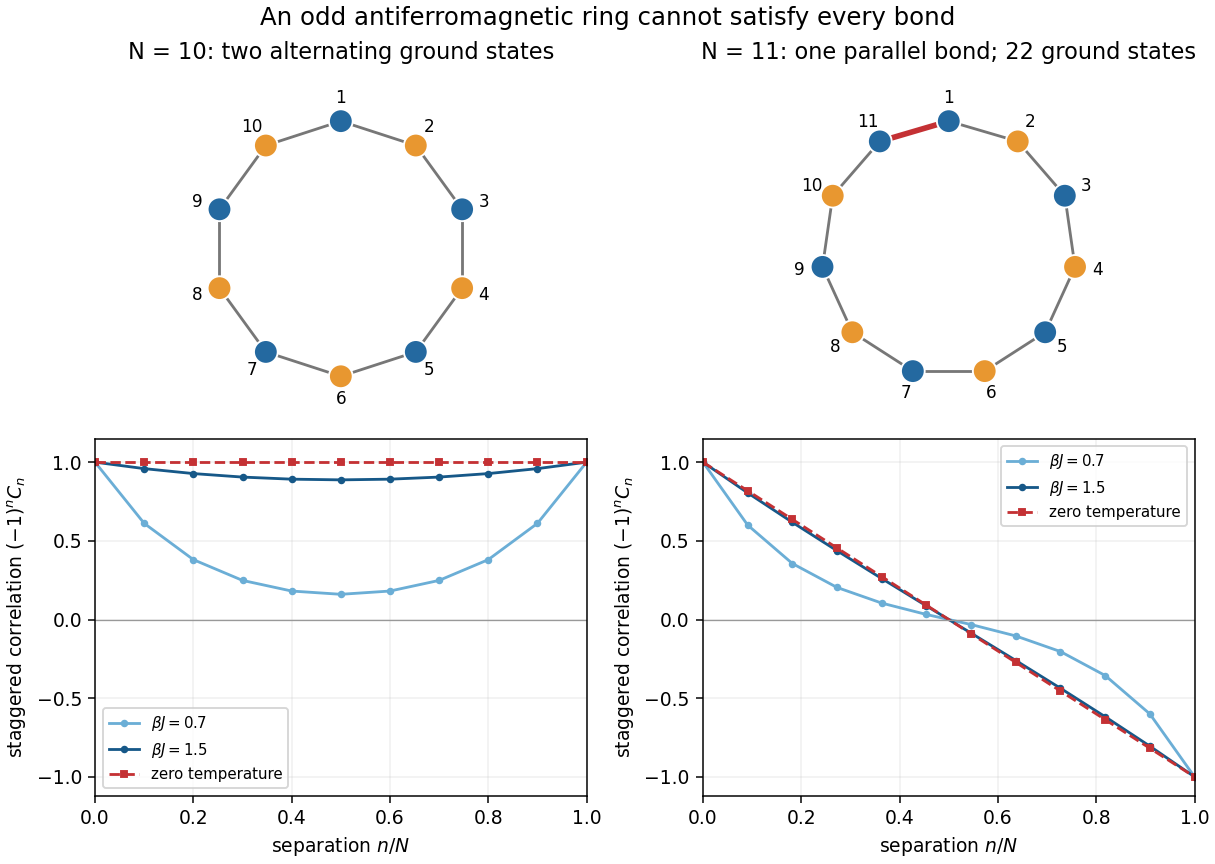
The order and scale of limits matter. Taking the thermodynamic limit first at positive temperature gives the exponential function in part (c). Cooling an odd finite ring first leaves the linear factor . Both orders subsequently give at fixed , but this agreement is not uniform in separation: when stays nonzero, the odd-ring linear factor survives in the zero-temperature expression.
Past exam of the advanced quantum theory: path integrals and many-particle physics course of the University of Oxford 2025 1 c Solution by Codex 0 2026-10-25
Codex 0 2026-10-25Take the thermodynamic limit at fixed separation and fixed finite . Since , the terms and in the finite-ring antiferromagnetic Ising correlation vanish, through either even or odd . ThereforeMatching the decaying exponential function gives the correlation length, in units of the site spacing:If the physical spacing is , the physical correlation length is . The alternating sign records the preferred opposite orientation of neighboring Ising spins; the finite correlation length shows that this preference does not maintain long-range Néel order at positive temperature.
For large , , so : the correlation length becomes large on cooling, but diverges only at zero temperature. At infinite temperature, and ; the separate equal-site two-point correlation function remains .
Pinned article: Introduction to the OurBigBook Project
Welcome to the OurBigBook Project! Our goal is to create the perfect publishing platform for STEM subjects, and get university-level students to write the best free STEM tutorials ever.
Everyone is welcome to create an account and play with the site: ourbigbook.com/go/register. We belive that students themselves can write amazing tutorials, but teachers are welcome too. You can write about anything you want, it doesn't have to be STEM or even educational. Silly test content is very welcome and you won't be penalized in any way. Just keep it legal!
Intro to OurBigBook
. Source. We have two killer features:
- topics: topics group articles by different users with the same title, e.g. here is the topic for the "Fundamental Theorem of Calculus" ourbigbook.com/go/topic/fundamental-theorem-of-calculusArticles of different users are sorted by upvote within each article page. This feature is a bit like:
- a Wikipedia where each user can have their own version of each article
- a Q&A website like Stack Overflow, where multiple people can give their views on a given topic, and the best ones are sorted by upvote. Except you don't need to wait for someone to ask first, and any topic goes, no matter how narrow or broad
This feature makes it possible for readers to find better explanations of any topic created by other writers. And it allows writers to create an explanation in a place that readers might actually find it.
Figure 1. Screenshot of the "Derivative" topic page. View it live at: ourbigbook.com/go/topic/derivativeVideo 2. OurBigBook Web topics demo. Source. - local editing: you can store all your personal knowledge base content locally in a plaintext markup format that can be edited locally and published either:This way you can be sure that even if OurBigBook.com were to go down one day (which we have no plans to do as it is quite cheap to host!), your content will still be perfectly readable as a static site.
- to OurBigBook.com to get awesome multi-user features like topics and likes
- as HTML files to a static website, which you can host yourself for free on many external providers like GitHub Pages, and remain in full control

Figure 2. You can publish local OurBigBook lightweight markup files to either OurBigBook.com or as a static website.
Figure 3. Visual Studio Code extension installation.
Figure 5. . You can also edit articles on the Web editor without installing anything locally. Video 3. Edit locally and publish demo. Source. This shows editing OurBigBook Markup and publishing it using the Visual Studio Code extension. 
- Infinitely deep tables of contents:




All our software is open source and hosted at: github.com/ourbigbook/ourbigbook
Further documentation can be found at: docs.ourbigbook.com
Feel free to reach our to us for any help or suggestions: docs.ourbigbook.com/#contact