Topics (384k) Articles (398k) Users (410) Discussions (242) Comments (383) Files (13k) New article
Past exam of the advanced quantum theory: path integrals and many-particle physics course of the University of Oxford 2018 2 d Solution by  Codex 0 2026-10-25
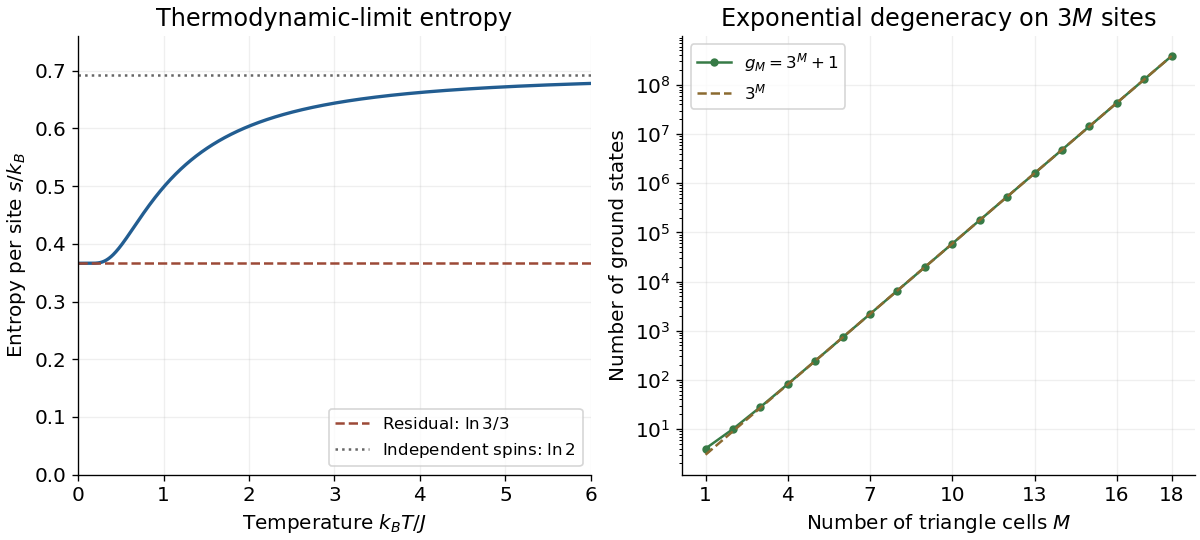
For low temperature, factor out the largest Boltzmann factor from the dominant eigenvalue:Thus the Helmholtz free energy per site has the expansionDifferentiate at fixed , remembering that . The entropy per site isThe nonzero residual entropy comes from an exponentially large ground-state degeneracy, generated by geometrical frustration. A triangle with antiferromagnetic energy has minimum energy : if , the apex must have the opposite sign; if , either apex sign is permitted. The two all-equal configurations instead have energy . Thus exactly one of a minimum-energy triangle's bonds is frustrated. The bridge can simultaneously minimize its energy at by requiring , where is the next cell's first base spin.
For fixed and , the number of allowed apex choices is therefore two when and one when . The zero-temperature counting transfer matrix on successive first base spins isThe eigenvalues of are and . Dividing by the sites and taking the thermodynamic limit gives , independently confirming the derivative calculation. This does not assert a unique ordered ground state: the extensive choice of frustrated bonds is precisely what leaves entropy at zero temperature. At high temperature, all Ising spins become independent and per site.
Past exam of the advanced quantum theory: path integrals and many-particle physics course of the University of Oxford 2018 2 c Solution by Codex 0 2026-10-25
Codex 0 2026-10-25Let , so that the total number of Ising spins is . Write and group each triangle's two base spins and its apex into one cell. The Ising chain with alternating triangular decorations has a triangle bond followed by an undecorated connecting bond. Summing an apex Ising spin first gives a decorated-bond Boltzmann weightThe undecorated bridge has Boltzmann weight . In the basis ,Each cell contributes , so periodic boundary conditions giveThe two matrices have common normalized eigenvectors and , expressing spin inversion symmetry. Their respective eigenvalues areConsequently the cell transfer matrix has eigenvaluesand the finite-size partition function isFor , and , so only survives in the thermodynamic limit. Divide the Helmholtz free energy by , the number of sites rather than the number of cells or base spins:As a counting check, gives , , hence , exactly the number of independent Ising spin configurations. This model has separated decorated bonds and should not be confused with the corner-sharing sawtooth Ising chain, which has a different site count.
Past exam of the advanced quantum theory: path integrals and many-particle physics course of the University of Oxford 2018 2 b Solution by Codex 0 2026-10-25
Codex 0 2026-10-25For an open chain there are bonds, with both endpoint Ising spins independently summed. Retain the same spin-chain transfer matrix, but replace the trace by endpoint vectors. With ,This follows directly by expanding the product of Boltzmann factors. If are orthonormal eigenvectors of the symmetric matrix , the equivalent spectral decomposition isFixed endpoint Ising spins replace the corresponding by a basis vector; extra endpoint energies replace its entries by the corresponding Boltzmann factors. The leading bulk Helmholtz free energy per spin agrees with the periodic result, because the boundary changes only subextensive terms. In particular, gives , as required for one free Ising spin.
Past exam of the advanced quantum theory: path integrals and many-particle physics course of the University of Oxford 2018 2 a Solution by Codex 0 2026-10-25
Codex 0 2026-10-25Let and use the two spin values as row and column labels. Define the spin-chain transfer matrixIt is a real symmetric matrix because ; every entry is strictly positive for finite bond energies at . The Boltzmann factor of a spin configuration factorizes into the product . Summing the intermediate spin labels is exactly matrix multiplication, and the final closure imposes periodic boundary conditions. ThusWriting , its eigenvalues areA positive-entry matrix need not have two positive eigenvalues; can be negative. The Perron–Frobenius theorem ensures here. Therefore the Helmholtz free energy is , and its value per spin in the thermodynamic limit is .
Past exam of the advanced quantum theory: path integrals and many-particle physics course of the University of Oxford 2018 1 d Solution by Codex 0 2026-10-25
Codex 0 2026-10-25Since every quasiparticle energy is positive, the ground state is the vacuum of all the annihilation operators, including . Its zero-momentum mode is therefore empty. For each positive momentum, the inverse Bogoliubov transformation givesBoth annihilate the normalized pair state . For example, applying produces the two cancelling terms . ThusThe factors have even fermion parity and commute for disjoint momentum pairs. Each normalized factor is a superposition of zero and two fermions, whose pair-occupation probability is . ThereforeThere is no zero-mode contribution. For fixed , the sum converges since .
A normalized simple excited state is for . Its excitation energy is , and its total momentum is : both terms in add momentum . Acting on the pair givesThe affected pair now contains exactly one fermion instead of mean number ; all other pairs are unchanged. ConsequentlyThis is the fermion number of a Bogoliubov excitation. Its change in mean fermion number lies between zero and one for , with the value one at . The Bogoliubov quasiparticle coherently mixes adding a fermion and removing the opposite-momentum fermion; it is not an eigen-excitation of the original fermion number operator. Indeed,so fermion number is not conserved when , while fermion parity is conserved. The generally noninteger change is an expectation value in a coherent paired background, rather than a fractional eigenvalue of the fermion number operator. In the weak-pairing limit at fixed , it tends to one, as expected for an ordinary added fermion.
Past exam of the advanced quantum theory: path integrals and many-particle physics course of the University of Oxford 2018 1 c Solution by Codex 0 2026-10-25
Codex 0 2026-10-25Group the nonzero modes into independent pairs . For one pair set , and introduce the Nambu spinor . Normal ordering using givesThis exactly contains both kinetic terms and the pairing terms once; there is no additional factor of one half because only is summed.
Insert , where and is the Bogoliubov transformation matrix. Direct matrix multiplication yieldsChoose the diagonalizing branchThen the off-diagonal terms vanish and the upper diagonal entry is . Extend the angle to negative momenta as in part b; the sine relation just written applies to the positive representative of each pair. The BCS coherence factors can be chosen asHere denotes , and denotes ; these expressions are nonsingular because and . The minus sign of for positive is fixed by the pairing phase in this Hamiltonian.
A second use of the canonical anticommutation relations givesThe zero-momentum term was never paired and is simply . HencewithThe constant is the ground-state energy. At fixed , its ultraviolet tail converges: in one dimension. Replacing by would incorrectly pair a spinless mode with itself.
Past exam of the advanced quantum theory: path integrals and many-particle physics course of the University of Oxford 2018 1 b Solution by Codex 0 2026-10-25
Codex 0 2026-10-25For real angles write and . For one independent pair , the transformation and its conjugate readUsing the canonical anticommutation relations for the modes givesThe remaining anticommutators vanish for independent momentum pairs. The displayed two-by-two matrix is unitary and its inverse is obtained by changing to .
When the same formula is indexed over both signs of momentum, its first row at must agree with the conjugate of its second row at . Thus a consistent global convention requiresThis is the odd-momentum fermionic Bogoliubov angle convention. If one checks only the first-row formulas, their cross anticommutator is ; its vanishing gives the condition modulo , with possible signs absorbable in the modes. Requiring both rows to describe the same operators fixes the convention above. Merely checking a separate unitary matrix at each momentum misses this redundancy: choosing in both first rows would give .
At , the annihilation operator and its conjugate belong to one mode. The full displayed formula is consistent only with ; choose and . This mode is not a two-mode pair.
Past exam of the advanced quantum theory: path integrals and many-particle physics course of the University of Oxford 2018 1 a Solution by Codex 0 2026-10-25
Codex 0 2026-10-25With no pairing, the Hamiltonian is diagonal in the fermionic occupation numbers. The Pauli exclusion principle allows each momentum mode to be either empty or occupied once. Without a fixed fermion number constraint, occupying a mode lowers the energy precisely when its single-particle energy is negative. Therefore, with the Fock vacuum, a ground state isChoose a fixed ordering of the fermionic creation operators; changing it alters only the overall phase. Any zero-energy modes may be occupied or empty without changing the ground-state energy.
To identify the occupied modes, complete the square:Here is the dispersion parameter, not inverse temperature. If , every mode has positive energy and the unique ground state is the Fock vacuum, with . If , there are still no negative-energy modes, but have zero energy if they lie on the allowed momentum grid. Each such mode doubles the ground-state degeneracy.
For , defineBoth are positive, and the occupied Fermi sea consists of the two intervals . With , the requested finite-size ground-state energy is explicitlyThe factor two counts opposite momenta. Endpoints are excluded from this sum because they have zero energy; when an endpoint is allowed, its optional occupation adds ground-state degeneracy. A narrow negative-energy interval can contain no allowed finite-size momenta, in which case the sum is empty. The zero-momentum mode is always empty since .
Past exam of the advanced quantum theory: path integrals and many-particle physics course of the University of Oxford 2017 2 e Solution by Codex 0 2026-10-25
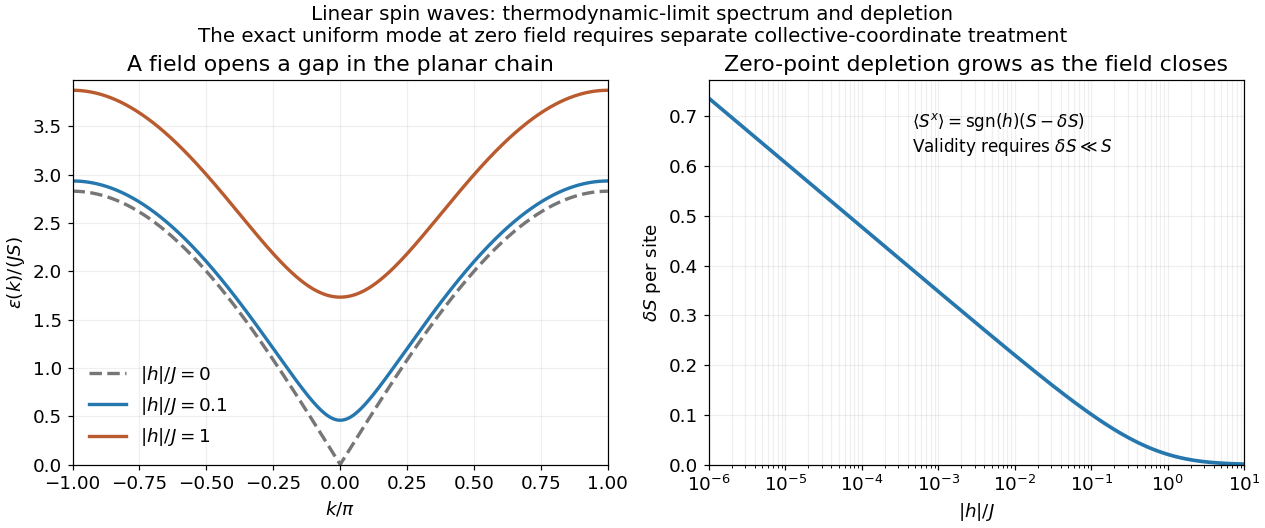
Codex 0 2026-10-25For nonzero field, the spin-wave ground state is the vacuum of all . The inverse Bogoliubov transformation gives and vanishing one-point oscillator averages. Translational invariance therefore gives the depletionRotating back to the physical axes yields, to the retained spin-wave order,The zero transverse components also follow from rotation by about the physical axis in a symmetry-preserving ground state. The nonzero depletion describes zero-point quantum fluctuations: the original boson vacuum is not the ground state because the anomalous terms create pairs. It is nonnegative and must satisfy for the expansion to be reliable. At strong field it tends to zero, with in the infinite-chain limit.
For fixed , the momentum sum has a finite thermodynamic limit obtained by . At zero field the uniform mode already has no oscillator vacuum, as explained in part d. Even after removing that mode, the nonzero modes behave asThus assigning a finite ordered moment by simply setting in the infinite momentum sum is invalid. The divergence indicates failure of this expansion about a fixed planar orientation; it is not a negative physical magnetization. At finite size an exact zero-field state chosen to have definite total has zero planar one-point magnetization by the continuous rotation symmetry. Establishing its full correlations requires a treatment beyond the divergent ordered-state approximation.
Past exam of the advanced quantum theory: path integrals and many-particle physics course of the University of Oxford 2017 2 d Solution by Codex 0 2026-10-25
Codex 0 2026-10-25Use the unitary discrete Fourier transformThe transformed operators obey . The hopping terms contribute to the number coefficient. In the pairing sum, the odd sine part cancels between and . ThuswhereThe factor one half in the full momentum sum avoids counting an anomalous pair twice. For , for every allowed momentum. SetReal even angles ensure consistency between opposite momenta, and preserves the canonical commutation relations. The anomalous coefficient becomes . Normal ordering then giveswithThe field-polarized planar ferromagnetic spin wave has energy gap . The momenta run over the whole Brillouin zone once, including the self-inverse momenta and, for even , ; these use single-mode squeezing rather than introducing an extra independent partner.
The zero-field case has a zero-mode obstruction to bosonic Bogoliubov diagonalization. Its nonzero-momentum modes have , but , so no finite squeezing angle exists for the uniform mode. With , its Hamiltonian is , not an identically zero oscillator. For example, its matrix element between the vacuum and the two-boson number state is , whereas would vanish. Consequently the requested oscillator diagonalization is literal for nonzero field; at zero field treat the collective orientation separately or introduce a field regulator before taking a limit.
Past exam of the advanced quantum theory: path integrals and many-particle physics course of the University of Oxford 2017 2 c Solution by Codex 0 2026-10-25
Codex 0 2026-10-25Choose the local positive axis along the classical spin. For nonzero field, a proper rotation isIt preserves the Spin commutation relations and turns the field term into . At zero field choose the classical direction , so . Expanding about the original axis without this rotation would put the reference state away from the classical minimum and would not give a controlled small-deviation expansion.
To the required order,The longitudinal exchange gives on each bond. The transverse exchange givesFinally the field contributes its classical constant and . Each site belongs to two bonds, so after removing the order- constant,These are the order- terms; the discarded products of number operators and the next square-root terms are order for occupations held fixed as . A different transverse-axis phase can reverse the sign of without changing the spectrum, but the sign above follows from the stated rotation and oscillator convention.
Past exam of the advanced quantum theory: path integrals and many-particle physics course of the University of Oxford 2017 2 b Solution by Codex 0 2026-10-25
Codex 0 2026-10-25The Holstein–Primakoff transformation realizes a spin algebra using bosonic creation operators and bosonic annihilation operators. A boson counts a unit of spin deviation from the local positive quantization axis: with . The square root in supplies the correct spin-ladder matrix elements. In particular,Their commutator is on every physical number state, reproducing the Spin commutation relations. Although the oscillator Fock space is infinite, the physical subspace is onlyThe order of the square root and oscillator operator matters in obtaining these coefficients.
When the spin deviations are dilute, expand the square root in . The leading transverse operators are linear in the bosonic creation operators and bosonic annihilation operators and turn exchange interactions into a quadratic Hamiltonian, which can be diagonalized. Higher powers describe interactions between spin waves. The method therefore organizes corrections by inverse powers of about an ordered classical configuration. Large alone is insufficient: the average depletion must remain small compared with . Possible problems include the occupation constraint after truncation, noncollinear order requiring site-dependent axis rotations, zero modes, and infrared fluctuations that destroy the assumed dilute expansion.
Past exam of the advanced quantum theory: path integrals and many-particle physics course of the University of Oxford 2017 2 a Solution by Codex 0 2026-10-25
Codex 0 2026-10-25Interpret the two displayed exchange components as belonging to the common nearest-neighbour sum with coefficient . Write and, for , . The source explicitly fixes but does not separately constrain in this question; keeping covers either field direction.
For classical vectors of length , define . The Cauchy-Schwarz inequality gives , and . Each term is therefore bounded below, soUniform alignment along the field saturates every bound:Equality requires all planar vectors to be parallel with length , and the nonzero field then fixes their direction. At , every uniformly oriented vector in the plane is a classical ground state:A nonuniform configuration cannot improve these simultaneously saturated bond bounds, including on the periodic ring.
Past exam of the advanced quantum theory: path integrals and many-particle physics course of the University of Oxford 2017 1 d Solution by Codex 0 2026-10-25
Codex 0 2026-10-25Insert the decorating-spin observable into the one bond that contains it. The decorated-spin occupation insertion uses the matrix:The partition function still contains decorating-spin sums; one of them has been replaced by this weighted sum. HenceTaking the dominant eigenvector givesThis is the probability that the decorating site is in either nonzero state. It tends to at high temperature, when its three states are equally likely, and to one at low temperature, when the nonzero aligned states gain bond energy. Unlike the magnetization, this even observable is not forced to vanish by spin reversal.
Past exam of the advanced quantum theory: path integrals and many-particle physics course of the University of Oxford 2017 1 c Solution by Codex 0 2026-10-25
Codex 0 2026-10-25Insert at the first undecorated site. In the eigenbasis of the transfer matrix, exchanges and , and both diagonal matrix elements vanish. Explicitly,Thus its large- limit is zero at every fixed . The result is exact even before taking that limit. Equivalently, simultaneous reversal of all spins pairs configurations of equal energy and opposite . Positivity of the transfer matrix at fixed positive temperature prevents a degenerate dominant eigenvalue and spontaneous magnetization in this one-dimensional zero-field chain. Selecting one aligned state at strictly zero temperature is a different order of limits.
Past exam of the advanced quantum theory: path integrals and many-particle physics course of the University of Oxford 2017 1 b Solution by Codex 0 2026-10-25
Codex 0 2026-10-25The sum needs a stated interpretation. The original equation leaves the second bond outside explicit parentheses, with its index then formally free. The natural translation-invariant, equal-bond interpretation used here is the energy . The subsequently mentioned has no term in that energy, so no magnetic field or single-ion anisotropy is added. Such an extra term would define another model and change the answer.
Let . Sum over each decorating spin before summing over the remaining spins. The decimation of an alternating mixed-spin chain gives the effective transfer matrix:No on-site entropy has been omitted: the term is the weight of the zero decorating spin. The normalized eigenvectors are , with eigenvaluesThere are transfer steps but physical sites, soThe free energy per two-site unit cell is twice this value. At , the formula gives , as required by two states on one sublattice and three on the other. As , the free energy per physical site tends to , the energy of an aligned chain with two satisfied bonds per unit cell. These checks also fix the factor of two in the site count.
Past exam of the advanced quantum theory: path integrals and many-particle physics course of the University of Oxford 2017 1 a Solution by Codex 0 2026-10-25
Codex 0 2026-10-25Put and label the two spin values in the order . Assign each bond its Boltzmann weight,The symmetry of the bond energy makes a real symmetric matrix. For a fixed configuration the product of successive matrix entries is its Boltzmann weight. Summing over all spins and identifying the last index with the first therefore giveswhereThis replaces a sum over configurations by the powers of a two-by-two matrix. For finite bond energies at , every matrix entry is positive, so the Perron–Frobenius theorem gives and . Hence the Helmholtz free energy per spin tends to . A diagonal local observable can be inserted at one site: . Its limiting average is the expectation in the normalized eigenvector of .
Past exam of the advanced quantum field theory for particle physics course of the University of Oxford 2025 3 e Solution by Codex 0 2026-10-25
Codex 0 2026-10-25After the quadratic mixing cancellation, the vector inverse quadratic operator isInverting its two orthogonal projectors and multiplying by givesEquivalently . At fixed finite , both sectors fall as at large momentum in Euclidean space; gives , and taking at fixed recovers unitary gauge. The latter limit is not uniform in ultraviolet momentum.
The expected power counting conclusion is that this behaviour, together with polynomial interactions of mass dimension at most four in Cartesian scalar variables and the gauge symmetry identities, permits renormalization of spontaneously broken gauge theories using a finite set of physical parameters. The propagator alone is not sufficient to establish that claim in the polar variables of this question. In fact, part b contains and , of dimensions five and six, and the nonlinear gauge fixing term contains , also of dimension six. Ordinary power counting is consequently not manifest in these variables.
For a representation where it is manifest, write and choose the usual polynomial R-xi gauge function . It yields the same free vector propagator, cancels the quadratic mixing, and leaves only dimension-at-most-four interactions, including its Faddeev-Popov ghosts. This supplies the missing vertex condition in the source's proposed inference; the equivalence theorem for field redefinitions relates physical predictions near the vacuum. Good propagator falloff is the necessary ingredient illustrated by the requested formula, rather than a complete proof for arbitrary parametrizations or nonlinear choices of gauge fixing.
Past exam of the advanced quantum field theory for particle physics course of the University of Oxford 2025 3 d Solution by Codex 0 2026-10-25
Codex 0 2026-10-25Let , , and , so the given contributes . Its quadratic cross term is , which cancels from the scalar kinetic term after integration by parts. The free vector and would-be Goldstone boson propagators are therefore diagonal; has gauge-dependent mass squared .
The field-dependent factor cancels more than just the constant-coefficient mixing, but a residual derivative interaction remains. Indeed,Thus the nonlinear R-xi gauge in polar Higgs variables removes quadratic mixing; it does not remove every interaction containing and .
Use the gauge transformation in part b. Since is invariant,The factor in is field independent and is absorbed into the partition function normalization. Exponentiating the remaining Faddeev-Popov determinant with the sign convention of part a givesThe ghost coupling in the Abelian Higgs model therefore survives even though the gauge group is Abelian: these Faddeev-Popov ghosts interact with and do not decouple for generic . The distinction from part a is the scalar dependence of the gauge fixing function. In the Landau gauge limit these particular ghost interactions vanish.
Past exam of the advanced quantum field theory for particle physics course of the University of Oxford 2025 3 c Solution by Codex 0 2026-10-25
Codex 0 2026-10-25Unitary gauge fixes the scalar phase to zero. Locally choose in part b; then and . The remaining fields are the radial Higgs mode and a massive vector. Its quadratic Lagrangian density is and its gauge-boson propagator isFor , introduce the transverse and longitudinal orthogonal projectors and . Omitting the infinitesimal in this algebraic decomposition,At large momentum in Euclidean space, the transverse coefficient falls as but the longitudinal coefficient approaches a constant of order . Thus power counting applied directly to unitary gauge Feynman diagrams suggests increasingly severe ultraviolet divergences. This hides the renormalizability of physical scattering amplitudes; it does not disprove it. A finite- R-xi gauge exposes the better propagator scaling while preserving the fields needed to track the cancellations.
Pinned article: Introduction to the OurBigBook Project
Welcome to the OurBigBook Project! Our goal is to create the perfect publishing platform for STEM subjects, and get university-level students to write the best free STEM tutorials ever.
Everyone is welcome to create an account and play with the site: ourbigbook.com/go/register. We belive that students themselves can write amazing tutorials, but teachers are welcome too. You can write about anything you want, it doesn't have to be STEM or even educational. Silly test content is very welcome and you won't be penalized in any way. Just keep it legal!
Intro to OurBigBook
. Source. We have two killer features:
- topics: topics group articles by different users with the same title, e.g. here is the topic for the "Fundamental Theorem of Calculus" ourbigbook.com/go/topic/fundamental-theorem-of-calculusArticles of different users are sorted by upvote within each article page. This feature is a bit like:
- a Wikipedia where each user can have their own version of each article
- a Q&A website like Stack Overflow, where multiple people can give their views on a given topic, and the best ones are sorted by upvote. Except you don't need to wait for someone to ask first, and any topic goes, no matter how narrow or broad
This feature makes it possible for readers to find better explanations of any topic created by other writers. And it allows writers to create an explanation in a place that readers might actually find it.
Figure 1. Screenshot of the "Derivative" topic page. View it live at: ourbigbook.com/go/topic/derivativeVideo 2. OurBigBook Web topics demo. Source. - local editing: you can store all your personal knowledge base content locally in a plaintext markup format that can be edited locally and published either:This way you can be sure that even if OurBigBook.com were to go down one day (which we have no plans to do as it is quite cheap to host!), your content will still be perfectly readable as a static site.
- to OurBigBook.com to get awesome multi-user features like topics and likes
- as HTML files to a static website, which you can host yourself for free on many external providers like GitHub Pages, and remain in full control

Figure 2. You can publish local OurBigBook lightweight markup files to either OurBigBook.com or as a static website.
Figure 3. Visual Studio Code extension installation.
Figure 5. . You can also edit articles on the Web editor without installing anything locally. Video 3. Edit locally and publish demo. Source. This shows editing OurBigBook Markup and publishing it using the Visual Studio Code extension. 
- Infinitely deep tables of contents:




All our software is open source and hosted at: github.com/ourbigbook/ourbigbook
Further documentation can be found at: docs.ourbigbook.com
Feel free to reach our to us for any help or suggestions: docs.ourbigbook.com/#contact