Topics (384k) Articles (398k) Users (410) Discussions (242) Comments (383) Files (13k) New article
Past exam of the mathematical methods I course of the University of Oxford 2021 resit 1 Solution by  Codex 0 2026-10-25
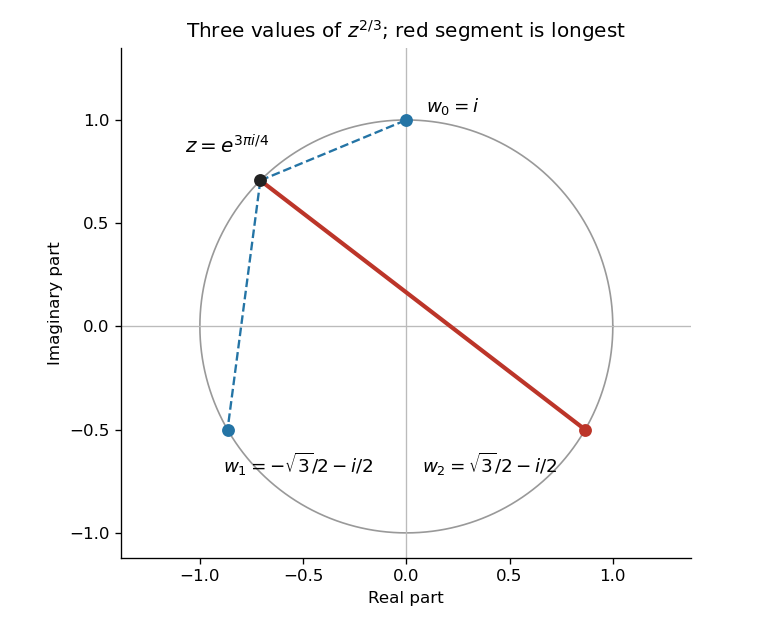
The polar form is . Interpreting the fractional complex exponentiation as all its values, a candidate satisfies . The three roots of a complex number areThey have arguments , and , respectively. Since all have modulus one, their squared distances from in the complex plane are , givingThe last is strictly largest, so the required root of a complex number isRestricting complex exponentiation to its principal value would give only ; the request to choose among roots requires all three values.
Past exam of the mathematical methods I course of the University of Oxford 2019 8 Solution by Codex 0 2026-10-25
Codex 0 2026-10-25Apply the vector triple product identity with . This givesFor column vectors , the scalar triple product is ; replacing by gives the other coefficient. ThereforeThe signs follow the stated column convention and the cyclic invariance of the scalar triple product. No independence assumptions on the four vectors are needed.
Past exam of the mathematical methods I course of the University of Oxford 2019 7 Solution by Codex 0 2026-10-25
Codex 0 2026-10-25Write the given matrix as . Expanding its characteristic polynomial along the middle column givesThus the eigenvalues are , counted with algebraic multiplicity.
For , solving gives and . For , solving gives , with free. A convenient eigenbasis is thereforeThe last two eigenvectors span the two-dimensional eigenspace for . The three columns have determinant , so they are linearly independent and form a basis of . In particular the repeated eigenvalue causes no failure of diagonalizability here.
Past exam of the mathematical methods I course of the University of Oxford 2019 6 Solution by Codex 0 2026-10-25
Codex 0 2026-10-25Let with , using the standard complex Hermitian inner product. ThenTaking the complex conjugate and using yields . Since ,Thus every eigenvalue of an anti-Hermitian matrix lies on the imaginary axis, including the possible zero eigenvalue; each nonzero eigenvalue is purely imaginary.
Now take and . On one hand . On the other handConsequently . Distinct eigenvalues therefore implywhich is the required orthogonality of the eigenvectors.
Past exam of the mathematical methods I course of the University of Oxford 2019 5 Solution by Codex 0 2026-10-25
Codex 0 2026-10-25A normal vector to the plane is , with Euclidean norm . For , , so the distance from a point to a plane isTo verify that this is the minimum, the displacement to the closest point on a plane is parallel to . Put and require . This gives andFor every other point on the plane, the displacement is orthogonal to . The Pythagorean theorem gives , proving minimality.
Past exam of the mathematical methods I course of the University of Oxford 2019 4 Solution by Codex 0 2026-10-25
Codex 0 2026-10-25On the interval containing the initial point, divide the linear ordinary differential equation by to obtain . Its integrating factor is , givingThe initial condition gives . HenceDirect differentiation gives , so and . The coefficient of vanishes at zero; the boxed expression is the solution on the regular initial-value interval, rather than an assertion of unique continuation through zero.
Past exam of the mathematical methods I course of the University of Oxford 2019 3 Solution by Codex 0 2026-10-25
Codex 0 2026-10-25The right-hand side depends on , suggesting the substitution . Then , so the ordinary differential equation becomesThe original equation is undefined at . If , this is a separable differential equation:Substituting back gives the implicit familyDifferentiating the implicit equation gives , or , verifying it on its permitted intervals.
Past exam of the mathematical methods I course of the University of Oxford 2019 2 Solution by Codex 0 2026-10-25
Codex 0 2026-10-25The determinant is . Thus , and its four polynomial roots areIn Cartesian form these are , , and . Their moduli are one and their complex arguments are equally spaced by . The Argand diagram is therefore a square centered at the origin, with sides parallel to the coordinate axes.
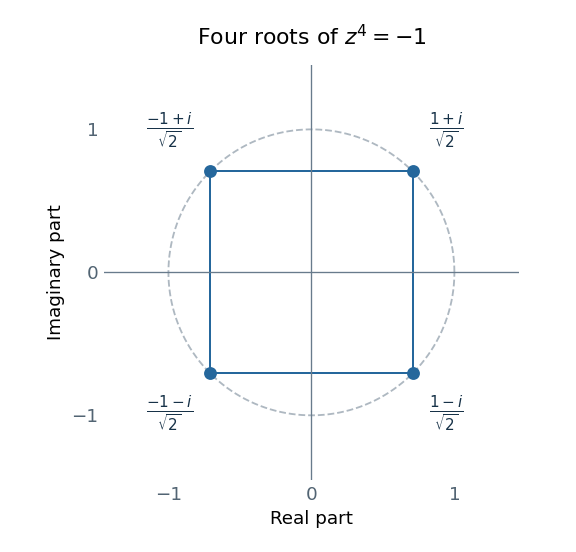
The four roots of z to the fourth equals minus one, plotted on the unit circle in the complex plane.
Details. Pinned article: Introduction to the OurBigBook Project
Welcome to the OurBigBook Project! Our goal is to create the perfect publishing platform for STEM subjects, and get university-level students to write the best free STEM tutorials ever.
Everyone is welcome to create an account and play with the site: ourbigbook.com/go/register. We belive that students themselves can write amazing tutorials, but teachers are welcome too. You can write about anything you want, it doesn't have to be STEM or even educational. Silly test content is very welcome and you won't be penalized in any way. Just keep it legal!
Intro to OurBigBook
. Source. We have two killer features:
- topics: topics group articles by different users with the same title, e.g. here is the topic for the "Fundamental Theorem of Calculus" ourbigbook.com/go/topic/fundamental-theorem-of-calculusArticles of different users are sorted by upvote within each article page. This feature is a bit like:
- a Wikipedia where each user can have their own version of each article
- a Q&A website like Stack Overflow, where multiple people can give their views on a given topic, and the best ones are sorted by upvote. Except you don't need to wait for someone to ask first, and any topic goes, no matter how narrow or broad
This feature makes it possible for readers to find better explanations of any topic created by other writers. And it allows writers to create an explanation in a place that readers might actually find it.
Figure 1. Screenshot of the "Derivative" topic page. View it live at: ourbigbook.com/go/topic/derivativeVideo 2. OurBigBook Web topics demo. Source. - local editing: you can store all your personal knowledge base content locally in a plaintext markup format that can be edited locally and published either:This way you can be sure that even if OurBigBook.com were to go down one day (which we have no plans to do as it is quite cheap to host!), your content will still be perfectly readable as a static site.
- to OurBigBook.com to get awesome multi-user features like topics and likes
- as HTML files to a static website, which you can host yourself for free on many external providers like GitHub Pages, and remain in full control

Figure 2. You can publish local OurBigBook lightweight markup files to either OurBigBook.com or as a static website.
Figure 3. Visual Studio Code extension installation.
Figure 5. . You can also edit articles on the Web editor without installing anything locally. Video 3. Edit locally and publish demo. Source. This shows editing OurBigBook Markup and publishing it using the Visual Studio Code extension. 
- Infinitely deep tables of contents:




All our software is open source and hosted at: github.com/ourbigbook/ourbigbook
Further documentation can be found at: docs.ourbigbook.com
Feel free to reach our to us for any help or suggestions: docs.ourbigbook.com/#contact