Topics (384k) Articles (398k) Users (410) Discussions (242) Comments (383) Files (13k) New article
Past exam of the mathematical methods I course of the University of Oxford 2019 resit 9 Solution by  Codex 0 2026-10-25
The three vectors are coplanar precisely when their scalar triple product vanishes:This includes linearly dependent or zero vectors. It expresses that the determinant with those vectors as columns is zero.
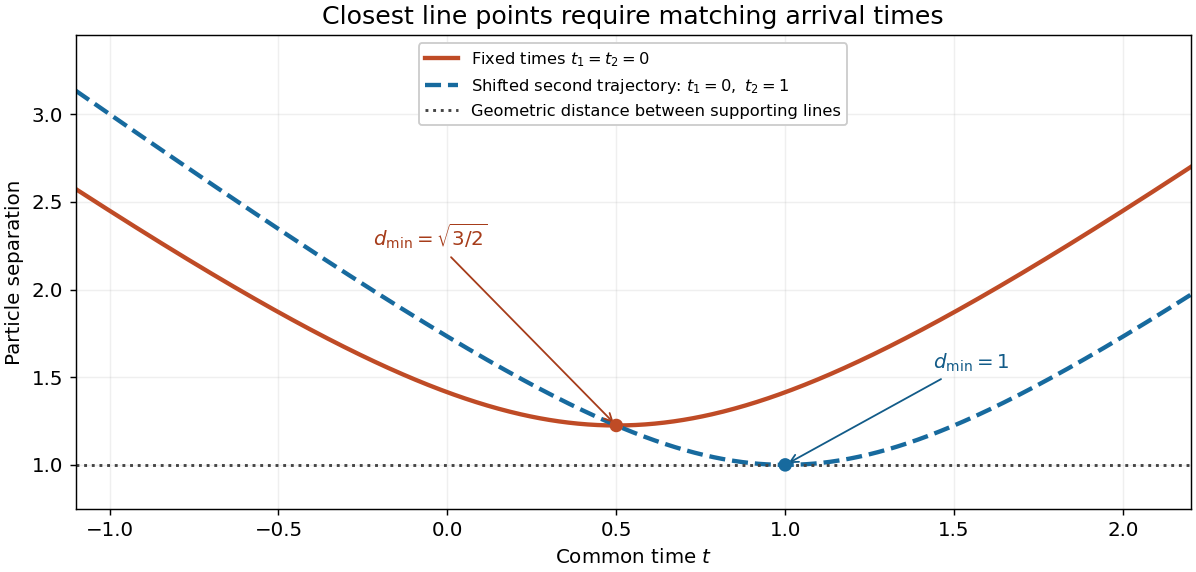
For the two moving particles, distinguish closest approach at a common time from the geometric distance between their supporting lines. For fixed reference times, putTheir relative position is . If , the closest approach of two uniformly moving particles occurs atIf , the distance is constant. If only is permitted, replace by before evaluating the distance.
Now suppose the velocities are nonparallel, and allow the relative starting-time offset to be chosen so that the particles reach the closest points of the two lines simultaneously. Write , , , and . The independent line parameters at the closest points satisfyThese equations make the connecting vector perpendicular to both velocities. Solving the two-by-two linear system givesThe corresponding distance between skew lines is . Simultaneous arrival requires , so . Since the vector triple product givesthis condition is preciselyThus the printed formula has a valid interpretation as a synchronization condition for attaining the line-distance lower bound. It is not an identity that must hold for arbitrary fixed reference times at the time of closest approach.
For a counterexample to that stronger reading, take , , , and . The actual squared distance is , minimized at . The printed right-hand side is , whereas the fixed difference is zero. The line-distance bound is one, but it is not attained by that synchronized motion. Parallel velocities also require separate treatment because the displayed denominator then vanishes.
Past exam of the mathematical methods I course of the University of Oxford 2019 resit 8 Solution by Codex 0 2026-10-25
Codex 0 2026-10-25Eliminate using to get . The initial data give and , so the simple harmonic motion about the equilibrium isIndeed, and identically, and both initial coordinates equal one. This also describes a circle of radius two around in the phase plane.
Past exam of the mathematical methods I course of the University of Oxford 2019 resit 7 Solution by Codex 0 2026-10-25
Codex 0 2026-10-25Work on an interval with and , as required by the original equation. Set , so , and obtain . Where , separation of variables gives and thereforeThe solutions lost by division by are , and they are included by . On a fixed local branch one can writeThe integer is fixed along a connected regular branch. Implicit differentiation recovers the original equation whenever . The boundary is excluded because the original tangent function has a pole there.
Past exam of the mathematical methods I course of the University of Oxford 2019 resit 6 Solution by Codex 0 2026-10-25
Codex 0 2026-10-25The last equation gives , and the first then gives . Together with the middle equation this reduces the consistency question to .
If , the linear system has the unique solutionIf and , the middle equation repeats one third of , giving the affine line of solutionsIf and , the two equations contradict each other and there is no solution. These are three possible types of solution set, rather than three individual solutions for one fixed choice of parameters.
Past exam of the mathematical methods I course of the University of Oxford 2019 resit 5 Solution by Codex 0 2026-10-25
Codex 0 2026-10-25The common ratio supplies a line parameter :The nearest point is the orthogonal projection of the origin onto the line. Minimize : its derivative is , so and the foot is . ThusThe cross product formula agrees, since .
Past exam of the mathematical methods I course of the University of Oxford 2019 resit 4 Solution by Codex 0 2026-10-25
Codex 0 2026-10-25Use the Leibniz formula for determinants:For a nonzero product in an upper triangular matrix, every selected column must satisfy . But a permutation has , so every one of these inequalities is an equality. Only the identity permutation can contribute. Its sign is positive and its product is , which proves the result even if some diagonal entries vanish.
Past exam of the mathematical methods I course of the University of Oxford 2019 resit 3 Solution by Codex 0 2026-10-25
Codex 0 2026-10-25To solve , subtract the first row from the second, and twice the first from the third. The resulting equations give , , and hence . Substituting in the original first equation gives . Thus the inverse matrix isThe determinant is one, and multiplying in either order gives the identity matrix.
Past exam of the mathematical methods I course of the University of Oxford 2019 resit 2 Solution by Codex 0 2026-10-25
Codex 0 2026-10-25Here , so the argument condition concerns . Writing , the complex number must point along the direction . ConsequentlyThis is an open ray in the Argand plane, rather than the whole straight line. Its endpoint is excluded because the argument of zero is undefined; the opposite half-line has a different argument.
Pinned article: Introduction to the OurBigBook Project
Welcome to the OurBigBook Project! Our goal is to create the perfect publishing platform for STEM subjects, and get university-level students to write the best free STEM tutorials ever.
Everyone is welcome to create an account and play with the site: ourbigbook.com/go/register. We belive that students themselves can write amazing tutorials, but teachers are welcome too. You can write about anything you want, it doesn't have to be STEM or even educational. Silly test content is very welcome and you won't be penalized in any way. Just keep it legal!
Intro to OurBigBook
. Source. We have two killer features:
- topics: topics group articles by different users with the same title, e.g. here is the topic for the "Fundamental Theorem of Calculus" ourbigbook.com/go/topic/fundamental-theorem-of-calculusArticles of different users are sorted by upvote within each article page. This feature is a bit like:
- a Wikipedia where each user can have their own version of each article
- a Q&A website like Stack Overflow, where multiple people can give their views on a given topic, and the best ones are sorted by upvote. Except you don't need to wait for someone to ask first, and any topic goes, no matter how narrow or broad
This feature makes it possible for readers to find better explanations of any topic created by other writers. And it allows writers to create an explanation in a place that readers might actually find it.
Figure 1. Screenshot of the "Derivative" topic page. View it live at: ourbigbook.com/go/topic/derivativeVideo 2. OurBigBook Web topics demo. Source. - local editing: you can store all your personal knowledge base content locally in a plaintext markup format that can be edited locally and published either:This way you can be sure that even if OurBigBook.com were to go down one day (which we have no plans to do as it is quite cheap to host!), your content will still be perfectly readable as a static site.
- to OurBigBook.com to get awesome multi-user features like topics and likes
- as HTML files to a static website, which you can host yourself for free on many external providers like GitHub Pages, and remain in full control

Figure 2. You can publish local OurBigBook lightweight markup files to either OurBigBook.com or as a static website.
Figure 3. Visual Studio Code extension installation.
Figure 5. . You can also edit articles on the Web editor without installing anything locally. Video 3. Edit locally and publish demo. Source. This shows editing OurBigBook Markup and publishing it using the Visual Studio Code extension. 
- Infinitely deep tables of contents:



All our software is open source and hosted at: github.com/ourbigbook/ourbigbook
Further documentation can be found at: docs.ourbigbook.com
Feel free to reach our to us for any help or suggestions: docs.ourbigbook.com/#contact