Topics (384k) Articles (398k) Users (410) Discussions (242) Comments (383) Files (13k) New article

An American call option with no expiry. For geometric Brownian motion with drift under a risk-neutral measure, positive dividend yield , , and volatility , let solve . Its value is below and above. The power solves the stationary Black-Scholes equation with continuous stock dividends; value matching and smooth fit determine the threshold.
The candidate dominates the positive part because its continuation branch is convex and tangent to at . In the exercise region its discounted-generator residual is : the root equation gives . Applying Itô's formula to the discounted value, localized if necessary, gives an upper bound on every exercise policy. Stopping at the first hit of attains it; on paths not yet hitting, the bounded discounted continuation value tends to zero. This supplies the optimal stopping verification. As , , the threshold diverges and the value tends to .
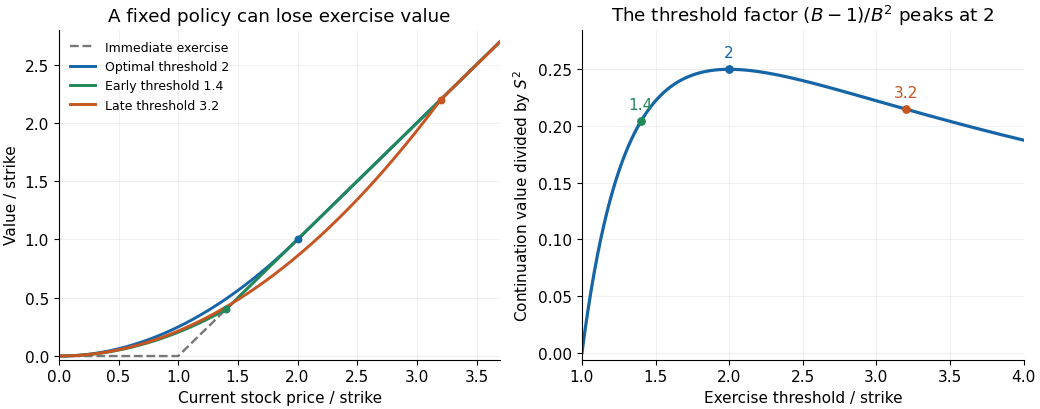
Early and late exercise thresholds both lose value relative to the optimal perpetual-call threshold
. An ideal Black-Scholes example with strike one, interest rate 0.05, volatility 0.2 and dividend yield 0.045 gives exponent two and optimal threshold two. A late fixed-policy value may lie below the immediate exercise payoff; it cannot be the price of an unrestricted American option. Details.A multilinear map is antisymmetric when swapping two arguments negates its value. Over a field of characteristic different from , this is equivalent to being an alternating multilinear map: repeated arguments give , hence ; conversely expand to get the sign change. In characteristic , the repeated-argument condition is stronger than the sign-change condition alone.
At uniform sampling times , adding an integer multiple of the sampling rate to a sinusoid's frequency changes its complex phase by an integer multiple of . The samples therefore agree. Real cosines also identify the two signs of frequency, giving the displayed representative below the Nyquist frequency. A chosen nonzero sampling-time origin changes the equivalent phase, rather than the alias frequency.
Ambiguity between spatial oscillations sampled on a grid. At positions , the factors and agree for every integer . Spatial wavenumbers outside therefore cannot be distinguished without additional assumptions. For a traveling event of temporal frequency and apparent speed , the associated criterion is , with a margin for filtering. Temporal oversampling does not remove this spatial ambiguity.
A square-root branch point has ramification index : one circuit switches local branches and two restore the original branch. Both zero and infinity are square-root branch points of , since the coordinate changes the latter local expression to . A finite limiting value at a branch point does not imply a removable singularity.
A game tree evaluation rule using maxima at the controlled player’s decision nodes and expected values at chance nodes:respectively. Terminal utilities fix the boundary values. These rules exactly optimize a finite-horizon expected utility objective by backward induction. For cyclic infinite-horizon reachability problems, a finite Markov decision process formulation and value iteration replace naive expansion of an infinite game tree. Start with one at successful terminal states and zero elsewhere, keep terminal values fixed, and apply the maximizing/expectation backups repeatedly. The th iterate is the greatest success probability achievable within transitions, by backward induction. These values are nondecreasing and bounded by one. For every policy, eventual success is the increasing set union of success within finite horizons, so its probability is the limit of those finite-horizon probabilities. Taking the supremum over policies and horizons in either order proves that the iterates converge to the optimal eventual-success probability. The limiting fixed-point equations can also admit larger solutions, so the initialization from terminal-success indicators matters.
Backward induction on a finite game tree containing maximizing choices, minimizing choices and chance nodes. Terminal utilities are backed up by , and , respectively. Exact chance node evaluation generally needs every positive-probability outcome; ordinary alpha-beta pruning does not transfer unchanged because one child's value does not bound the full weighted sum.
If , their pointwise minimum, pointwise maximum and each convex combination with are admissible heuristics. Each inequality follows directly by comparison with . The maximum has heuristic dominance over the minimum and every such convex combination.
A sum need not be an admissible heuristic: two exact estimates of the same cost-one remaining action sum to two. A sufficient condition for a valid additive construction is separate nonnegative action-cost allocations with , and estimates bounded by the corresponding optimal allocated costs. Every goal-reaching graph path then costs at least under its original costs. Taking the minimum proves admissibility without counting the same work twice.
If are consistent heuristics, their maximum, minimum and fixed convex combinations are also consistent heuristics. For the maximum, choose an index attaining it at the source and bound its successor by the successor maximum. For the minimum, choose an index attaining it at the successor and bound the source minimum by that component. For a convex combination, multiply the two consistency inequalities by their nonnegative weights and add them. All these combinations vanish at goals when the inputs do.
A thermodynamic path for saturated adiabatic displacement including latent heating from condensation. A pseudoadiabatic model removes condensate, while a reversible model retains it; they need not have the same heat capacity or condensate loading.
For an ideal gas of constant specific heat, an isentrope without phase changes satisfies . A dilute saturated atmosphere approximates this path only when both vapour sensible heat and latent-heating corrections are small.
For a fixed-composition ideal gas, the reversible adiabatic process relation gives . Under hydrostatic equilibrium, . Increasing positive at fixed surface conditions increases temperature at a given smaller pressure and raises the model's formal zero-temperature height. That finite-height mathematical boundary is not a physical absolute-zero prediction.
Pinned article: Introduction to the OurBigBook Project
Welcome to the OurBigBook Project! Our goal is to create the perfect publishing platform for STEM subjects, and get university-level students to write the best free STEM tutorials ever.
Everyone is welcome to create an account and play with the site: ourbigbook.com/go/register. We belive that students themselves can write amazing tutorials, but teachers are welcome too. You can write about anything you want, it doesn't have to be STEM or even educational. Silly test content is very welcome and you won't be penalized in any way. Just keep it legal!
Intro to OurBigBook
. Source. We have two killer features:
- topics: topics group articles by different users with the same title, e.g. here is the topic for the "Fundamental Theorem of Calculus" ourbigbook.com/go/topic/fundamental-theorem-of-calculusArticles of different users are sorted by upvote within each article page. This feature is a bit like:
- a Wikipedia where each user can have their own version of each article
- a Q&A website like Stack Overflow, where multiple people can give their views on a given topic, and the best ones are sorted by upvote. Except you don't need to wait for someone to ask first, and any topic goes, no matter how narrow or broad
This feature makes it possible for readers to find better explanations of any topic created by other writers. And it allows writers to create an explanation in a place that readers might actually find it.
Figure 1. Screenshot of the "Derivative" topic page. View it live at: ourbigbook.com/go/topic/derivativeVideo 2. OurBigBook Web topics demo. Source. - local editing: you can store all your personal knowledge base content locally in a plaintext markup format that can be edited locally and published either:This way you can be sure that even if OurBigBook.com were to go down one day (which we have no plans to do as it is quite cheap to host!), your content will still be perfectly readable as a static site.
- to OurBigBook.com to get awesome multi-user features like topics and likes
- as HTML files to a static website, which you can host yourself for free on many external providers like GitHub Pages, and remain in full control

Figure 2. You can publish local OurBigBook lightweight markup files to either OurBigBook.com or as a static website.
Figure 3. Visual Studio Code extension installation.
Figure 5. . You can also edit articles on the Web editor without installing anything locally. Video 3. Edit locally and publish demo. Source. This shows editing OurBigBook Markup and publishing it using the Visual Studio Code extension. 
- Infinitely deep tables of contents:



All our software is open source and hosted at: github.com/ourbigbook/ourbigbook
Further documentation can be found at: docs.ourbigbook.com
Feel free to reach our to us for any help or suggestions: docs.ourbigbook.com/#contact