An geophysicist studies geophysics through mathematical theory, observation or experiment. The field determines the relevant physical systems and measurements, while the individual biographies below connect particular contributions with their scientific ideas.
Mark D. Zoback coauthored research using borehole breakouts to infer in-situ crustal stress. The orientation and shape of borehole-wall failure become informative through a mechanical model relating local stress concentration to the far-field stress.[ref]
Well bore breakouts and in situ stress by Mark D. Zoback and others. author list and the described study’s abstract or introductory account
Lorraine E. Lisiecki coauthored a global stack of benthic oxygen-isotope records with Maureen E. Raymo. Combining many sediment records helps identify large-scale climate variations while requiring explicit alignment and age-model assumptions.[ref]
A Pliocene-Pleistocene stack of 57 globally distributed benthic oxygen-isotope records by Lorraine E. Lisiecki and Maureen E. Raymo. author list and the described study’s abstract or introductory account
Maureen E. Raymo coauthored a globally distributed benthic oxygen-isotope stack with Lorraine E. Lisiecki. The work provides a common framework for comparing marine climate records through time, connecting local sediment observations with global climate structure.[ref]
A Pliocene-Pleistocene stack of 57 globally distributed benthic oxygen-isotope records by Lorraine E. Lisiecki and Maureen E. Raymo. author list and the described study’s abstract or introductory account
Mark A. Wieczorek investigates planetary interiors using gravity and surface measurements. His GRAIL work combines the lunar gravity field with surface topography to constrain the density and thickness of the Moon's crust.[ref]
The Crust of the Moon as Seen by GRAIL by Mark A. Wieczorek and colleagues. Abstract: gravity, topography and inferred crustal structure
The measurement is an inverse problem: a surface load and a subsurface density contrast can both affect gravity. Independent geological and compositional constraints help distinguish possible interiors that would otherwise produce similar signals.
Renee C. Weber studies planetary interiors through seismology. Her lunar-core research reanalysed deep-moonquake seismograms from the Apollo stations, combining weak arrivals to identify waves that interacted with the lunar core.[ref]
Seismic detection of the layers of the lunar core by Renee C. Weber and colleagues. NASA research summary: deep moonquakes, array processing and solid/fluid core inference
The method uses repeatable sources and known station geometry to improve signals hidden in scattered wave trains. Interpreting the enhanced arrivals still requires a seismic velocity model and reliable phase identification; the core is inferred from wave propagation rather than directly photographed.
Matthias Morzfeld is a researcher in computational and mathematical geophysics whose work combines models with observations. His Scripps Oceanography profile identifies research on data assimilation, inverse problems, Monte Carlo methods and uncertainty, and records a mechanical-engineering doctorate at UC Berkeley in2011. His author-maintained UC San Diego homepage describes a particular interest in how sampling methods behave in high-dimensional spaces.[ref]
Matthias Morzfeld profile at Scripps Oceanography. Research Interests, Education and personal research statement
His earlier work with Fai Ma and Ali Imam studied decoupling of viscously damped linear systems in oscillatory free vibration. Their2009 paper constructs a time-varying coordinate transformation by synchronizing phases of damped modes, extending classical modal analysis beyond its usual classical-damping setting.[ref]
The Decoupling of Damped Linear Systems in Oscillatory Free Vibration by Fai Ma, Ali Imam and Matthias Morzfeld. p408, Abstract; §2, coordinate coupling
This addresses how a damping matrix can keep motion coupled even when undamped normal modes have been identified.An original Bayesian inference example illustrates the model–observation combination underlying his later research interests. Suppose a scalar state has prior distribution and an independent measurement error has a Gaussian distribution , with observed . The posterior distribution has density proportional toThus . The estimate moves toward the measurement while retaining the information and uncertainty from the prior. The posterior variance is lower than either the prior variance4 or the measurement-error variance1 in this stipulated independent Gaussian model.
These chosen numbers are not a result from Morzfeld's papers. They isolate a simple update mechanism; nonlinear dynamics, sparse observations and large state spaces can make the corresponding computation much harder. His work develops and studies numerical tools for such model–data problems rather than assuming that a small Gaussian calculation suffices for an Earth-science application.[ref]
Matthias Morzfeld profile at Scripps Oceanography. numerical methods and high-dimensional sampling interests
Christian Schoof developed a first-principles description of where a marine ice sheet detaches from bedrock and becomes a floating ice shelf. His 2011 analysis treated this grounding line as a contact boundary in Stokes flow, with different stress conditions on grounded and floating regions.[ref]
The analysis derives boundary conditions for ice thickness and flux from the local contact problem. Additional boundary layers make velocity and surface slope connect smoothly, showing why a depth-averaged flow model needs carefully matched grounding-line conditions rather than an arbitrarily prescribed junction.
Michael E. McIntyre studies geophysical fluid dynamics, including atmospheric and oceanic motion. His graduate notes develop the connection between rotation, density stratification and large-scale motion, providing a physical foundation for interpreting waves and circulation rather than treating weather maps as purely descriptive patterns.[ref]
Fundamentals of Atmosphere-Ocean Dynamics by Michael Edgeworth McIntyre. Graduate lecture notes: course scope
That connection is useful because a local parcel force balance and the evolution of a global circulation concern different scales. Conservation laws and carefully stated approximations determine when a reduced dynamical model can represent the observed flow.
Sydney Chapman developed a quantitative explanation of atmospheric ozone photochemistry. In the basic mechanism, ultraviolet radiation dissociates molecular oxygen, an oxygen atom combines with another molecular oxygen and a third collision partner to form ozone, and further reactions remove it. His 1930 treatment connected the production and destruction reaction rates with the distribution and seasonal variation of ozone, while explicitly setting aside uncertain atmospheric transport. It was a testable physical model with stated omissions, rather than a complete account of all observed ozone changes.[ref]
A Theory of Upper-Atmospheric Ozone by Sydney Chapman. Introduction and sections on formation and removal of atmospheric ozone; original-paper excerpt

Portrait of Sydney Chapman (mathematician)
. NOAA. Public domain in the United States (NOAA official work). Source usage terms, via Wikimedia Commons. Source.Klaus Hasselmann explained how rapid, irregular weather fluctuations can generate slow climate variability. His 1976 Hasselmann stochastic climate model separates fast atmospheric variables from more slowly responding components such as the ocean and cryosphere, retaining the fluctuating forcing that simple time averaging would discard. Slow components integrate that forcing; stabilizing climate feedbacks prevent the variance from growing without bound. This supplies a mechanism for internally generated variability even when the external conditions do not vary.[ref]
Stochastic climate models Part I. Theory by Klaus Hasselmann. Abstract and section 7, separation of timescales, fluctuating forcing and stabilizing feedback
A physicist who developed stochastic climate models and founded the Max Planck Institute for Meteorology in 1975.[ref]
Professional profile of Klaus Hasselmann (mpimet.mpg.de). Klaus Hasselmann and the beginning of climate research: founding directorship and stochastic model

Portrait of Klaus Hasselmann
. Pegy22 (author field on Commons). CC0 1.0, via Wikimedia Commons. Source.Kalle Kiik coauthored a magnetic survey and subsurface model of the Lonar impact crater. The study compares measured magnetic anomalies with rock magnetic properties and the geometry of the surrounding Deccan Traps.[ref]
Magnetic Anomaly and Model of the Lonar Meteorite Impact Crater in Maharashtra, India by Kalle Kiik and others. Sections 3–6: magnetic-property measurements, background model and profile interpretation
A magnetic profile is the field of a three-dimensional source, not a direct section through it. Accounting for background magnetization and surface topography helps separate the crater-related signal from its surroundings.
Heidrun Kopp coauthored seismic refraction surveys of the O'Higgins Seamount Group and Juan Fernández Ridge. Wide-angle arrivals constrain the structure of an oceanic ridge approaching an Andean subduction zone.[ref]
Seismic investigations of the O'Higgins Seamount Group and Juan Fernández Ridge by Heidrun Kopp and others. Abstract: crossed seismic profiles, limited crustal thickening and hydration interpretation
The study tests whether extra crust alone supplies enough slab buoyancy to explain shallow subduction. Seismic speeds also depend on hydration and material composition, making the relation between the mapped ridge and the descending plate a physical interpretation rather than a purely geometric one.
Derrick Hasterok coauthored an analysis of oceanic heat flux measurements used to estimate the Earth's heat loss. Filtering sites by sediment cover and proximity to seamounts reduces the influence of ventilated hydrothermal circulation when testing conductive cooling models.[ref]
Oceanic heat flow: implications for global heat loss by Derrick Hasterok and others. Abstract: database filtering, hydrothermal ventilation and conductive heat loss
Water can carry heat laterally through young oceanic crust, so a local conductive measurement can underestimate the heat lost by the larger region. Survey environment is therefore part of the interpretation.
Frank G. Lemoine coauthored a high-resolution lunar gravity solution from GRAIL spacecraft tracking. The GRGM900C model represents the field using spherical harmonics and compares it with the gravity predicted from lunar surface topography.[ref]
GRGM900C: A degree 900 lunar gravity model from GRAIL primary and extended mission data by Frank G. Lemoine and others. Abstract and sections 4.2–4.3: tracking solution and gravity/topography comparison
Higher harmonic degree resolves shorter spatial scales, but useful resolution also depends on orbit geometry and measurement uncertainty. Residual gravity after topographic correction helps investigate subsurface density structure.
Gina M. Schmalzle coauthored a study of persistent creep in the Cascadia subduction zone. It combines station-position time series, uplift measurements and paleoseismic subsidence to estimate plate locking and compare deformation over different timescales.[ref]
Central Cascadia subduction zone creep by Gina M. Schmalzle and others. Abstract: GPS, tide-gauge/levelling and paleoseismic constraints
Reduced interseismic uplift and reduced earthquake subsidence motivate partial-creep models for central Cascadia. The proposed connection with Siletzia involves permeability and pore pressure; the measured deformation and the mechanism proposed to explain it remain distinct parts of the argument.
Miles Bodmer coauthored onshore–offshore seismic tomography of the Cascadia subduction zone. Relative arrival delays reveal along-strike changes in mantle seismic velocity, which were compared with plate locking and episodic slip patterns.[ref]
Buoyant Asthenosphere Beneath Cascadia Influences Megathrust Segmentation by Miles Bodmer and others. Abstract and section 4: tomographic observations and buoyancy hypothesis
The study proposes that buoyant material beneath the slab changes forces transmitted to the plate interface. A low-velocity anomaly supports a thermal or compositional interpretation only through an additional material and dynamical model.
John Tuzo Wilson introduced transform faults as a distinct type of boundary needed to connect seafloor spreading and other relative plate motions. Where two spreading-ridge segments are offset, active sliding occurs on the connecting part of the fracture; its continuation beyond a ridge can separate crust moving together and need not remain an active plate boundary. The geometry predicts a slip direction that cannot be inferred merely by treating the offset ridge as a formerly continuous line. His 1965 proposal made a structural pattern into a test of plate tectonics.[ref]
A New Class of Faults and their Bearing on Continental Drift by John Tuzo Wilson. 1965 paper, transform geometry between offset spreading centers

Portrait of John Tuzo Wilson
. Stephen Morris, University of Toronto, 1992. CC BY-SA 3.0, via Wikimedia Commons. Source.Hugo Benioff investigated whether sequences of earthquakes could reveal large faults extending far below the Earth's surface. His 1949 study used accumulated estimates of elastic-rebound strain increments to compare events as possible movements on one structure. He interpreted the Tonga–Kermadec and South American sequences as activity on great inclined faults reaching roughly depth. The observations helped establish the deep geometry later associated with a Wadati-Benioff zone; the original fault interpretation belongs to the historical development preceding modern subduction theory.[ref]
Seismic evidence for the fault origin of oceanic deeps by Hugo Benioff. 1949 paper abstract, strain-increment method and inclined deep structures
A seismology researcher associated with deep earthquake distributions, the Wadati-Benioff zone and seismograph development.

Hugo Benioff in 1964, portrait hosted by the Caltech Seismological Laboratory
. Kiyoo Wadati established that some earthquakes originate far deeper than the shallow sources then commonly assumed. His 1927 study analyzed recorded waveforms and seismic travel times, including the 27 July 1926 event interpreted as occurring about beneath central Japan. The argument used instrumental observations to constrain source depth, rather than inferring it solely from surface damage. He also investigated the geographical distribution of deep events, helping make deep earthquake sources an observable part of the Earth's interior.[ref]
The existence of deep-focus earthquakes and their study by Kiyoo Wadati. 1927 original Japanese abstract, waveform/travel-time analysis and the July 1926 event; source title translated here
A seismology researcher associated with the recognition of deep earthquakes and the Wadati-Benioff zone.

Catherine A. Rychert and Peter M. Shearer used fifteen years of global seismic wave observations to image a sharp interface near the lithosphere-asthenosphere boundary. Conversions from P waves to S waves constrain the interface's depth and sharpness: a transition that preserves high-frequency converted phases is too sharp to be explained by a broad thermal gradient alone. Their interpretation therefore considers composition, melting and seismic anisotropy, and distinguishes the interface beneath oceans from a possible internal boundary inside thicker cratons.[ref]
A global view of the lithosphere-asthenosphere boundary by Catherine A. Rychert and Peter M. Shearer. Abstract, converted phases, sharpness and tectonic-setting-dependent interpretation
A seismology researcher studying lithosphere and asthenosphere structure. Institutional profile: mit.whoi.edu/faculty/5644/
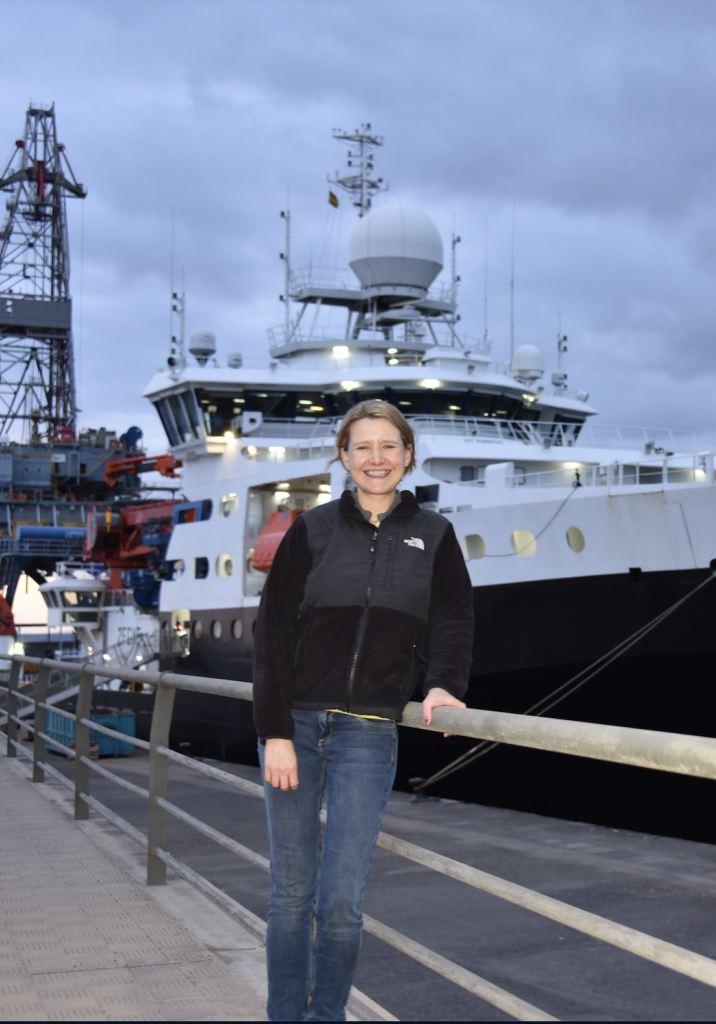
Catherine A. Rychert, portrait linked from the MIT-WHOI Joint Program institutional profile
. David A. D. Evans and Ross N. Mitchell combined paleomagnetism with the record of ancient continental margins to reconstruct a core of the supercontinent Nuna. Rotating same-age paleomagnetic poles into a common reconstruction tests whether the proposed continental neighbors share a compatible history. The study compared Siberia, Laurentia and Baltica, using agreement and later divergence of their records to constrain assembly and separation. These magnetic tests complement geological fits rather than assuming that a visually plausible arrangement uniquely reconstructs a vanished supercontinent.[ref]
Assembly and breakup of the core of Paleoproterozoic-Mesoproterozoic supercontinent Nuna by David A. D. Evans and Ross N. Mitchell. Introduction and Nuna reconstruction, paleomagnetic comparison and continental-margin constraints
A researcher in paleomagnetism and continental reconstruction, including supercontinent histories. Institutional profile: earth.yale.edu/profile/david-evans


Paul Spudich coauthored a description of rupture directivity based on arrival-time contours across a finite earthquake source. If a rupture advances toward a receiver, seismic waves from successively rupturing patches can arrive over a compressed interval; retreating rupture spreads those arrivals out. The formulation makes this directional pulse concentration depend on source geometry and rupture timing, supplying a physical measure for interpreting strong ground motion.[ref]
A formulation of directivity for earthquake sources using isochrone theory by Paul Spudich and others. 2004 report, finite-source isochrone formulation and directivity interpretation
Geophysicist and author of primary studies of earthquake ground motion and rupture directivity. His authorship and USGS affiliation are documented on the 2004 report: pubs.usgs.gov/of/2004/1268/ .
James Byerlee synthesized laboratory measurements of rock friction, providing the empirical basis of Byerlee's law. The work compares the shear stress needed for sliding with the normal compressive stress and examines effects of roughness and fault gouge.[ref]
Friction of rocks by James Byerlee. Abstract and Conclusions: normal-stress regimes, roughness and low-friction gouge exceptions
The experiments explain why many rocks show similar sliding resistance at high normal stress while some gouge-rich faults can be much weaker. Applying the laboratory relation to a natural fault also requires its fluid-pressure and material conditions.
Javier Escartín coauthored a study linking detachment faults near ridge-transform junctions to shear stress and the resulting tension in adjacent lithosphere.[ref]
How transform fault shear influences where detachment faults form near mid-ocean ridges by Jana C. Schierjott and others. Abstract: three-dimensional models and the stress mechanism for inside-corner detachment faulting
Boris J. P. Kaus coauthored three-dimensional models testing how transform fault stresses affect adjacent detachment fault formation, beyond a simple weak-boundary explanation.[ref]
How transform fault shear influences where detachment faults form near mid-ocean ridges by Jana C. Schierjott and others. Abstract: three-dimensional models and the stress mechanism for inside-corner detachment faulting
Thomas Morrow coauthored a comparison of ridge-transform geometry with models of detachment fault formation, investigating why the faults favour one side of a junction.[ref]
How transform fault shear influences where detachment faults form near mid-ocean ridges by Jana C. Schierjott and others. Abstract: three-dimensional models and the stress mechanism for inside-corner detachment faulting
Xiaochuan Tian coauthored numerical experiments separating the effects of boundary friction and transform-generated tension on the formation of detachment faults near spreading ridges.[ref]
How transform fault shear influences where detachment faults form near mid-ocean ridges by Jana C. Schierjott and others. Abstract: three-dimensional models and the stress mechanism for inside-corner detachment faulting
Mark D. Behn coauthored models coupling magmatic accommodation of seafloor spreading with faulting, testing how transform-generated stresses favour long-lived detachment faults.[ref]
How transform fault shear influences where detachment faults form near mid-ocean ridges by Jana C. Schierjott and others. Abstract: three-dimensional models and the stress mechanism for inside-corner detachment faulting
Garrett Ito coauthored a study of how magmatism and transform fault stresses influence the asymmetric formation of detachment faults near slow-spreading ridges.[ref]
How transform fault shear influences where detachment faults form near mid-ocean ridges by Jana C. Schierjott and others. Abstract: three-dimensional models and the stress mechanism for inside-corner detachment faulting
Jana C. Schierjott coauthored three-dimensional ridge-transform models that favour excess lithospheric tension from transform fault shear as an explanation of asymmetric detachment fault formation.[ref]
How transform fault shear influences where detachment faults form near mid-ocean ridges by Jana C. Schierjott and others. Abstract: three-dimensional models and the stress mechanism for inside-corner detachment faulting
Edward J. Garnero coauthored a test of the Moon's interior using seismic attenuation, tidal dissipation and Love numbers. The calculation asked whether melt-free mantle material could reproduce several independent observations.[ref]
Dissipation at tidal and seismic frequencies in a melt-free Moon by Francis Nimmo and others. Abstract: joint dissipation and tidal-response constraints
Attenuation depends on forcing frequency and material relaxation, so a large energy loss need not uniquely imply a liquid layer.
Ulrich H. Faul coauthored lunar models using a laboratory-calibrated description of anelasticity in melt-free olivine. This connects small-scale mineral deformation with measurable planetary energy loss.[ref]
Dissipation at tidal and seismic frequencies in a melt-free Moon by Francis Nimmo and others. Abstract: deformation-based rheological model
Such a comparison tests whether solid-state relaxation can explain observations before an additional molten layer is required.
Francis Nimmo coauthored models connecting the Moon's thermal structure with its tidal and seismic energy dissipation. Melt-free models matched several amplitudes but predicted the wrong sign for the measured tidal frequency dependence.[ref]
Dissipation at tidal and seismic frequencies in a melt-free Moon by Francis Nimmo and others. Abstract: successful constraints and remaining frequency-dependence discrepancy
Andrew J. Michael coauthored a comparison of stress-orientation measurements with competing strength models for the San Andreas Fault. The study combines earlier observations with new inversions of focal mechanisms, finding that similar measured orientations can support different interpretations.[ref]
Stress orientations at intermediate angles to the San Andreas Fault, California by Jeanne L. Hardebeck and Andrew J. Michael. Abstract: intermediate orientations and alternative strength models
Fault geometry and the distribution of available slipping surfaces affect how orientation is translated into strength. Measuring a stress direction therefore does not by itself determine an absolute friction coefficient.
Dave R. Stegman coauthored laboratory modelling of interactions between a mantle plume and subduction-driven mantle flow. The work tests how a moving slab can distort a buoyant source before its thermal effects reach the surface.[ref]
Ross W. Griffiths coauthored experiments investigating how mantle flow changes the surface expression of a mantle plume. A plume can be diverted or divided rather than rising through a motionless environment, altering the volcanic pattern used to infer its source.[ref]
K. A. Druken coauthored physical models of interacting subduction and mantle plumes. The experiments examine whether changing three-dimensional flow can account for contrasting volcanic progressions near Yellowstone, connecting surface patterns with a testable transport mechanism.[ref]
Bifurcation of the Yellowstone plume driven by subduction-induced mantle flow by Christopher Kincaid and others. Abstract: laboratory model and opposing volcanic progressions
Christopher Kincaid coauthored laboratory experiments that combine slab-driven circulation with a buoyant mantle plume. Their results show how plume deformation can produce contrasting volcanic progressions, providing a mechanism to test against the Snake River Plain and High Lava Plains.[ref]
Jun Korenaga coauthored a comparison of the Earth's thermal evolution with melting conditions inferred from ancient basalts. Reconstructing primary magmas provides estimates of mantle potential temperature that can be compared with heat-budget and mantle convection models.[ref]
Thermal history of the Earth and its petrological expression by Claude Herzberg and others. Abstract and Methods: petrological temperatures and thermal evolution
The comparison separates evidence for hotter ambient mantle from exceptionally hot plume-derived melts.
Walter D. Mooney and Raymond J. Durrheim compared seismic velocity profiles and geological evidence across Precambrian regions to investigate the evolution of continental crust and lithosphere.[ref]
Their comparison concerns preserved crustal provinces. Later deformation, intrusion and selective survival affect which ancient material remains available, so present crustal thickness is not automatically the original thickness at formation.
Raymond J. Durrheim and Walter D. Mooney used seismic and geochemical constraints to compare Archean and Proterozoic lithosphere. Their work tests proposed relations between crustal age, thickness and lower-crustal structure.[ref]
Evolution of the Precambrian lithosphere: Seismological and geochemical constraints by Raymond J. Durrheim and Walter D. Mooney. Abstract: crustal evolution and preserved velocity-depth profiles
Combining rock composition with wave-speed measurements helps distinguish candidate structures that a single travel-time measurement would not identify uniquely.
Taras V. Gerya coauthored three-dimensional geodynamic modelling of plume-triggered subduction initiation. The models combine a negatively buoyant plate, localized magmatic weakening and a sufficiently weak hydrated interface to test the onset of self-sustaining descent.[ref]
Plate tectonics on the Earth triggered by plume-induced subduction initiation by Taras V. Gerya and others. Abstract: three physical conditions for sustained subduction
The mechanism addresses how a strong outer shell can begin to fail and sink. Showing that this occurs under specified conditions establishes a possible route to plate motion, rather than dating the first terrestrial episode.
Peter E. van Keken coauthored global models of water transport by subducting slabs. Thermal calculations are combined with mineral stability to estimate where bound water is released and how much remains in deeper material.[ref]
Subduction factory: 4. Depth-dependent flux of H2O from subducting slabs worldwide by Peter E. van Keken and others. Abstract and Methods: thermal models, mineral stability and water retention
Cold and hot subduction zones need not dehydrate at the same depths. The calculation connects metamorphic facies, flux melting and the deep water budget through composition-dependent reaction conditions.
Bradford J. Foley coauthored models coupling planetary cooling, melt production and the carbon cycle on stagnant-lid planets. The model balances volcanic carbon dioxide supply against weathering and tests conditions compatible with a temperate surface.[ref]
Carbon Cycling and Habitability of Earth-Sized Stagnant Lid Planets by Bradford J. Foley and Andrew J. Smye. Abstract: coupled thermal evolution, degassing and weathering limits
The result makes plate tectonics a physical variable to test in a habitability model, rather than an automatic prerequisite. Initial heat and carbon inventories remain important assumptions.
James C. G. Walker coauthored a model of long-term climate regulation by silicate weathering. Warmer conditions can increase reactions that consume atmospheric carbon dioxide, reducing greenhouse warming and opposing the initial temperature change.[ref]
The mechanism links the solid Earth to climate through a chemical and transport budget. Its effectiveness depends on water, exposed reactive rock and the rate at which carbon returns to the atmosphere; a stabilizing tendency does not imply instant regulation.
W. J. Morgan contributed to the kinematics of plate tectonics. With Dan McKenzie, he analysed how the relative motions of three plates constrain the evolution of a triple junction.[ref]
The physical issue is compatibility: three separately specified boundary motions must meet at one moving junction. This makes a plate reconstruction more restrictive than drawing plausible boundary lines independently and helps distinguish configurations that can persist from those requiring a change of geometry.
A. B. Watts studies how gravity, topography and mechanical support reveal planetary structure. His analysis of gravity and topography near Hawaii separated short-wavelength volcanic loading from the broad Hawaiian swell.[ref]
Gravity and bathymetry in the central Pacific Ocean by A. B. Watts. Abstract: ship/submarine gravity observations and wavelength-dependent interpretation
The distinction matters because similar surface relief can have different support at depth. Lithospheric flexure and a deeper mass density distribution contribute differently to the measured gravity anomaly, so combined observations are more informative than elevation alone.
H. F. Reid developed the elastic-rebound theory of earthquakes from deformation associated with the 1906 California earthquake. The theory connects slow accumulation of elastic strain with sudden fault slip and release of stored energy.[ref]
Reid's Elastic Rebound Theory by United States Geological Survey. Surface-displacement observations and the elastic-rebound interpretation
An offset marker records displacement during rupture, while measurements spread over a broader region reveal the preceding deformation. These are complementary observations: the final offset alone does not describe the full volume of rock that stored elastic energy before the event.
W. Ellsworth co-developed a double-difference earthquake relocation method with F. Waldhauser. Their algorithm compares differences in arrival times from nearby earthquakes recorded at common stations, reducing errors shared along similar propagation paths.[ref]
The result is improved relative location within an earthquake cluster, rather than an automatic exact absolute position. The distinction helps interpret fine fault geometry without confusing relative precision with the accuracy of the underlying velocity model.
F. Waldhauser co-developed double-difference earthquake relocation with W. Ellsworth. The method combines ordinary arrival-time data with precise waveform-based differential measurements, then adjusts relative source positions to fit those differences.[ref]
A Double-difference Earthquake Location Algorithm: Method and Application to the Northern Hayward Fault, California by F. Waldhauser and W. Ellsworth. Abstract: combined catalogue/cross-correlation observations and iterative solution
Closely related waveforms provide useful timing information through cross-correlation. Combining those observations with a network of stations can reveal structure within a seismic cluster that a collection of independently located events would blur.
R. D. van der Hilst uses seismology to investigate Earth's interior. His teaching develops the connection between measured seismic arrivals and wave propagation, while his research includes global seismic tomography used to constrain mantle circulation.[ref]
Essentials of Geophysics: Seismology by R. D. van der Hilst. Course notes: seismic propagation and Earth structure
[ref]Evidence for deep mantle circulation from global tomography by R. D. van der Hilst and others. Abstract: mantle structure from global tomography
The inferential step is important: a wave-speed anomaly is an observation-dependent model, and interpreting it as temperature, composition or flow requires additional physical assumptions.
S. J. Mackwell investigates the mechanical behaviour of planetary materials through laboratory deformation experiments. His work on hot, dry rock connects measured stress and strain rate with the strength expected in the crust of Venus.[ref]
High-temperature deformation of dry diabase, with application to crustal deformation on Venus by S. J. Mackwell and others. Experimental and textural study of high-temperature deformation
Extrapolating a laboratory flow law to a planet requires the relevant temperature, composition and deformation regime. A single viscosity measured under one set of conditions therefore does not establish a universal crustal viscosity.
John G. Sclater coauthored work linking ocean-floor depth and heat flux to the age of oceanic lithosphere. With Barry Parsons, he compared cooling models against both types of observation.[ref]
An analysis of the variation of ocean floor bathymetry and heat flow with age by Barry Parsons and John G. Sclater. Abstract: cooling/plate models tested with depth and heat flow
Cooling changes both the thermal gradient that drives heat loss and the mass density structure that affects subsidence. Their joint use constrains the thermal evolution more strongly than either observation alone.
Barry Parsons coauthored an analysis of how ocean-floor depth and heat flux change with age, using those data to compare models of cooling oceanic lithosphere.[ref]
An analysis of the variation of ocean floor bathymetry and heat flow with age by Barry Parsons and John G. Sclater. Abstract: model comparison and observational constraints
Articles were limited to the first 100 out of 123 total.
Articles by others on the same topic
There are currently no matching articles.