Topics (384k) Articles (398k) Users (410) Discussions (242) Comments (383) Files (13k) New article

A paleontologist who investigated taphonomy through experiments on soft-tissue fossilization, connecting observable decay and mineralization to exceptional preservation.[ref]

Portrait of Derek Briggs
. External portrait hosted by Yale University, Department of Earth & Planetary Sciences. Source.A paleontologist who studied early jawed vertebrates, including Silurian fossils with character combinations that inform the origins of modern jaw and skull structures.[ref]

Portrait of Min Zhu (paleontologist)
. External portrait hosted by Institute of Vertebrate Paleontology and Paleoanthropology, Chinese Academy of Sciences. Source.Paleontologist studying large-scale evolution and extinction selectivity, including the marine fossil record.

Portrait of David Jablonski
. Image courtesy of Susan M. Kidwell. Source.Paleontologist whose research includes early life and physiological interpretations of mass extinction.

Portrait of Andrew H. Knoll
. The Royal Society (Royal Society uploader); existing crop by Auguel. CC BY-SA 4.0, via Wikimedia Commons. Source.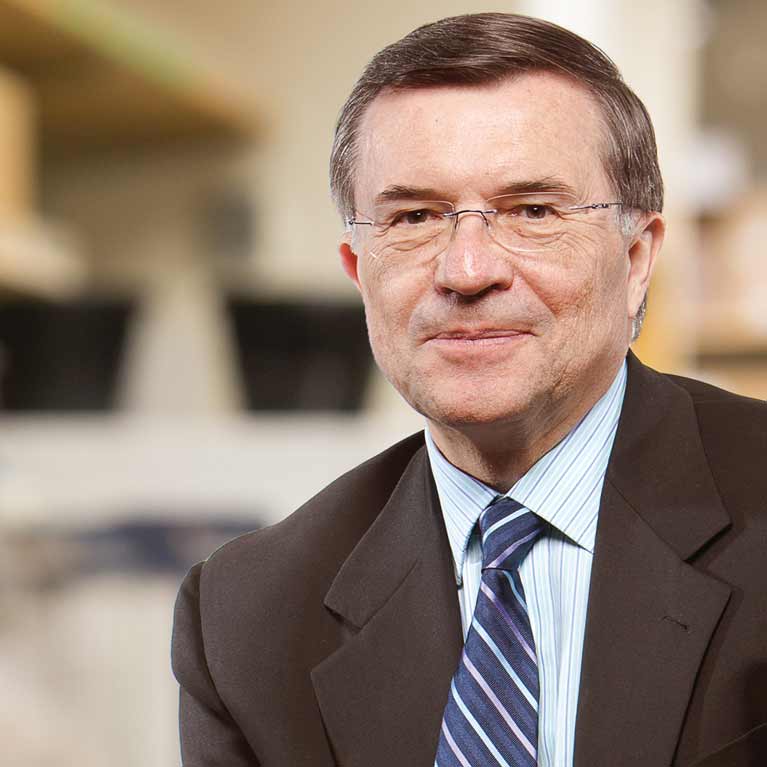
Portrait of Terrence J. Sejnowski
. A biophysicist who coauthored single-molecule methods for estimating the number of subunits in membrane-bound proteins. Counting bleaching steps connected an optical time series to molecular assembly.[ref]
Subunit counting in membrane-bound proteins by Maximilian H. Ulbrich and Ehud Y. Isacoff. study design and results; author roster
A researcher who coauthored adaptive-optics imaging and densitometry of human cone mosaics. Measuring variation among individuals connected retinal sampling with trichromatic vision without assuming one fixed cone ratio for every observer.[ref]
Organization of the Human Trichromatic Cone Mosaic by Heidi Hofer and others. study design and results; author roster
A researcher who coauthored basilar-membrane measurements before and after a reversible physiological perturbation. Changes in sensitivity and tuning tested a contribution of active cochlear feedback.[ref]
A researcher who coauthored event-related-potential experiments separating auditory features from their conjunctions. Frequency and location selection conditions tested successive components of auditory attention.[ref]
Stages of auditory feature conjunction: an event-related brain potential study by David L. Woods and others. study design and results; author roster
A researcher who coauthored controlled comparisons of orthonasal and retronasal odor delivery. Route-by-odor effects tested the importance of how a chemical stimulus reaches the sensory surface.[ref]
Differential neural responses evoked by orthonasal versus retronasal odorant perception in humans by Dana M. Small and others. study design and results; author roster
A researcher who coauthored recordings during a visual paired-associate task. Cue and delay responses connected neuronal activity with learned relationships between stimuli rather than only their immediate appearance.[ref]
Neural organization for the long-term memory of paired associates by Kuniyoshi Sakai and others. study design and results; author roster
A researcher who coauthored recordings of primate hippocampal spatial-view cells. Measurements of locomotion and eye position helped distinguish represented locations from the animal’s own position or gaze direction alone.[ref]
Spatial view cells in the primate hippocampus by Edmund T. Rolls and others. study design and results; author roster
A researcher who coauthored head-direction recordings before and after eye opening in rats. Early directional activity tested how an organized neural signal develops before ordinary visual experience.[ref]
The development of the head direction system before eye opening in the rat by Hui Min Tan and others. study design and results; author roster
A researcher who coauthored adult CA3-restricted receptor-deletion experiments. Comparing recall with full and partial cues tested a contribution to associative recovery rather than only acquisition of a complete cue configuration.[ref]
Requirement for hippocampal CA3 NMDA receptors in associative memory recall by Kazu Nakazawa and others. study design and results; author roster
A researcher who coauthored simultaneous dentate-gyrus and CA3 recordings during conflicting spatial cues. Comparing the populations tested pattern separation and completion under the same input perturbation.[ref]
A researcher who developed a computational account of learning invariance from transformation sequences. Linking successive views provided a proposed route to stable object representations without assuming that every view is explicitly labeled.[ref]
Learning invariance from transformation sequences by Peter Földiák. study design and results; author roster
A researcher who coauthored models of invariant object recognition using continuous transformations. Comparing spatial overlap with temporal ordering tested which features of training sequences supported learned invariance.[ref]
Learning invariant object recognition in the visual system with continuous transformations by Simon M. Stringer and others. study design and results; author roster
A researcher who coauthored experiments changing temporal relationships among viewed objects. Subsequent neural tests connected unsupervised experience with changes in position-tolerant visual representation.[ref]
Unsupervised natural experience rapidly alters invariant object representation in visual cortex by Nuo Li and others. study design and results; author roster
Pinned article: Introduction to the OurBigBook Project
Welcome to the OurBigBook Project! Our goal is to create the perfect publishing platform for STEM subjects, and get university-level students to write the best free STEM tutorials ever.
Everyone is welcome to create an account and play with the site: ourbigbook.com/go/register. We belive that students themselves can write amazing tutorials, but teachers are welcome too. You can write about anything you want, it doesn't have to be STEM or even educational. Silly test content is very welcome and you won't be penalized in any way. Just keep it legal!
Intro to OurBigBook
. Source. We have two killer features:
- topics: topics group articles by different users with the same title, e.g. here is the topic for the "Fundamental Theorem of Calculus" ourbigbook.com/go/topic/fundamental-theorem-of-calculusArticles of different users are sorted by upvote within each article page. This feature is a bit like:
- a Wikipedia where each user can have their own version of each article
- a Q&A website like Stack Overflow, where multiple people can give their views on a given topic, and the best ones are sorted by upvote. Except you don't need to wait for someone to ask first, and any topic goes, no matter how narrow or broad
This feature makes it possible for readers to find better explanations of any topic created by other writers. And it allows writers to create an explanation in a place that readers might actually find it.
Figure 1. Screenshot of the "Derivative" topic page. View it live at: ourbigbook.com/go/topic/derivativeVideo 2. OurBigBook Web topics demo. Source. - local editing: you can store all your personal knowledge base content locally in a plaintext markup format that can be edited locally and published either:This way you can be sure that even if OurBigBook.com were to go down one day (which we have no plans to do as it is quite cheap to host!), your content will still be perfectly readable as a static site.
- to OurBigBook.com to get awesome multi-user features like topics and likes
- as HTML files to a static website, which you can host yourself for free on many external providers like GitHub Pages, and remain in full control

Figure 2. You can publish local OurBigBook lightweight markup files to either OurBigBook.com or as a static website.
Figure 3. Visual Studio Code extension installation.
Figure 5. . You can also edit articles on the Web editor without installing anything locally. Video 3. Edit locally and publish demo. Source. This shows editing OurBigBook Markup and publishing it using the Visual Studio Code extension. 
- Infinitely deep tables of contents:



All our software is open source and hosted at: github.com/ourbigbook/ourbigbook
Further documentation can be found at: docs.ourbigbook.com
Feel free to reach our to us for any help or suggestions: docs.ourbigbook.com/#contact