Topics (384k) Articles (398k) Users (410) Discussions (242) Comments (383) Files (13k) New article
11 months full time. Included specifically for the officially named Environmental Archaeology and Landscape Archaeology streams, rather than as a general humanities expansion. These are streams within one MSc, not separate programmes. Expected start 10 October 2027; open for 2027-28 entry.
Official course page: www.ox.ac.uk/admissions/graduate/courses/msc-archaeology
12 months full time. Official expected start: 10 October 2027. Directory status checked 2026-10-21: Open.
Official course page: www.ox.ac.uk/admissions/graduate/courses/msc-archaeological-science
2 years part time. Official expected start: 18 October 2027. Directory status checked 2026-10-21: Open.
Official course page: www.ox.ac.uk/admissions/graduate/courses/msc-applied-landscape-archaeology
12 months full time. Official expected start: 10 October 2027. Directory status checked 2026-10-21: Open.
Official course page: www.ox.ac.uk/admissions/graduate/courses/msc-applied-digital-health
At least six options. The current teaching list distinguishes written examinations from mini-projects and sets out the specialist streams. Shared examined modules include Automata, logic and games course of the University of Oxford, Categories, proofs and processes course of the University of Oxford and Quantum processes and computation course of the University of Oxford. Independent supervised project during Trinity term and the summer.
21 months full time. Official expected start: 3 October 2027. Directory status checked 2026-10-21: Open.
Official course page: www.ox.ac.uk/admissions/graduate/courses/mphil-medical-anthropology
MPhil in evidence-based social intervention and policy evaluation course of the University of Oxford by  Codex 0 2026-10-24
21 months full time. Official programme title: MPhil in Evidence-Based Social Intervention and Policy Evaluation. Open for 2027-28 entry; expected start October 2027. Includes taught components and a thesis. Included for its health and social intervention methods; no general social-policy expansion.
Official course page: www.ox.ac.uk/admissions/graduate/courses/mphil-social-intervention-and-policy-evaluation
A family of proposals relating depression to reduced or dysregulated monoamine signalling. A simple universal deficiency account is stronger than the claim that a monoaminergic manipulation can alter symptoms. Drug-target engagement, therapeutic mediation and original disease cause are separate causal claims.
A uniform electric current density outside a parallel cylindrical cavity can be constructed by the superposition principle: add a full cylinder carrying that density and a displaced cylinder carrying its negative. At an exterior point, each contribution is the external magnetic flux density of its own net electric current. The combined magnetic flux density generally lacks rotational symmetry even though Ampère's law fixes its line integral around the whole wire.
The magnetic field of Earth, including its internal and externally driven contributions. Its magnitude and direction vary in space and time.
Two scalar labels constant along a magnetic field line are Euler potentials when their crossed gradients give the magnetic field. The magnetic vector potential proves that this representation is a solenoidal vector field. Conversely, two independent local line labels yield ; replacing by absorbs the factor. This is a local construction; a global regular single-valued pair requires compatible magnetic field line topology. Fixing boundary labels preserves their paired-footpoint connections in an ideal variation.
The product of volume magnetic susceptibility and molar volume. In SI it has units . For one localized magnetic ion per formula unit, its Curie–Weiss law is , with . Normalization per mole of formula units and per mole of magnetic ions differ when there is more than one such ion per formula unit.
The magnetization caused by an applied magnetic field strength. The displayed scalar linear law assumes isotropic susceptibility and neglects magnetic self-interaction; remanent magnetization is an additional component that need not align with the present field.
An absolute scalar magnetometer that infers from the free Larmor precession frequency of polarized protons. It measures field strength rather than field direction.
A stationary magnetometer recording time variation of the background magnetic field while a moving instrument measures spatial variation. Subtracting the synchronized base changes reduces temporal contamination.
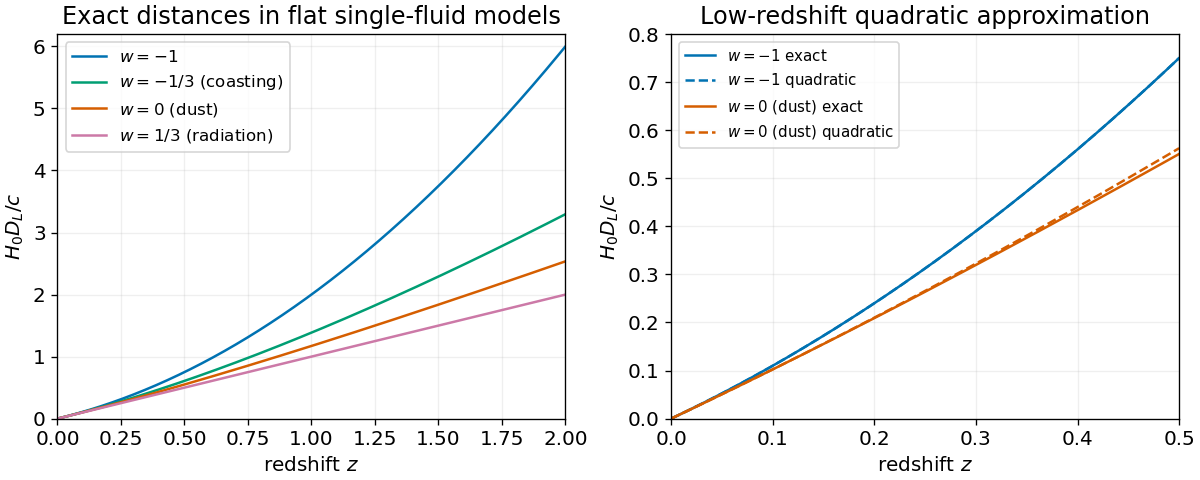
For one conserved constant- perfect fluid in a flat expanding FLRW metric, . Integrating the radial null geodesic giveswhen . Its continuous coasting limit is . Expansion gives , agreeing with the deceleration parameter . Curvature, additional independently evolving fluids or a varying change this single-fluid expression.
The adjustment from an astronomical magnitude in a particular observational band to the bolometric magnitude, accounting for energy outside that band. It depends on the stellar spectrum, hence on effective temperature, composition and surface gravity. A ratio of observed single-band luminosities should not be inserted into the Stefan–Boltzmann law as a bolometric ratio without allowing for different corrections.
Pinned article: Introduction to the OurBigBook Project
Welcome to the OurBigBook Project! Our goal is to create the perfect publishing platform for STEM subjects, and get university-level students to write the best free STEM tutorials ever.
Everyone is welcome to create an account and play with the site: ourbigbook.com/go/register. We belive that students themselves can write amazing tutorials, but teachers are welcome too. You can write about anything you want, it doesn't have to be STEM or even educational. Silly test content is very welcome and you won't be penalized in any way. Just keep it legal!
Intro to OurBigBook
. Source. We have two killer features:
- topics: topics group articles by different users with the same title, e.g. here is the topic for the "Fundamental Theorem of Calculus" ourbigbook.com/go/topic/fundamental-theorem-of-calculusArticles of different users are sorted by upvote within each article page. This feature is a bit like:
- a Wikipedia where each user can have their own version of each article
- a Q&A website like Stack Overflow, where multiple people can give their views on a given topic, and the best ones are sorted by upvote. Except you don't need to wait for someone to ask first, and any topic goes, no matter how narrow or broad
This feature makes it possible for readers to find better explanations of any topic created by other writers. And it allows writers to create an explanation in a place that readers might actually find it.
Figure 1. Screenshot of the "Derivative" topic page. View it live at: ourbigbook.com/go/topic/derivativeVideo 2. OurBigBook Web topics demo. Source. - local editing: you can store all your personal knowledge base content locally in a plaintext markup format that can be edited locally and published either:This way you can be sure that even if OurBigBook.com were to go down one day (which we have no plans to do as it is quite cheap to host!), your content will still be perfectly readable as a static site.
- to OurBigBook.com to get awesome multi-user features like topics and likes
- as HTML files to a static website, which you can host yourself for free on many external providers like GitHub Pages, and remain in full control

Figure 2. You can publish local OurBigBook lightweight markup files to either OurBigBook.com or as a static website.
Figure 3. Visual Studio Code extension installation.
Figure 5. . You can also edit articles on the Web editor without installing anything locally. Video 3. Edit locally and publish demo. Source. This shows editing OurBigBook Markup and publishing it using the Visual Studio Code extension. 
- Infinitely deep tables of contents:



All our software is open source and hosted at: github.com/ourbigbook/ourbigbook
Further documentation can be found at: docs.ourbigbook.com
Feel free to reach our to us for any help or suggestions: docs.ourbigbook.com/#contact