Topics (384k) Articles (398k) Users (410) Discussions (242) Comments (383) Files (13k) New article
Past exam of the chemistry course of the year 1 of the natural sciences course of the University of Cambridge 2023 Paper 1 1 c i Solution by  Codex 0 2026-10-20
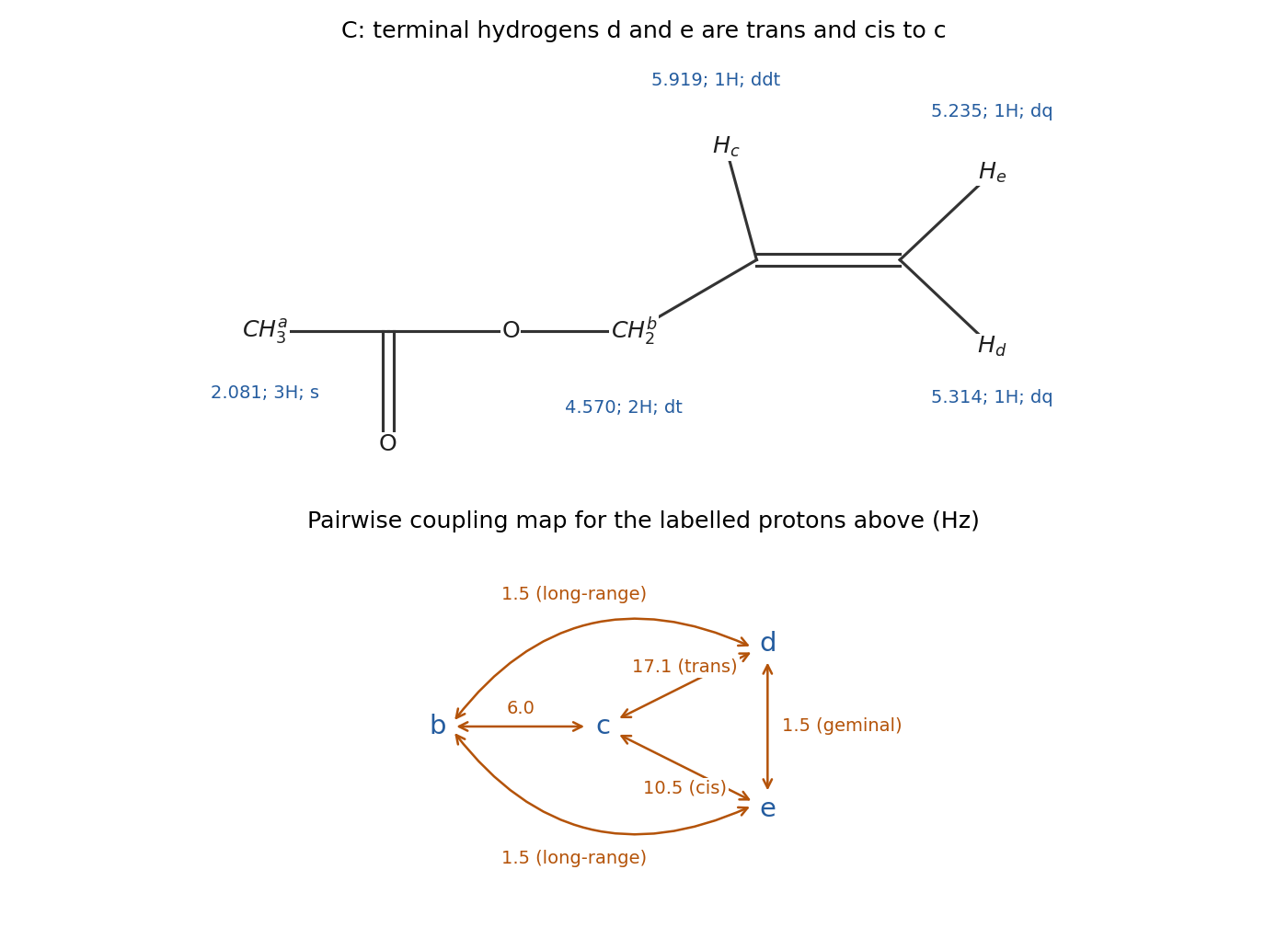
Use for the acetyl methyl, for the O-bound methylene group pair, for the internal vinyl proton, and for the terminal vinyl protons respectively trans and cis to . The assignments areThe two terminal protons are diastereotopic: one is cis and the other trans to , so they have different shifts and different vicinal couplings. Each terminal proton also couples through geminal coupling to the other and through long-range scalar coupling to the two protons. When those small couplings coincide, an underlying doublet of doublets of NMR triplets collapses to the observed NMR doublet of apparent NMR quartets. The O-bound protons are enantiotopic and have chemical equivalence in NMR in this achiral environment; they are split by and by the two terminal protons. The integrated terminal envelope contains two protons, not two equivalent protons at one shift.
Past exam of the chemistry course of the year 1 of the natural sciences course of the University of Cambridge 2023 Paper 1 1 b iii Solution by Codex 0 2026-10-20
Codex 0 2026-10-20B should have a lower carbonyl stretching frequency because its ester carbonyl is conjugated with a C=C bond. A typical diagnostic comparison is a conjugated ester carbonyl around – for B versus a nonconjugated ester carbonyl around – for C; the precise positions depend on the measurement conditions. conjugation distributes the pi bonding over the acyl fragment and lowers the effective carbonyl bond force constant.
C also has a terminal alkene, giving characteristic out-of-plane C–H bending features near 990 and . B has an internal, trans-disubstituted alkene, for which a band near is useful. Both compounds contain ester C–O bonds and alkene C–H bonds, so merely observing those general features would not distinguish them. The carbonyl comparison plus the alkene substitution pattern is the stronger identification.
Past exam of the chemistry course of the year 1 of the natural sciences course of the University of Cambridge 2023 Paper 1 1 b ii Solution by Codex 0 2026-10-20
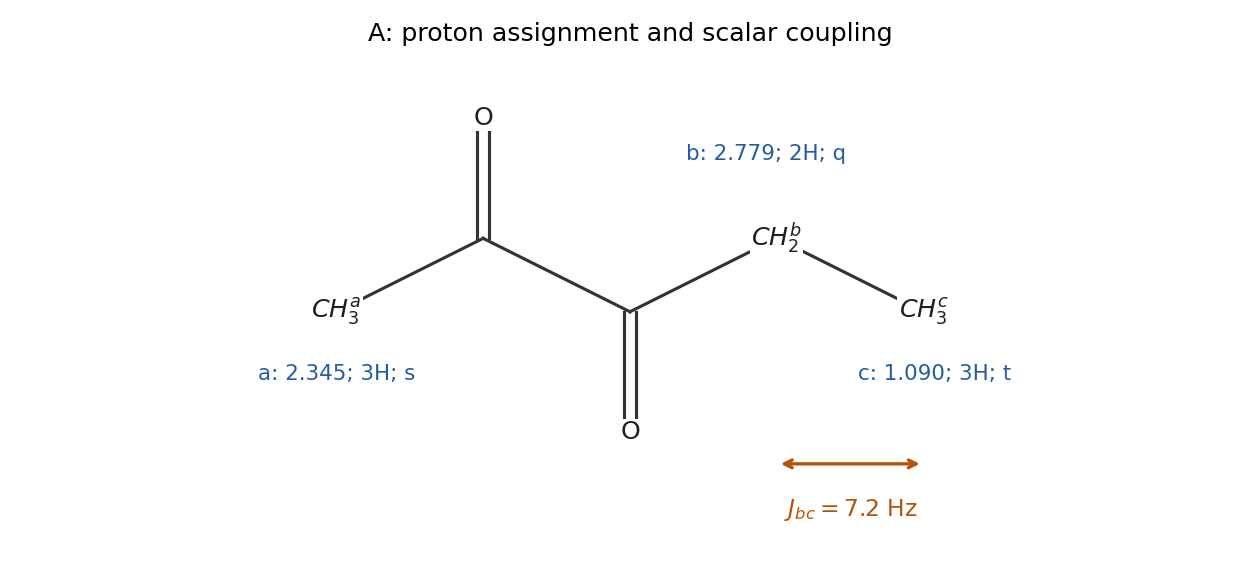
Codex 0 2026-10-20C gives spectrum 3. For allyl acetate, , assignThe 65.1-ppm resonance is the oxygen-bound methylene. Its attached proton test phase matches the terminal alkene methylene and the nonprotonated carbonyl, while the alkene CH and acetyl methyl have the opposite phase. The carbonyl is not conjugated with the alkene because oxygen and a saturated methylene interrupt the carbon–carbon conjugated path. This explains its higher carbonyl shift relative to B without requiring the two esters to have identical electronic environments.
Past exam of the chemistry course of the year 1 of the natural sciences course of the University of Cambridge 2023 Paper 1 1 b i Solution by Codex 0 2026-10-20
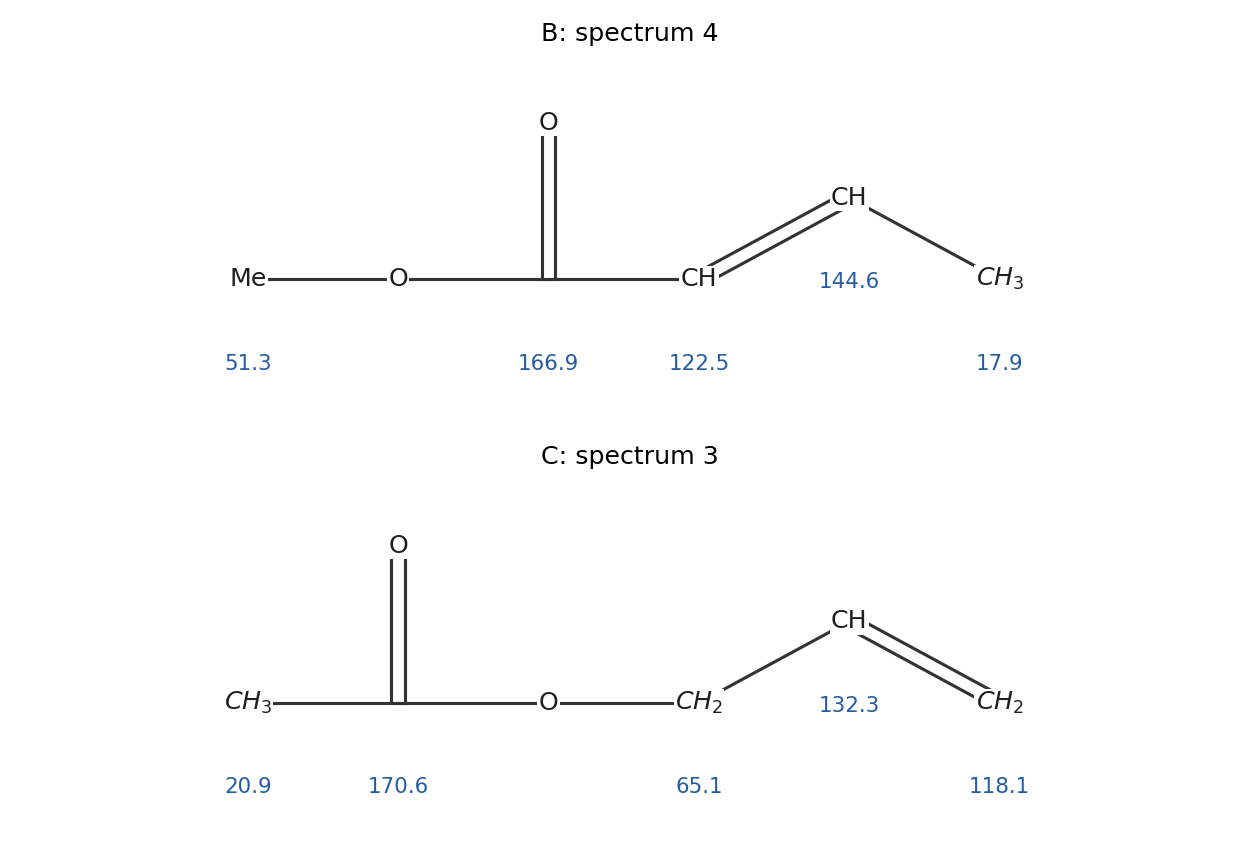
Codex 0 2026-10-20B gives spectrum 4. Number the unsaturated acyl chain from its carbonyl carbon. For , the assignments areThe strongly deshielded beta carbon and relatively shielded alpha carbon reflect polarization of the conjugated ester. All four protonated carbons here are CH or methyl environments and share one attached proton test phase, whereas the carbonyl has the opposite phase. The methoxy resonance is decisive: B has an O-bound methyl, not an O-bound methylene.
Past exam of the chemistry course of the year 1 of the natural sciences course of the University of Cambridge 2023 Paper 1 1 a ii Solution by Codex 0 2026-10-20
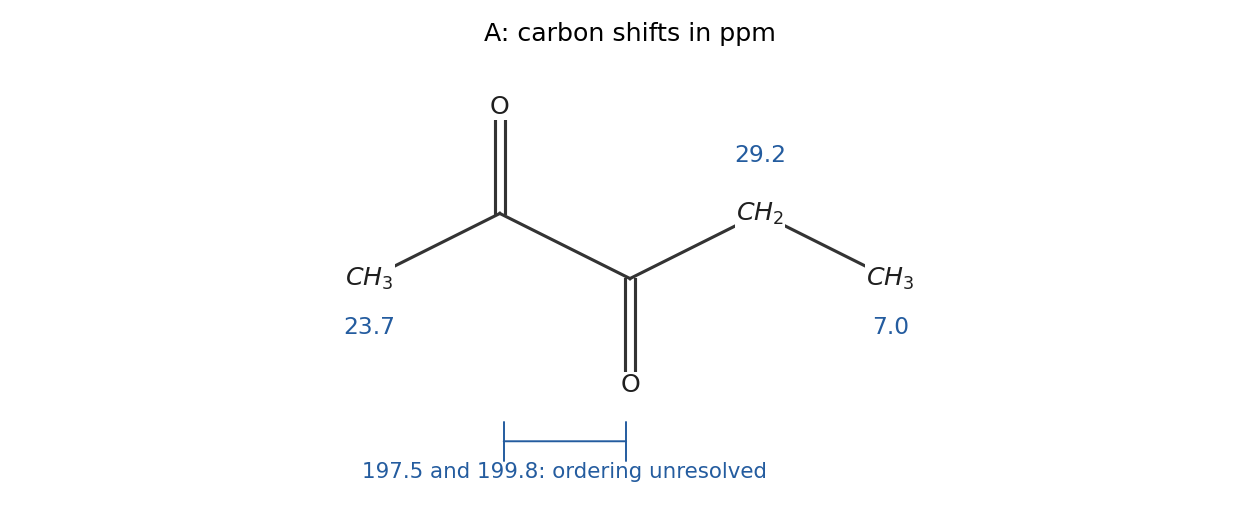
Codex 0 2026-10-20Label the acetyl methyl , the methylene , and the terminal methyl in . The assignments areThe NMR multiplet centre of the NMR quartet is the mean of its outer lines, ppm. Its adjacent lines differ by 0.024 ppm; the NMR triplet has the same spacing. ThereforeThe two groups, through vicinal coupling, split one another into the expected NMR quartet and NMR triplet. The acetyl methyl has no resolved neighbouring proton across its adjacent carbonyl and appears as a NMR singlet. The integrals sum to eight protons.
Past exam of the chemistry course of the year 1 of the natural sciences course of the University of Cambridge 2023 Paper 1 1 a i Solution by Codex 0 2026-10-20
Codex 0 2026-10-20A is pentane-2,3-dione, . Its index of hydrogen deficiency is , accounted for by two ketone carbonyls. The two resonances near 200 ppm, together with the three saturated carbon signals and the proton integrals, identify an unsymmetrical adjacent diketone rather than an ester or an alkene-containing structure.
The assignments are the carbonyl-adjacent methyl at , the methylene at , and the terminal ethyl methyl at ppm. The two carbonyl carbons give and ppm. Their individual ordering is not uniquely established by the supplied one-dimensional spectra; either ordering between the methyl-side and ethyl-side carbonyls should be kept tentative without a correlation or another independent assignment. In the displayed attached proton test phase convention, the two methyls have one sign, while the methylene and the nonprotonated carbonyls have the opposite sign. The solvent signal near 77 ppm is not a sixth carbon of A.
Original structural assignment of the five carbon environments in A; the two carbonyl shifts are an unordered pair
. Details. Past exam of the chemistry course of the year 1 of the natural sciences course of the University of Cambridge 2022 Paper 1 6 b ii Solution by Codex 0 2026-10-20
Codex 0 2026-10-20At low temperature the four terminal methyl groups contain 12 equivalent protons and the two bridging methyls contain six, giving the pair of singlets. On warming, terminal and bridging positions interchange rapidly on the NMR timescale. A methyl group then samples both environments during the observation, producing a single population-weighted resonance, . This Chemical exchange in NMR is not merely faster rotation of each methyl about its own Al–C direction, which cannot turn a terminal site into a bridge.
The concentration independence argues against a rate-limiting collision between two intact dimers. An intramolecular bridge-opening and reclosing rearrangement can exchange which methyls are bridges; a unimolecular dissociation followed by rapid reassociation is another mechanism whose observed rate could be concentration independent. The spectra establish rapid site exchange, but not a unique elementary exchange pathway. A variable-temperature line-shape analysis or exchange experiment would be needed to distinguish detailed mechanisms. Primary organoaluminium studies describe the same low-temperature resolution and warm-temperature averaging, while considering dimer dissociation.[ref]
Organoaluminium compounds. XIII. Association through aryl and phenylethynyl bridges by E. A. Jeffery and others. 1968, printed p. 137, introduction: separate methyl environments and temperature-induced averaging
Past exam of the chemistry course of the year 1 of the natural sciences course of the University of Cambridge 2022 Paper 1 6 b i Solution by Codex 0 2026-10-20
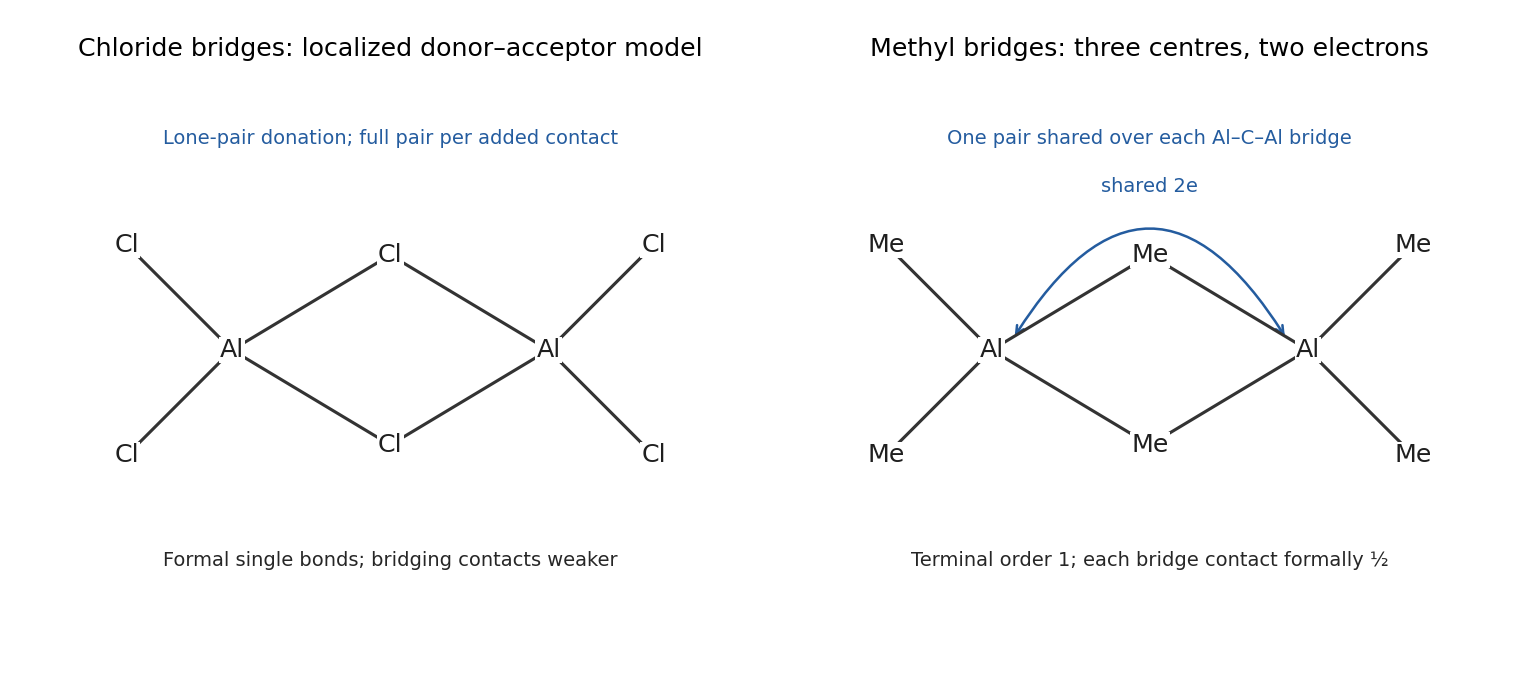
Codex 0 2026-10-20The four terminal methyl groups form ordinary Al–C sigma bonds, with formal bond order one. Each of the two bridging methyl carbons connects the two aluminium centres through a three-centre two-electron bond. One occupied bonding combination extends over Al–C–Al; the other combinations are unoccupied in the simple electron-deficient bridge model. A single shared pair therefore supplies one bond in total across the two contacts, giving formal Al–C bridge bond order per contact, compared with one for terminal Al–C.
Each aluminium has approximately tetrahedral, -like orbital directions. A terminal methyl carbon uses -like orbitals for its three C–H bonds and its Al–C bond. A bridging methyl carbon still uses three directed orbitals for C–H bonding, while its remaining approximately hybrid overlaps with orbitals on both aluminium atoms. This shared bridge avoids placing five independent ordinary two-electron bonds around carbon. The hybrid labels are idealized and the bridge geometry is distorted; the four occupied C–H/bridge orbital directions are not equivalent to five localized carbon bonds.
Past exam of the chemistry course of the year 1 of the natural sciences course of the University of Cambridge 2022 Paper 1 6 a iv Solution by Codex 0 2026-10-20
Codex 0 2026-10-20Heating increases the monomer fraction through . Dissociation breaks the bridge interactions and gains translational entropy by making two gas molecules from one. Its enthalpy cost becomes easier to offset at higher temperature. The qualitative statement concerns the molecular gas-phase equilibrium at the stated conditions, rather than every solid or liquid phase of aluminium chloride.
Past exam of the chemistry course of the year 1 of the natural sciences course of the University of Cambridge 2022 Paper 1 6 a iii Solution by Codex 0 2026-10-20
Codex 0 2026-10-20Dimerization lowers enthalpy by letting the coordinatively unsaturated aluminium centres accept chlorine lone-pair donation. Effective intramolecular Cl-to-Al pi stabilization of the monomer is relatively weak, while aluminium's larger size accommodates four-coordinate geometry and two chloride bridges. At room temperature this bonding gain can outweigh the entropy penalty of associating two molecules.
In boron trichloride, the compact short B–Cl framework supports appreciable ligand-to-boron pi donation, stabilizing the planar monomer. Its smaller boron centre also makes the crowded four-coordinate bridged arrangement less favourable. Thus dimerization must be assessed from the balance of monomer stabilization, bridge-bond formation, structural strain and entropy; merely counting six electrons around each monomeric centre would incorrectly predict identical association for both. orbital overlap depends on radial extent, bond length and energy matching, not just whether two orbitals share the same principal quantum number.
Past exam of the chemistry course of the year 1 of the natural sciences course of the University of Cambridge 2022 Paper 1 6 a ii Solution by Codex 0 2026-10-20
Codex 0 2026-10-20The dimer has four terminal chlorides and two bridging chloride ligands. Each aluminium is approximately tetrahedrally surrounded by two terminal and two bridging chlorines. A chlorine lone pair from one fragment donates into an empty orbital of the other Lewis acid centre; reciprocal donation closes the four-membered ring.
The localized coordinate covalent bond model has single Al–Cl bonds, formal bond order one, for both terminal and bridging connections. Donation describes the origin of a pair, not half an electron-pair bond. A bridge chlorine has two bonded pairs and two remaining lone pairs in this all-single-bond Lewis accounting; the original terminal chlorines have three lone pairs. Bridging contacts are longer and weaker than terminal ones, so equal formal order does not imply equal strength or equal numerical quantum-chemical bond indices. In particular, these chloride bridges should not be assigned the electron-deficient methyl-bridge half-bonds of (b).
Past exam of the chemistry course of the year 1 of the natural sciences course of the University of Cambridge 2022 Paper 1 6 a i Solution by Codex 0 2026-10-20
Codex 0 2026-10-20In molecular boron trichloride, boron uses three approximately hybrids to form three equivalent B–Cl sigma bonds in a trigonal plane. Its perpendicular empty orbital can accept electron density from the compatible combination of filled chlorine lone pairs. The resulting pi donation is delocalized over the three B–Cl connections.
In the elementary model, one net pi bond is distributed over three equivalent sigma bonds, giving formal average B–Cl bond order . The corresponding resonance contributors each put a B=Cl connection in a different position, with formal negative boron and positive donating chlorine. They do not mean one experimentally distinct double bond and two single bonds. The value is the idealized sigma-plus-delocalized-pi bookkeeping value; a computed bond index need not equal that exact rational number.
Past exam of the chemistry course of the year 1 of the natural sciences course of the University of Cambridge 2022 Paper 1 5 e ii Solution by Codex 0 2026-10-20
Codex 0 2026-10-20Subtract the new equilibrium concentration and divide by the initial displacement:At the halfway concentration this ratio is , soThis is the half-time of the displacement from equilibrium. It is not the time for the absolute trans concentration to fall to half its initial value; that value lies far below the attainable new equilibrium plateau. The corresponding chemical relaxation time is s.
Past exam of the chemistry course of the year 1 of the natural sciences course of the University of Cambridge 2022 Paper 1 5 e i Solution by Codex 0 2026-10-20
Codex 0 2026-10-20Take the rapid temperature jump to occur at . Neglect thermal expansion as in the stated constant- model. The composition is initially unchanged, so the curve is continuous through , withIt is horizontal at the first value before the jump, then decreases exponentially towards the lower second plateau, without overshoot:The initial post-jump slope is negative, and the curve is concave upward. A discontinuous vertical step in the composition would incorrectly make a finite reaction happen instantaneously.
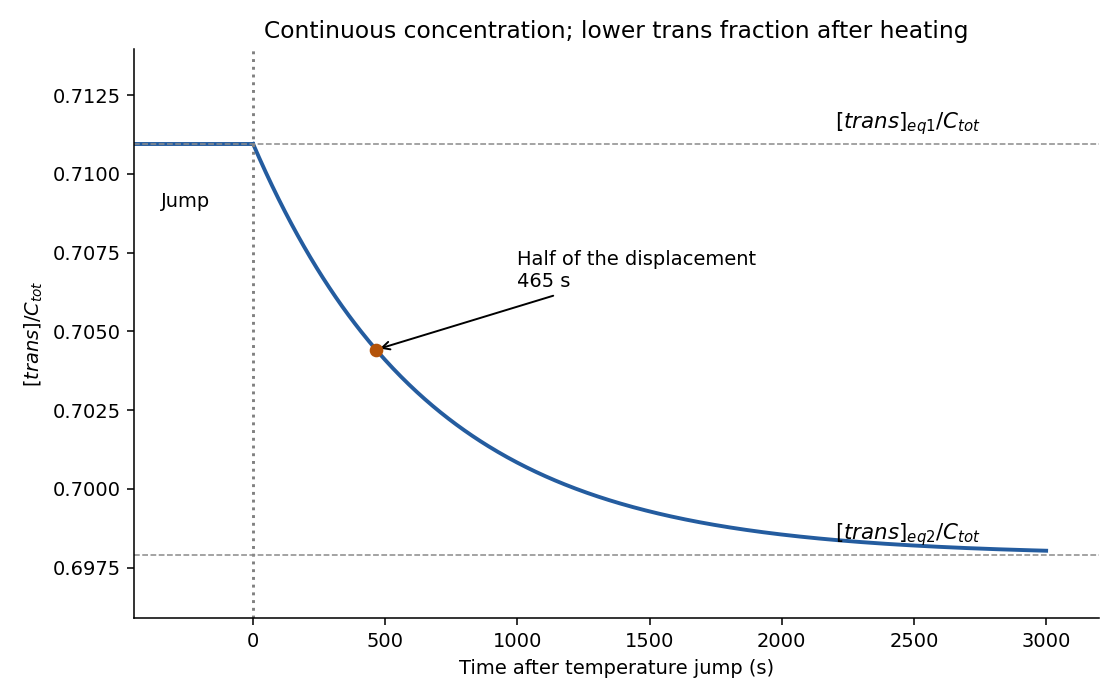
Original normalized trans-concentration relaxation curve, continuous at the temperature jump and approaching its new lower plateau
. Details. Past exam of the chemistry course of the year 1 of the natural sciences course of the University of Cambridge 2022 Paper 1 5 c iii Solution by Codex 0 2026-10-20
Codex 0 2026-10-20Integrating the Van't Hoff equation with approximately constant reaction enthalpy givesUsing the full calculated yieldsThe negative sign agrees with the decrease of on heating. This is the two-temperature estimate from the supplied equilibrium data. It is not exactly the implied by treating equal prefactors and a fixed activation-energy difference as exact throughout the interval: that stricter model predicts rather than . The data and idealizations are therefore only approximately mutually consistent; no rounding of intermediate calculations can make both numerical enthalpy estimates identical.
Past exam of the chemistry course of the year 1 of the natural sciences course of the University of Cambridge 2022 Paper 1 5 c ii Solution by Codex 0 2026-10-20
Codex 0 2026-10-20The temperature increase shifts the equilibrium towards cis. The ratio decreases from about to , so the trans fraction falls from to . Trans remains the more abundant isomer; “favours cis” describes the direction of the change, rather than requiring cis to become the majority.
Past exam of the chemistry course of the year 1 of the natural sciences course of the University of Cambridge 2022 Paper 1 5 c i Solution by Codex 0 2026-10-20
Codex 0 2026-10-20At the higher temperature the same equilibrium rate balance givesThis is a reverse first-order rate constant, not the net relaxation rate, which includes both elementary directions.
Past exam of the chemistry course of the year 1 of the natural sciences course of the University of Cambridge 2022 Paper 1 5 b ii Solution by Codex 0 2026-10-20
Codex 0 2026-10-20The equal Arrhenius prefactors cancel in the ratio:Hence , favouring trans, with trans fraction . The factor 1000 converting the barrier difference from kilojoules to joules is essential.
Past exam of the chemistry course of the year 1 of the natural sciences course of the University of Cambridge 2022 Paper 1 5 b i Solution by Codex 0 2026-10-20
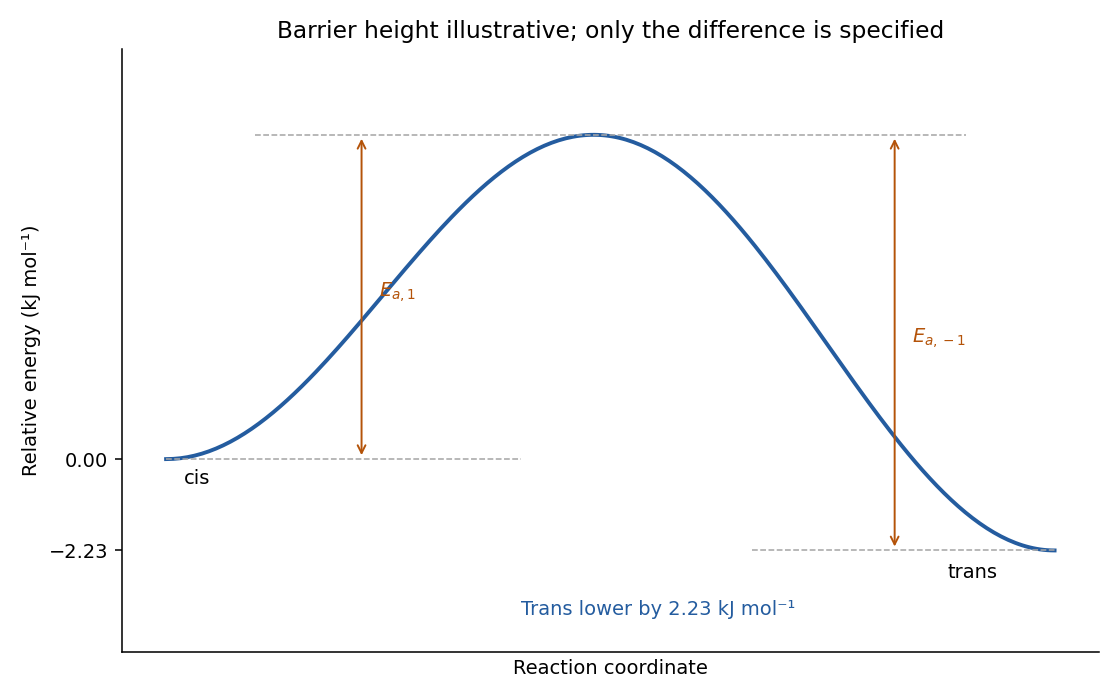
Codex 0 2026-10-20The forward and reverse pathways pass through the same transition state. Measured from the cis minimum, the forward barrier is ; measured from the trans minimum, the reverse barrier is . Since , the trans minimum lies below the cis minimum in the elementary energy-profile model:The absolute barrier heights cannot be deduced from their difference. The following original profile uses an arbitrary transition-state height and labels that distinction explicitly.
Past exam of the chemistry course of the year 1 of the natural sciences course of the University of Cambridge 2022 Paper 1 5 a iii Solution by Codex 0 2026-10-20
Codex 0 2026-10-20Let , which is conserved for this closed one-to-one isomerization at fixed volume. Substitute into the equilibrium ratio:ThereforeThe equilibrium split is independent of having started with pure cis, provided equilibration is complete and no side reaction changes the total concentration.
Pinned article: Introduction to the OurBigBook Project
Welcome to the OurBigBook Project! Our goal is to create the perfect publishing platform for STEM subjects, and get university-level students to write the best free STEM tutorials ever.
Everyone is welcome to create an account and play with the site: ourbigbook.com/go/register. We belive that students themselves can write amazing tutorials, but teachers are welcome too. You can write about anything you want, it doesn't have to be STEM or even educational. Silly test content is very welcome and you won't be penalized in any way. Just keep it legal!
Intro to OurBigBook
. Source. We have two killer features:
- topics: topics group articles by different users with the same title, e.g. here is the topic for the "Fundamental Theorem of Calculus" ourbigbook.com/go/topic/fundamental-theorem-of-calculusArticles of different users are sorted by upvote within each article page. This feature is a bit like:
- a Wikipedia where each user can have their own version of each article
- a Q&A website like Stack Overflow, where multiple people can give their views on a given topic, and the best ones are sorted by upvote. Except you don't need to wait for someone to ask first, and any topic goes, no matter how narrow or broad
This feature makes it possible for readers to find better explanations of any topic created by other writers. And it allows writers to create an explanation in a place that readers might actually find it.
Figure 1. Screenshot of the "Derivative" topic page. View it live at: ourbigbook.com/go/topic/derivativeVideo 2. OurBigBook Web topics demo. Source. - local editing: you can store all your personal knowledge base content locally in a plaintext markup format that can be edited locally and published either:This way you can be sure that even if OurBigBook.com were to go down one day (which we have no plans to do as it is quite cheap to host!), your content will still be perfectly readable as a static site.
- to OurBigBook.com to get awesome multi-user features like topics and likes
- as HTML files to a static website, which you can host yourself for free on many external providers like GitHub Pages, and remain in full control

Figure 2. You can publish local OurBigBook lightweight markup files to either OurBigBook.com or as a static website.
Figure 3. Visual Studio Code extension installation.
Figure 5. . You can also edit articles on the Web editor without installing anything locally. Video 3. Edit locally and publish demo. Source. This shows editing OurBigBook Markup and publishing it using the Visual Studio Code extension. 
- Infinitely deep tables of contents:




All our software is open source and hosted at: github.com/ourbigbook/ourbigbook
Further documentation can be found at: docs.ourbigbook.com
Feel free to reach our to us for any help or suggestions: docs.ourbigbook.com/#contact