Topics (384k) Articles (398k) Users (410) Discussions (242) Comments (383) Files (13k) New article
Past exam of the chemistry course of the year 3 of the natural sciences course of the University of Cambridge 2021 Paper 2A Section A 17 b Solution by  Codex 0 2026-10-20
The model predicts . For a uniform ten-site cyclic Hückel method model,Ten pi electrons fill with two electrons per orbital. The Homo is the degenerate pair, soThis is the prediction for the stipulated planar conjugated ring. It does not assert that an unconstrained all-cis ten-membered ring actually adopts a strain-free planar geometry.
Past exam of the chemistry course of the year 3 of the natural sciences course of the University of Cambridge 2021 Paper 2A Section A 17 a Solution by Codex 0 2026-10-20
Codex 0 2026-10-20 and . The Hückel method gives benzene's occupied frontier level as and its unoccupied frontier level as . ThereforeUsing the Koopmans' theorem approximation for the ionization energy, , gives and the stated parameters. This calibration neglects orbital relaxation, electron correlation and any distinction between a measured optical excitation and an independent-particle orbital gap.
Past exam of the chemistry course of the year 3 of the natural sciences course of the University of Cambridge 2021 Paper 2A Section A 16 c Solution by Codex 0 2026-10-20
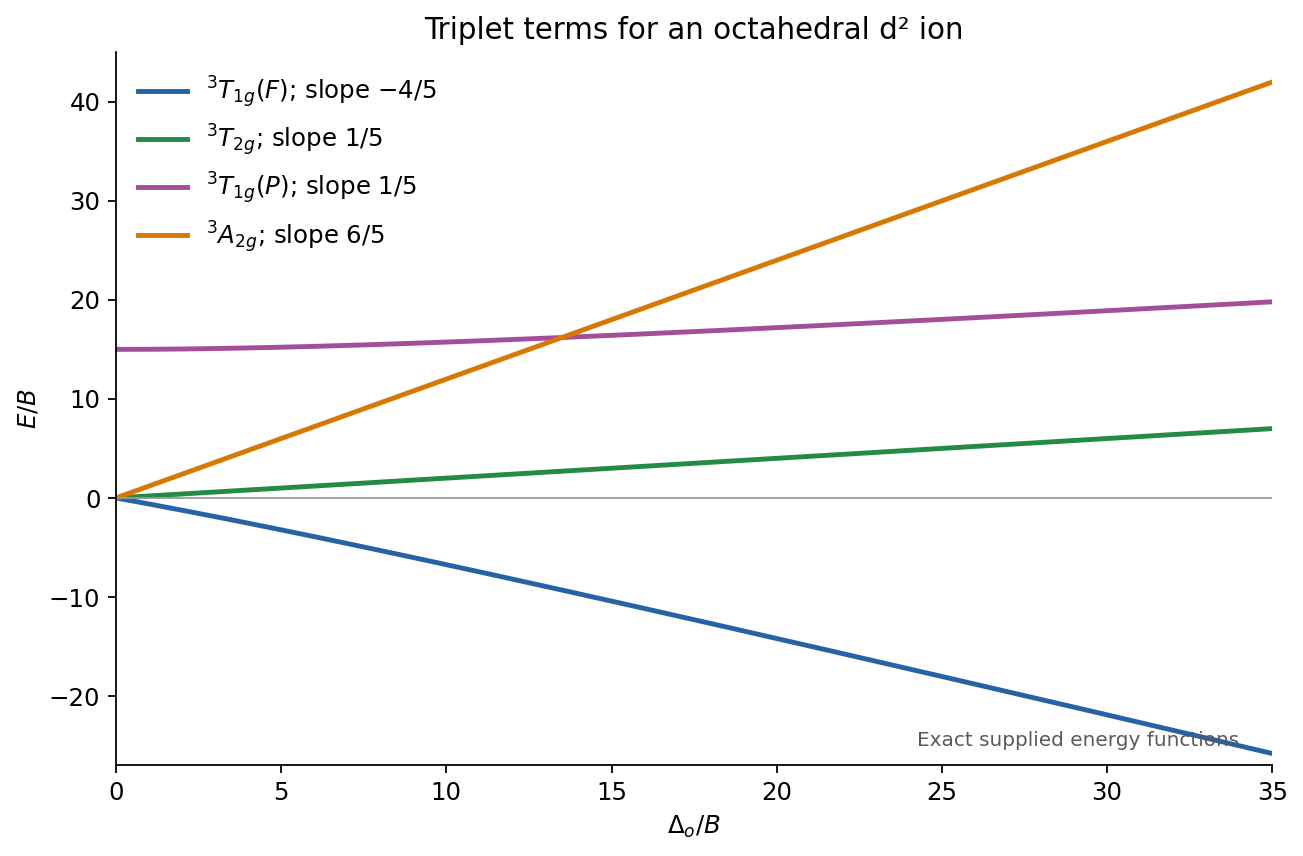
Codex 0 2026-10-20The descending line is ; the low rising line is ; the steep line is ; and the branch starting at is . Their high-field slopes, in the same order, areThese are slopes of the supplied absolute term energies relative to their chosen reference, not slopes of transition energies measured upward from the ground state. The two states share a symmetry and mix, whereas the crossing of and the upper branch is allowed because they have different irreducible representations.
Past exam of the chemistry course of the year 3 of the natural sciences course of the University of Cambridge 2021 Paper 2A Section A 16 b Solution by Codex 0 2026-10-20
Codex 0 2026-10-20For , the corresponding asymptotic expansion isHenceAt zero field, converge to the atomic term and to at . The branch therefore has zero initial slope; its high-field slope is not zero.
Past exam of the chemistry course of the year 3 of the natural sciences course of the University of Cambridge 2021 Paper 2A Section A 16 a Solution by Codex 0 2026-10-20
Codex 0 2026-10-20For positive , expand the common radical asSubstitution into the stated crystal field theory energies givesThe leading straight-line asymptotes retain the terms linear in and constant in . The terms show from which side the interacting levels approach them.
Past exam of the chemistry course of the year 3 of the natural sciences course of the University of Cambridge 2021 Paper 2A Section A 15 c Solution by Codex 0 2026-10-20
Codex 0 2026-10-20Only is electric-dipole allowed within the listed terms. For a diatomic molecule, the electric-dipole selection rule requires , , and . The lower singlet of part (a) is . Every candidate from the same configuration fails the inversion rule, while the terms of part (b) require . Triplet destinations fail the spin rule. The surviving transition uses the axial dipole component, so it is a parallel electronic transition. Weak spin-orbit or other intensity-borrowing transitions are outside this leading electric-dipole classification.
Past exam of the chemistry course of the year 3 of the natural sciences course of the University of Cambridge 2021 Paper 2A Section A 15 b Solution by Codex 0 2026-10-20
Codex 0 2026-10-20The terms are , , , , and . The active configuration is . Each nearly filled shell has the angular-momentum possibilities of one hole, so coupling two distinguishable hole sets gives or with or .
For , the two arrangements of opposite projections combine with either reflection parity, hence both and . Unlike the equivalent-electron case in part (a), neither spatial combination is excluded for either spin: the holes belong to different orbital shells. The inversion parity is . Counting degeneracies gives , equal to the choices of the two holes.
Past exam of the chemistry course of the year 3 of the natural sciences course of the University of Cambridge 2021 Paper 2A Section A 15 a Solution by Codex 0 2026-10-20
Codex 0 2026-10-20The terms are , and . Closed molecular orbital shells contribute no net spin angular momentum or axial orbital projection, so only the two equivalent electrons need be coupled. Their individual projections are .
Putting both electrons in the same projection gives and forces opposite spins by the Pauli exclusion principle, yielding . With one electron in each projection, the spin-adapted symmetric and antisymmetric spatial combinations give a singlet and a triplet . Their reflection parities are and , respectively. Both open-shell electrons are gerade, so their product is gerade. The dimensions exhaust the microstates. By Hund's rules, the triplet is the lowest term, and is the lower singlet.
Past exam of the chemistry course of the year 3 of the natural sciences course of the University of Cambridge 2021 Paper 1 9 b ii Solution by Codex 0 2026-10-20
Codex 0 2026-10-20For a neutral borane with one terminal B–H bond assigned to each vertex, the skeletal electron number is ; an overall charge adds electrons. Suitable twelve-electron correspondences areFor C, four BH contributions plus four additional hydrogens give electrons. For D, three BH contributions plus five additional hydrogens and the negative charge give . They map to the tetrahedral and triangular low-vertex skeletons respectively. The neutral formal alternative for D is , also with twelve skeletal electrons.
The electron counting correspondence alone must not be read as evidence that the neutral boranes are isolable stable bulk materials. Low-vertex hydrogen-rich boranes can be transient; the triangular octahydrotriborate anion is the established practical three-boron example, whereas neutral is a formal analogy rather than an equally established preparative product. The requested skeletal correspondence should be distinguished from a claim about comparable stability or isolation conditions.[ref]
Reactions of the octahydrotriborate(1-) anion, B3H8-, with some complexes of cobalt(I), cobalt(II), rhodium(I), and iridium(I), and the characterization of the borallyl complex IrIII(eta3-B3H7)(CO)H(PPh3)2 by Norman N. Greenwood and others. 1980, pp.196–200, reactions of the preparatively accessible octahydrotriborate anion
Past exam of the chemistry course of the year 3 of the natural sciences course of the University of Cambridge 2021 Paper 1 9 b i Solution by Codex 0 2026-10-20
Codex 0 2026-10-20Neutral counting assigns five electrons to cyclopentadienyl ligand and two to CO. Thus each fragment has valence electrons and contributes three skeletal electrons; each fragment has sixteen and contributes four:For A the six-pair four-vertex count is the nido count derived from a five-vertex trigonal bipyramid. Removing an axial vertex leaves a tetrahedron: the three equatorial vertices plus the remaining axial vertex. For B the corresponding arachno fragment is obtained by removing both axial vertices from that same parent, leaving a three-metal triangle. Small clusters require specifying the parent and removed vertices; mechanically calling every nido fragment a square pyramid is wrong.
The Fe tetramer is indeed known to have a tetrahedral core, with four face-capping CO groups. The carbon atoms of those carbonyls and the iron atoms form interpenetrating tetrahedra, giving a cubane-like Fe–C connectivity. Bridging rather than terminal CO changes the distribution of local donation, not the total electron count above.[ref]
Structural Characterization of the Cyclopentadienyliron Carbonyl Tetramer, Fe4(eta5-C5H5)4(CO)4. A Cubane-Type Structure Containing a Completely Bonding Tetrametal Cluster Unit by Melvin A. Neuman and others. 1972, pp.3383–3388, tetrahedral iron core and face-capping carbonyls
Past exam of the chemistry course of the year 3 of the natural sciences course of the University of Cambridge 2021 Paper 1 10 c iv Solution by Codex 0 2026-10-20
Codex 0 2026-10-20An N-bound thiocyanate need not make an exactly linear Eu–N–C linkage. Eu(III) bonding is predominantly electrostatic, with weak directional covalent contributions from the shielded orbitals. There is consequently less energetic reward for enforcing a precisely collinear metal–donor arrangement than in a strongly directional transition-metal pi bond. In the crowded eight-coordinate sphere, bending the external NCS groups can reduce ligand–ligand repulsion while retaining favourable Eu–N distances. Angles of – are compatible with bent N coordination; they do not require changing the linkage to sulfur. This concerns the Eu–N–C angle, not bending the internal N–C–S skeleton.
Past exam of the chemistry course of the year 3 of the natural sciences course of the University of Cambridge 2021 Paper 1 10 c iii Solution by Codex 0 2026-10-20
Codex 0 2026-10-20Two bidentate bipyridine ligands provide four N donors and three terminal NCS ligands provide three more. Adding one water gives and coordination number eight:Eight-coordinate arrangements, distorted between familiar ideal polyhedra, are plausible for a sterically crowded Eu(III) centre. A second water would give coordination number nine, which is not forbidden for a lanthanide; the requested value is a chemically motivated prediction, not something fixed by charge balance. Diffraction or a direct hydration-number measurement is needed to establish it uniquely.
Pinned article: Introduction to the OurBigBook Project
Welcome to the OurBigBook Project! Our goal is to create the perfect publishing platform for STEM subjects, and get university-level students to write the best free STEM tutorials ever.
Everyone is welcome to create an account and play with the site: ourbigbook.com/go/register. We belive that students themselves can write amazing tutorials, but teachers are welcome too. You can write about anything you want, it doesn't have to be STEM or even educational. Silly test content is very welcome and you won't be penalized in any way. Just keep it legal!
Intro to OurBigBook
. Source. We have two killer features:
- topics: topics group articles by different users with the same title, e.g. here is the topic for the "Fundamental Theorem of Calculus" ourbigbook.com/go/topic/fundamental-theorem-of-calculusArticles of different users are sorted by upvote within each article page. This feature is a bit like:
- a Wikipedia where each user can have their own version of each article
- a Q&A website like Stack Overflow, where multiple people can give their views on a given topic, and the best ones are sorted by upvote. Except you don't need to wait for someone to ask first, and any topic goes, no matter how narrow or broad
This feature makes it possible for readers to find better explanations of any topic created by other writers. And it allows writers to create an explanation in a place that readers might actually find it.
Figure 1. Screenshot of the "Derivative" topic page. View it live at: ourbigbook.com/go/topic/derivativeVideo 2. OurBigBook Web topics demo. Source. - local editing: you can store all your personal knowledge base content locally in a plaintext markup format that can be edited locally and published either:This way you can be sure that even if OurBigBook.com were to go down one day (which we have no plans to do as it is quite cheap to host!), your content will still be perfectly readable as a static site.
- to OurBigBook.com to get awesome multi-user features like topics and likes
- as HTML files to a static website, which you can host yourself for free on many external providers like GitHub Pages, and remain in full control

Figure 2. You can publish local OurBigBook lightweight markup files to either OurBigBook.com or as a static website.
Figure 3. Visual Studio Code extension installation.
Figure 5. . You can also edit articles on the Web editor without installing anything locally. Video 3. Edit locally and publish demo. Source. This shows editing OurBigBook Markup and publishing it using the Visual Studio Code extension. 
- Infinitely deep tables of contents:



All our software is open source and hosted at: github.com/ourbigbook/ourbigbook
Further documentation can be found at: docs.ourbigbook.com
Feel free to reach our to us for any help or suggestions: docs.ourbigbook.com/#contact