Topics (384k) Articles (398k) Users (410) Discussions (242) Comments (383) Files (13k) New article
Past exam of the chemistry course of the year 1 of the natural sciences course of the University of Cambridge 2023 Paper 1 6 b i Solution by  Codex 0 2026-10-20
The valence configurations are , , and . Their full closed-shell cores are respectively , , and . The filled 4f and 5d subshells of lead are not the outer valence configuration requested.
Past exam of the chemistry course of the year 1 of the natural sciences course of the University of Cambridge 2023 Paper 1 5 c v Solution by Codex 0 2026-10-20
Codex 0 2026-10-20Using bonds broken minus bonds formed, the enthalpies per mole of elementary events areUnder the steady-state approximation in chemical kinetics, initiation and termination have equal event rates, so their enthalpy contributions cancel. The two propagation steps also have equal flux, and their combined enthalpy is per overall reaction producing two moles of HCl. Step 3 dominates the heat release; the small endothermic contribution of step 2 only slightly offsets it.
An insulated vessel cannot remove this released energy as heat, so its temperature rises as reaction proceeds. In a rigid vessel the precise energy balance uses reaction internal energy and constant-volume heat capacities, whereas a constant-pressure adiabatic balance uses enthalpy; the strong exothermic conclusion is the same. Warming changes the rate constants, and activated initiation and propagation can accelerate, producing positive thermal feedback and potentially a rapid temperature rise. A numerical final temperature or a claim of an inevitable explosion is not justified without composition, heat capacities and heat-loss information. The initially assumed 298-K rate constants cannot remain fixed throughout an appreciable adiabatic temperature rise.
Past exam of the chemistry course of the year 1 of the natural sciences course of the University of Cambridge 2023 Paper 1 5 c iv Solution by Codex 0 2026-10-20
Codex 0 2026-10-20Let be the event rate for step , soThe free radical balances, including the factors of two for initiation and termination, areThus and , givingBoth propagation events form hydrogen chloride, soThe orders are one in hydrogen, one half in chlorine and three halves overall, with when the observed rate is HCl formation. If the rate is instead defined as the stoichiometrically normalized reaction rate, half that formation rate, the prefactor lacks the factor two. The bath concentration cancels because the same M-assisted initiation and recombination control the free radical pool. The result does not require ; different free radical concentrations make their steady fluxes equal. For molar concentration, has units .
Past exam of the chemistry course of the year 1 of the natural sciences course of the University of Cambridge 2023 Paper 1 5 c iii Solution by Codex 0 2026-10-20
Codex 0 2026-10-20Apply the steady-state approximation in chemical kinetics to the hydrogen and chlorine free radicals. After a short initiation transient their formation and consumption can balance while the stable reactants continue to be depleted and hydrogen chloride accumulates. Accordingly set and .
This does not mean the free radicals are absent or that the whole mixture is at equilibrium. hydrogen and chlorine molecules and the hydrogen chloride product generally cannot all be assigned steady concentrations over appreciable conversion. The inert-body concentration can be treated as an imposed or slowly varying bath quantity; it is not an intermediate to which a free radical balance must be applied.
Past exam of the chemistry course of the year 1 of the natural sciences course of the University of Cambridge 2023 Paper 1 5 c ii Solution by Codex 0 2026-10-20
Codex 0 2026-10-20The reverse elementary rate constant is extraordinarily small at 298 K. Its reaction would require hydrogen chloride and a chlorine free radical to produce a hydrogen free radical and chlorine, reversing a highly exothermic propagation step. The value found above makes this channel negligible for the intended reacting mixture compared with forward propagation.
A large equilibrium constant alone does not permit a reverse reaction to be ignored under every conceivable composition: if forward reactants were exhausted, concentration ratios would matter. The simplification applies during the forward chain-reaction regime specified, rather than constituting a universal statement about all late-time or imposed reverse conditions.
Past exam of the chemistry course of the year 1 of the natural sciences course of the University of Cambridge 2023 Paper 1 5 c i Solution by Codex 0 2026-10-20
Codex 0 2026-10-20Step 1 is initiation; steps 2 and 3 are propagation; step 4 is termination. Initiation dissociates a chlorine molecule into two chlorine free radicals. Each propagation step consumes one free radical and creates another, carrying the chain forward without destroying its free radical carrier overall. Termination removes two chlorine free radicals by recombination.
The inert collision partner accepts or supplies energy as needed and is regenerated. It is not a free radical chain carrier or a net reagent. Adding the two propagation steps cancels the hydrogen and chlorine free radicals and gives one complete conversion of hydrogen plus chlorine to two molecules of hydrogen chloride.
Past exam of the chemistry course of the year 1 of the natural sciences course of the University of Cambridge 2023 Paper 1 5 b ii Solution by Codex 0 2026-10-20
Codex 0 2026-10-20For forward and reverse elementary reactions at equilibrium, the two rates are equal. Both directions have two reactant particles and use the same concentration convention, so the conversion factors cancel and . ThereforeFor molar rather than molecular number concentration, the bimolecular rate constant is multiplied by the Avogadro constant:Only one factor is needed: converting the two concentration factors contributes , while converting the production rate from molecules to moles removes one factor.
Past exam of the chemistry course of the year 1 of the natural sciences course of the University of Cambridge 2023 Paper 1 5 b i Solution by Codex 0 2026-10-20
Codex 0 2026-10-20Rearrange the Arrhenius relation using the molar activation energy and the molar gas constant:The exponent is dimensionless. There is no Avogadro factor in it because both and are expressed per mole; the molecular concentration convention only determines the units of the prefactor.
Past exam of the chemistry course of the year 1 of the natural sciences course of the University of Cambridge 2023 Paper 1 5 a ii Solution by Codex 0 2026-10-20
Codex 0 2026-10-20The Arrhenius equation isThe exponential gives the strongly temperature-dependent energetic factor. For a simple bimolecular collision picture, collects the encounter frequency per reactant concentration and the fraction of encounters with a suitable orientation and other dynamical requirements. Thus a collision is not automatically a successful reaction even when its energy is sufficient.
has the same units as , which depend on the rate law; it is not always a frequency in . More generally it is an effective prefactor containing statistical and dynamical contributions rather than a literal universal collision count. Treating it as temperature independent is the approximation requested here.
Past exam of the chemistry course of the year 1 of the natural sciences course of the University of Cambridge 2023 Paper 1 5 a i Solution by Codex 0 2026-10-20
Codex 0 2026-10-20The products lie below the reactants, while the transition state lies above both. On an energy-versus-reaction-coordinate plot, the forward activation energy is the vertical separation , not the difference between product and reactant energies. For an exothermic elementary path, , and the reverse barrier is .
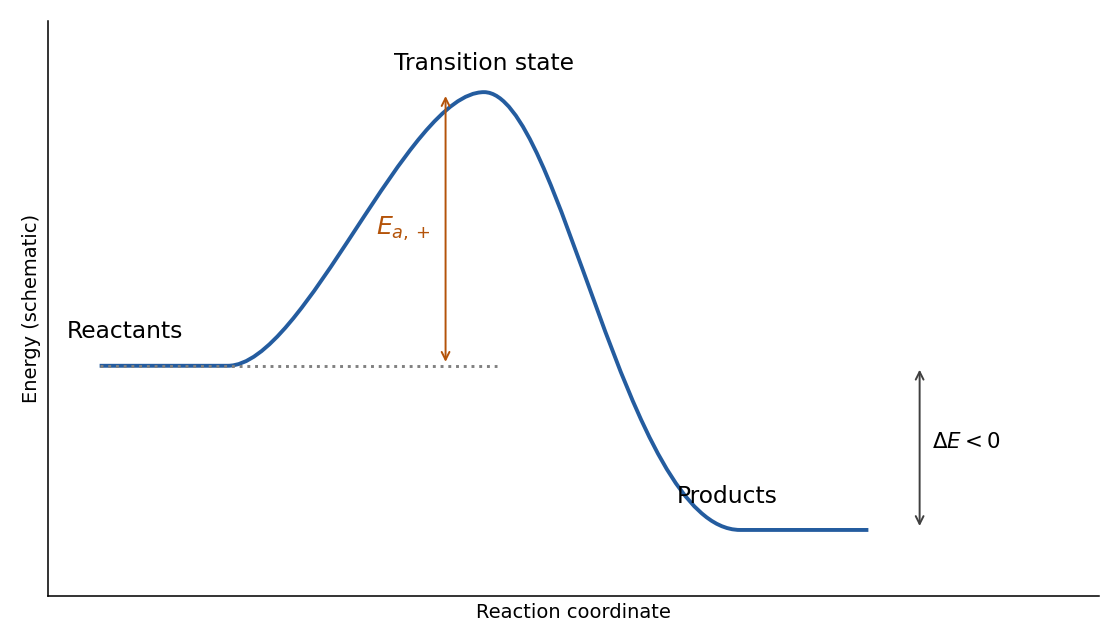
Original schematic exothermic energy profile with reactant, product, transition-state and forward-barrier labels
. Details. Past exam of the chemistry course of the year 1 of the natural sciences course of the University of Cambridge 2023 Paper 1 2 b iv Solution by Codex 0 2026-10-20
Codex 0 2026-10-20Li can retain a bound triangular framework, but an equilateral triangle with three valence electrons is Jahn-Teller unstable. The six core electrons are effectively spectators. In the simplest triangular valence model, two electrons occupy the fully bonding level and one occupies the degenerate upper pair. Making one edge different splits that pair; the single electron occupies the lower component, giving an electronic stabilization that can outweigh the cost of a small distortion. An isosceles triangle is sufficient to lift the degeneracy, so three different edge lengths are not required.
The two 2.8-Å contacts are close to, but slightly longer than, the 2.7-Å dimer bond, while the 3.5-Å edge is much weaker. Delocalization and partial antibonding occupation explain why these cannot be treated as three independent full-strength Li–Li single bonds. lithium's nearby valence functions provide additional polarization and mixing channels absent from a hydrogen -only description, allowing a more flexible multicentre electronic structure. The existence of a bound minimum, unlike ground-state H, is an energetic fact rather than a consequence of three-electron counting alone. Calculated Li surfaces show bound states, a conical intersection and Jahn-Teller coupling.[ref]
Past exam of the chemistry course of the year 1 of the natural sciences course of the University of Cambridge 2023 Paper 1 2 b iii Solution by Codex 0 2026-10-20
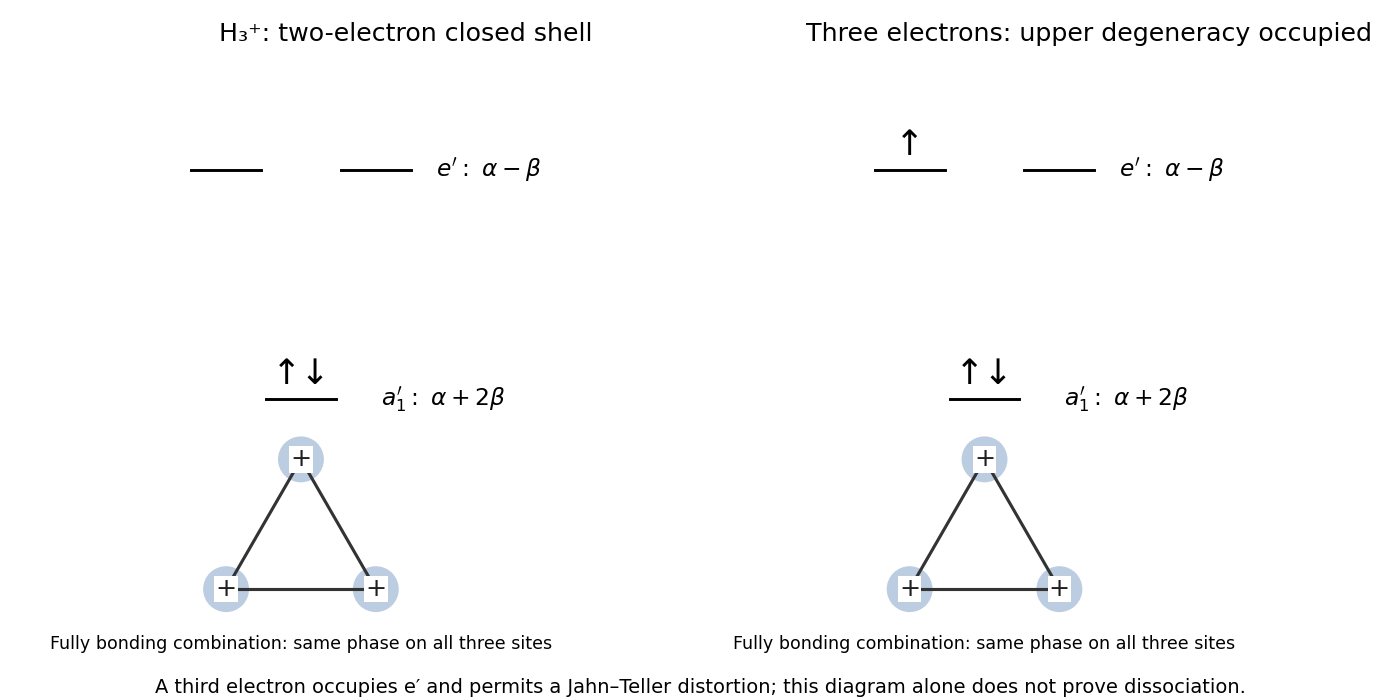
Codex 0 2026-10-20The third electron must enter the higher, degenerate and partly antibonding orbital pair rather than the already filled fully bonding orbital. At an equilateral geometry the configuration becomes . This weakens the collective bonding and creates orbital degeneracy, so a distortion can lower the singly occupied component and localize bonding. Along the ground-state reaction coordinate, formation of a normal two-electron H–H bond with a separated hydrogen atom becomes favourable.
The result is ground-state dissociation to , not loss of a proton from the cation or formation of three isolated atoms. One should not claim that adding one electron exactly cancels two bonding electrons: a simple three-orbital count alone does not predict a zero bond order or prove dissociation. The important qualitative changes are occupancy of an antibonding/degenerate level and access to a lower-energy dimer-plus-atom arrangement. A complete dissociation statement requires the potential-energy surface, including nuclear repulsion; electronically excited neutral H states are a separate issue.
Past exam of the chemistry course of the year 1 of the natural sciences course of the University of Cambridge 2023 Paper 1 2 b ii Solution by Codex 0 2026-10-20
Codex 0 2026-10-20Two electrons can occupy a fully bonding orbital delocalized equally over all three hydrogen atoms. Three atomic orbitals on an equilateral triangle form one totally symmetric combination and a degenerate pair of higher orbitals. In an orthonormal equal-interaction model with diagonal energy and off-diagonal ,The lower orbital is proportional to , with constructive overlap along every edge. Its two electrons give a three-centre two-electron bond and equivalent interactions between every pair of nuclei. At the equilibrium distance, this bonding competes with nuclear Coulomb force to favour the symmetric triangular arrangement. The occupied shell is nondegenerate and closed, so there is no first-order Jahn-Teller incentive to distinguish the three edges. A straight-line or localized single-bond description would miss that equally shared bonding pattern.
Past exam of the chemistry course of the year 1 of the natural sciences course of the University of Cambridge 2023 Paper 1 2 b i Solution by Codex 0 2026-10-20
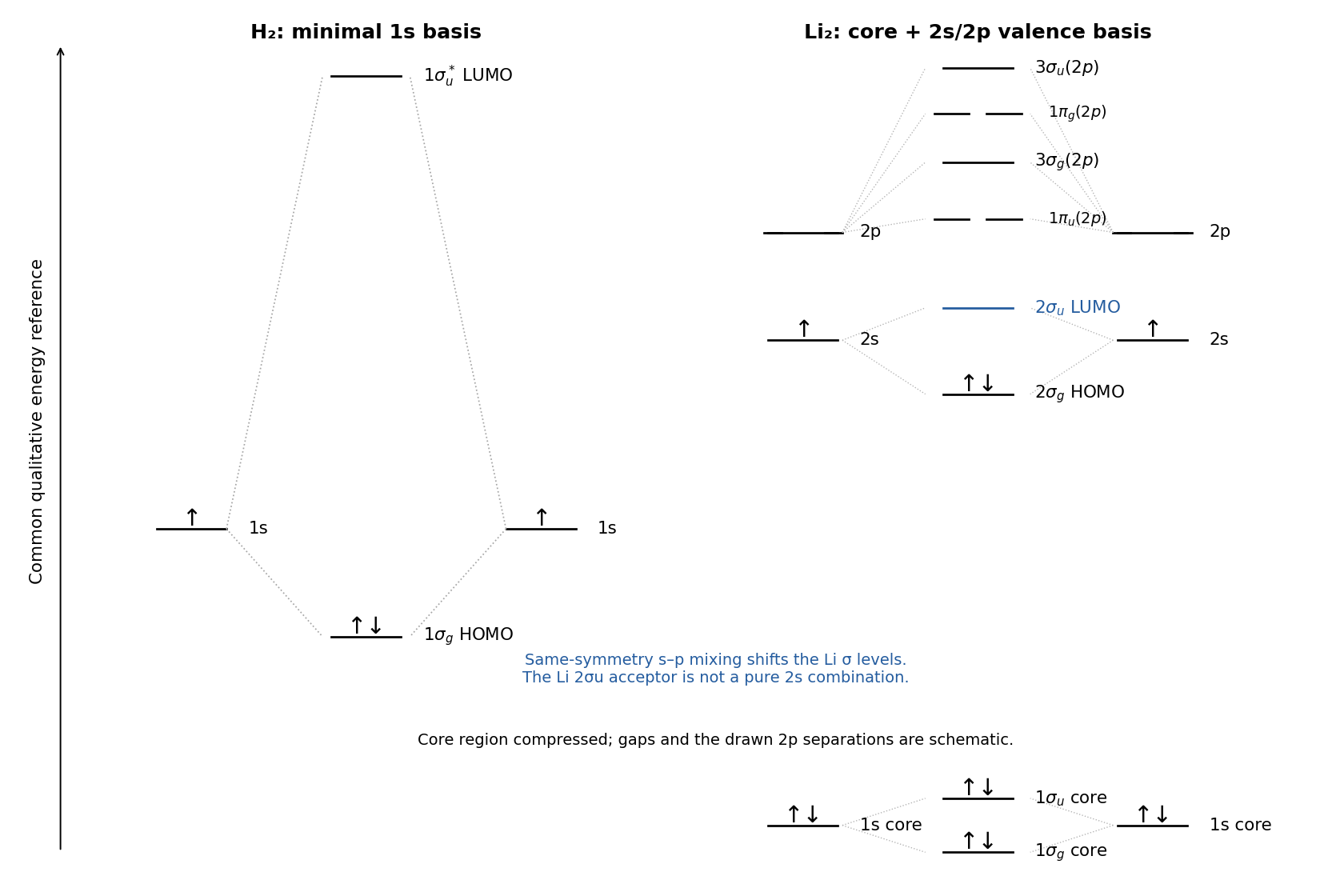
Codex 0 2026-10-20Both dimers have two electrons in a valence sigma-bonding orbital and a formal valence bond order of one. For hydrogen the minimal-basis configuration is , with the -derived as highest occupied molecular orbital and as LUMO. The bonding combination has no internuclear node; the antibonding combination does.
For lithium, include the filled core pair of levels as well as the valence levels:The first two orbitals are predominantly core combinations whose bonding and antibonding occupations cancel in a simple bond-order count. The highest occupied molecular orbital is predominantly , denoted ; the LUMO is , predominantly the antibonding combination but modified by mixing with compatible contributions. The nearby empty -derived sigma and pi levels must also be shown. Only orbitals of matching symmetry mix, so this does not mean that every combination mixes with every combination.
On a common qualitative energy reference, hydrogen is much lower than lithium's valence , while lithium's core levels lie much deeper. The Li valence bonding–antibonding separation is smaller, consistent with its longer and weaker bond. The figure uses a compressed core region and schematic gaps, not measured orbital energies. The role of symmetry-compatible s–p orbital mixing in the first-row diatomics is illustrated in institutional molecular-orbital notes.[ref]
Past exam of the chemistry course of the year 1 of the natural sciences course of the University of Cambridge 2023 Paper 1 2 a v Solution by Codex 0 2026-10-20
Codex 0 2026-10-20Excess ethanol drives a reversible ester exchange mainly through the actual mixture composition, not through a large new bond-energy advantage. The net reaction exchanges one ester and one alcohol for a closely related ester and alcohol. It preserves the main bond types and has no obvious large exothermicity. Solvation and ion pairing can contribute to its enthalpy, but there is no basis here for asserting a large negative standard reaction enthalpy.
There are two molecules on each side, so an increase in particle count is not the entropy explanation. Instead useWith ethanol as the solvent and little methanol initially, the reaction quotient is small; product formation and mixing lower the Gibbs free energy until the exchange equilibrium is reached. ethanol can be treated approximately as having fixed activity near its pure-solvent value, rather than assigned an arbitrarily enormous activity, while methanol remains dilute. This composition-dependent chemical-potential contribution is the appropriate entropic/mixing argument. It explains forward conversion under these conditions without claiming that must be positive, or that complete conversion follows without an equilibrium constant or removal of methanol.
Past exam of the chemistry course of the year 1 of the natural sciences course of the University of Cambridge 2023 Paper 1 2 a iv Solution by Codex 0 2026-10-20
Codex 0 2026-10-20ethanol undergoes proton transfer with the methoxide produced. The oxygen lone pair of methoxide attacks the hydroxyl proton of ethanol, while the ethanol O–H bond pair returns to its oxygen:The alcohol acidities are similar, so this is an equilibrium, not an overwhelmingly one-way deprotonation determined solely by intrinsic acidity. The large ethanol reservoir and initially small methanol concentration nevertheless matter. This exchange means that lithium ethoxide need not be consumed stoichiometrically in the net transesterification. Neutral ethanol can also participate in proton shuttling; it is not acting as a reducing reagent or as a substrate for elimination under these conditions.
Past exam of the chemistry course of the year 1 of the natural sciences course of the University of Cambridge 2023 Paper 1 2 a iii Solution by Codex 0 2026-10-20
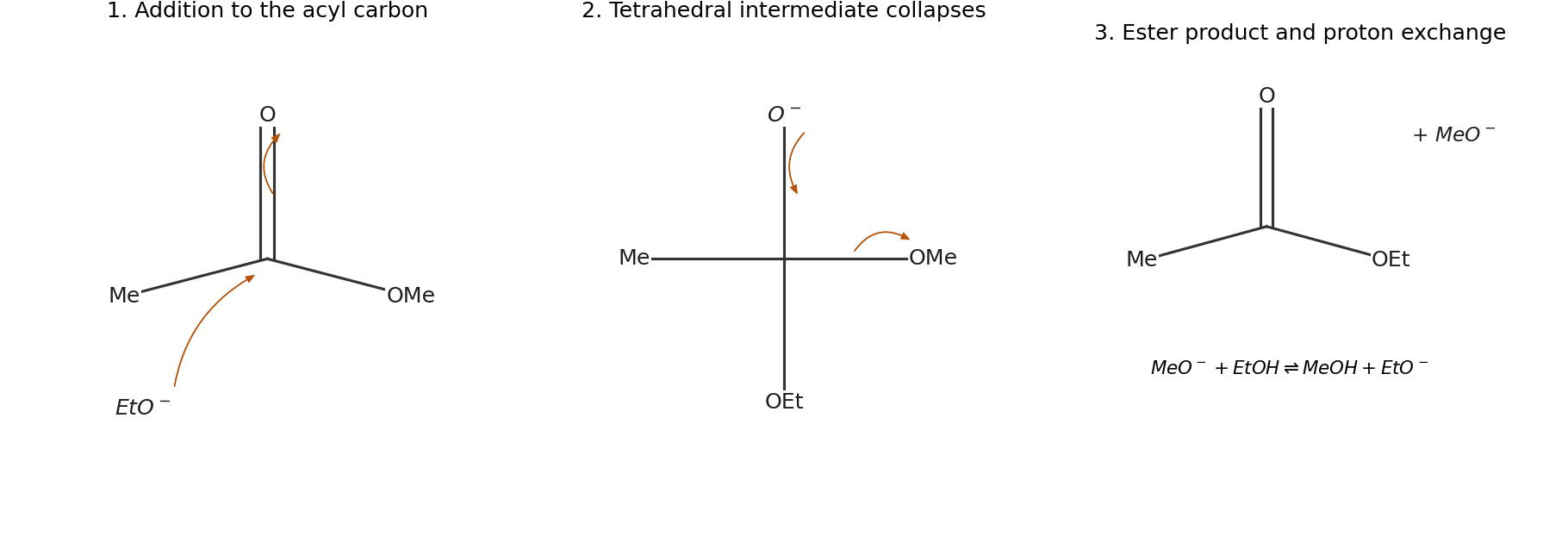
Codex 0 2026-10-20The mechanism is nucleophilic addition followed by elimination of methoxide. An ethoxide oxygen lone pair attacks the carbonyl carbon, while the C=O pi pair moves to oxygen:The tetrahedral intermediate collapses when its anionic oxygen reforms the carbonyl and the C–OMe bond breaks with its electron pair going to the methoxy oxygen:lithium is a coordinating counterion; it does not supply an electron pair to the acyl carbon. proton exchange with ethanol connects the methoxide produced to the ethoxide catalyst pool and gives methanol, so the net solvent-mediated exchange is methyl acetate plus ethanol to ethyl acetate plus methanol. The reversibility of the elementary acyl steps is important: changing an alkoxy group is not automatically an irreversible reaction.
Past exam of the chemistry course of the year 1 of the natural sciences course of the University of Cambridge 2023 Paper 1 2 a ii Solution by Codex 0 2026-10-20
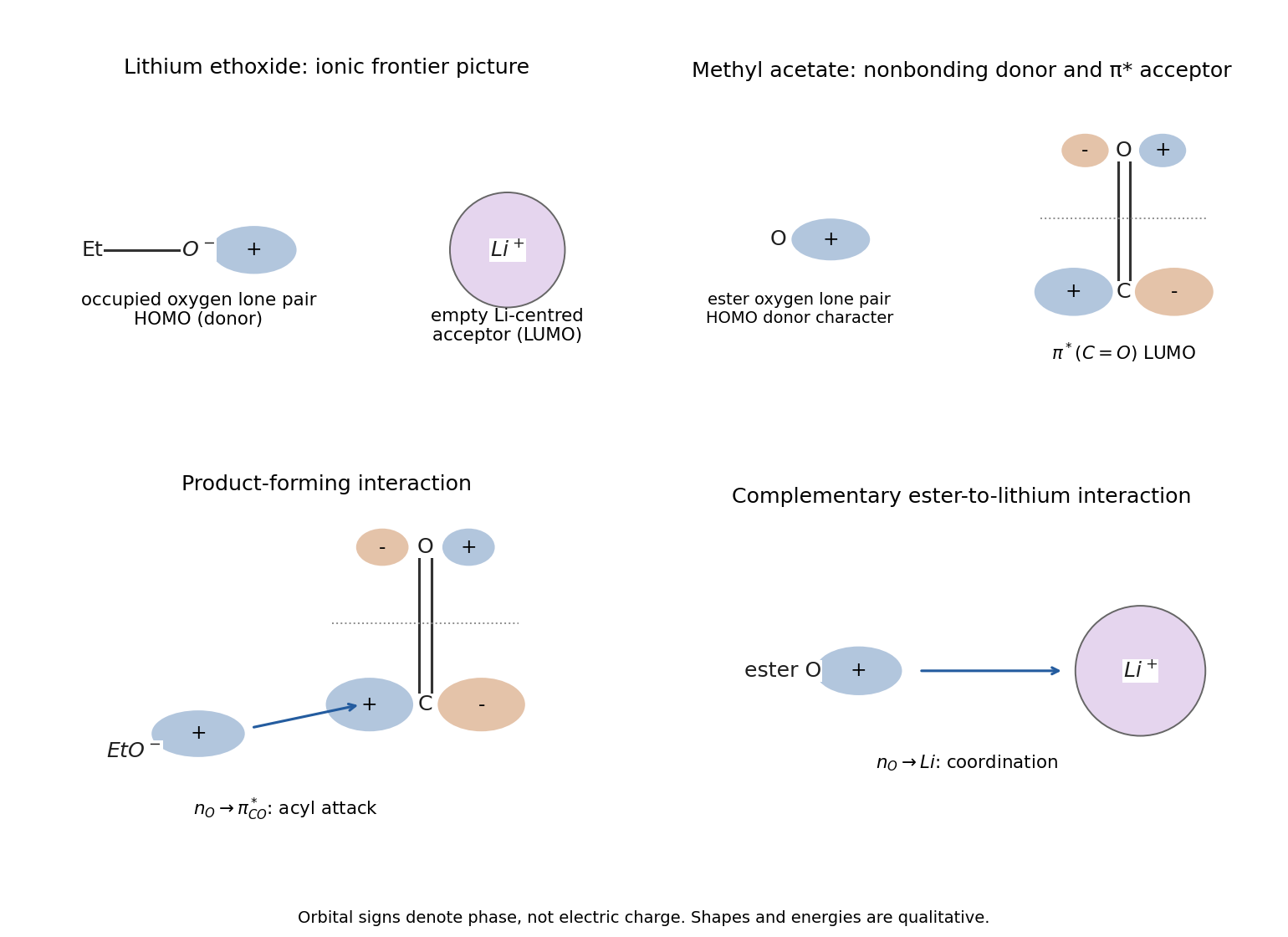
Codex 0 2026-10-20The product-forming pairing is . Orient an occupied ethoxide oxygen lobe toward the large carbon lobe of the carbonyl acceptor with matching phase. An oblique approach permits constructive overlap while the pi bond weakens; this is the usual Bürgi-Dunitz trajectory to acyl carbon. The high-energy occupied orbital on the anion makes ethoxide the stronger electron-pair donor than the neutral ester oxygen.
The reverse frontier pairing, , gives oxygen-to-lithium coordination. It is a plausible stabilizing contact and can coexist with the first interaction, rather than constituting an alternative way to replace the ester alkoxy group. In the elementary frontier picture, the anionic donor-to-carbonyl interaction is the important pairing for the new covalent bond and is favoured by its donor strength and appropriate accepting coefficient at carbon. The Li contact can polarize the carbonyl and organize the reacting pair. Precise energy-gap rankings require a specified solvated lithium species; the sketches alone do not justify pretending that lithium coordination cannot occur.
Past exam of the chemistry course of the year 1 of the natural sciences course of the University of Cambridge 2023 Paper 1 2 a i Solution by Codex 0 2026-10-20
Codex 0 2026-10-20The reactive occupied orbital of ethoxide is an oxygen lone pair; the acyl electrophile accepts into its carbonyl orbital. Draw the ethoxide lone pair as a directional oxygen-centred lobe directed toward an electrophile. In a lithium-ion-pair picture the low unoccupied acceptor on lithium is an empty, diffuse Li-centred orbital, with 2s/2p character depending on coordination. It should not be confused with an occupied Li–O covalent bonding pair.
For methyl acetate, the occupied frontier donor is principally an oxygen nonbonding orbital, mixed with the ester orbital system. Its low-lying reactive acceptor is , with opposite phases on carbon and oxygen and a relatively large accepting lobe on the carbonyl carbon. The corresponding sketch must show a node between the carbonyl atoms. These are chemically useful frontier-orbital descriptions; lithium alkoxide aggregation and ethanol solvation make a unique isolated-molecule orbital energy diagram an oversimplification.
Past exam of the chemistry course of the year 1 of the natural sciences course of the University of Cambridge 2023 Paper 1 1 c ii Solution by Codex 0 2026-10-20
Codex 0 2026-10-20The large vinyl couplings are 17.1 Hz trans and 10.5 Hz cis; the O-methylene-to-vinyl coupling is 6.0 Hz. At this field, convert every separation by . Comparing the centres of corresponding terminal-proton submultiplets givesThe repeated 0.005-ppm fine spacing from allylic scalar coupling and geminal coupling gives the magnitudesFor example, splitting by a geminal proton and two equivalent long-range-coupled methylene protons, all with the same magnitude, produces overlapping lines with intensities . The 6-Hz splitting of creates two such small NMR triplets centred at 4.580 and 4.560 ppm. An independent check comes from the internal-vinyl multiplet: a centre at 5.919 ppm with splittings 17.1, 10.5 and 6.0 Hz, the last to two equivalent protons, reproduces all twelve labelled line positions. The spectrum determines these coupling magnitudes, not their algebraic signs.
Pinned article: Introduction to the OurBigBook Project
Welcome to the OurBigBook Project! Our goal is to create the perfect publishing platform for STEM subjects, and get university-level students to write the best free STEM tutorials ever.
Everyone is welcome to create an account and play with the site: ourbigbook.com/go/register. We belive that students themselves can write amazing tutorials, but teachers are welcome too. You can write about anything you want, it doesn't have to be STEM or even educational. Silly test content is very welcome and you won't be penalized in any way. Just keep it legal!
Intro to OurBigBook
. Source. We have two killer features:
- topics: topics group articles by different users with the same title, e.g. here is the topic for the "Fundamental Theorem of Calculus" ourbigbook.com/go/topic/fundamental-theorem-of-calculusArticles of different users are sorted by upvote within each article page. This feature is a bit like:
- a Wikipedia where each user can have their own version of each article
- a Q&A website like Stack Overflow, where multiple people can give their views on a given topic, and the best ones are sorted by upvote. Except you don't need to wait for someone to ask first, and any topic goes, no matter how narrow or broad
This feature makes it possible for readers to find better explanations of any topic created by other writers. And it allows writers to create an explanation in a place that readers might actually find it.
Figure 1. Screenshot of the "Derivative" topic page. View it live at: ourbigbook.com/go/topic/derivativeVideo 2. OurBigBook Web topics demo. Source. - local editing: you can store all your personal knowledge base content locally in a plaintext markup format that can be edited locally and published either:This way you can be sure that even if OurBigBook.com were to go down one day (which we have no plans to do as it is quite cheap to host!), your content will still be perfectly readable as a static site.
- to OurBigBook.com to get awesome multi-user features like topics and likes
- as HTML files to a static website, which you can host yourself for free on many external providers like GitHub Pages, and remain in full control

Figure 2. You can publish local OurBigBook lightweight markup files to either OurBigBook.com or as a static website.
Figure 3. Visual Studio Code extension installation.
Figure 5. . You can also edit articles on the Web editor without installing anything locally. Video 3. Edit locally and publish demo. Source. This shows editing OurBigBook Markup and publishing it using the Visual Studio Code extension. 
- Infinitely deep tables of contents:




All our software is open source and hosted at: github.com/ourbigbook/ourbigbook
Further documentation can be found at: docs.ourbigbook.com
Feel free to reach our to us for any help or suggestions: docs.ourbigbook.com/#contact