Topics (384k) Articles (398k) Users (410) Discussions (242) Comments (383) Files (13k) New article
Past exam of the chemistry course of the year 3 of the natural sciences course of the University of Cambridge 2022 Paper 2A Section A 17 c Solution by  Codex 0 2026-10-20
The fixed localized determinant is unsuitable near equilibrium. It does not develop the correct shared bonding orbital and is not a pure singlet: for one alpha and one beta orbital, , which is nonzero unless the occupied spatial orbitals coincide. At dissociation it is an equal singlet/triplet mixture, though their energies become degenerate there. Near equilibrium the physical ground state is a bonding singlet. An optimized UHF calculation can recover the restricted, spin-pure solution by making its two occupied spatial orbitals equal; that does not rescue the particular fixed atomic-orbital determinant written here. A spin-adapted multideterminant description is needed to combine good bonding near equilibrium with correct singlet dissociation.
Past exam of the chemistry course of the year 3 of the natural sciences course of the University of Cambridge 2022 Paper 2A Section A 17 b Solution by Codex 0 2026-10-20
Codex 0 2026-10-20At this separation the orbital overlap and interatomic two-electron exchange integrals are negligible. Each localized electron then contributes essentially the isolated hydrogen energy, while the interatomic electrostatic terms cancel to leading order for neutral fragments. Including nuclear repulsion in the molecular energy givesThe closed-shell RHF determinant instead doubly occupies . It retains ionic configurations with both electrons on the same atom, even at dissociation. Using atomic units and the Hartree energy in the stated unrelaxed hydrogenic 1s basis, the same-atom two-electron Coulomb integral is . Consequently at infinite separationwhere energies and integrals inside the first expression are in atomic units. It is much too high compared with two neutral atoms. Retaining the leading intersite Coulomb term at gives , still about above UHF. The numerical RHF estimates specify the supplied fixed 1s basis; a larger optimized orbital space changes them. If nuclear repulsion is excluded by an electronic-energy convention, subtract the same from both quoted total molecular energies. The restricted/unrestricted comparison and their dissociation behaviour are unchanged.[ref]
XXXIV. Notes on the molecular orbital treatment of the hydrogen molecule by Charles Alfred Coulson and Inga Fischer-Hjalmars. 1949, pp. 386–393, minimal atomic-1s molecular-orbital treatment
Past exam of the chemistry course of the year 3 of the natural sciences course of the University of Cambridge 2022 Paper 2A Section A 17 a Solution by Codex 0 2026-10-20
Codex 0 2026-10-20Writing and , the normalized determinant isIts two spin orbitals are orthogonal because , even if the spatial atomic functions have nonzero overlap. Exchanging both the spatial and spin coordinates of the two electrons reverses the sign, as required for fermionic antisymmetry.
Past exam of the chemistry course of the year 3 of the natural sciences course of the University of Cambridge 2022 Paper 2A Section A 16 c Solution by Codex 0 2026-10-20
Codex 0 2026-10-20A quencher-independent intersystem-crossing rate adds to the unquenched decay rate:The normalized Stern-Volmer equation retains the same form, so intersystem crossing does not bias if the actual unquenched lifetime is used. It reduces below one and changes the slope through ; assuming would then give the wrong result. A quencher that itself changes intersystem crossing or returns triplet population to the singlet requires a larger kinetic scheme.
Past exam of the chemistry course of the year 3 of the natural sciences course of the University of Cambridge 2022 Paper 2A Section A 16 b Solution by Codex 0 2026-10-20
Codex 0 2026-10-20Rearrangement gives the Stern-Volmer equationThus a straight-line plot against has unit intercept and slope . Determine using an independently measured unquenched lifetime, or use known in the restricted model. Yield measurements alone do not separate two unknown rate constants. Equivalently the slope of is .
Use the absorbed intensity rather than incident intensity to normalize samples, and correct solvent/background signals, quencher absorption and fluorescence reabsorption. Under dynamic fluorescence quenching the lifetime ratio should follow the same straight line as the yield ratio. A reduced intensity without the corresponding lifetime change suggests static fluorescence quenching or an optical artefact; curvature can also indicate multiple populations or more complicated kinetics.
Past exam of the chemistry course of the year 3 of the natural sciences course of the University of Cambridge 2022 Paper 2A Section A 16 a Solution by Codex 0 2026-10-20
Codex 0 2026-10-20Let and treat the quencher concentration as a constant reservoir. Weak steady excitation, one emitting population, and the three specified processes giveDividing the fluorescence photon-production rate by the absorbed photon rate therefore givesThis assumes no saturation, photochemical loss, reabsorption, static association or additional excited-state decay, and that each counted absorbed photon reaches the stated population. In this restricted scheme and the unquenched lifetime is .
Past exam of the chemistry course of the year 3 of the natural sciences course of the University of Cambridge 2022 Paper 2A Section A 15 b Solution by Codex 0 2026-10-20
Codex 0 2026-10-20The ground state changes from high-spin , , to low-spin , . The larger splitting eventually compensates the additional pairing cost. Because all plotted excitation energies are re-referenced to the new ground state, the branches change slope at the crossover. The break is not an infinite physical excitation energy or a discontinuity of the underlying Hamiltonian.
Past exam of the chemistry course of the year 3 of the natural sciences course of the University of Cambridge 2022 Paper 2A Section A 15 a Solution by Codex 0 2026-10-20
Codex 0 2026-10-20The octahedral splitting separates the metal and orbital sets. The Racah parameter characterizes interelectronic repulsion and hence the spacing of many-electron d-shell terms; it is not another name for . A Tanabe-Sugano diagram plots term excitation energies against , for specified values of the other repulsion-parameter ratios. Each ordinate is measured relative to whichever term is the ground state at that field strength. The original many-electron treatment diagonalizes the relevant d-shell energy matrices rather than identifying every absorption with a one-electron gap.[ref]
On the Absorption Spectra of Complex Ions. I by Yukito Tanabe and Satoru Sugano. 1954, pp. 753–766, d-shell energy matrices in a cubic field
Past exam of the chemistry course of the year 3 of the natural sciences course of the University of Cambridge 2022 Paper 1 10 b iii Solution by Codex 0 2026-10-20
Codex 0 2026-10-20The unusually stable divalent configurations Eu(II) and Yb(II) make their third ionization particularly costly. Forming Eu(III), , or Yb(III), removes an electron from a half-filled or filled f shell. The positive ionization-energy contribution therefore increases relative to the smoother background across the series.
Their trivalent ionic radii and hydration enthalpies do not supply a matching abrupt extra stabilization. Differences in atomization and the divalent character of elemental Eu and Yb partly compensate the ionization anomaly but do not erase the net less favourable trivalent aqueous formation enthalpy. This explanation concerns formation of the aqueous ions, not a claim that or is intrinsically the most stable isolated f configuration.
Past exam of the chemistry course of the year 3 of the natural sciences course of the University of Cambridge 2022 Paper 1 10 b ii Solution by Codex 0 2026-10-20
Codex 0 2026-10-20The large positive sum of ionization energies and large negative hydration enthalpy dominate, with a smaller but significant positive atomization term. Ionization depends on effective nuclear attraction, orbital energies and the stability of successive gas-ion electron configurations; removing the third electron may require disruption of a particularly stable divalent f configuration. Atomization depends on the metal's cohesive bonding and valence participation, and need not vary perfectly smoothly.
Hydration becomes more favourable for higher charge density. All the compared ions have charge , so smaller effective ionic radius generally gives more negative hydration enthalpy. Incomplete shielding by the 4f shell produces the lanthanide contraction and strengthens ion–water attraction along the series. A Born-type electrostatic estimate has a stabilization scale proportional to , but hydration-shell structure, water polarization and temperature dependence prevent treating that crude scale as an exact enthalpy formula. The hydration trend is smoother than the sharp configuration-dependent ionization anomalies. The measured formation enthalpy reflects cancellation of large terms, so comparison of just one term can give a misleading prediction.
Past exam of the chemistry course of the year 3 of the natural sciences course of the University of Cambridge 2022 Paper 1 10 b i Solution by Codex 0 2026-10-20
Codex 0 2026-10-20Use the balanced aqueous-acid reactionA Hess cycle first atomizes the metal, then ionizes its gas-phase atoms, then hydrates the triply charged gas ions:Close the reference leg by combining the three electrons with to make . Calling that element-independent contribution givesA single-ion standard enthalpy of formation uses the conventional hydrogen-ion reference; it must not be treated as a balanced creation of net charge from neutral metal without an electron/reference term. The constant hydrogen leg does not affect comparisons along the lanthanide series.
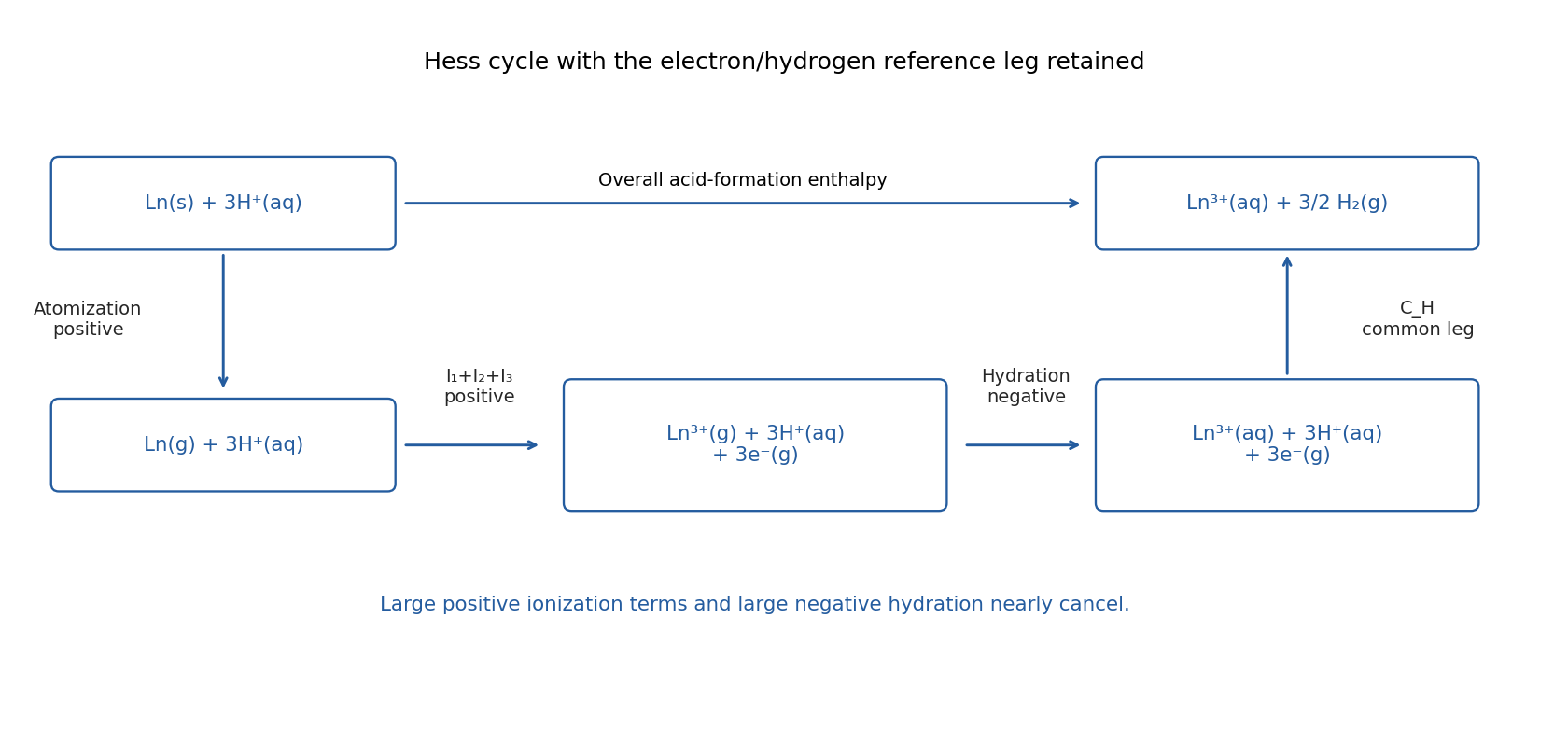
Original Hess cycle separating atomization, three ionizations, hydration and the common aqueous hydrogen reference leg
. Details. Past exam of the chemistry course of the year 3 of the natural sciences course of the University of Cambridge 2022 Paper 1 10 a ii Solution by Codex 0 2026-10-20
Codex 0 2026-10-20chromium is the characteristic assignment, giving Cr(I)–Cr(I) with a formal quintuple bond. Each formamidinate is monoanionic, so gives . chromium(I) is and the pair supplies ten d electrons. Relative to a metal–metal axis, the idealized bonding combinations are sigma, pi and delta:End-on sigma overlap gives the largest splitting, pi overlap a smaller splitting, and delta overlap the weakest. A useful qualitative ordering places bonding sigma lowest, then the two pi combinations, then the two delta combinations; all are occupied. Their antibonding partners are empty, with the weakly split delta-star levels nearest their bonding counterparts. The actual three-bridge ligand field can mix and split symmetry-compatible levels, so the diagram is a bond-axis model rather than five perfectly degenerate metal d levels in the molecular complex.
The identified lantern-type anion has an experimentally determined Cr–Cr distance near Å; reduction of its nine-bonding-electron precursor supplies the tenth electron. This corroborates the model more specifically than citing “short bonds” in an unrelated framework.[ref]
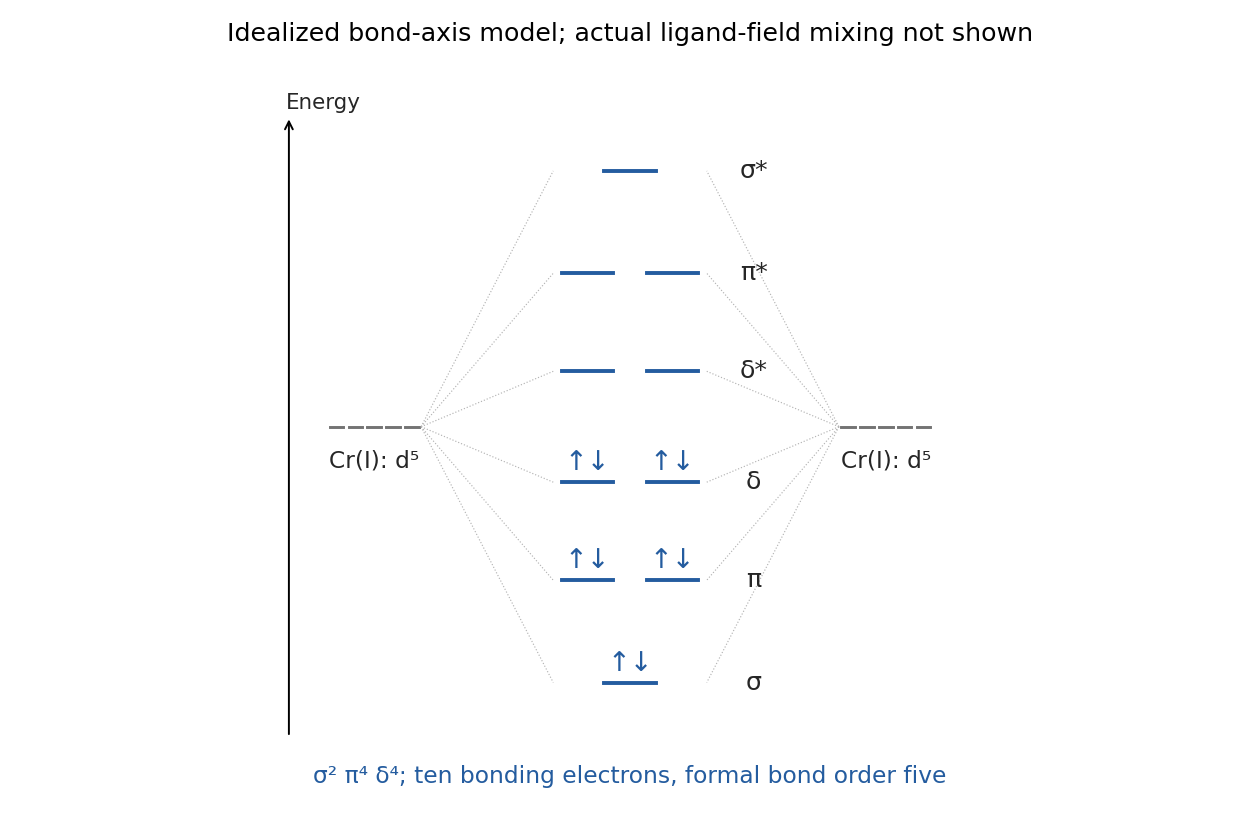
Original idealized d-orbital combinations and ten-electron occupancy for a sigma-two-pi-two-delta quintuple bond
. Details. Past exam of the chemistry course of the year 3 of the natural sciences course of the University of Cambridge 2022 Paper 1 10 a i Solution by Codex 0 2026-10-20
Codex 0 2026-10-20Ultrashort metal–metal contacts are favoured when the valence configuration fills strongly metal–metal-bonding orbitals while leaving their antibonding partners empty. Early or middle transition metals in low oxidation states can retain enough d electrons for multiple bonding without the unavoidable antibonding occupation of a more filled d shell. Good radial and angular overlap, a compatible metal–metal axis, and low competing ligand-field stabilization all matter; a short contact should be interpreted together with an orbital/electron-counting model, not automatically called a high-order bond.
Ligands should support a geometry in which the relevant d orbitals can overlap and protect the low-valent pair from oligomerization or oxidative attack. Bulky aryl-substituted bridging amidinates can provide this protection while maintaining an appropriate small coordination number. Strongly coordinating axial ligands or inappropriate pi interactions can compete with metal–metal bonding, especially its weaker delta components. For quadruple or quintuple bonds, retaining two appropriately oriented delta-capable orbitals is particularly important; a geometry optimized only for metal–ligand bonding can remove that advantage.
Ligand bridges need not literally squeeze two otherwise unbound metals together. Comparing bond lengths across oxidation states and across related ligands helps distinguish electronic multiple bonding from enforced steric compression. The lantern-type dichromium experiment in (ii) is informative because reduction changes the electron occupation within essentially the same three-bridge supporting framework.[ref]
Remarkably Short Metal-Metal Bonds: A Lantern-Type Quintuply Bonded Dichromium(I) Complex by Yi-Chou Tsai and others. 2008, printed pp. 7250–7253: mixed-valent precursor, reduced anion, orbital analysis and discussion of ligand constraints
Pinned article: Introduction to the OurBigBook Project
Welcome to the OurBigBook Project! Our goal is to create the perfect publishing platform for STEM subjects, and get university-level students to write the best free STEM tutorials ever.
Everyone is welcome to create an account and play with the site: ourbigbook.com/go/register. We belive that students themselves can write amazing tutorials, but teachers are welcome too. You can write about anything you want, it doesn't have to be STEM or even educational. Silly test content is very welcome and you won't be penalized in any way. Just keep it legal!
Intro to OurBigBook
. Source. We have two killer features:
- topics: topics group articles by different users with the same title, e.g. here is the topic for the "Fundamental Theorem of Calculus" ourbigbook.com/go/topic/fundamental-theorem-of-calculusArticles of different users are sorted by upvote within each article page. This feature is a bit like:
- a Wikipedia where each user can have their own version of each article
- a Q&A website like Stack Overflow, where multiple people can give their views on a given topic, and the best ones are sorted by upvote. Except you don't need to wait for someone to ask first, and any topic goes, no matter how narrow or broad
This feature makes it possible for readers to find better explanations of any topic created by other writers. And it allows writers to create an explanation in a place that readers might actually find it.
Figure 1. Screenshot of the "Derivative" topic page. View it live at: ourbigbook.com/go/topic/derivativeVideo 2. OurBigBook Web topics demo. Source. - local editing: you can store all your personal knowledge base content locally in a plaintext markup format that can be edited locally and published either:This way you can be sure that even if OurBigBook.com were to go down one day (which we have no plans to do as it is quite cheap to host!), your content will still be perfectly readable as a static site.
- to OurBigBook.com to get awesome multi-user features like topics and likes
- as HTML files to a static website, which you can host yourself for free on many external providers like GitHub Pages, and remain in full control

Figure 2. You can publish local OurBigBook lightweight markup files to either OurBigBook.com or as a static website.
Figure 3. Visual Studio Code extension installation.
Figure 5. . You can also edit articles on the Web editor without installing anything locally. Video 3. Edit locally and publish demo. Source. This shows editing OurBigBook Markup and publishing it using the Visual Studio Code extension. 
- Infinitely deep tables of contents:




All our software is open source and hosted at: github.com/ourbigbook/ourbigbook
Further documentation can be found at: docs.ourbigbook.com
Feel free to reach our to us for any help or suggestions: docs.ourbigbook.com/#contact