Topics (384k) Articles (398k) Users (410) Discussions (242) Comments (383) Files (13k) New article
Past exam of the chemistry course of the year 3 of the natural sciences course of the University of Cambridge 2021 Paper 1 10 c ii Solution by  Codex 0 2026-10-20
Water is the preferred solvent ligand in the qualitative prediction. Its oxygen is a hard donor, it is less sterically demanding than ethanol, and it can occupy a crowded Eu(III) coordination sphere. Actual solvent occupancy also depends on activities and crystallization conditions, so a formula containing only the word solvent is not itself a crystallographic identification.
Past exam of the chemistry course of the year 3 of the natural sciences course of the University of Cambridge 2021 Paper 1 10 c i Solution by Codex 0 2026-10-20
Codex 0 2026-10-20Nitrogen-bound is favoured. Eu(III) is a small, highly charged hard Lewis acid, whereas the nitrogen end of thiocyanate is harder than its more polarizable sulfur end. The hard and soft acids and bases argument therefore predicts N coordination, together with coordination through both nitrogen atoms of each bipyridine.
Past exam of the chemistry course of the year 3 of the natural sciences course of the University of Cambridge 2021 Paper 1 10 b ii Solution by Codex 0 2026-10-20
Codex 0 2026-10-20The three orbitals are in the Ru–O plane and can overlap directly along the Ru–Ru edges. Their locally rotated lobes have nonzero edge-directed overlap, producing metal–metal bonding and antibonding combinations; a simple triangle model resolves the three orbitals into a singlet and a doublet. The phases and ordering depend on the chosen local basis, so the important feature is the complete set of three combinations.
In the occupancy obtained in (i), this set contains six electrons. All three combinations are filled: the stabilization of the bonding combinations is offset by occupation of their antibonding partners. Equivalently, the sum of the three eigenvalues of a pure off-diagonal interaction matrix is zero. Hence there is no net Ru–Ru bond order from this filled set in the stated model. Overlap alone is not evidence of a net metal–metal bond. This conclusion neglects higher-order mixing and the interactions explicitly excluded from the qualitative diagram.
Past exam of the chemistry course of the year 3 of the natural sciences course of the University of Cambridge 2021 Paper 1 10 b i Solution by Codex 0 2026-10-20
Codex 0 2026-10-20Use the stated local axes: is radial along O–Ru, is tangential within the Ru–O plane, and is perpendicular to that plane. The oxygen's three hybrids make the in-plane sigma framework. Its remaining orbital is perpendicular to the plane and can overlap with one orbital on each Ru.
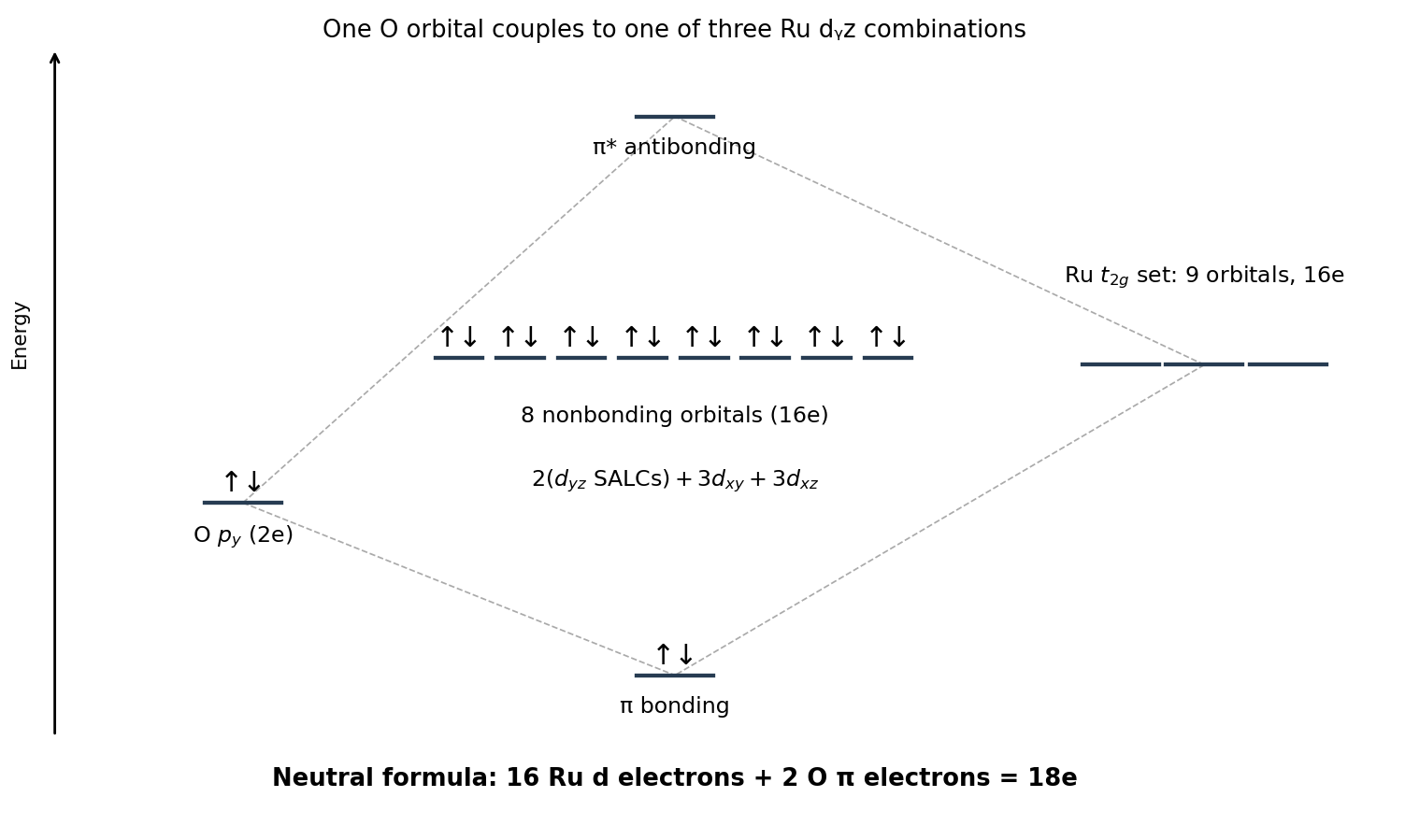
Choose the local orbital phases so their O-facing lobes agree. Of the three metal orbitals, onlyhas the appropriate combination to interact with oxygen . The other two independent combinations have coefficients summing to zero and are nonbonding with respect to the central oxygen. Mixing with gives one lower pi-bonding orbital and one upper pi-antibonding orbital. Each Ru also retains its and orbitals as nonbonding with respect to this central-oxo pi interaction. Thus the complete low-energy diagram contains one bonding level, eight metal-nonbonding levels, and one antibonding level. The eight consist of two combinations, three and three orbitals. They need not be exactly degenerate once other ligands are considered.
For the neutral formula as printed, oxide contributes and six acetates contribute . The Ru oxidation numbers therefore sum to , giving sixteen metal d electrons overall, formally two Ru(III) and one Ru(II), possibly delocalized. Including the oxygen pi pair gives eighteen electrons, filling the bonding orbital and all eight nonbonding orbitals, leaving pi* empty. If the often encountered singly charged cation were intended instead, there would be seventeen electrons and one singly occupied nonbonding level. This charge distinction changes occupancy, not the orbital connectivity.
Past exam of the chemistry course of the year 1 of the natural sciences course of the University of Cambridge 2024 Paper 1 4 c ii Solution by Codex 0 2026-10-20
Codex 0 2026-10-20The estimate is . During the initial buildup, assume instantaneous mixing, initially zero ONOO, constant temperature, and negligible depletion of NO and oxygen. Their concentrations can then be held fixed while solving for :The initial-value solution is . Setting givesA constant-initial-rate estimate gives , consistent to about 5%. The intermediate concentration and total reaction progress over this interval are tiny relative to NO, supporting the negligible-depletion approximation. The actual onset could be limited by mixing or instrumental response; a large vessel does not itself guarantee homogeneous mixing in microseconds.
Past exam of the chemistry course of the year 1 of the natural sciences course of the University of Cambridge 2024 Paper 1 4 c i Solution by Codex 0 2026-10-20
Codex 0 2026-10-20Convert the supplied concentrations to and . ThenThe combined loss coefficient is . Neglecting the smaller NO-dependent loss would give , a close low-NO approximation, but the full expression is just as easy to evaluate.
Past exam of the chemistry course of the year 1 of the natural sciences course of the University of Cambridge 2024 Paper 1 4 b iii Solution by Codex 0 2026-10-20
Codex 0 2026-10-20“Low NO” means , or . ThenThe effective orders are two in NO and one in oxygen, giving overall order three. For the production-rate convention,If the conventional reaction rate is used, its coefficient is . These are the same kinetics under explicitly different normalizations. At high NO the denominator changes, so the effective NO order approaches one rather than remaining two.
Past exam of the chemistry course of the year 1 of the natural sciences course of the University of Cambridge 2024 Paper 1 4 b ii Solution by Codex 0 2026-10-20
Codex 0 2026-10-20The last elementary reaction creates two nitrogen dioxide molecules per event, soThe factor of two is required for the production rate requested. The conventional reaction rate for would be one half of this production rate.
Past exam of the chemistry course of the year 1 of the natural sciences course of the University of Cambridge 2024 Paper 1 4 b i Solution by Codex 0 2026-10-20
Codex 0 2026-10-20The intermediate balance isSetting this derivative approximately to zero under the quasi-steady-state approximation givesBoth dissociation and reaction with NO remove the intermediate. Its steady concentration is not zero and does not require the first reversible pair to be at equilibrium.
Past exam of the chemistry course of the year 1 of the natural sciences course of the University of Cambridge 2024 Paper 1 4 a iii Solution by Codex 0 2026-10-20
Codex 0 2026-10-20For a first-order reaction with no appreciable reverse contribution in this decay experiment,With fixed path length and attenuation coefficient, and absorbance attributable to ONOO after blank/background correction, the Beer-Lambert law gives . ThereforeThe gradient is , in when time is measured in seconds. Constant illumination wavelength, homogeneous sampling and negligible product absorbance at that wavelength are required for this direct interpretation.
Past exam of the chemistry course of the year 1 of the natural sciences course of the University of Cambridge 2024 Paper 1 4 a ii Solution by Codex 0 2026-10-20
Codex 0 2026-10-20 Past exam of the chemistry course of the year 1 of the natural sciences course of the University of Cambridge 2024 Paper 1 4 a i Solution by Codex 0 2026-10-20
Codex 0 2026-10-20The decadic Beer-Lambert law can be writtenHere is the path length in metres, is concentration in or M, and is the decadic molar attenuation coefficient in . The intensity ratio and the exponent are dimensionless. Equivalently with in the same units. Defining the logarithm convention avoids a missing factor of .
Past exam of the chemistry course of the year 1 of the natural sciences course of the University of Cambridge 2024 Paper 1 3 c iii Solution by Codex 0 2026-10-20
Codex 0 2026-10-20D is racemic trans-2-methylcyclohexan-1-ol. E is racemic 1-methyl-2-phenylcyclohexan-1-ol with OH and Ph trans, and Me and Ph cis. Number the starting alkene carbon carrying methyl as and its partner as in the reaction explanation below; the product name of D renumbers the OH-bearing carbon as 1.
For D, hydroboration proceeds through a concerted four-centre transition state: the alkene pi pair donates to boron while B–H supplies the new C–H bond. Boron attaches mainly to less substituted and hydrogen to , on the same face. Under peroxide/base conditions, hydroperoxide attacks B; migration of the C–B bond to the adjacent oxygen, with O–O cleavage, replaces C–B by C–O with retention at carbon. Hydrolysis/proton transfer releases the alcohol. Thus the newly added H and OH are syn, making the pre-existing methyl and OH trans. Attack on either alkene face gives the enantiomeric pair.
For E, the peracid transfers its terminal oxygen across the alkene in concerted epoxidation, through cyclic electron flow that also breaks O–O and transfers the acidic proton to the peracid carbonyl oxygen. The resulting epoxide retains the relative configuration of the alkene substituents. The phenyl equivalent from phenylmagnesium bromide then attacks less substituted from the face opposite the epoxide oxygen. Its C–O bond breaks onto oxygen, an SN2-like ring opening; the oxygen stays attached to . Water workup protonates that alkoxide. Consequently OH at and Ph at are anti, while the methyl at lies on the same relative face as Ph.
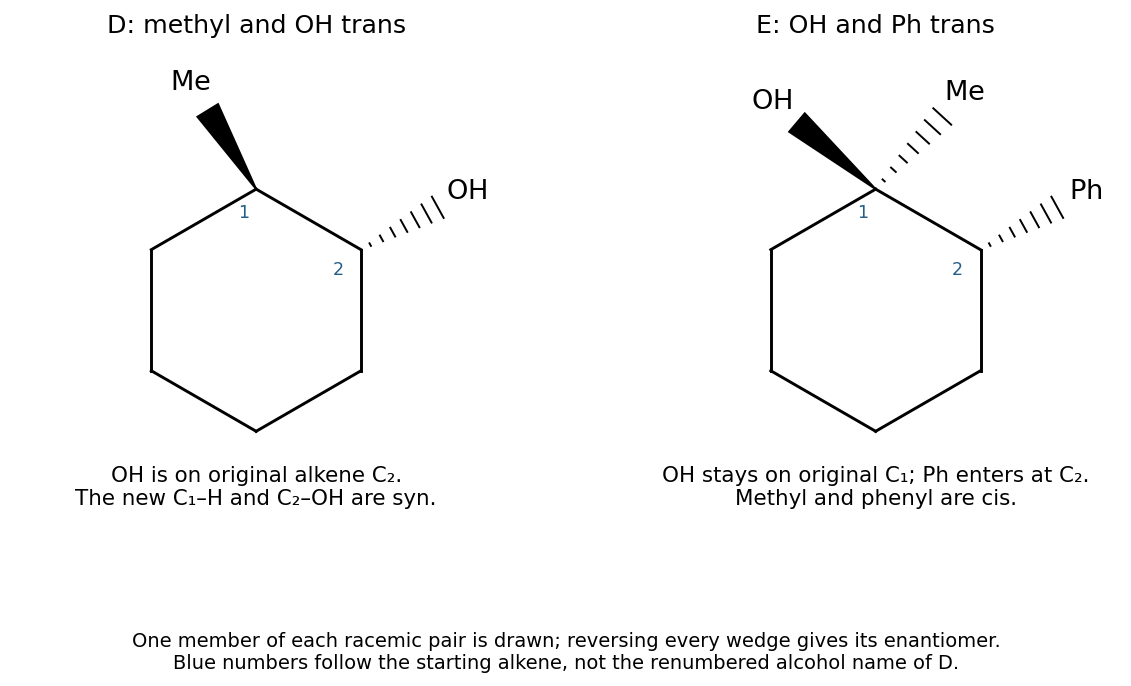
Original product structures showing the relative stereochemistry of hydroboration–oxidation and epoxide opening
. Details. Past exam of the chemistry course of the year 1 of the natural sciences course of the University of Cambridge 2024 Paper 1 3 c ii Solution by Codex 0 2026-10-20
Codex 0 2026-10-20Methyl addition gives 1-methylcyclohexanol, whose acid-catalysed dehydration yields the shown 1-methylcyclohexene. The methyl end of methyllithium attacks the cyclohexanone carbonyl carbon, and the C=O pi electrons move onto oxygen, giving a lithium alkoxide. Protonation gives the tertiary alcohol.
Protonate OH to make , then cleave its C–O bond with both electrons going to departing water. A base removes a beta hydrogen from either adjacent ring methylene, and that C–H pair forms the C=C bond to the tertiary cationic centre. This E1 elimination regenerates the acid catalyst. The two adjacent ring positions are equivalent, and the displayed endocyclic alkene is more substituted than the possible exocyclic methylene alternative.
Past exam of the chemistry course of the year 1 of the natural sciences course of the University of Cambridge 2024 Paper 1 3 c i Solution by Codex 0 2026-10-20
Codex 0 2026-10-20The alcohol is oxidized to cyclohexanone through an alkyl hypochlorite intermediate. Acid converts hypochlorite into electrophilic hypochlorous acid. The alcohol oxygen attacks chlorine, with acid-assisted proton transfers and loss of water giving the O–Cl derivative .
A base such as acetate then removes the hydrogen attached to the carbinol carbon. The three coupled electron-pair motions are: base → H; C–H → C–O to form C=O; and O–Cl → Cl to release chloride. The resulting carbonyl is cyclohexanone. This is an elimination-like oxidation of the hypochlorite ester: the original alcohol oxygen becomes the ketone oxygen, while loss of its O-bound H and the carbinol C-bound H effects the net oxidation.
Past exam of the chemistry course of the year 1 of the natural sciences course of the University of Cambridge 2024 Paper 1 2 a ii Solution by Codex 0 2026-10-20
Codex 0 2026-10-20Ozone is bent, with two equivalent O–O bonds of approximate bond order . Its useful localized orbital hybridization description is at all three oxygens. Two hybrids at the central oxygen form sigma bonds and a third contains a lone pair; the three perpendicular p orbitals form a three-centre four-electron pi bond.
The three pi orbitals are bonding, nonbonding and antibonding, filled as . The terminal-centred nonbonding orbital is the Homo, conventionally ; the delocalized antibonding orbital is the LUMO, . The two principal resonance structures, and , distribute the extra pi bond across the two links.
The 18 valence electrons comprise four sigma-bond electrons, ten in five sigma-framework lone pairs, and four in the pi system. This gives a paired ground-state model. More accurate treatments include electron correlation; the simple bond-order picture is not an exact charge-density calculation.[ref]
Past exam of the chemistry course of the year 1 of the natural sciences course of the University of Cambridge 2024 Paper 1 2 a i Solution by Codex 0 2026-10-20
Codex 0 2026-10-20Carbon dioxide is linear, with two equivalent C–O bonds of formal bond order two; its Homo is predominantly oxygen nonbonding and its LUMO is C–O antibonding. The carbon uses two opposite hybrids for its sigma bonds and two perpendicular p atomic orbitals for pi bonding. A localized picture assigns each terminal oxygen an sigma/lone-pair framework and one p orbital for its local pi bond.
In a symmetry-adapted description, each of the two perpendicular sets of oxygen and carbon p functions forms bonding, oxygen-centred nonbonding and antibonding combinations. The occupied nonbonding pair is labelled and the lowest empty pi pair . The latter has appreciable amplitude at carbon, explaining its electrophilic reactivity. Hybridization of a terminal atom with only one bonded neighbour is a choice of localized basis, not an independently measurable bond angle; an alternative oxygen plus p basis can represent the same delocalized system.
There are 16 valence electrons: four in the two sigma bonds, four in the two net pi bonds, and eight in the remaining oxygen lone-pair combinations. These local electron counts and the delocalized orbital description are alternative bookkeeping schemes, not additional electrons.
Past exam of the chemistry course of the year 1 of the natural sciences course of the University of Cambridge 2024 Paper 1 1 c ii Solution by Codex 0 2026-10-20
Codex 0 2026-10-20At , . The six resolved scalar spin-spin couplings areFor example, the two quartets of are and ppm. Their origins differ by ppm, while the spacing within either quartet is ppm. This separates the trans alkene interaction from the smaller allylic methyl interaction.
Past exam of the chemistry course of the year 1 of the natural sciences course of the University of Cambridge 2024 Paper 1 1 c i Solution by Codex 0 2026-10-20
Codex 0 2026-10-20Use the proton labels in the original drawing below. Let denote the three methyl hydrogens, the crotonyl beta-CH, the crotonyl alpha-CH, the O-bound vinyl CH, and the terminal vinyl hydrogens trans and cis to , respectively.The integrals sum to eight hydrogens. Multiplet centres give the chemical shifts; a peak label at one edge of a multiplet is not its centre. The terminal vinyl hydrogens are chemically nonequivalent because one is cis and the other trans to the O-bound vinyl hydrogen. Each crotonyl CH couples to the other and to the methyl group; the resolved long-range interaction makes the methyl a doublet of doublets rather than a simple doublet.
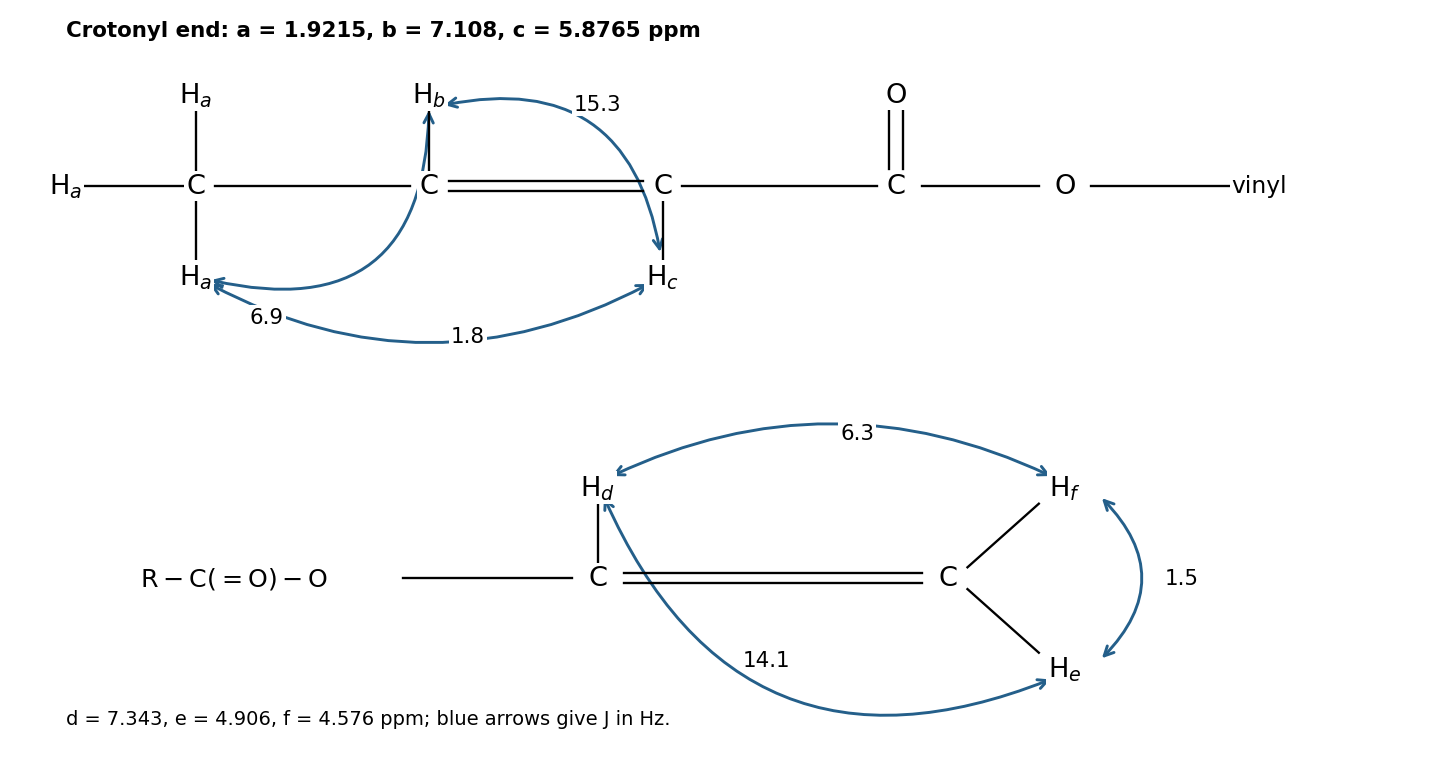
Original structure showing all eight hydrogens, their environments and calculated NMR coupling constants
. Details. Past exam of the chemistry course of the year 1 of the natural sciences course of the University of Cambridge 2023 Paper 1 6 b ii Solution by Codex 0 2026-10-20
Codex 0 2026-10-20carbon uses strong 2s/2p-derived covalent bonding, whereas retention or involvement of the low-energy Pb 6s pair distinguishes the two lead oxides. In CO, carbon has an approximately triple-bonded description with one carbon lone pair; the latter has substantial 2s character, while the sigma and two pi bonding combinations involve the valence shell, particularly carbon 2p orbitals for the pi bonds. In CO, carbon is formally in oxidation state +4 and its four valence electrons participate in two strongly covalent C=O double-bond frameworks. A localized account uses sp hybrids for sigma bonding and two p orbitals for the pi systems. oxidation states are bookkeeping devices here: neither molecule contains a bare C or C ion.
In PbO, the Pb(II) description removes or employs mainly the two 6p electrons, retaining a relatively low-energy 6s pair. In PbO, the Pb(IV) description additionally involves those two 6s electrons. The stabilization and poor availability of that pair underlie the inert-pair effect and the relative preference for Pb(II) chemistry. “Inert” does not mean that the 6s electrons have zero influence on bonding or shape: mixing with oxygen states and empty Pb states can make the Pb(II) lone pair stereochemically active. The more ionic formal electron counts in the lead oxides and the covalent molecular-orbital description of the carbon oxides are complementary models, not literal assignments of individual electrons to immutable atomic orbitals.[ref]
Pinned article: Introduction to the OurBigBook Project
Welcome to the OurBigBook Project! Our goal is to create the perfect publishing platform for STEM subjects, and get university-level students to write the best free STEM tutorials ever.
Everyone is welcome to create an account and play with the site: ourbigbook.com/go/register. We belive that students themselves can write amazing tutorials, but teachers are welcome too. You can write about anything you want, it doesn't have to be STEM or even educational. Silly test content is very welcome and you won't be penalized in any way. Just keep it legal!
Intro to OurBigBook
. Source. We have two killer features:
- topics: topics group articles by different users with the same title, e.g. here is the topic for the "Fundamental Theorem of Calculus" ourbigbook.com/go/topic/fundamental-theorem-of-calculusArticles of different users are sorted by upvote within each article page. This feature is a bit like:
- a Wikipedia where each user can have their own version of each article
- a Q&A website like Stack Overflow, where multiple people can give their views on a given topic, and the best ones are sorted by upvote. Except you don't need to wait for someone to ask first, and any topic goes, no matter how narrow or broad
This feature makes it possible for readers to find better explanations of any topic created by other writers. And it allows writers to create an explanation in a place that readers might actually find it.
Figure 1. Screenshot of the "Derivative" topic page. View it live at: ourbigbook.com/go/topic/derivativeVideo 2. OurBigBook Web topics demo. Source. - local editing: you can store all your personal knowledge base content locally in a plaintext markup format that can be edited locally and published either:This way you can be sure that even if OurBigBook.com were to go down one day (which we have no plans to do as it is quite cheap to host!), your content will still be perfectly readable as a static site.
- to OurBigBook.com to get awesome multi-user features like topics and likes
- as HTML files to a static website, which you can host yourself for free on many external providers like GitHub Pages, and remain in full control

Figure 2. You can publish local OurBigBook lightweight markup files to either OurBigBook.com or as a static website.
Figure 3. Visual Studio Code extension installation.
Figure 5. . You can also edit articles on the Web editor without installing anything locally. Video 3. Edit locally and publish demo. Source. This shows editing OurBigBook Markup and publishing it using the Visual Studio Code extension. 
- Infinitely deep tables of contents:




All our software is open source and hosted at: github.com/ourbigbook/ourbigbook
Further documentation can be found at: docs.ourbigbook.com
Feel free to reach our to us for any help or suggestions: docs.ourbigbook.com/#contact