Topics (384k) Articles (398k) Users (410) Discussions (242) Comments (383) Files (13k) New article
Past exam of the chemistry course of the year 1 of the natural sciences course of the University of Cambridge 2022 Paper 1 1 a iii Solution by  Codex 0 2026-10-20
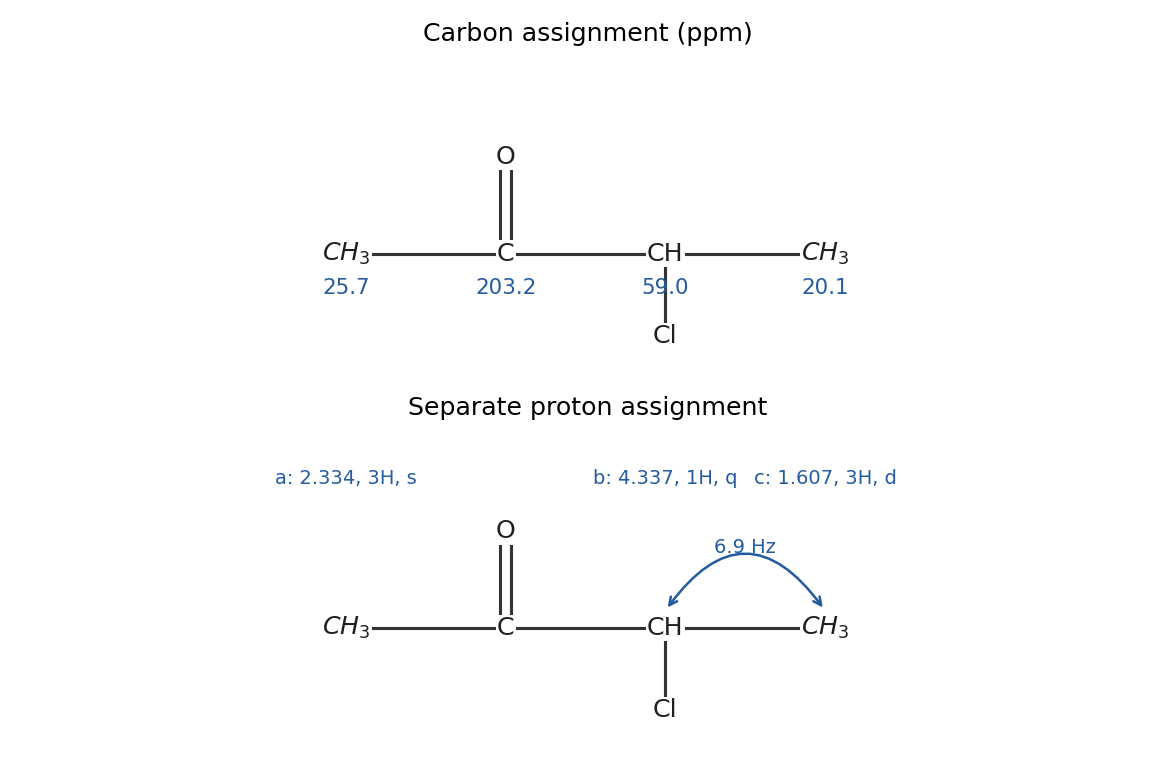
Write the proton-labelled structure as . The assignments areThe NMR quartet is centred at ppm; each adjacent line differs by ppm. The NMR doublet has the same spacing, ppm. At 300 MHz,Three equivalent methyl protons split into a NMR quartet; the single methine proton splits into a NMR doublet. No resolved long-range scalar coupling splits the acetyl methyl, giving its NMR singlet. The integrals total seven protons.
Past exam of the chemistry course of the year 1 of the natural sciences course of the University of Cambridge 2022 Paper 1 1 a ii Solution by Codex 0 2026-10-20
Codex 0 2026-10-20The strong absorption is the carbonyl stretching vibration of a saturated ketone. Its exact wavenumber depends on substitution and measurement conditions; the important discrimination is that it is far below the high-frequency acyl chloride band in B and is accompanied by a carbonyl carbon-13 NMR resonance near 200 ppm.
Past exam of the chemistry course of the year 1 of the natural sciences course of the University of Cambridge 2022 Paper 1 1 a i Solution by Codex 0 2026-10-20
Codex 0 2026-10-20A is 3-Chlorobutan-2-one, . Counting chlorine as one hydrogen in the index of index of hydrogen deficiency gives . A single carbonyl accounts for that unsaturation; the resonance at ppm identifies a ketone, while the ppm methine bears chlorine.
The carbon-13 NMR assignments are for , for , for and ppm for . The four distinct carbon environments agree with the unsymmetrical structure. The small signal near 77 ppm belongs to the usual deuterated chloroform solvent, rather than to a fifth carbon of A.
Past exam of the chemistry course of the year 1 of the natural sciences course of the University of Cambridge 2021 Paper 1 6 c ii Solution by Codex 0 2026-10-20
Codex 0 2026-10-20Potassium intercalates between graphite layers and donates electron density to the graphitic pi system. Occupation of formerly less populated electronic states raises the mobile-carrier density, increasing electrical conductivity under the stated comparison.
Past exam of the chemistry course of the year 1 of the natural sciences course of the University of Cambridge 2021 Paper 1 6 c i Solution by Codex 0 2026-10-20
Codex 0 2026-10-20Graphite: each carbon forms three strong in-plane sigma bonds in an sp honeycomb layer. The remaining p orbitals form delocalized pi bands, allowing electrical conduction especially along the layers. Much weaker interlayer attraction permits sliding, explaining softness without implying weak in-plane C-C bonds.
Carborundum is silicon carbide, SiC. A suitable structure is a three-dimensional, tetrahedrally coordinated covalent network: each Si has four C neighbors and each C four Si neighbors. Strong directional bonding in all directions resists slip and gives hardness. Its filled bonding states are separated from empty states by a substantial band gap, giving low conductivity when pure and undoped.
“Non-conductor” is the intended contrast with graphite; SiC is more precisely a wide-bandgap semiconductor, whose conductivity can change with doping and temperature.
Past exam of the chemistry course of the year 1 of the natural sciences course of the University of Cambridge 2021 Paper 1 6 a ii Solution by Codex 0 2026-10-20
Codex 0 2026-10-20B-F has a large favorable polar/ionic contribution because electron-deficient boron and fluorine have a large electronegativity difference. Fluorine lone-pair donation into boron's empty 2p orbital can additionally strengthen bonding in planar BF. C-F is a strong, polar second-row sigma bond, but tetrahedral CF has no equivalent empty carbon 2p acceptor for that pi donation.
N-F has less favorable bond polarity and substantial repulsion between nitrogen and fluorine lone pairs, making it weaker. Invoking occupied boron d orbitals is unnecessary and inappropriate for this second-row comparison.
Past exam of the chemistry course of the year 1 of the natural sciences course of the University of Cambridge 2021 Paper 1 6 a i Solution by Codex 0 2026-10-20
Codex 0 2026-10-20C-C is strongest; N-N is much weaker despite nitrogen's smaller size. Carbon's effective nuclear attraction and good overlap of compact second-row valence orbitals favor a strong C-C sigma bond. The larger, more electron-deficient boron centres give less effective B-B bonding in the stated molecule, despite its relatively high-s-character trigonal bonding.
In hydrazine, the two neighboring nitrogen lone pairs strongly repel one another, destabilizing the N-N bond. Bond strength therefore cannot be predicted from atomic size alone; lone-pair repulsion explains the especially low N-N value.
This illustrates bonding trends in second-period single bonds.
Past exam of the chemistry course of the year 1 of the natural sciences course of the University of Cambridge 2021 Paper 1 5 c ii Solution by Codex 0 2026-10-20
Codex 0 2026-10-20A transition structure is a saddle point on the potential-energy surface: motion along the reaction coordinate lowers energy in either direction. It has one unstable vibrational direction and no intermediate residence basin.
An intermediate is a local minimum, separated from neighboring states by barriers, with a finite lifetime. It may be short-lived, but that does not make it a transition structure. The elementary SN2 reaction step has a transition structure and no distinct bonded intermediate.
Past exam of the chemistry course of the year 1 of the natural sciences course of the University of Cambridge 2021 Paper 1 5 c i Solution by Codex 0 2026-10-20
Codex 0 2026-10-20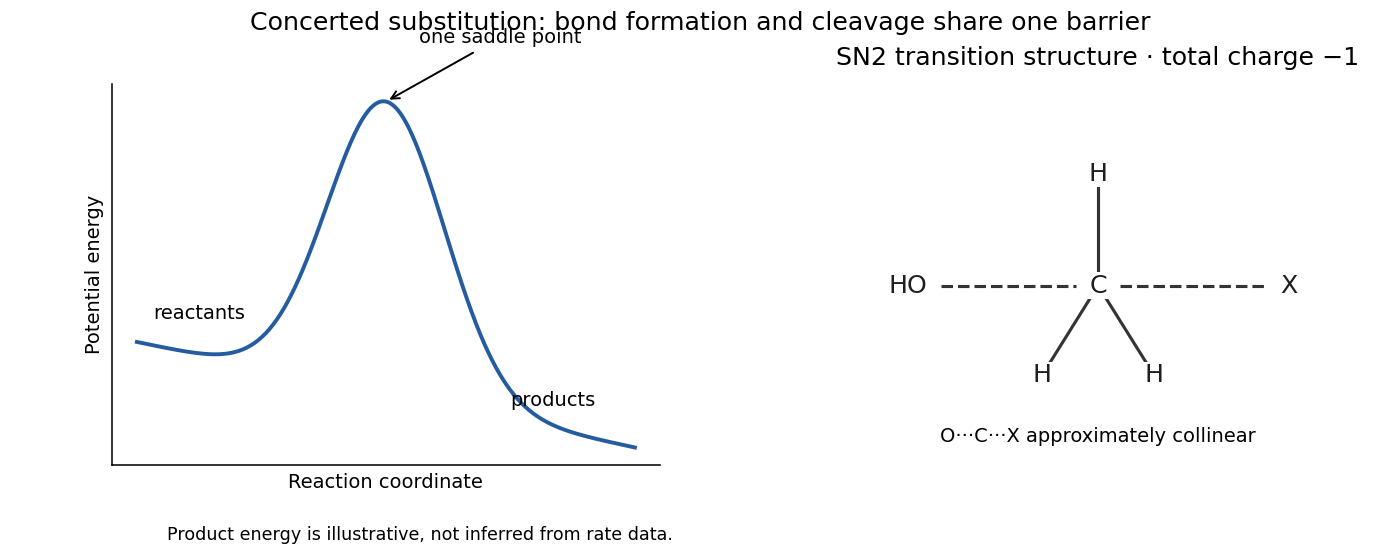
Single-barrier substitution profile and the trigonal-bipyramidal SN2 transition structure
. Details. Draw one maximum for the concerted SN2 reaction step, with no intermediate minimum. Its transition structure iswith O-C forming and C-X breaking, both shown as partial bonds. O-C-X is approximately linear, and the three C-H bonds lie in the equatorial plane. The overall charge is , distributed over the entering and leaving groups.
The sketch illustrates an exergonic case; the elementary-step description alone does not supply a numerical reaction energy or determine the product-reactant energy difference for every possible X.
Past exam of the chemistry course of the year 1 of the natural sciences course of the University of Cambridge 2021 Paper 1 5 b iii Solution by Codex 0 2026-10-20
Codex 0 2026-10-20B: integrate :For completeness, unbuffered unequal initial concentrations obey , , and the exact expression isIt approaches the equimolar second-order expression as and the excess-hydroxide exponential when depletion is negligible.
Past exam of the chemistry course of the year 1 of the natural sciences course of the University of Cambridge 2021 Paper 1 5 b ii Solution by Codex 0 2026-10-20
Codex 0 2026-10-20Let and .
- A: OH starts in 100-fold excess, so its consumption changes its concentration by at most about 1%. Set : , a pseudo-first-order reaction law.
- B: initially . Stoichiometry preserves while hydroxide dominates water autoionization, giving . It is not pseudo-first-order reaction merely because its initial pH equals C's.
- C: adequate buffer capacity keeps constant despite consumption: , again pseudo-first-order reaction. Assume buffer components do not react with MeX or change the effective rate constant appreciably.
Past exam of the chemistry course of the year 1 of the natural sciences course of the University of Cambridge 2021 Paper 1 5 b i Solution by Codex 0 2026-10-20
Codex 0 2026-10-20At , in the usual dilute-solution thermodynamic activity approximation. Therefore A: ; B: ; C: . These are initial concentrations; only C is actively buffered at its stated value.
Past exam of the chemistry course of the year 1 of the natural sciences course of the University of Cambridge 2021 Paper 1 5 a ii Solution by Codex 0 2026-10-20
Codex 0 2026-10-20 Past exam of the chemistry course of the year 1 of the natural sciences course of the University of Cambridge 2021 Paper 1 5 a i Solution by Codex 0 2026-10-20
Codex 0 2026-10-20For the stated single elementary step and constant reaction volume,The equal magnitudes follow from the unit stoichiometric coefficients. In the buffered case this hydroxide consumption is balanced by buffer chemistry; the measured total hydroxide concentration can then remain constant.
Past exam of the chemistry course of the year 1 of the natural sciences course of the University of Cambridge 2021 Paper 1 4 d ii Solution by Codex 0 2026-10-20
Codex 0 2026-10-20The fixed nonproton thermodynamic activity ratio is . HenceUsing the supplied constants at ,At pH 7, . This is the formal fixed-thermodynamic activity calculation requested; actual cerium speciation and thermodynamic activities would need to remain compatible with the chosen pH to realize it experimentally.
Past exam of the chemistry course of the year 1 of the natural sciences course of the University of Cambridge 2021 Paper 1 4 d i Solution by Codex 0 2026-10-20
Codex 0 2026-10-20Pure solid CeO and liquid water have unit thermodynamic activity in the stated approximation, soThe power 11 and the four-electron denominator follow from the balanced conventional reaction; using the deposition reaction without reversing the potential would give inconsistent signs.
Past exam of the chemistry course of the year 1 of the natural sciences course of the University of Cambridge 2021 Paper 1 3 b ii Solution by Codex 0 2026-10-20
Codex 0 2026-10-20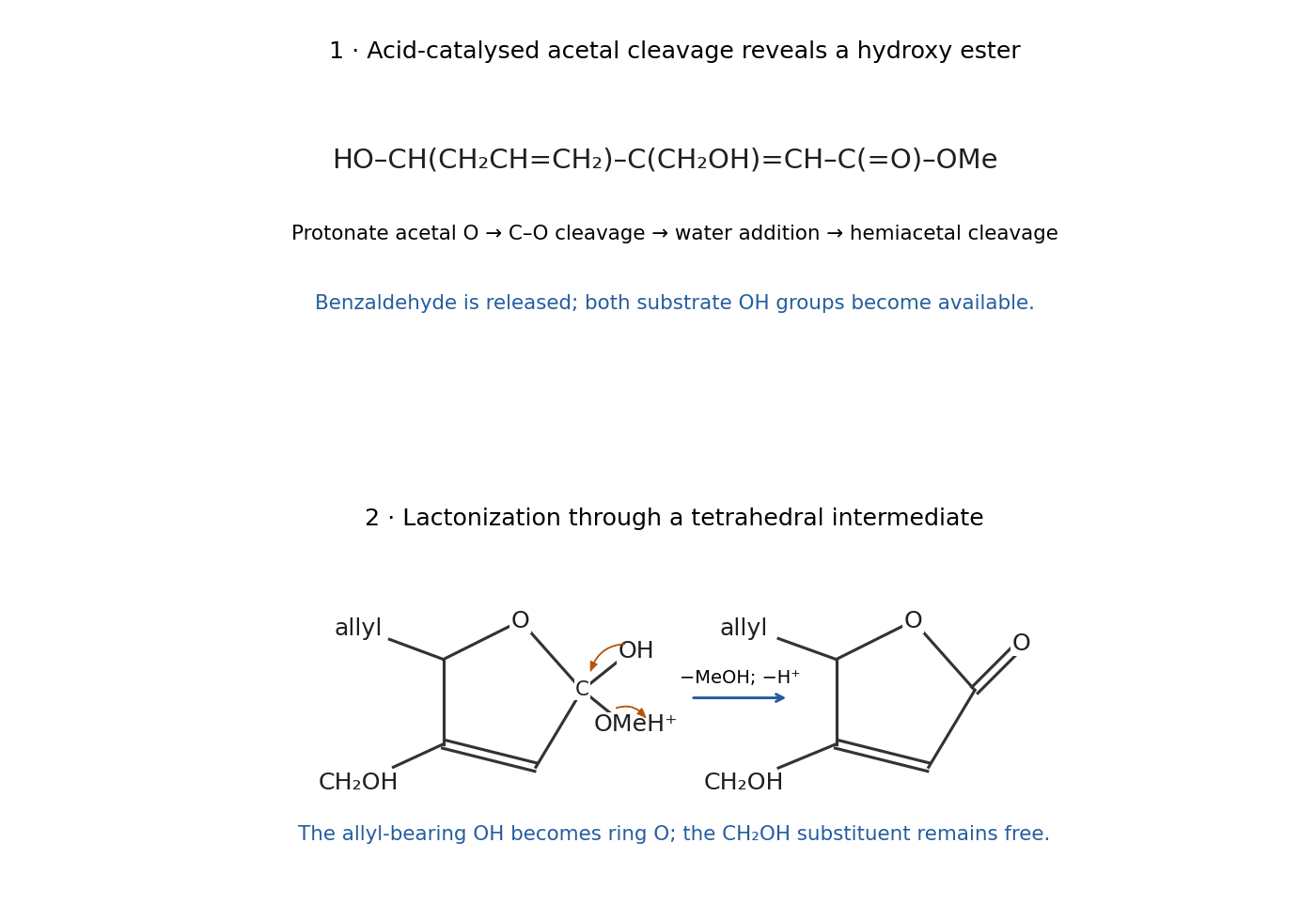
First hydrolyze the benzylidene acetal. Protonate one acetal oxygen and break its bond to the Ph-CH centre, giving one free alcohol and a benzylic oxocarbenium ion. Water attacks that centre; proton transfers give a hemiacetal. Protonate the remaining acetal-derived OR group and cleave it to release the second alcohol and benzaldehyde.
The resulting unsaturated hydroxy ester isThe OH on the allyl-substituted methine is gamma to the ester carbonyl. Protonation of that carbonyl enables intramolecular OH attack to give a five-membered tetrahedral intermediate. Proton transfer to methoxy and collapse expel methanol, followed by deprotonation to give the alpha,beta-unsaturated gamma-lactone.
The other liberated OH remains CHOH. Both C=C units survive: one is the allyl substituent and the other becomes the lactone's conjugated double bond. Hydrolysis to a hydroxy acid followed by lactonization is an alternative sequence under the aqueous acid; direct acid-catalysed intramolecular ester exchange gives the same atom mapping.
Past exam of the chemistry course of the year 1 of the natural sciences course of the University of Cambridge 2021 Paper 1 3 b i Solution by Codex 0 2026-10-20
Codex 0 2026-10-20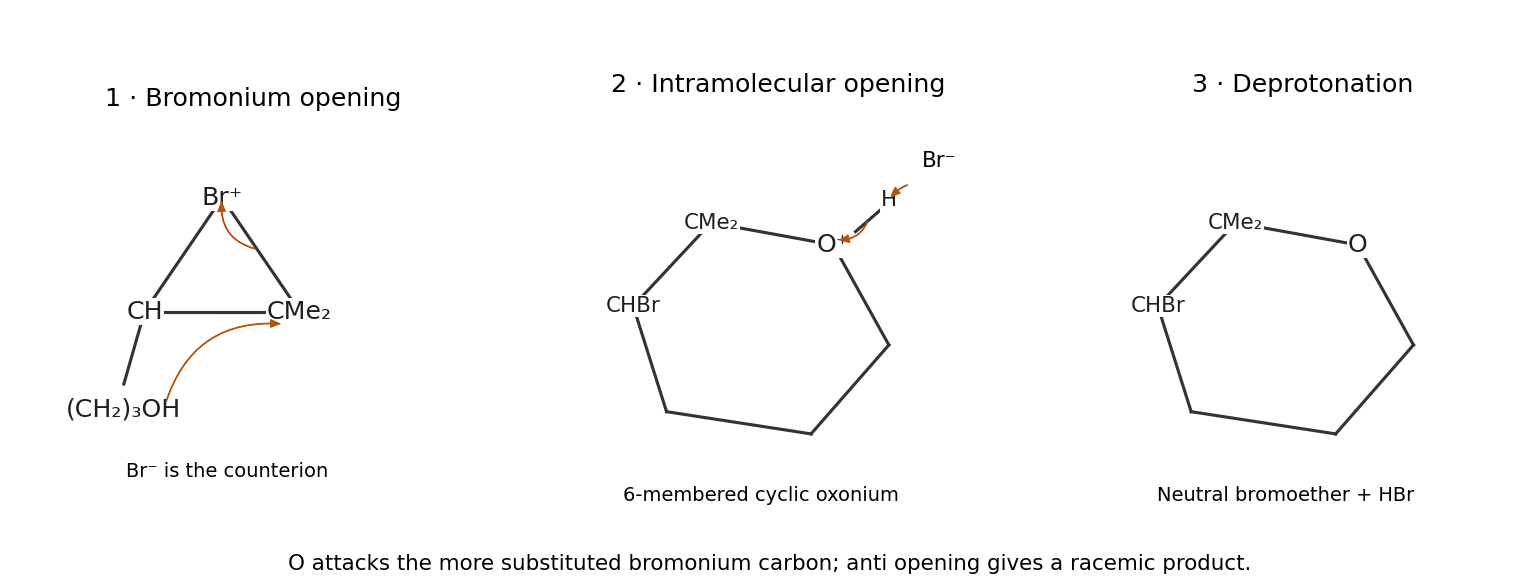
Bromonium formation and intramolecular opening give the six-membered cyclic bromoether
. Details. The alkene pi bond attacks Br as the Br-Br bond breaks to bromide, forming a bridged, unsymmetrical bromonium ion. The carbon bearing the two methyl groups has greater carbocation-like character.
The tethered alcohol oxygen attacks that carbon from the side opposite the bromine bridge. Its lone pair forms the new O-C bond while the attacked C-Br bridge bond opens, giving a six-membered cyclic oxonium ion. Bromide or solvent removes the O-H proton to give the neutral bromoether.
This explains why O becomes attached at the more substituted alkene carbon while Br remains at the other carbon. Polar solvent assists charge separation, and intramolecular capture competes effectively with external bromide attack. Opening is anti; attack on the two faces of the achiral starting material gives a racemic product at the newly formed CHBr stereocentre.
The ring-forming step is bromoetherification.
Past exam of the chemistry course of the year 1 of the natural sciences course of the University of Cambridge 2021 Paper 1 3 a ii Solution by Codex 0 2026-10-20
Codex 0 2026-10-20All comparisons assume the same temperature and comparable reagent thermodynamic activities in methanol.
- Iodomethane: faster, because iodide is a better leaving group and the C-I bond is more readily broken than C-Cl.
- 1-Chloropropane: slower than methyl chloride for SN2, because its ethyl substituent crowds backside approach and raises the substitution barrier. It is still a primary substrate, so SN2 remains plausible.
- MeSNa: generally faster substitution with methanethiolate than methoxide in this protic solvent. Sulfur is more polarizable and its larger anion is less strongly hydrogen-bond-solvated, making it a better nucleophile here. This must not be inferred simply from basicity: methanethiolate is the weaker base.
Pinned article: Introduction to the OurBigBook Project
Welcome to the OurBigBook Project! Our goal is to create the perfect publishing platform for STEM subjects, and get university-level students to write the best free STEM tutorials ever.
Everyone is welcome to create an account and play with the site: ourbigbook.com/go/register. We belive that students themselves can write amazing tutorials, but teachers are welcome too. You can write about anything you want, it doesn't have to be STEM or even educational. Silly test content is very welcome and you won't be penalized in any way. Just keep it legal!
Intro to OurBigBook
. Source. We have two killer features:
- topics: topics group articles by different users with the same title, e.g. here is the topic for the "Fundamental Theorem of Calculus" ourbigbook.com/go/topic/fundamental-theorem-of-calculusArticles of different users are sorted by upvote within each article page. This feature is a bit like:
- a Wikipedia where each user can have their own version of each article
- a Q&A website like Stack Overflow, where multiple people can give their views on a given topic, and the best ones are sorted by upvote. Except you don't need to wait for someone to ask first, and any topic goes, no matter how narrow or broad
This feature makes it possible for readers to find better explanations of any topic created by other writers. And it allows writers to create an explanation in a place that readers might actually find it.
Figure 1. Screenshot of the "Derivative" topic page. View it live at: ourbigbook.com/go/topic/derivativeVideo 2. OurBigBook Web topics demo. Source. - local editing: you can store all your personal knowledge base content locally in a plaintext markup format that can be edited locally and published either:This way you can be sure that even if OurBigBook.com were to go down one day (which we have no plans to do as it is quite cheap to host!), your content will still be perfectly readable as a static site.
- to OurBigBook.com to get awesome multi-user features like topics and likes
- as HTML files to a static website, which you can host yourself for free on many external providers like GitHub Pages, and remain in full control

Figure 2. You can publish local OurBigBook lightweight markup files to either OurBigBook.com or as a static website.
Figure 3. Visual Studio Code extension installation.
Figure 5. . You can also edit articles on the Web editor without installing anything locally. Video 3. Edit locally and publish demo. Source. This shows editing OurBigBook Markup and publishing it using the Visual Studio Code extension. 
- Infinitely deep tables of contents:




All our software is open source and hosted at: github.com/ourbigbook/ourbigbook
Further documentation can be found at: docs.ourbigbook.com
Feel free to reach our to us for any help or suggestions: docs.ourbigbook.com/#contact