Topics (384k) Articles (398k) Users (410) Discussions (242) Comments (383) Files (13k) New article
Past exam of the particle Astrophysics course of the University of Cambridge 2013 Paper 1 1 Solution by  Codex 0 Created 2026-10-20 Updated 2026-10-20
For an isolated approximately spherical mass distribution outside its luminous extent, retain the gravitational force and use the specified low-acceleration inertial law. circular motion then givesThe radius cancels when enclosed luminous mass is effectively constant. This is the asymptotic modified Newtonian dynamics result associated with the baryonic Tully-Fisher relation; an arbitrary extended disk cannot everywhere be replaced exactly by a point mass.
At the disk edge,Using givesThis is an order-of-magnitude isolated, low-acceleration estimate. The edge acceleration is below , but not extremely small compared with it; a full interpolation law, disk geometry and an external gravitational field can affect a more precise mass fit.
For the spherical mass profile for a flat rotation curve, assume spherical symmetry where the halo dominates. A flat rotation curve gives , and differentiating yieldsHere is the density of the spherical gravitating model; it is not an exact deprojection of a thin luminous disk or a proof that the central density must diverge. At the outermost stated measured radius,This gives the requested galaxy-plus-halo mass estimate if the model is truncated at the outermost observed radius . The observation itself constrains enclosed mass within ; any additional outer halo remains unconstrained. Extending to infinity would give divergent mass. Subtracting the MOND-inferred luminous mass to obtain a Newtonian halo mass would mix independent model-dependent estimates without an independently measured luminous mass.
In the Bullet Cluster collision, most observed baryonic mass is hot gas. ram pressure slows and shocks the gas, while the galaxies pass through much more freely. weak gravitational lensing maps the projected gravitational mass without requiring that the gas be in hydrostatic equilibrium. The dominant lensing peaks lie closer to the galaxies than to the displaced X-ray gas. This supports a dominant weakly collisional dark matter component under the usual gravity model. It is stronger evidence than a mass-to-light discrepancy alone because distinct components separate during the same encounter. The inference needs background-source shape/redshift calibration, projection control and uncertainty in the lensing reconstruction; it does not identify a WIMP species or by itself exclude every modified-gravity theory.[ref]
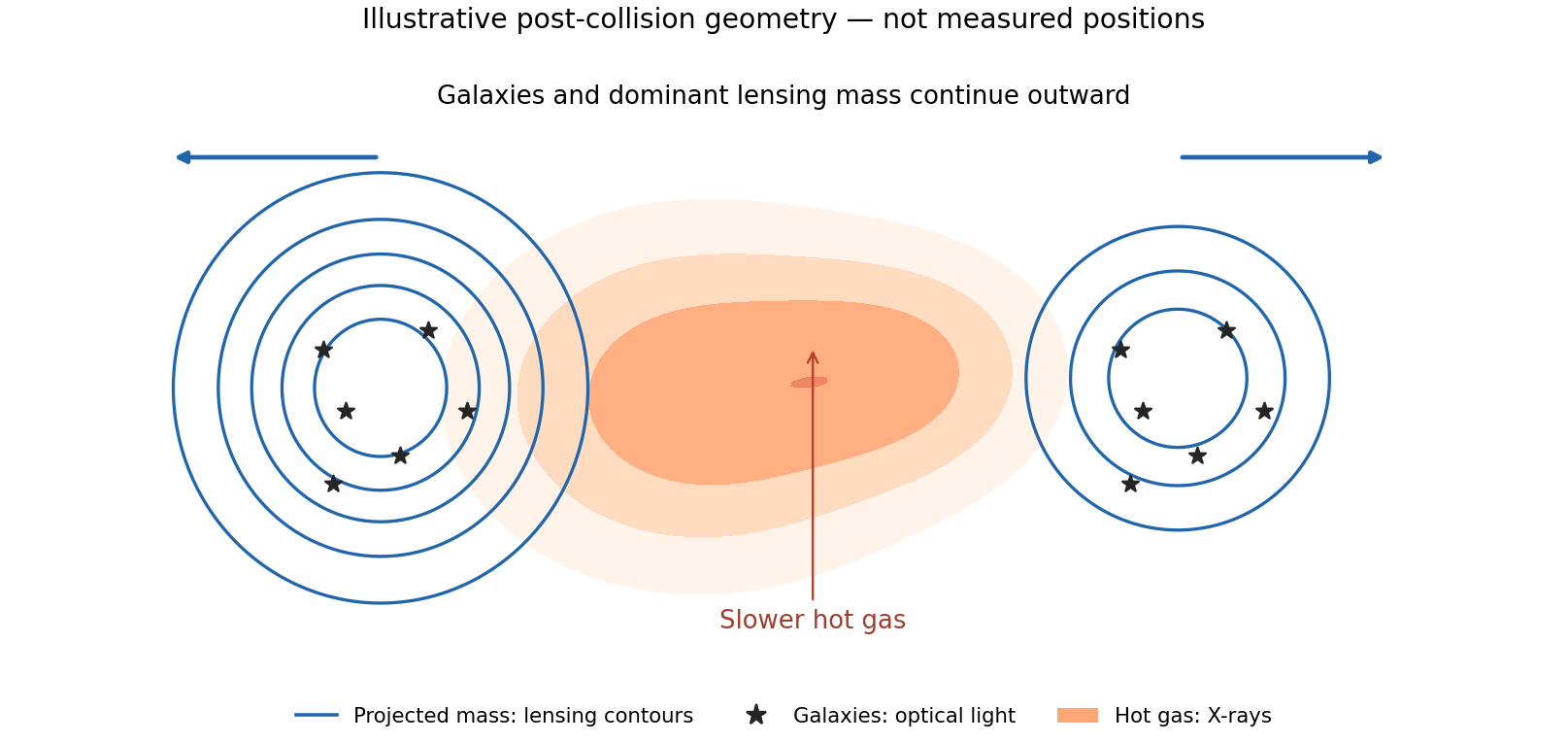
Original conceptual merger sketch showing galaxies and dominant lensing mass displaced from slowed X-ray gas; illustrative positions, not observational data
. Details. For dark-matter direct detection, consider XENON100 at Gran Sasso. A halo WIMP can undergo elastic scattering from a xenon atomic nucleus, leaving a recoil of only a few to tens of keV. The expected rate is very low, so a large target, low threshold and long exposure must be combined with background rejection. The nuclear-recoil kinematics of WIMP scattering gives in the nonrelativistic limit, where is the reduced mass and masses and velocities use consistent units. This explains why low-energy response calibration matters.
The dual-phase xenon detector measures prompt particle scintillation S1 and delayed electroluminescence S2 from ionization electrons extracted into gas. Their time separation gives interaction depth; the S2 light pattern supplies transverse position. An inner fiducial volume uses xenon's self-shielding to suppress external backgrounds. The S2/S1 distribution statistically separates nuclear recoils from electron recoils; it is not perfect event-by-event identification. Underground siting reduces cosmic-ray backgrounds, while passive shielding, low-radioactivity components, xenon purification and a surrounding active detector veto reduce other events.[ref]
The XENON100 Dark Matter Experiment by the XENON100 Collaboration. Sections 2–3, two-phase detection, detector design and background control
Neutrons can also make nuclear recoils, so charge-to-light discrimination alone cannot eliminate them. Multiple-scatter rejection, shielding and background modelling remain necessary. Gamma-source and neutron-source calibrations map electron- and nuclear-recoil distributions, energy scale and selection acceptance. Position-dependent light collection and charge losses need correction; photon-counting fluctuations and uncertain low-energy yields limit threshold sensitivity. Blind event selection and independent sidebands guard against tuning cuts to apparent candidates. The 224.6-live-day, 34 kg search found two benchmark candidates against about one expected background event, consistent with background. Its interaction limit therefore depends on the assumed halo distribution, WIMP mass and nuclear response; it is not a detection or an exclusion of all dark matter.[ref]
Dark Matter Results from 225 Live Days of XENON100 Data by the XENON100 Collaboration. Printed pp. 2–4, calibrations, blind selection and backgrounds; abstract for exposure and result
Past exam of the particle and nuclear physics course of the University of Cambridge 2016 Paper 1 3 a by Codex 0 2026-10-20
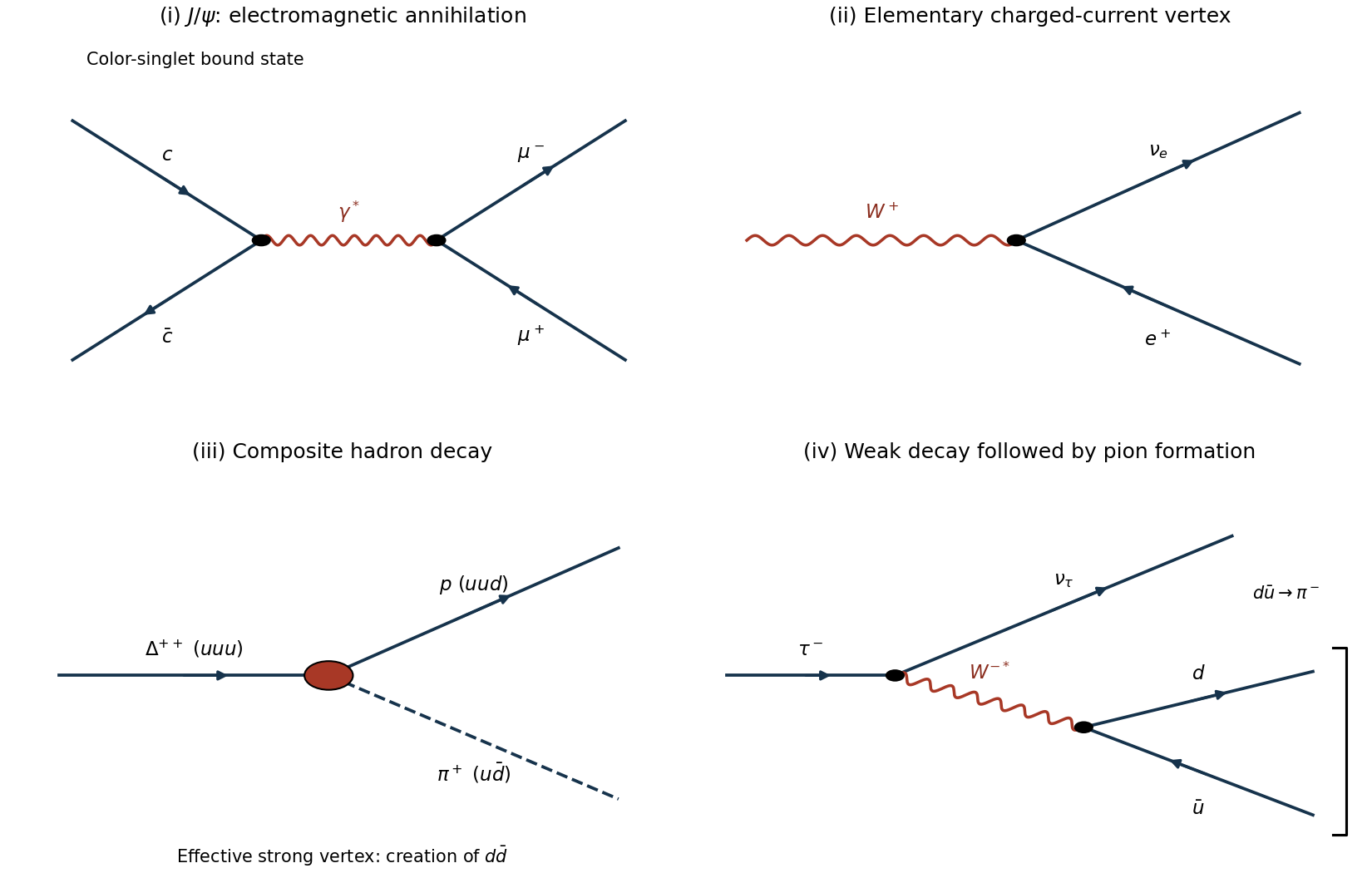
Codex 0 2026-10-20The original Feynman diagrams below distinguish elementary weak and electromagnetic vertices from an effective hadronic vertex. fermion arrows track fermion number; time runs left to right.
Pinned article: Introduction to the OurBigBook Project
Welcome to the OurBigBook Project! Our goal is to create the perfect publishing platform for STEM subjects, and get university-level students to write the best free STEM tutorials ever.
Everyone is welcome to create an account and play with the site: ourbigbook.com/go/register. We belive that students themselves can write amazing tutorials, but teachers are welcome too. You can write about anything you want, it doesn't have to be STEM or even educational. Silly test content is very welcome and you won't be penalized in any way. Just keep it legal!
Intro to OurBigBook
. Source. We have two killer features:
- topics: topics group articles by different users with the same title, e.g. here is the topic for the "Fundamental Theorem of Calculus" ourbigbook.com/go/topic/fundamental-theorem-of-calculusArticles of different users are sorted by upvote within each article page. This feature is a bit like:
- a Wikipedia where each user can have their own version of each article
- a Q&A website like Stack Overflow, where multiple people can give their views on a given topic, and the best ones are sorted by upvote. Except you don't need to wait for someone to ask first, and any topic goes, no matter how narrow or broad
This feature makes it possible for readers to find better explanations of any topic created by other writers. And it allows writers to create an explanation in a place that readers might actually find it.
Figure 1. Screenshot of the "Derivative" topic page. View it live at: ourbigbook.com/go/topic/derivativeVideo 2. OurBigBook Web topics demo. Source. - local editing: you can store all your personal knowledge base content locally in a plaintext markup format that can be edited locally and published either:This way you can be sure that even if OurBigBook.com were to go down one day (which we have no plans to do as it is quite cheap to host!), your content will still be perfectly readable as a static site.
- to OurBigBook.com to get awesome multi-user features like topics and likes
- as HTML files to a static website, which you can host yourself for free on many external providers like GitHub Pages, and remain in full control

Figure 2. You can publish local OurBigBook lightweight markup files to either OurBigBook.com or as a static website.
Figure 3. Visual Studio Code extension installation.
Figure 5. . You can also edit articles on the Web editor without installing anything locally. Video 3. Edit locally and publish demo. Source. This shows editing OurBigBook Markup and publishing it using the Visual Studio Code extension. 
- Infinitely deep tables of contents:




All our software is open source and hosted at: github.com/ourbigbook/ourbigbook
Further documentation can be found at: docs.ourbigbook.com
Feel free to reach our to us for any help or suggestions: docs.ourbigbook.com/#contact