Topics (384k) Articles (398k) Users (410) Discussions (242) Comments (383) Files (13k) New article
Past exam of the optics and electrodynamics course of the University of Cambridge 2013 Paper 1 4 Solution by  Codex 0 2026-10-20
A Hertzian dipole is an ideal localized oscillating source much smaller than its radiation wavelength. Its electric version is an infinitesimal current element; its magnetic version is a small current loop with moment . Such elements model the far-field radiation and radiation resistance of electrically small antennas. The approximation requires source dimensions much smaller than .
The supplied magnetic field has a quasistatic term, an induction term and a transverse radiation term. The electric field has induction and radiation terms. Brackets mean evaluation at the retarded time , not a time average. Near terms mainly exchange stored energy; only the fields give a nonvanishing outgoing power integral as .
For a fixed dipole axis the radiation fields satisfy . The radial Poynting flux is thereforeUsing yieldsFor a general changing dipole direction, replace the squared scalar acceleration by .
Radiation resistance is the equivalent input resistance whose mean power equals radiated power, not ohmic heating. For a fixed small loop carrying , , soThis uses peak current ; with rms current the power is .
The satellite loop needs its changing orientation as well as its induced current. Put the spin axis along z, the external field along x, and let . With and resistance , the resistance-only approximation givesWrite . The full magnetic moment isIt has a static component and a rotating component at . Consequently , andHolding the dipole axis fixed while inserting the sinusoidal current would instead give , eight times smaller. That is the fixed-axis-loop result; it does not describe the stated rotating loop. This is frequency doubling of an induction-driven rotating loop; the changing vector direction is essential.
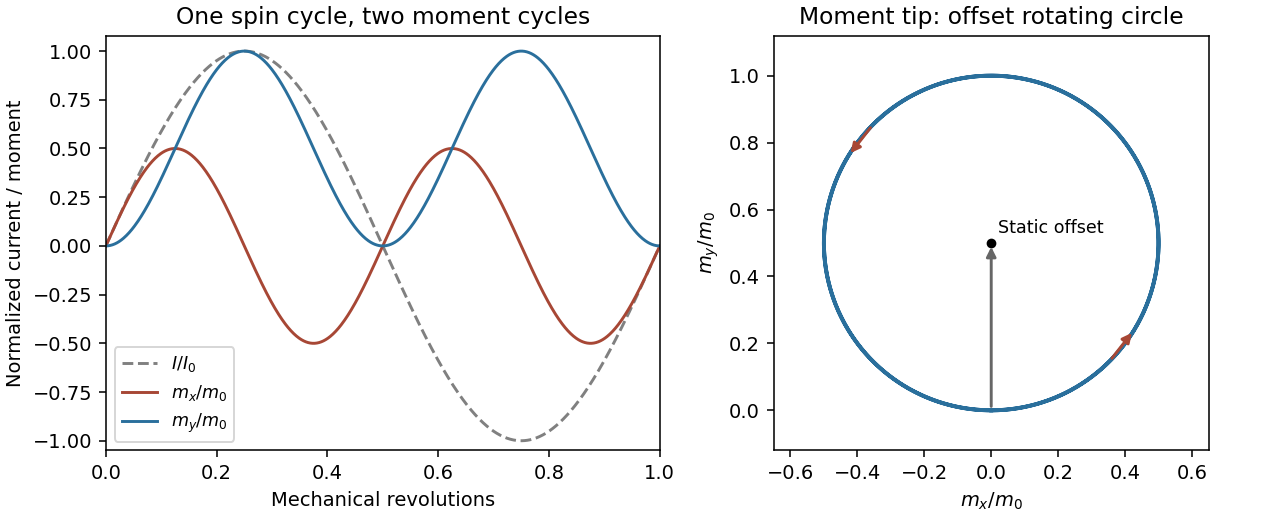
Original calculated rotation-induced current and vector magnetic-moment components, illustrating the static plus twice-spin-frequency decomposition
. Details. The resistance-only model is conditional: loop inductance is not supplied. If self-inductance L matters, solve . In the steady state . Its phase changes the static moment direction but not the twice-frequency component's magnitude, so the power becomesThe first expression is the requested resistive idealization and an upper estimate within this passive RL correction. Radiation reaction is negligible compared with the stipulated ohmic resistance. The radiated energy comes from rotational kinetic energy: the induced magnetic torque brakes the loop. Most lost rotational energy is Joule heating; a small part escapes as radiation. Maintaining a constant spin would require external mechanical power.
For scale only, take , a representative near-Earth field rather than a supplied orbital measurement. The terrestrial surface range reported by NOAA is roughly –; the actual orbital value depends on position.[ref]
Geomagnetism Frequently Asked Questions by National Oceanic and Atmospheric Administration. What are the magnetic elements? Total field intensity range
With and , the resistance-only model givesInductance would reduce this power. The kilohertz signal is exceptionally weak and a metre-scale receiving antenna is electrically tiny. Ionospheric absorption/reflection and strong natural or instrumental low-frequency backgrounds make ordinary ground reception impractical. This is not a theorem that the ionosphere blocks every low-frequency mode: field-guided propagation and condition-dependent leakage are real, as the VIPER mission's measurements were designed to test.[ref]NASA Rocket Mission Studying Escaping Radio Waves by National Aeronautics and Space Administration. VIPER description: absorption/reflection layers and condition-dependent trans-ionospheric propagation
At a separation , , so the observer is not securely in the far field. The radiation term alone has at most the characteristic magnetic amplitudein this optimistic resistance-only vacuum model. Near and induction fields must be retained for a full prediction; a simple far-field inverse-square power estimate is not an exact received signal here. Another satellite avoids the whole ground ionospheric path, but plasma propagation, receiving sensitivity, bandwidth, orientation, integration time and spacecraft noise remain unspecified. Detection is not forbidden in principle, but routine practical detection is implausible at this scale; a definitive instrument-level yes/no does not follow from the supplied data.
Past exam of the optics and electrodynamics course of the University of Cambridge 2013 Paper 1 3 Solution by Codex 0 2026-10-20
Codex 0 2026-10-20For propagation along z, write . A Jones vector contains the complex transverse components. Equal phase modulo gives linear polarization; equal magnitudes with phase difference give circular polarization. A common overall phase has no effect on the polarization ellipse. A deterministic optical element acts by a Jones matrix, with successive matrices ordered from right to left along the light path.
A circular polarizer uses a linear polarizer transmitting x and a quarter-wave plate whose principal axes are at . Up to an overall phase, convenient matrices in fixed physical x/y axes areThe plate is lossless, , and is circular in the supplied convention. Put P on side A and Q on side B: forward passage is .
Unpolarized light has no single Jones vector. Represent its intensity by the coherency matrix and propagate it as . Forward transmission givesThus the transmitted light is circular with intensity . The initial polarizer removes one incoherent linear component; the plate changes phase without restoring the lost intensity.
Reverse passage encounters Q before P and has in the same fixed transverse axes. It givesThe output is linearly polarized along x and again has intensity . A retarder alone leaves an unpolarized coherency matrix unchanged. Consequently an unpolarized scene appears darker from either side, although the transmitted polarization differs. No polarization-dependent response of the observer is needed to explain this reduction.
For the mirror calculations below, use an ideal near-normal isotropic reflector, up to a common phase. In fixed physical transverse axes reflection leaves the polarization ellipse unchanged; it reverses circular helicity because the propagation direction reverses. A reciprocal plate has the same relative phase delay on the return traversal in this fixed-axis convention. In particular : two passes exchange x and y linear states.
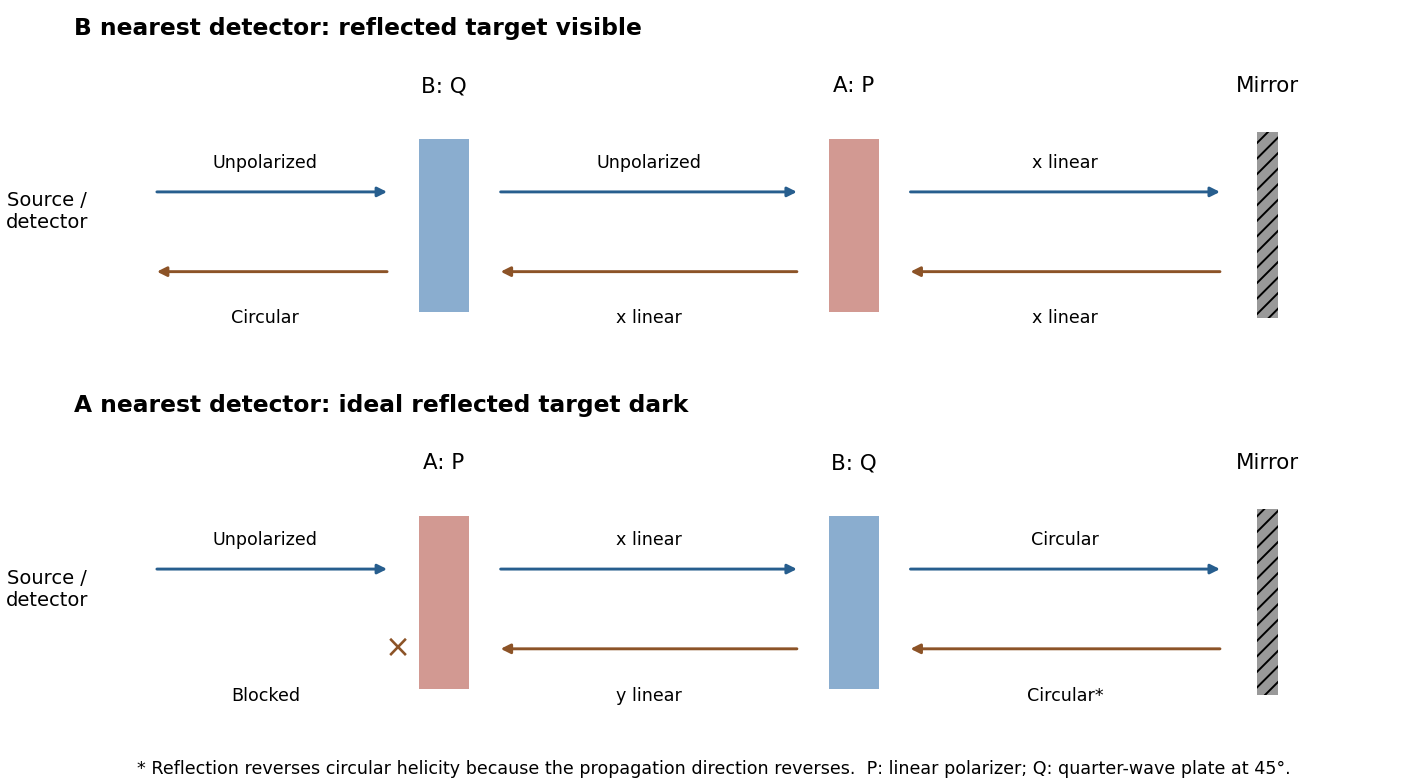
Original outward and return polarization-state diagrams for the two orientations of a polarizer-plus-quarter-wave-plate filter in front of a mirror
. Details. Past exam of the nonlinear Optics and Quantum States of Light course of the University of Cambridge 2016 Paper 1 3 Solution by Codex 0 2026-10-20
Codex 0 2026-10-20An optical squeezed vacuum has zero mean field, nonzero mean photon number , and unequal noise in two principal optical quadratures. With and , the vacuum variance is and . In axes aligned with the squeezing,The ideal pure state saturates . A below-threshold degenerate optical parametric amplifier or oscillator can generate it: a coherent pump drives pair creation into a mode, and the pump phase selects the squeezed quadrature. Loss mixes in vacuum noise, while technical phase fluctuations mix the squeezed and antisqueezed axes.
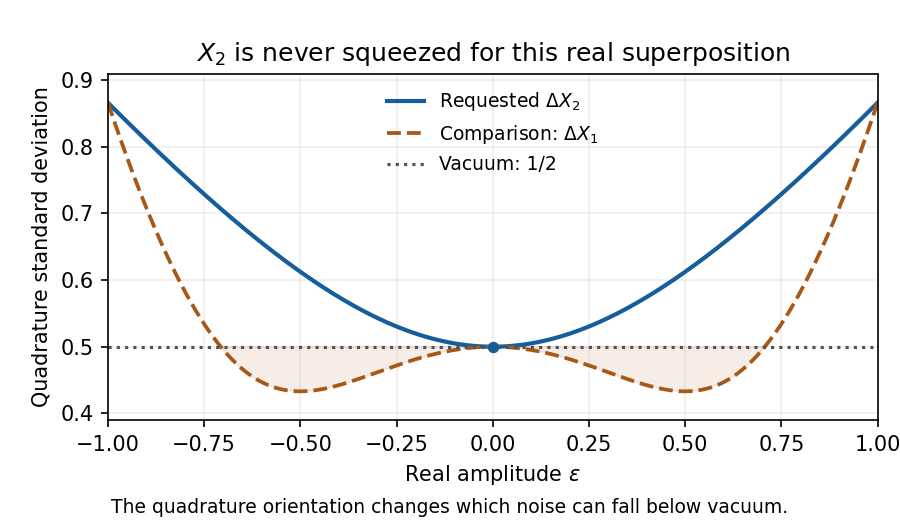
For the stated vacuum–one-photon superposition, normalization requires . Direct Fock-basis matrix elements giveUsing ,Consequently there is no squeezing of the specified quadrature:It equals the vacuum uncertainty only at and reaches at . The curve is even in . The orientation matters: the same real superposition has , which is below for . This does not turn it into a Gaussian squeezed vacuum; it simply illustrates quadrature squeezing of a vacuum–one-photon superposition.
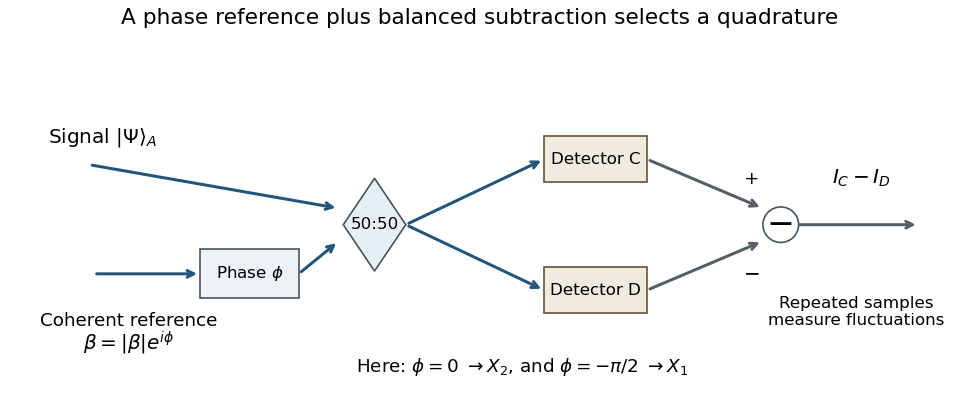
For the printed beam splitter convention, expansion gives the operator identitiesThuswhere different input modes commute. The source's equality mixing an expectation on one side with an operator on the other is understood as this operator identity, or with expectation brackets on both sides. The mean difference reveals phase-sensitive mutual coherence between inputs; it is not by itself a photon-number correlation measurement of the usual Hanbury Brown–Twiss type. Repeated fluctuations, rather than one mean value, are needed to infer quadrature uncertainty.
For the independent coherent local oscillator, replace by in the mean. The effective signal operator isTherefore measures , and measures , each multiplied by . Choosing measures . These phase choices follow the specified complex beam-splitter matrix; importing a different beam-splitter convention would shift them.
This is balanced homodyne detection. A stable strong local oscillator supplies the phase reference, the signal and oscillator meet at a 50:50 beam splitter, and matched photodetector currents are subtracted. Varying the reference phase selects different quadrature projections. Recording their distributions supplies more information than their means and supports optical homodyne tomography.
The strong-reference limit also needs a noise qualification. Define , with . For independent signal and coherent reference, an exact ideal-detector calculation givesOne derivation writes , where is in vacuum. The reference-amplitude term gives the first contribution; the remaining vacuum term contributes . Thus the normalized variance approaches the signal quadrature variance when the reference is sufficiently strong relative to the signal. A finite reference is not exactly a classical noiseless field.
A single detector can also carry quadrature information, but its mean alone still does not determine the variance. It measures , retaining the large reference background and its fluctuations. For fixed signal moments and a large coherent reference,The additional vacuum-level term and the uncancelled reference power must be calibrated. In practice the reference may also have much larger classical intensity noise. Balanced subtraction cancels the common total-power term and strongly rejects common-mode technical noise while retaining the phase-sensitive difference. Detector imbalance, unequal efficiencies and reference phase noise limit that advantage. It is therefore the more direct and usually more sensitive quadrature-noise measurement, rather than a claim that a single-port measurement contains no useful information.
Past exam of the nonlinear Optics and Quantum States of Light course of the University of Cambridge 2016 Paper 1 1 Solution by Codex 0 2026-10-20
Codex 0 2026-10-20The process is sum-frequency generation, with . The same reversible three-wave mixing interaction permits the reverse conversion when the higher-frequency field supplies the pump. The second-order nonlinear polarization couples the three waves; its effective coefficient includes the crystal orientation and polarizations.
One efficiency limit is phase mismatch: contributions generated at different positions acquire different phases and can cancel. A second practical limit is spatial walk-off, which reduces the overlap of finite beams in a birefringent crystal. A beam radius and relative walk-off angle give an overlap length of order . Absorption and scattering provide further losses. Group-velocity mismatch matters for pulses, and pump depletion eventually invalidates an undepleted-pump calculation; none of these effects should be silently included in the ideal lossless plane-wave equations.
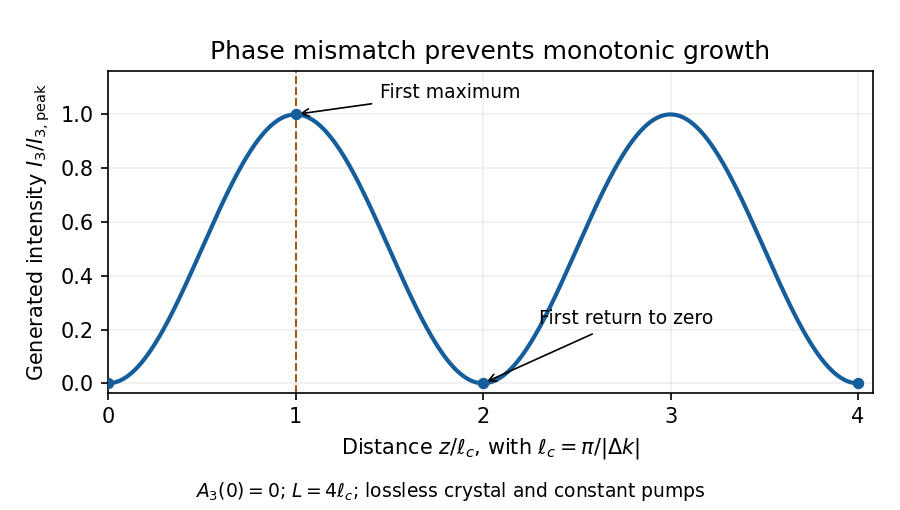
Define and hold constant. Direct integration of the driven equation giveswhere . The second expression has a continuous phase-matched limit. If the generated field is initially absent,For this is proportional to : the first maximum is at the nonlinear optical coherence length , and the first subsequent zero is at . A seed adds interference with the generated amplitude and can change that pattern. At exact phase matching, the unseeded result grows as only while pump depletion remains negligible.
To retain depletion consistently, differentiate each intensity before inserting the coupled equations:For real in the lossless convention, put . The result isThe signs follow the printed amplitude equations. In initial up-conversion, the newly generated makes , so the two input intensities decrease while the sum-frequency intensity increases. Adding the derivatives gives zero because . The total intensity is conserved, even though the three individual intensities change.
The Manley-Rowe relations areDividing an intensity by gives photon flux density. A conversion event removes one photon from each lower-frequency mode and adds one to the upper mode, or does the reverse. Therefore and count conserved sums of photon fluxes, while counts the conserved lower-frequency difference. They are not three independent invariants: . Energy conservation is also recovered as .
The unweighted combinations generally fail because the exchanged photons have different energies. Explicitly,The qualification “generally” matters: is conserved for equal lower frequencies in a distinct-mode degenerate case, and every derivative vanishes when there is no exchange. The equations establish nonconservation for generic unequal-frequency interaction, not for all special solutions.
Past exam of the nonlinear Optics and Quantum States of Light course of the University of Cambridge 2015 Paper 1 3 Solution by Codex 0 2026-10-20
Codex 0 2026-10-20An ideal cross-Kerr interaction between two single modes is , with . The number operators commute with the interaction, so this coupling changes phases without transferring photons between the modes. To implement the specified positive conditional phase, usewhere within the one-photon polarization subspace. The horizontal branch has zero interacting occupation. Since , the specified conditional rotation follows. This is an ideal lossless single-mode model; an actual travelling-wave medium's bandwidth, loss and noise are not established by writing this Hamiltonian.
Use and . A coherent state has centre and variance in either optical quadrature. Multiplication of by rotates that centre anticlockwise through , keeping the coherent state noise disk unchanged. For real positive the two centres are and .
Normalize the initial polarization of an electromagnetic wave qubit. The output of the medium isThe joint state is generally an entangled state. The overlap magnitude is . The state factorizes when the amplitudes coincide, while nearly distinguishable amplitudes make the polarization nearly maximally entangled with the optical mode. Before any polarization conditioning, tracing out mode 2 gives the mixture , with no interference between branches.
Include the normalization factors in the half-wave plate map: and . The transformed joint state isConditioning on a vertical result and setting therefore preparesThis pure optical cat state is the conditional output; it is not the unconditioned reduced state immediately after the Kerr medium. The measurement erases the polarization label, allowing the two amplitudes to interfere. The calculated optical Wigner functions below display the resulting fringes; their negative regions are quasiprobability, not negative detection probabilities. These illustrative plots choose : the rotation panel uses , while the cat panels use the conditional Kerr rotation and three different relative phases .
The coherent-state overlap follows by expanding in the Fock basis:Thus andThe postselection probability for Kerr-cat preparation includes both the normalized input qubit and the wave plate. At the vertical branch has zero probability and no normalized conditional state. For the remaining calculation take real, as required.
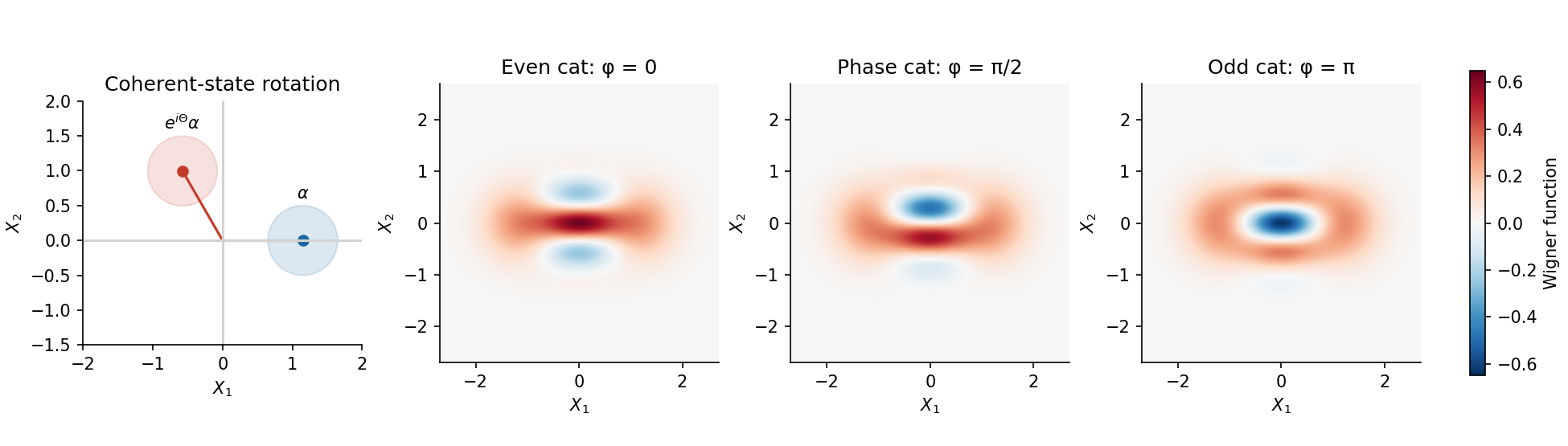
Original coherent-state rotation and calculated phase-space interference of three conditional cat states
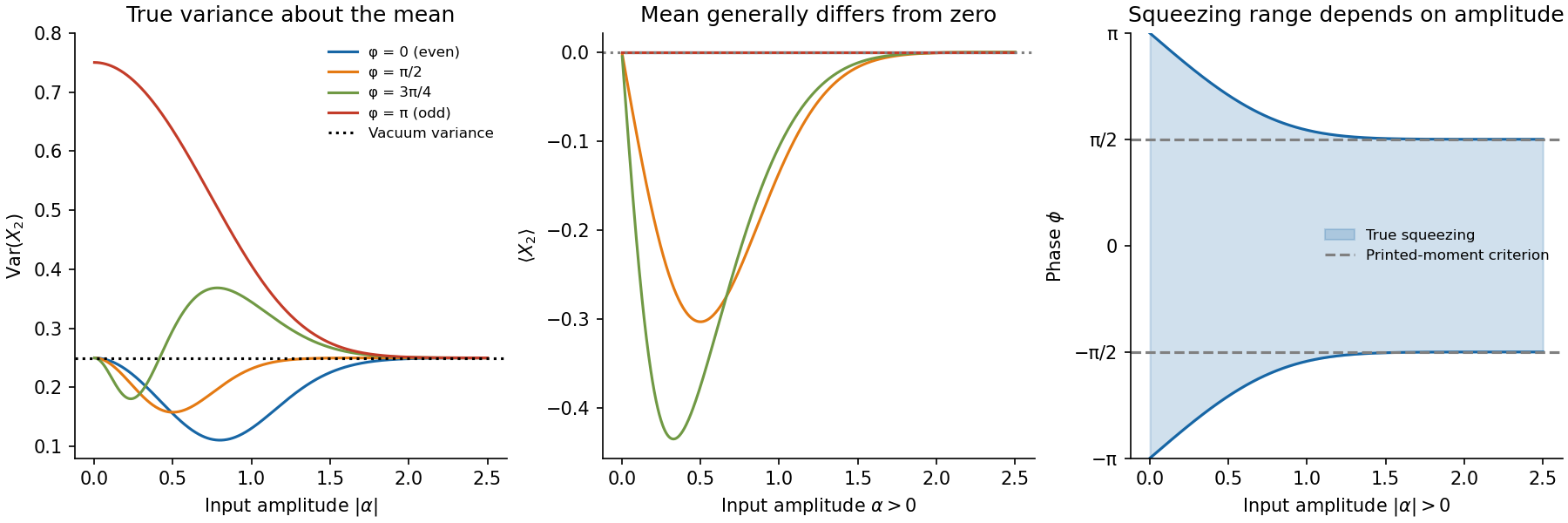
. Details. Using , put . Directly evaluating diagonal and cross terms givesThe last quantity is the mean photon number in the conditional cat, which differs from the input coherent state mean . Since ,However, its first moment iswhich is generally nonzero. The original PDF's assertion of a zero mean for arbitrary is inconsistent with its stated pure state. Consequently its displayed expression is the second moment, not the general variance. The phase-dependent cat-state quadrature variance isThe printed result does become the variance for , notably the even and odd cat states. It could also describe an ensemble mixing equal weights of and : that different state's mean vanishes while its second moment is unchanged. Such phase averaging is not part of the specified pure-state preparation.
For nonzero finite , and . The correct quadrature squeezing condition in this quadrature is thereforeFor a representative phase in , this is . If instead one applies the printed second moment as a variance, the resulting condition is , or modulo . That is sufficient, but not necessary, for the actual pure state's squeezing. For example, at , while . This explicitly tests the difference.
For a fixed phase other than modulo , expandAs the input mean number , the normalized state tends to vacuum, andThis expansion is nonuniform near the odd-cat phase. At exactly the vacuum terms cancel and the normalized odd coherent-state superposition tends to , giving , while its postselection probability tends to zero. The even coherent-state superposition at instead contains only even photon numbers and tends smoothly to vacuum.
At large input mean number, , the two coherent state branches become nearly orthogonal, and for every fixed phase. The mean tends to zero as well. This does not make the state an incoherent mixture: phase-space interference still distinguishes the ideal quantum superposition, although its contribution to this low-order moment is exponentially small. The loss of coherence in an optical cat state arises when ordinary loss reveals the branch to the environment and suppresses that interference, with factor for transmissivity .
For the especially simple even cat,It starts at , falls to about at , and returns towards from below. The odd-cat curve decreases from towards from above. Other fixed-phase curves have the small- and large-amplitude limits derived above; for negative , squeezing ends when . In balanced homodyne detection, centre each quadrature distribution on its measured mean before inferring its variance.
Pinned article: Introduction to the OurBigBook Project
Welcome to the OurBigBook Project! Our goal is to create the perfect publishing platform for STEM subjects, and get university-level students to write the best free STEM tutorials ever.
Everyone is welcome to create an account and play with the site: ourbigbook.com/go/register. We belive that students themselves can write amazing tutorials, but teachers are welcome too. You can write about anything you want, it doesn't have to be STEM or even educational. Silly test content is very welcome and you won't be penalized in any way. Just keep it legal!
Intro to OurBigBook
. Source. We have two killer features:
- topics: topics group articles by different users with the same title, e.g. here is the topic for the "Fundamental Theorem of Calculus" ourbigbook.com/go/topic/fundamental-theorem-of-calculusArticles of different users are sorted by upvote within each article page. This feature is a bit like:
- a Wikipedia where each user can have their own version of each article
- a Q&A website like Stack Overflow, where multiple people can give their views on a given topic, and the best ones are sorted by upvote. Except you don't need to wait for someone to ask first, and any topic goes, no matter how narrow or broad
This feature makes it possible for readers to find better explanations of any topic created by other writers. And it allows writers to create an explanation in a place that readers might actually find it.
Figure 1. Screenshot of the "Derivative" topic page. View it live at: ourbigbook.com/go/topic/derivativeVideo 2. OurBigBook Web topics demo. Source. - local editing: you can store all your personal knowledge base content locally in a plaintext markup format that can be edited locally and published either:This way you can be sure that even if OurBigBook.com were to go down one day (which we have no plans to do as it is quite cheap to host!), your content will still be perfectly readable as a static site.
- to OurBigBook.com to get awesome multi-user features like topics and likes
- as HTML files to a static website, which you can host yourself for free on many external providers like GitHub Pages, and remain in full control

Figure 2. You can publish local OurBigBook lightweight markup files to either OurBigBook.com or as a static website.
Figure 3. Visual Studio Code extension installation.
Figure 5. . You can also edit articles on the Web editor without installing anything locally. Video 3. Edit locally and publish demo. Source. This shows editing OurBigBook Markup and publishing it using the Visual Studio Code extension. 
- Infinitely deep tables of contents:




All our software is open source and hosted at: github.com/ourbigbook/ourbigbook
Further documentation can be found at: docs.ourbigbook.com
Feel free to reach our to us for any help or suggestions: docs.ourbigbook.com/#contact