Topics (384k) Articles (398k) Users (410) Discussions (242) Comments (383) Files (13k) New article
Past exam of the materials science course of the University of Cambridge 2022 Paper 1 6 a Solution by  Codex 0 2026-10-20
The fixed support supplies the end shear force and the largest bending moment, . In elementary beam bending, the greatest longitudinal tensile and compressive stresses lie on opposite outer faces of the section at the fixed end, with zero longitudinal bending stress on the neutral axis. For a downward tip load on a horizontal cantilever, the upper face is in tension and the lower face in compression. Transverse shear stress has a different distribution, largest near the neutral axis for a rectangular section; “highest force” should therefore be interpreted with the stress component specified.
Past exam of the materials science course of the University of Cambridge 2022 Paper 1 5 a Solution by Codex 0 2026-10-20
Codex 0 2026-10-20The exponential in the Peierls stress makes a large core-width-to-Burgers vector ratio favourable for easy dislocation glide. Densely packed slip planes often have wider cores because the shear distortion can spread over more atomic rows, reducing the lattice-periodic barrier. Close-packed directions provide short lattice translations and hence small allowed Burgers vectors; their line energies, approximately proportional to , are also relatively low. These effects favour dense planes and directions, but the relation between packing and core width is a physical argument rather than a consequence of substituting arbitrary independent into the formula. Body-centred cubic metals have densely packed directions without a truly close-packed plane, and their screw-core behaviour can require additional qualifications.
Past exam of the materials science course of the University of Cambridge 2022 Paper 1 4 c Solution by Codex 0 2026-10-20
Codex 0 2026-10-20The lamellae are ferrite and cementite, together forming pearlite. The displayed quantity is surface height in an atomic force microscopy image. Nital preferentially attacks the ferrite, leaving it lower and therefore darker; the narrow raised cementite lamellae appear bright. This is not the same contrast mechanism as brightness in an optical micrograph. Faster cooling that still permits pearlite formation causes transformation at greater undercooling and generally gives finer lamellar spacing. Cooling sufficiently rapidly to bypass diffusional transformation instead produces other products, potentially martensite; it does not merely keep making pearlite indefinitely finer.
Past exam of the materials science course of the University of Cambridge 2022 Paper 1 4 a Solution by Codex 0 2026-10-20
Codex 0 2026-10-20At , . Reading the carbon line gives to graphical accuracy. With , the characteristic diffusion length isIf “distance” means a one-coordinate root-mean-square displacement, use ; the three-dimensional radial root-mean-square is . The graph does not justify precision between these conventions. Equal diffusion distance in equal time requires equal diffusion coefficients. The copper line reaches this diffusivity around , giving , about . Carbon moves interstitially through ferrite, whereas copper self-diffusion is substitutional and vacancy-mediated, with a much higher effective activation barrier.
Past exam of the materials science course of the University of Cambridge 2022 Paper 1 3 c Solution by Codex 0 2026-10-20
Codex 0 2026-10-20Choose an objective aperture around a precipitate superlattice reflection, such as , which is absent from the disordered aluminium matrix. The selected beam then makes precipitates bright in dark-field transmission electron microscopy, while the matrix gives little intensity in that beam. Tilt the grain to place the chosen reflection close to its Bragg diffraction condition and preferably approach a two-beam geometry. This reduces excitation error and can increase precipitate brightness; the exact maximum also depends on foil thickness, strain and dynamical scattering. Selecting a shared fundamental reflection would give much poorer chemical-order selectivity.
Past exam of the materials science course of the University of Cambridge 2022 Paper 1 3 a Solution by Codex 0 2026-10-20
Codex 0 2026-10-20In the kinematic approximation, the face-centered cubic lattice contributes only reflections with all even or all odd. Viewing along selects the zero-order zone , so the nonzero allowed spots within the cutoff are , with the transmitted beam at the centre. The nearest-neighbour separation is in the crystallographic reciprocal-distance convention, or in the angular-wavevector convention. No matrix lattice parameter is supplied, so a numerical matrix spacing would require extra data.
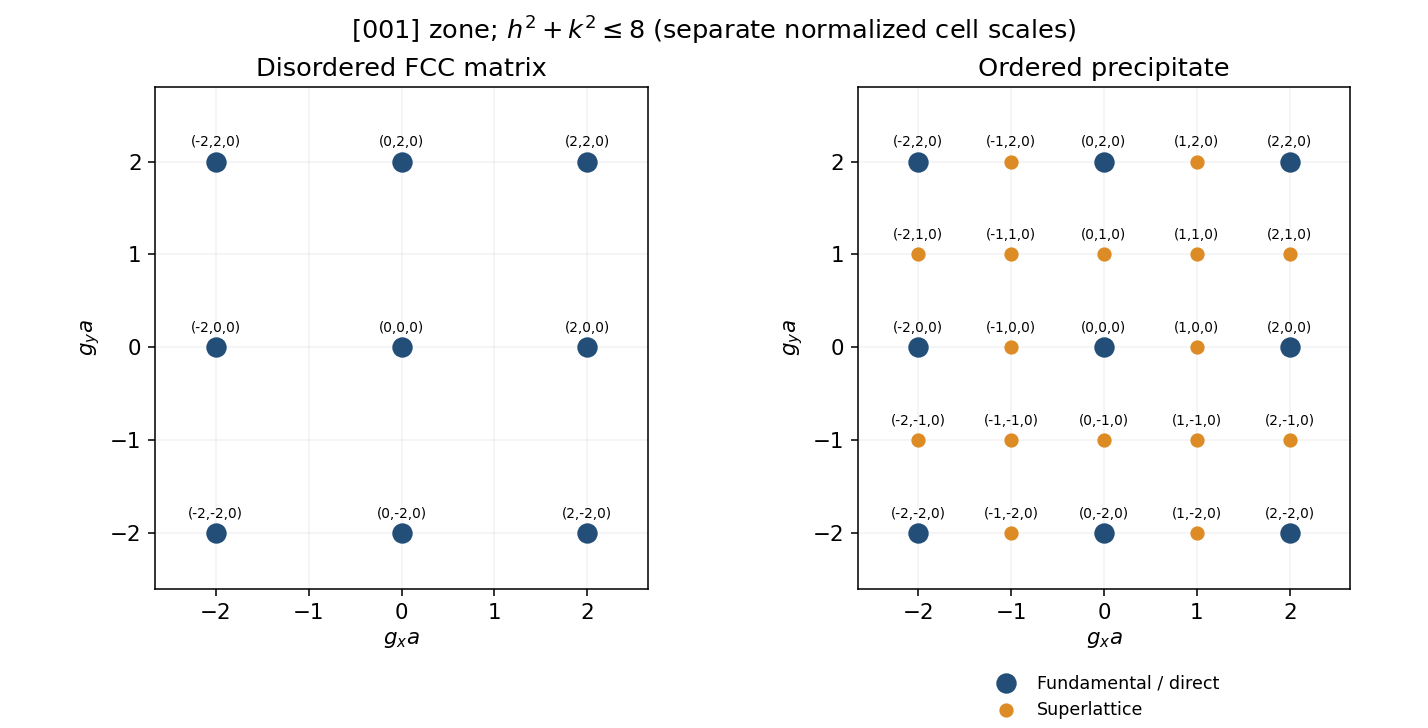
Calculated zero-order diffraction spots before and after chemical ordering
. Original kinematic spot diagrams with reciprocal coordinates normalized by the relevant cubic cell edge. The right panel shows additional superlattice positions; actual intensity also depends on thickness, excitation and scattering factors. Details. Past exam of the materials science course of the University of Cambridge 2022 Paper 1 2 c Solution by Codex 0 2026-10-20
Codex 0 2026-10-20Each missing oxide ion leaves two units of excess positive effective charge, compensated by reducing two Ce ions to Ce. For oxygen vacancies per conventional unit cell, of its four cerium ions must be trivalent: 10% Ce. This assumes the same number of cation sites per unit volume as in the doped calculation and that oxygen loss is compensated entirely by this cerium-valence change. If reduction changes the cell volume appreciably, matching the absolute vacancy density requires correcting the percentage for that change.
Pinned article: Introduction to the OurBigBook Project
Welcome to the OurBigBook Project! Our goal is to create the perfect publishing platform for STEM subjects, and get university-level students to write the best free STEM tutorials ever.
Everyone is welcome to create an account and play with the site: ourbigbook.com/go/register. We belive that students themselves can write amazing tutorials, but teachers are welcome too. You can write about anything you want, it doesn't have to be STEM or even educational. Silly test content is very welcome and you won't be penalized in any way. Just keep it legal!
Intro to OurBigBook
. Source. We have two killer features:
- topics: topics group articles by different users with the same title, e.g. here is the topic for the "Fundamental Theorem of Calculus" ourbigbook.com/go/topic/fundamental-theorem-of-calculusArticles of different users are sorted by upvote within each article page. This feature is a bit like:
- a Wikipedia where each user can have their own version of each article
- a Q&A website like Stack Overflow, where multiple people can give their views on a given topic, and the best ones are sorted by upvote. Except you don't need to wait for someone to ask first, and any topic goes, no matter how narrow or broad
This feature makes it possible for readers to find better explanations of any topic created by other writers. And it allows writers to create an explanation in a place that readers might actually find it.
Figure 1. Screenshot of the "Derivative" topic page. View it live at: ourbigbook.com/go/topic/derivativeVideo 2. OurBigBook Web topics demo. Source. - local editing: you can store all your personal knowledge base content locally in a plaintext markup format that can be edited locally and published either:This way you can be sure that even if OurBigBook.com were to go down one day (which we have no plans to do as it is quite cheap to host!), your content will still be perfectly readable as a static site.
- to OurBigBook.com to get awesome multi-user features like topics and likes
- as HTML files to a static website, which you can host yourself for free on many external providers like GitHub Pages, and remain in full control

Figure 2. You can publish local OurBigBook lightweight markup files to either OurBigBook.com or as a static website.
Figure 3. Visual Studio Code extension installation.
Figure 5. . You can also edit articles on the Web editor without installing anything locally. Video 3. Edit locally and publish demo. Source. This shows editing OurBigBook Markup and publishing it using the Visual Studio Code extension. 
- Infinitely deep tables of contents:



All our software is open source and hosted at: github.com/ourbigbook/ourbigbook
Further documentation can be found at: docs.ourbigbook.com
Feel free to reach our to us for any help or suggestions: docs.ourbigbook.com/#contact