Topics (384k) Articles (398k) Users (410) Discussions (242) Comments (383) Files (13k) New article
Past exam of the materials science course of the University of Cambridge 2019 Paper 1 1 c Solution by  Codex 0 2026-10-20
The solid trace is wurtzite; the dashed trace is zinc blende. The isolated strong dashed peak is the cubic reflection. The solid trace has hexagonal , and reflections in this angular interval; its central peak is the one at , while cubic occurs at . These assignments are consistent with the absence of lower-angle reflections.
In the ideal close-packed model, the cubic and hexagonal reflections probe the same local alternating layer geometry. Their scattering strength per suitably normalized amount of material and their angular factors are therefore very similar, but powder diffraction multiplicity differs: the cubic family has eight directed normals, while hexagonal has two. This explains the approximately fourfold greater intensity of the dashed peak. Comparing unnormalized conventional-cell structure factors alone would be misleading because the cells contain different numbers of formula units. Peak heights additionally depend on line widths; the multiplicity argument applies most directly to integrated intensities.
Past exam of the materials science course of the University of Cambridge 2019 Paper 1 1 b Solution by Codex 0 2026-10-20
Codex 0 2026-10-20The zinc blende structure has an FCC sulfur sublattice and zinc on half its tetrahedral sites. One conventional unit cell uses S at and Zn at those positions displaced by , reduced modulo one. The wurtzite structure has ABAB sulfur layers, instead of ABCABC layers. One hexagonal-cell convention uses S at and Zn at , with ideal . Looking along superposes S and Zn in that latter coordinate convention; the height labels distinguish them.
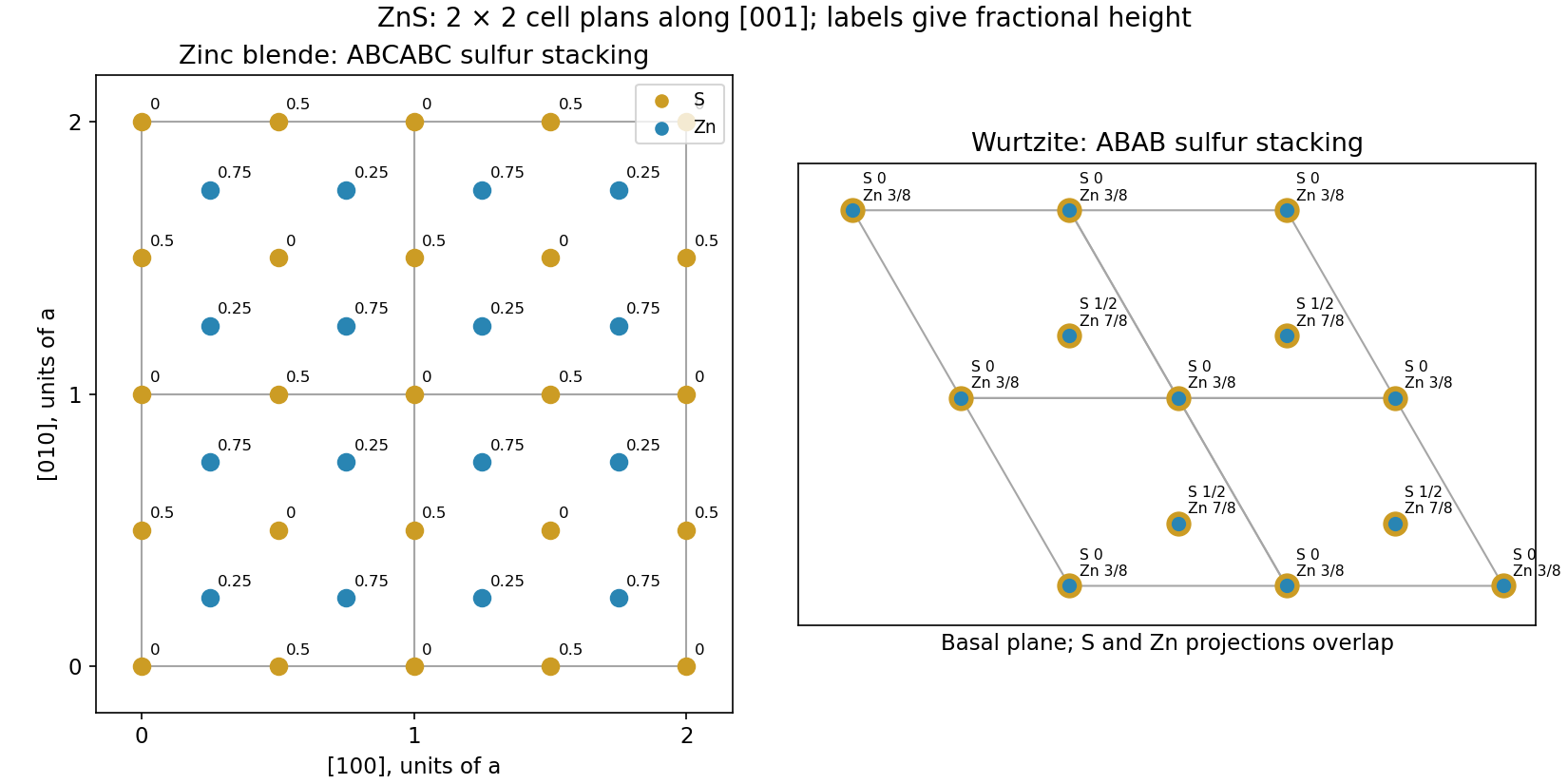
Two-by-two zinc sulfide unit-cell projections along the stacking axes
. Original coordinate constructions. Heights are fractional coordinates along the viewing axis. The hexagonal plan uses basal vectors at 120 degrees. Details.The closest-packed sulfur planes are , with four distinct plane orientations, for zinc blende structure, and , with one orientation, for wurtzite structure. Opposite normals describe the same unoriented plane orientation. Hexagonal four-index notation writes the latter basal family as .
Past exam of the materials science course of the University of Cambridge 2018 Paper 1 7 c Solution by Codex 0 2026-10-20
Codex 0 2026-10-20Read the coesite–stishovite boundary at approximately and . The slope is thereforeA Celsius temperature difference equals the corresponding kelvin difference. The graph does not justify treating the endpoints as exact measurements.
For stishovite, the tetragonal cell volume divided by two givesFor monoclinic coesite the cell volume is , soUsing and Avogadro's constant, the mass-specific volumes areFor the direction stishovite to coesite,For the reverse, coesite to stishovite, the entropy change is about . Stishovite is the denser phase: a positive boundary slope and its smaller volume imply a lower entropy on the high-pressure side. Stating the direction prevents an otherwise avoidable sign ambiguity.
Past exam of the materials science course of the University of Cambridge 2018 Paper 1 7 b Solution by Codex 0 2026-10-20
Codex 0 2026-10-20For two phases of the same pure substance at equilibrium, their chemical potentials are equal. Along their coexistence boundary,Differentiating the equality givesTherefore the Clapeyron equation isMolar or mass-specific quantities give the same slope if a consistent basis is used. follows from equal Gibbs free energies at coexistence.
Solid phases are relatively incompressible and have modest thermal expansion over many intervals. If their entropy and volume differences vary slowly enough that is approximately constant, the boundary is approximately straight. Straightness is an approximation, not a thermodynamic requirement. Heat-capacity differences, pressure dependence of volume, other transitions and proximity to special points can curve the boundary. The ideal-vapor integrated Clausius-Clapeyron approximation is not appropriate for these two solid phases.
Past exam of the materials science course of the University of Cambridge 2018 Paper 1 7 a Solution by Codex 0 2026-10-20
Codex 0 2026-10-20A displacive transformation changes structure through coordinated atomic displacements, whereas a reconstructive transformation changes the bonding/connectivity arrangement more substantially.
In a displacive change, neighboring atoms move cooperatively without the long-range compositional redistribution characteristic of diffusion-controlled precipitation. The change can preserve many near-neighbor relationships and can occur rapidly when its kinetic conditions are met.
A reconstructive change requires breaking and re-forming the relevant structural connections to establish a different arrangement, often with a larger activation barrier and slower nucleation and growth. It may consequently show substantial kinetic persistence of a metastable phase. The distinction concerns the atomic mechanism, not merely whether the final phase has a different symmetry; neither label by itself supplies a universal transformation rate.
Past exam of the materials science course of the University of Cambridge 2018 Paper 1 6 d Solution by Codex 0 2026-10-20
Codex 0 2026-10-20Within the rubbery regime, viscosity usually decreases as temperature increases, because segmental rearrangement becomes easier. The spring's entropic contribution generally increases approximately with absolute temperature at fixed effective network density, so tends to increase modestly under that assumption.
Consequently decreases. The storage-modulus crossover moves to larger squared frequency,and the high-frequency plateau moves upward if increases. The warmer curve in the figure illustrates those two changes. At intermediate frequencies the reduced relaxation time can lower the storage modulus even though its eventual plateau is higher; there is no requirement that the entire curve move upward.
These trends assume the same rubbery material state and no degradation, crystallization or change in effective network density. Close to other transitions the simple entropic-spring and viscosity picture needs modification.
Past exam of the materials science course of the University of Cambridge 2018 Paper 1 6 b Solution by Codex 0 2026-10-20
Codex 0 2026-10-20Interpret the supplied real quantity as the storage modulus , with the spring modulus in this continuum representation and the corresponding viscosity. Let . ThenAt high frequency, , the response approaches the spring stiffness; at low frequency it becomes much softer:In the series Maxwell model, the spring and dashpot carry the same stress while their strains add. A rapidly changing load allows little viscous flow, so the spring dominates the strain response. Over a long cycle the dashpot has time to deform, giving a small storage modulus and a fluid-like low-frequency response. This is generic viscoelastic mechanics, independent of the biological parts deferred above.
Past exam of the materials science course of the University of Cambridge 2018 Paper 1 5 c Solution by Codex 0 2026-10-20
Codex 0 2026-10-20Let be a characteristic crack depth and its geometry factor. A simple fast-fracture condition isThe crack should penetrate a wall of thickness before reaching the critical size, so the simplified leak-before-break criterion is , with appropriate geometry and stable-through-wall-crack assumptions.
The conventional material-based maximum thickness uses the yield stress as a conservative limiting operating stress:It ensures that the depth required for penetration is subcritical even at the stated limiting stress. Geometrical factors depend on crack shape and orientation; this is an educational screening estimate rather than a full crack-growth or leak-detection analysis. The handbook's fracture formula uses the same stress-intensity and geometry-factor convention.[ref]
Materials Data Book by Cambridge University Engineering Department. 2011 edition revised2019, printed p.6, Fast Fracture; this confirms the formula convention, not the exact2018NST supplied values
There is an important distinction if the actual pressure and radius are fixed while thickness varies. Substituting at penetration givesThat is a lower, not upper, bound on thickness under the fixed-pressure model. Yield avoidance additionally requires . It would be inconsistent to derive the fixed-pressure expression and call it a maximum. The standard maximum quoted above answers a different, yield-limited material-selection comparison.
Past exam of the materials science course of the University of Cambridge 2018 Paper 1 5 b Solution by Codex 0 2026-10-20
Codex 0 2026-10-20Linear elastic fracture mechanics predicts a near-tip tensile stress varying approximately asA ductile material yields near the tip before that mathematical singularity can be realized. Plastic deformation blunts the crack and redistributes stress over a finite process zone, as shown in the right-hand diagram. Constraint can sustain stresses above the uniaxial yield stress, so the schematic plateau should not be interpreted as a universal exactly- cap.
A useful process-zone scale is with a geometry- and constraint-dependent coefficient. Advancing the crack then requires energy for plastic deformation and other irreversible processes as well as forming new surfaces. Consequently the critical energy release rate is much larger than the reversible surface-energy term of a perfectly brittle idealization:In a small-scale-yielding plane-strain description, with . Large-scale yielding requires an elastic-plastic measure rather than treating a linear-elastic stress-intensity criterion as exact. The increased dissipation and crack-tip blunting explain the larger energy requirement.
Pinned article: Introduction to the OurBigBook Project
Welcome to the OurBigBook Project! Our goal is to create the perfect publishing platform for STEM subjects, and get university-level students to write the best free STEM tutorials ever.
Everyone is welcome to create an account and play with the site: ourbigbook.com/go/register. We belive that students themselves can write amazing tutorials, but teachers are welcome too. You can write about anything you want, it doesn't have to be STEM or even educational. Silly test content is very welcome and you won't be penalized in any way. Just keep it legal!
Intro to OurBigBook
. Source. We have two killer features:
- topics: topics group articles by different users with the same title, e.g. here is the topic for the "Fundamental Theorem of Calculus" ourbigbook.com/go/topic/fundamental-theorem-of-calculusArticles of different users are sorted by upvote within each article page. This feature is a bit like:
- a Wikipedia where each user can have their own version of each article
- a Q&A website like Stack Overflow, where multiple people can give their views on a given topic, and the best ones are sorted by upvote. Except you don't need to wait for someone to ask first, and any topic goes, no matter how narrow or broad
This feature makes it possible for readers to find better explanations of any topic created by other writers. And it allows writers to create an explanation in a place that readers might actually find it.
Figure 1. Screenshot of the "Derivative" topic page. View it live at: ourbigbook.com/go/topic/derivativeVideo 2. OurBigBook Web topics demo. Source. - local editing: you can store all your personal knowledge base content locally in a plaintext markup format that can be edited locally and published either:This way you can be sure that even if OurBigBook.com were to go down one day (which we have no plans to do as it is quite cheap to host!), your content will still be perfectly readable as a static site.
- to OurBigBook.com to get awesome multi-user features like topics and likes
- as HTML files to a static website, which you can host yourself for free on many external providers like GitHub Pages, and remain in full control

Figure 2. You can publish local OurBigBook lightweight markup files to either OurBigBook.com or as a static website.
Figure 3. Visual Studio Code extension installation.
Figure 5. . You can also edit articles on the Web editor without installing anything locally. Video 3. Edit locally and publish demo. Source. This shows editing OurBigBook Markup and publishing it using the Visual Studio Code extension. 
- Infinitely deep tables of contents:



All our software is open source and hosted at: github.com/ourbigbook/ourbigbook
Further documentation can be found at: docs.ourbigbook.com
Feel free to reach our to us for any help or suggestions: docs.ourbigbook.com/#contact